
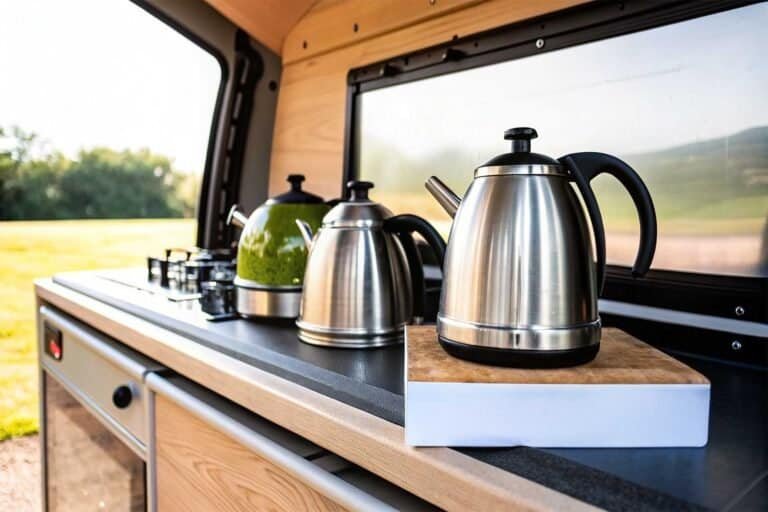
For vanlifers in the UK, the quest for the best camping kettle usually boils down to two contenders: a tough-as-nails stainless steel stovetop model that’ll survive anything, or a feather-light titanium kettle for those where every gram is a prisoner. Your perfect brew-maker really depends on your van’s heat source, how much cupboard space you have, and your daily ritual.
Choosing the Right Kettle for Your Campervan
Picking a camping kettle isn’t just another purchase; it’s an investment in your daily routine on the road. This guide is all about cutting through the marketing noise and focusing on what actually matters in a van: how efficiently it boils, how much of a beating it can take, and how neatly it packs away.
We’re going to lay out a no-nonsense framework for making a decision, looking at the real-world trade-offs between different materials and ways to get your water hot.
Whether you’re after a quick cuppa in a lay-by or that first proper coffee deep in the hills, this is about finding a kettle that genuinely fits your travel style and van setup. The goal is simple: make sure every brew is a good one.
Key Kettle Considerations for Vanlife
Before we get into specific models, you need to get your head around the main factors that will steer your choice. Each one involves a compromise, so figuring out your priorities from the start is half the battle.
- Heat Source Compatibility: What’s powering your van? Is it a simple gas hob, a beefy 12V system, or do you have a 240V inverter for mains power? Your setup will immediately decide whether a classic stovetop, a low-wattage electric, or even an induction kettle is on the cards.
- Capacity vs. Weight: A generous 1.5L kettle is brilliant for two or more people, but it’s a chunky beast to find a home for in a small van. On the flip side, a compact 0.8L model is much lighter but means boiling water in batches if you have company.
- Material and Durability: Stainless steel offers that bombproof reliability at a sensible price. Titanium is the premium choice if you’re obsessed with saving weight. Aluminium is the budget-friendly option, but I’ve found it doesn’t always stand up to the abuse of long-term vanlife.
- Water Source and Quality: The water you’re putting in the kettle matters. Knowing your campervan water tank setup and what filtration you’re running will help you keep your kettle from getting scaled up and tasting funky.
Let’s be honest, the kettle is often the heart of the morning routine.
Comparing Kettle Types at a Glance
To make this dead simple, here’s a quick rundown of the most common kettle types you’ll come across. This table cuts to the chase, showing their main strengths and weaknesses from a vanlifer’s perspective.
| Kettle Type | Primary Pro | Primary Con | Ideal Vanlife Scenario |
|---|---|---|---|
| Stainless Steel | Highly durable and versatile | Heavier than other options | The reliable workhorse for daily use in most DIY conversions. |
| Titanium | Extremely lightweight | Most expensive option | Perfect for minimalist setups or where weight-saving is everything. |
| Anodised Aluminium | Affordable and lightweight | Can dent or scratch easily | A solid budget choice for occasional campers or weekend trips. |
| 12V Electric | Convenient, no flame needed | Slow boil, high battery drain | Best suited for vans with a robust leisure battery system and patience. |
Right, let’s talk about the metal your kettle is made of. This isn’t just about making it look pretty on your van’s countertop; the material is easily the biggest factor in how much it weighs, how long it’ll last after being rattled around the country, and how it actually performs.
Choosing between stainless steel, aluminium, and titanium isn’t just a case of picking the cheapest. It’s about figuring out what your priorities are. Are you a full-timer who needs something that can survive daily abuse, or a weekend warrior counting every single gram? Let’s break down the big three.
We’ll look at the real-world pros and cons of each, giving you a clear picture of how they hold up to the reality of daily van life, especially in the often damp and demanding UK climate.
Stainless Steel: The Reliable Workhorse
When it comes to durability in the campervan world, stainless steel is the undisputed champion. It’s tough as old boots, shrugs off corrosion, and can handle being dropped, scraped, or shoved into a packed cupboard without complaint. This sheer resilience makes it a brilliant all-rounder for long-term van life.
The trade-off, of course, is weight. A typical 1-litre stainless steel kettle weighs in between 400g and 600g, making it noticeably heavier than the alternatives. But for most van builds where you aren’t obsessing over every last gram, this extra heft is a tiny price to pay for its robustness.
Another point worth mentioning is that stainless steel is non-reactive. That means it won’t leave a metallic tang in your water – a subtle but crucial detail for anyone who takes their morning brew seriously.
Key Insight: For the majority of vanlifers, stainless steel offers the best balance of durability, performance, and price. It’s the fit-and-forget option that just works, day in and day out.
Aluminium: The Lightweight Budget Option
Anodised aluminium is a popular choice, and for good reason: it’s lightweight and easy on the wallet. It’s also an excellent conductor of heat, which often means it boils water a smidge faster than stainless steel, saving you a little bit of that precious gas from your camping stove.
The main drawback is that it’s relatively soft. Aluminium kettles are prone to dents and scratches, and while the anodised coating helps prevent corrosion, a deep gouge can compromise this protective layer. This makes them less suited to the rough-and-tumble reality of a full-time van kitchen.
If you’re a weekend warrior or just starting out, an aluminium kettle is a perfectly sensible way to save a bit of cash. Just be prepared to treat it with more care than a steel one.
Titanium: The Ultralight Champion
For the minimalist vanlifer or anyone who also dabbles in backpacking, titanium is the ultimate material. It’s incredibly strong yet ridiculously light; a titanium kettle can weigh as little as 150g, a fraction of its steel counterpart.
This weight saving comes at a significant cost, as titanium is by far the most expensive option. It’s really a specialist material for those who are actively shaving grams off their setup for maximum efficiency. It heats up extremely quickly too, which is great for conserving fuel.
The market definitely reflects this focus on efficiency. In the UK outdoor and campervan scene, lightweight titanium and collapsible stainless-steel kettles make up about 62% of the models featured on “best camping kettle” lists. The typical weight range for these popular titanium models is just 80–180g. For vanlifers focused on minimalism, a kettle under 300g that can boil a cup in under three minutes offers an ideal mix of convenience and off-grid fuel economy. You can explore more camping statistics and trends to see how these preferences are shaping the market.
Other Materials to Consider
While the big three dominate the scene, you might come across a couple of other options:
- Enamel: These kettles have that classic, retro look that fits certain van aesthetics perfectly. They’re basically steel with a ceramic coating, making them durable but heavy and prone to chipping if you drop them.
- Collapsible Silicone: A brilliant space-saver. These kettles usually have a stainless steel base with silicone walls that squash down flat. They’re fantastic for tight spaces but require careful handling on gas stoves to stop flames from licking up the sides.
Ultimately, the best camping kettle material comes down to your personal priorities. Weigh up what’s more important to you – durability, weight, or budget – to find the perfect fit for your adventures.
Right, let’s get into the heart of the matter. Having the best kettle in the world is pointless if you can’t actually boil it. In a van, your heat source is everything. It dictates boil times, how much fuel you burn, and even safety. Your setup, whether it’s a simple gas hob or a full-blown off-grid electrical system, is going to immediately rule out certain types of kettles.
This is about more than just convenience. It’s a hard-nosed look at your power capacity, how you travel, and whether you want to rely on gas or drain your precious leisure battery. Let’s break down the common heat sources for UK vanlifers and figure out which kettle is right for each.
The Classic Gas Canister Stove
For the vast majority of van conversions, the humble gas canister stove is the centre of the kitchen. It’s dead reliable, gives you instant, powerful heat, and makes that satisfying roar that means a brew is only a few minutes away. This makes it compatible with pretty much any non-electric kettle, from a tough stainless steel one to an ultralight titanium model.
The big win here is control. You can tweak the flame to get a perfect rolling boil without scorching the sides of a smaller kettle or melting a silicone one. Gas is also brutally efficient for boiling water, usually getting a litre bubbling in just 3-5 minutes, depending on your stove’s oomph.
This is the go-to setup for off-grid travel. Gas canisters are easy to find all over the UK and put absolutely zero strain on your electrical system. It’s the standard for a reason: it just works.
Electric Kettles: The 12V vs 240V Divide
Electric kettles mean no open flames, but they come at a steep power cost. It is absolutely crucial to understand the two different types and what they’ll demand from your van’s electrical system before you even think about buying one.
A 12V kettle plugs straight into a cigarette lighter socket, pulling power directly from your leisure battery. While that sounds dead simple, they are notoriously slow and incredibly power-hungry. A typical 12V model can take a painful 15-20 minutes to boil, all while drawing a high, continuous current that will happily drain a smaller battery bank.
Real-World Reality: A 12V kettle is a nice idea for an emergency backup, but it’s rarely practical for daily use. Unless you’ve got a serious solar array and a hefty battery bank to back it up, you’ll just end up with a flat battery and lukewarm water.
A 240V kettle is a completely different beast. These are basically low-wattage versions of your home kettle and need one of two things: a mains hook-up at a campsite, or a powerful inverter connected to your leisure batteries. They’re much faster than the 12V versions, but they still place a massive load on your system. Firing up a 750W low-wattage kettle for five minutes will suck a significant chunk of power from your batteries.
Before you even consider going electric, you need to know your van’s power system inside and out. If you’re unsure, our guide on what size leisure battery you need walks you through the essential calculations to see if your setup can handle the strain.
Open Fire and Wood Burner Kettles
For those of us who lean into a more rustic vanlife, there’s nothing quite like boiling water over a campfire or on top of the log burner. But this method demands a specific kind of kettle, one built to withstand direct, brutal heat.
You absolutely must use a kettle made from a properly robust material like stainless steel or even cast iron. Lightweight aluminium or anything with plastic or silicone components is a definite no-go – they will melt, warp, or worse.
Look for a kettle with a sturdy, oversized handle, often a ‘bail handle’ that loops over the top. This is designed so you can hang it over a fire from a tripod or safely move it with a stick or a gloved hand, keeping a safe distance from the flames. Safety is everything here; a secure lid and a well-designed spout are non-negotiable to stop boiling water from spitting and spilling.
Putting Kettles Head-to-Head in the Real World
Theory is one thing, but the reality of life on the road is where a kettle really proves its worth. To find the best camping kettle for your van, we need to move beyond simple feature lists and drop different models into practical, head-to-head scenarios. This is where the trade-offs between weight, speed, convenience, and fuel economy become crystal clear.
We’ll look at two common vanlife situations: the solo traveller in a compact van where every gram and centimetre counts, and the family or couple in a larger conversion where capacity and ease of use are bigger priorities. Each comparison will break down the key factors to help you make the right choice for your setup.
The Solo Traveller Showdown
For the solo vanlifer, space is the ultimate luxury. Your kitchen might be nothing more than a single gas burner and a small cupboard. In this scenario, efficiency and packability are everything.
Scenario: A solo traveller in a compact van like a Ford Transit Connect, relying on a single-burner gas stove for all cooking. The goal is a kettle for one or two cups of tea at a time, with minimal weight and a tiny storage footprint.
Contender 1: Ultralight Titanium Kettle (0.9L)
This is the purist’s choice, no doubt about it. Weighing around 150g, it’s barely noticeable in a pack or drawer. Titanium’s incredible heat conductivity means it boils water exceptionally fast, sipping gas rather than guzzling it—a crucial advantage when you’re trying to make a single canister last for a week.
Its rigid structure is also surprisingly durable and handles the bumps and scrapes of vanlife far better than flimsy aluminium. The only real sting is the premium price tag.
Contender 2: Collapsible Silicone Kettle (1.0L)
This kettle is an absolute master of storage. With a solid stainless steel base and food-grade silicone walls, it squashes down to just a few centimetres high, easily slotting into the most crowded drawer. At around 400g, it’s heavier than the titanium option but still perfectly manageable.
The main catch? You have to be careful with flame control on a gas stove. Let the flames lick up the sides, and you’ll damage the silicone. While it’s robust enough, the silicone can also hold onto strong flavours if you don’t give it a good clean.
The Verdict: For the absolute minimalist who prioritises fuel efficiency and the lowest possible weight, the titanium kettle is the clear winner. But if your biggest challenge is simply finding a home for a rigid kettle, the collapsible model offers an unbeatable storage solution, as long as you’re mindful when using it.
The Family Van Comparison
When you’re travelling with two or more people, your priorities shift completely. Suddenly, capacity is king, and the convenience of not having to boil water three times for a single round of drinks can be a game-changer.
Each option—whether it’s gas, 12V, or mains electric—directly influences which kettle will perform best in your setup.
Scenario: A couple or small family in a larger conversion (like a Fiat Ducato) with a dual-hob gas stove and a robust electrical system featuring a 240V inverter. They need a kettle with enough capacity for at least three to four drinks at once.
Contender 1: Classic Stainless Steel Stovetop Kettle (1.6L)
This is the dependable workhorse of the vanlife world. A good stainless steel kettle is virtually indestructible, making it perfect for the rigours of full-time travel. Its larger capacity means you only need to boil it once for the morning coffee round, which feels like a genuine luxury.
It’s completely off-grid friendly, relying only on your gas supply. While it’s the heaviest and bulkiest option here, in a larger van with dedicated kitchen storage, that’s much less of a concern.
Contender 2: Low-Wattage 240V Electric Kettle (1.0L)
This kettle represents pure, unadulterated convenience. With the flick of a switch, you have boiling water without needing to light the hob—a nice safety feature, especially with kids or pets bouncing around the van. It’s ideal for quick brews when you’re plugged into campsite mains power.
The reality check comes when you’re off-grid. Its reliance on a powerful inverter makes it a significant drain on your leisure batteries. A five-minute boil can consume a surprising chunk of your stored power, making it a poor choice for wild camping unless you have a serious solar and battery setup to back it up.
The Verdict: For ultimate reliability and off-grid freedom, the stainless steel stovetop kettle remains the top choice. It’s simple, tough as old boots, and will never let you down. The low-wattage electric kettle is a fantastic luxury for those who spend a lot of time on campsites or have a high-spec electrical system that can handle the demand.
Vanlife Kettle Showdown Key Specification Comparison
Choosing the right kettle is all about matching its features to your van, your power setup, and how you travel. To make it easier, this table breaks down the key specs for the most common kettle types, helping you see at a glance which one fits your vanlife style.
| Kettle Type | Typical Capacity | Average Weight | Best For | Heat Source | Estimated Price Range |
|---|---|---|---|---|---|
| Stainless Steel Stovetop | 1.2L – 2.0L | 600g – 1kg | Durability, large groups, off-grid reliability | Gas, Wood Fire | £20 – £50 |
| Titanium Ultralight | 0.7L – 1.0L | 120g – 200g | Solo travellers, backpackers, fuel efficiency | Gas | £40 – £80 |
| Aluminium Stovetop | 1.0L – 1.5L | 200g – 400g | Budget-conscious travellers, weekend trips | Gas, Wood Fire | £15 – £30 |
| Collapsible Silicone | 1.0L – 1.5L | 400g – 600g | Minimalist vans, extreme space-saving | Gas | £25 – £45 |
| Low-Wattage Electric (240V) | 0.8L – 1.2L | 700g – 1.2kg | Campsite users, high-spec electrical systems | 240V Inverter, Mains | £30 – £60 |
| 12V Electric Kettle | 0.5L – 1.0L | 500g – 800g | Convenience on the move, basic electrical setups | 12V Cigarette Lighter | £20 – £40 |
Ultimately, there’s no single “best” kettle, only the best one for you. A solo hiker’s ultralight titanium pot would be useless for a family of four, just as a mains-powered electric kettle would be a dead weight for a wild camper. Use this comparison to pinpoint the option that aligns with your real-world needs on the road.
Key Features That Make a Difference
Right, so we’ve covered the big stuff like materials and heat sources. But honestly, it’s the small, thoughtful details that separate a kettle you tolerate from one you genuinely love using every day.
These are the things you’ll appreciate when you’re half-awake, brewing up in a tight space with the van gently rocking. They might seem minor in the shop, but they make a massive difference on the road.
From a spout that doesn’t send boiling water dribbling across your worktop to a handle that actually stays cool, these are the features that truly matter. Let’s get into what you should be looking for.
Spout Design and Pouring Control
In the close quarters of a van, a clean, controlled pour is non-negotiable. A badly designed spout that spits and splashes boiling water isn’t just messy—it’s a genuine safety hazard.
Keep an eye out for a classic gooseneck spout or a short, sharply angled one. These designs give you brilliant control, letting you pour a precise, drip-free stream straight into your mug. If you’re into your pour-over coffee with something like a V60, this kind of control is absolutely essential for a decent brew. Steer clear of kettles with short, wide openings; they tend to create an uncontrolled gush of water.
Essential Safety Features
Your campervan kitchen is a place where safety has to come first. A few simple design choices on a kettle can prevent accidents and make your daily routine that much safer.
- Secure Locking Lids: A lid that fits snugly or locks into place is vital. It’s the difference between a safe kettle and a splash hazard if it gets knocked. It also stops the lid from falling off mid-pour.
- Audible Whistle: That classic whistle does more than just tell you the water’s ready. It’s a brilliant fuel-saving device, stopping you from leaving the gas burning unnecessarily. More importantly, it prevents the kettle from boiling dry, which can damage it and create a fire risk.
- Heat-Resistant Handles: Look for handles coated in silicone or another heat-proof material. This simple feature means you can grab the kettle straight off the hob without fumbling around for an oven mitt or a tea towel.
Vanlife Tip: A secure lid has another great benefit for travel. It stops any leftover drips of water from sloshing out into your cupboards while you’re driving down a bumpy road.
Handles and Packability
The handle design has a direct impact on both how you use the kettle and how you store it. For vanlifers, a handle that folds away is a huge space-saver, allowing the kettle to slot into tight drawers or cupboards much more easily.
Folding handles can be top-mounted (like a bail handle) or side-mounted. Top handles are great for stability when you’re carrying a full kettle, while side handles often feel more natural for pouring. The main thing to check is that the folding mechanism is tough and locks securely in place when you’re using it—a wobbly handle holding boiling water is a recipe for disaster.
Cleaning and Maintenance
Your kettle is going to see a lot of action, so keeping it clean is important for both the taste of your brew and the life of the kettle itself. How easy it is to clean often comes down to the material and the size of the opening.
A wide lid makes it much easier to get your hand or a brush inside to scrub away any limescale, which is a common problem when you’re filling up from various hard water taps across the UK. Stainless steel and titanium are generally the easiest materials to clean and are great at not holding onto flavours. Silicone kettles, while dead handy for packing, can sometimes retain the taste of strong infusions like peppermint tea, so they might need a more thorough clean more often.
Right, we’ve waded through the technical stuff—materials, heat sources, and all the features that actually matter. Now it’s time to pull it all together. This isn’t just some random list of popular kettles; these are specific recommendations based on real-world vanlife scenarios I’ve seen and lived through.
Each of these suggestions is matched to a distinct style of vanlife. I’ve grounded every choice in the principles we’ve just discussed, giving you a solid starting point for finding the kettle that’ll actually work for your setup, whether you’re a die-hard minimalist or running a high-spec conversion.
Best Kettle for The Solo Minimalist
If you’re a solo traveller, every single gram and square inch of space counts. You’re not just looking for a kettle; you need a hyper-efficient piece of kit that boils fast, sips fuel, and packs down to practically nothing. The choice is obvious.
Our Recommendation: A Titanium Kettle with a capacity of around 0.8L to 1.0L.
Titanium’s heat transfer is ridiculously good. That means you get a lightning-fast boil using the least amount of gas possible—a massive win when you’re off-grid and trying to make a canister last. It’s featherlight but surprisingly tough, often doubling as a small cooking pot for rehydrating meals. Yes, it’s a premium bit of kit, but for unmatched performance and weight savings, nothing else comes close.
Best All-Rounder for DIY Conversions
This is where most of us in the UK vanlife scene land. You need a kettle that’s tough, dead reliable, and practical enough for the daily grind without costing a fortune. It needs to be a proper workhorse that you can depend on, day in, day out.
Our Recommendation: A classic Stainless Steel Stovetop Kettle with a 1.5L capacity.
There’s a reason this is the quintessential vanlife kettle. It’s virtually indestructible—you could probably drop it off a cliff, and it would survive. It’s also a breeze to clean and big enough to make a proper round of brews for two or three people in one go. The fact it works on any gas hob or even an open fire gives you the ultimate off-grid flexibility. Sure, it’s heavier, but its sheer robustness means you can trust it to withstand years of abuse on the road.
Honestly, this kind of kettle is a cornerstone of any decent van kitchen. Once you’ve got it sorted, you can get on with the fun stuff, like planning your meals. For some cracking ideas, check out our guide on cooking and eating on the road, which is packed with simple recipes that actually work in a campervan.
Best Kettle for High-Spec Vans with Inverters
If your van boasts a hefty leisure battery bank and a 240V inverter, you can afford the luxury of pure convenience. This is for the setup where home comforts are the priority, and you’re not constantly worrying about gas levels.
Our Recommendation: A Low-Wattage (under 1000W) 240V Electric Kettle.
This is push-button simplicity for your morning cuppa. It’s inherently safer to use indoors as there’s no open flame, and it frees up your gas hob for cooking breakfast at the same time. It’s the perfect choice if you frequently use campsites with electric hook-ups or have a properly specced electrical system designed to handle that kind of power draw without breaking a sweat.
Right, let’s tackle some of the common questions that pop up when you’re trying to pick a kettle for the van. I’ve heard them all at meet-ups and in forums, so here are the straight answers.
Can I Just Use My Kettle from Home in the Van?
Tempting, I know. But it’s a terrible idea. Your standard kitchen kettle is a power-hungry beast, typically pulling between 2,200 and 3,000 watts. Plug that into your average van inverter, and you’ll either trip your entire electrical system instantly or drain your leisure battery in the time it takes to find the teabags.
Honestly, using one off-grid is a recipe for disaster. If you’re set on electric, you absolutely must get a proper low-wattage travel model designed for campervan systems. Anything else is just asking for trouble.
How Do I Deal with Limescale?
Ah, the joy of UK hard water. You fill up from a tap in the Cotswolds and by the time you’re in Norfolk, your kettle is furred up. The best way to keep it at bay is simple: don’t leave water sitting in the kettle. Empty it after you’ve used it.
When the build-up gets bad, a splash of white vinegar and an equal amount of water does the trick. Boil the mix, then let it sit for an hour before giving it a really good rinse. If it’s stubbornly caked on, a dedicated kettle descaler will sort it out.
What’s the Most Fuel-Efficient Way to Boil Water?
Fuel is precious when you’re off-grid. Getting the most out of every gram of gas comes down to a few simple things. Use a kettle with a wide base to soak up as much heat as possible, but make sure the flame isn’t licking up the sides – that’s just wasted energy heating the air.
Always, always use a lid. It traps the heat and gets the water boiling much faster. The second you hear that whistle, turn the gas off.
Pro Tip: Stop boiling a full litre of water for one cup of tea. It’s a surprisingly wasteful habit. Only boil what you’re actually going to use. You’ll be amazed how much longer your gas canister lasts over a long trip.
Are Those Collapsible Silicone Kettles Actually Safe?
Yes, as long as you’re not buying some cheap knock-off from a dodgy website. Stick to reputable brands that use food-grade, BPA-free silicone, and they’re perfectly safe for boiling water.
The golden rule is to make sure the flame is always smaller than the kettle’s metal base. You want the heat on the steel, not directly touching the silicone walls. Get that right, and you’ll have no problems.
At The Feral Way, we provide honest, road-tested advice to help you build a van that works. Explore more of our guides and resources at https://www.theferalway.com.