
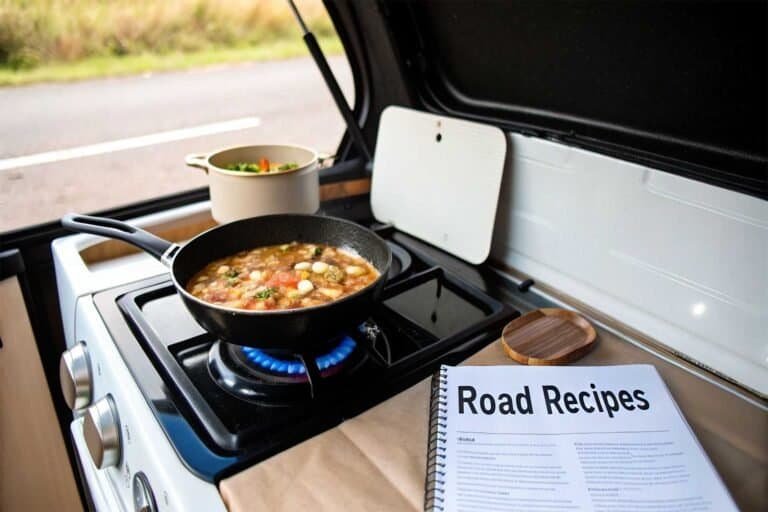
Successful van life meal planning doesn’t start in the supermarket aisle. It starts right where you’re standing, with a brutally honest look at your kitchen setup. It’s about knowing your space, your gear, and your power limits before you even think about what’s for dinner.
This first step is the difference between a realistic plan that makes life on the road a joy and a frustrating pile of wasted food. Get this right, and you’re setting yourself up for success.
Building Your Van Life Kitchen Foundation
Before you start dreaming up fancy meals, let’s get real about your mobile kitchen. A solid van life meal planning system has nothing to do with elaborate recipes; it’s all about creating a strategy that actually works with the tools you have.
Think of this as the blueprint for your adventures on the road. This initial audit is the most critical bit, preventing that sinking feeling when you realise you’ve bought ingredients for a meal you simply can’t cook.
Take Stock of Your Cooking and Cooling Gear
First up, what are you actually cooking on? A built-in two-burner hob is a world away from a single portable camping stove. The number of burners you have dictates the complexity of your meals. A single burner naturally pushes you towards one-pot wonders like curries, stews, and pasta dishes, and there’s nothing wrong with that.
Next, have a proper look at your fridge. Most vans rock a 12v compressor fridge, but their real-world capacity can be a bit of a shock.
- Fridge Capacity: Forget the manufacturer’s stated litres for a second. How much can you actually squeeze in there once you account for odd-shaped tubs and the need for a bit of airflow?
- Power Consumption: Your fridge is one of the biggest power hogs in the van. Its efficiency is a major factor in how long you can stay off-grid. If you’re starting from scratch, figuring out what size leisure battery you need for your appliances is a massive piece of the puzzle.
- Freezer Box: Is there a tiny freezer compartment? This is a total game-changer for stashing meat, frozen veg, or a backup meal for a lazy evening.
A common mistake is massively overestimating fridge space. The secret is to plan meals with a good mix of fresh stuff that needs chilling and pantry staples that don’t. This is how you manage that tiny cold box effectively.
Essentials vs. Gadgets: Be Ruthless
In a kitchen the size of a postage stamp, every single item has to earn its keep. It’s so easy to collect gadgets that seem like a great idea at the time but just end up as clutter. You need to be ruthless.
Your absolute essentials probably look something like this:
- One decent saucepan with a lid
- A versatile frying pan
- A sharp knife and a small chopping board
- A few basic utensils (spatula, big spoon, tongs)
- A colander or strainer
Anything beyond this is a luxury. Do you really need that air fryer or blender if your power system is already groaning under the strain? A simple kettle on the hob can do the job of a fancy coffee machine. Prioritise things that can do more than one job – a deep-sided frying pan can often double up as a wok or a shallow pot for sauces.
Get Honest About Your Eating Habits
The final, and maybe most important, piece of this puzzle is you. How do you actually like to eat? Ignoring your own habits is a surefire way to end up with a failed meal plan and a bin full of wasted food.
Ask yourself a few honest questions:
- How often do you eat? Are you a strict three-meals-a-day person, or do you prefer grazing on smaller snacks all day?
- Do you actually like cooking? After a long day of hiking or driving, are you someone who enjoys the process of cooking, or do you just want something on a plate in 15 minutes? Be honest.
- What’s your style? Do you eat meat every day, or are you happy with veggie meals a few times a week? Plant-based proteins are often easier to store and need less refrigeration, which is a big win in a van.
By taking a hard look at your gear, space, and your own preferences, you create a realistic framework to build on. This isn’t about limiting your options; it’s about empowering yourself to create a meal plan that genuinely supports your life on the road.
Designing a Flexible Rotational Menu
Right, let’s get past the endless cycle of pasta and pesto. A solid van life meal plan is the secret weapon that stops the daily “what’s for dinner?” debate dead in its tracks. It’s not about creating a rigid, boring schedule; it’s about building a flexible framework that saves you mental energy, time, and cash.
This is where a rotational menu comes in. It’s the key to keeping meals interesting without needing a massive pantry. It organises your cooking, makes shopping a breeze, and ensures you’re never caught out, even when you’re miles from the nearest shop.
Embrace the Capsule Pantry Concept
Think of this like a minimalist wardrobe, but for your kitchen. A capsule pantry is your core collection of around 20-25 versatile, long-lasting ingredients that form the backbone of pretty much everything you’ll cook. These are the items you always have stocked, ready to be mixed and matched into a huge variety of meals.
Your capsule pantry is your safety net, and it should be built from things you can find easily in UK budget supermarkets like Lidl and Aldi.
A well-stocked capsule pantry might look something like this:
- Grains & Carbs: Rice, pasta, oats, couscous, and wraps.
- Tinned Goods: Chopped tomatoes, chickpeas, lentils, kidney beans, and tuna.
- Oils & Sauces: Olive oil, soy sauce, hot sauce, and stock cubes.
- Herbs & Spices: A core set like garlic powder, onion powder, mixed herbs, cumin, and paprika.
- Long-Life Staples: UHT milk, onions, garlic, and potatoes.
With this foundation, your weekly shop becomes a simple top-up of fresh items like vegetables, meat, or dairy. This drastically cuts down on food waste because you’re always building meals from a known, reliable base.
Building Your Two-Week Rotational Menu
A two-week rotation is the sweet spot for van life. It’s long enough for plenty of variety so you don’t get bored, but short enough that it doesn’t feel like a massive planning headache. The goal is to come up with 14 dinner ideas you can cycle through, swapping them around depending on what you fancy.
Start by brainstorming meal categories you actually enjoy. Don’t get bogged down in specific recipes yet, just think about general themes. For example:
- Pasta Night (e.g., simple tomato and basil, tuna pasta bake)
- Curry Night (e.g., chickpea and spinach, lentil dhal)
- Taco/Wrap Night (e.g., bean chilli wraps, spicy chicken tacos)
- One-Pot Wonder (e.g., sausage and bean casserole, vegetable stew)
- Quick & Easy (e.g., omelettes with leftover veg, jacket potatoes)
The key is ingredient overlap. The leftover onion and pepper from Tuesday’s chilli can be the base for Friday’s omelette. The half-tin of coconut milk from a curry can be used in your morning porridge. This is how you make a tiny fridge and a small budget work hard for you.
To get this system dialled in, it’s worth exploring some effective weekly meal planning strategies that can be adapted for the beautiful chaos of life on the road.
A Sample Rotational Theme Structure
Here’s a dead-simple structure to get you started. You can just fill in the blanks with your favourite dishes that fit the theme and use ingredients from your capsule pantry.
| Day | Theme | Example Meal Idea |
|---|---|---|
| Monday | Meat-Free Monday | Lentil and vegetable stew |
| Tuesday | Taco Tuesday | Spicy bean chilli with wraps and toppings |
| Wednesday | Pasta Power | Sausage and pepper pasta |
| Thursday | Curry Club | Chickpea and potato curry with rice |
| Friday | Easy Fakeaway | Homemade burgers or loaded wedges |
| Saturday | One-Pot Special | Chicken and chorizo jambalaya |
| Sunday | Leftover Remix | ‘Everything-in-the-fridge’ stir-fry |
Once you’ve got one week you’re happy with, create a second, different week to rotate with it. This simple system gives you structure but leaves loads of room for spontaneity. If you stumble upon a great local farm shop with fresh asparagus, you can easily swap a meal out without derailing the whole plan. It’s this flexibility that makes a rotational menu actually work for the unpredictable nature of van life.
Get Smart with Your Shopping and Batch Cooking
Alright, you’ve got your rotating menu sorted. Now for the fun part: turning that plan into actual food without spending a fortune or losing your mind in a tiny kitchen. This is where a bit of strategy around your shopping and prep makes all the difference.
Mastering these two things is what separates a smooth, well-fed van life experience from one that feels like a constant battle against a tiny sink full of dirty pans. It’s about being deliberate. Do it right, and you’ll save a heap of time, money, and hassle.
The Power of a Master Shopping List
I’ll say it once: never, ever walk into a supermarket without a list. It’s your single best defence against impulse buys and that sinking feeling when you realise you’ve forgotten the onions. Your master list, built directly from your two-week menu, cuts out the decision fatigue and keeps you laser-focused.
Before you even step out of the van, take a quick look through your cupboards and fridge. Cross off anything you already have. There’s no point ending up with three half-used bags of rice taking up precious space.
Try organising your list by how you walk around the shop. It sounds simple, but it stops you from backtracking and makes the whole trip faster, especially when you’re in an unfamiliar town. I usually group mine like this:
- Fresh stuff (fruit and veg)
- Fridge bits (meat, dairy, etc.)
- Tins and dry goods
- Frozen (if you’ve got the freezer space)
Playing the UK Supermarket Game
Living in a van forces you to get smart with your money, and food is one area where you can really win. Your best mates here in the UK are the budget supermarkets – think Aldi and Lidl. You can get high-quality staples for a fraction of what you’d pay elsewhere.
But the real pro move is knowing when to shop. Most of the big supermarkets start slapping yellow reduction stickers on fresh items in the early evening, usually between 7 pm and 9 pm. Hitting the ‘whoopsie’ aisle at the right time can mean massive savings on meat, bread, and veg that are perfect for cooking up that same night.
My personal rule is to always cook a yellow-sticker item the day I buy it. It’s a brilliant way to have a slightly fancier meal, like fresh salmon or a good steak, without completely wrecking the budget.
Don’t ignore loyalty schemes, either. A Tesco Clubcard or Sainsbury’s Nectar card can unlock member-only prices that make a big difference to your final bill.
Batch Cooking: Your Secret Weapon
Here it is. The single most effective trick for making van life meals a breeze. Batch cooking just means setting aside a couple of hours one day to prep food for the days ahead. It might sound like a bit of a chore, but believe me, the payoff is huge.
This isn’t just a trick for people in houses; it’s perfectly suited to the whole ethos of van life. The UK scene has exploded, with over half a million people now living in vans full-time. For many, it’s a way to beat the crazy cost of living – in fact, 67% of van lifers say escaping high costs is their main reason. Thriftiness is key, and prepping bulk meals like a big chilli or a pasta bake using £3-£5 Aldi basics can sort you out for days, slashing food waste by up to 40% compared to a typical household. You can read more on these trends in these van driver statistics.
What Batch Cooking Actually Looks Like in a Van
You don’t need a massive kitchen for this. It’s all about smart, simple prep that makes assembling meals later on incredibly quick.
Here are a few things you can smash out in one session:
- Cook Your Grains: Get a big pot of rice, quinoa, or couscous on the go. Once it’s cool, stash it in the fridge. You can then quickly add it to salads, curries, or stir-fries all week.
- Chop Your Veg: Dice up a load of onions, peppers, and carrots. Keep them in an airtight container, ready to be chucked into whatever you’re cooking. This saves so much daily prep and washing up.
- Make a Big One-Pot Meal: Cook up a massive chilli, curry, or bolognese. Have a portion that night and you’ve got another one or two meals sorted for later in the week. Easy.
- Roast a Tray of Veggies: A big tray of roasted root veg or Mediterranean vegetables is incredibly versatile. Use them in wraps, salads, or just as a simple side dish.
Doing this drastically cuts down on how much gas or electricity you use each day. It means fewer dishes to wash in that tiny sink, and most importantly, it gives you your evenings back to actually enjoy the incredible places your van has taken you.
Mastering Food Storage in a Compact Space
Let’s be honest, the real art of van life meal planning isn’t about fancy recipes—it’s about mastering the Tetris-like puzzle of your tiny fridge and cupboards. A great meal plan is useless if you can’t actually store the ingredients. Getting this right is what separates a calm, organised van kitchen from a chaotic mess of wasted food and stress.
This is about more than just cramming things in wherever they’ll fit. It’s about creating a system. With a bit of road-tested know-how, you can make every single inch of your 12v fridge and pantry space work for you. That’s what keeps your food fresh when you’re parked up somewhere beautiful, miles from the nearest supermarket.
Making Your Small Fridge Work Harder
A typical van fridge is a masterclass in compromise, but it can be surprisingly effective if you treat it with respect. Square or rectangular stackable containers are your best mates here. They cut out the dead air space that round tubs create, letting you pack way more in.
It also pays to learn your fridge’s geography. Not all parts of it are equally cold. The bottom shelf and the area right next to the cooling element are always the coldest spots.
- Coldest Zone (Bottom): This is prime real estate. Reserve it for raw meat, fish, and dairy like milk or yoghurt that absolutely must stay chilled for safety.
- Middle Zone: Perfect for leftovers (in sealed containers, of course), eggs, and other things that need refrigeration but aren’t quite so temperature-sensitive.
- Door and Top Shelf (Warmest Zone): This is where your condiments, jams, and drinks should live. The temperature here fluctuates the most, so don’t put anything highly perishable here.
Organising your fridge this way does two things: it keeps your food safer and makes it a hell of a lot easier to find what you need without pulling everything out. A massive part of van life is knowing how to properly store food to extend its shelf life, and this is a skill you’ll want to lock down quickly.
What Doesn’t Need the Fridge
The easiest win for creating more fridge space is learning what doesn’t need to be in there in the first place. So many of us automatically chill things out of habit.
Storing items like potatoes, onions, garlic, and unopened condiments in a cool, dark cupboard is a simple but effective strategy. This one change can free up a surprising amount of precious fridge real estate for things that genuinely need to be chilled.
Even things like tomatoes and avocados are better off out of the fridge. They develop much better flavour and texture at room temperature and you can just pop them in once they’re ripe if you need to.
Food Safety and Security on the Road
Food safety is non-negotiable. With maybe one square foot of counter space, you have to be vigilant about cross-contamination. Always use separate chopping boards for raw meat and veg, and clean your surfaces properly between jobs. Once cooked, leftovers should be cooled down quickly and stored in an airtight container for no more than a couple of days.
But it’s not just about spoilage. The physical security of your food is something you probably haven’t thought about. In urban areas, a van can be a target. It might sound odd, but it’s worth thinking about. For those using a portable unit, our guide to the top 10 cool boxes for vanlife can help you pick one that’s both efficient and can be secured.
Road-Tested Recipes and a Sample UK Meal Plan
Right, let’s put some of this theory into practice. Strategy is one thing, but nothing beats seeing a real-world plan in action. This is where I bring it all together with some of my favourite, road-tested recipes and a proper, fully costed, week-long meal plan.
These are the actual meals that have fuelled my adventures across the UK, all designed for a simple two-burner hob and a tiny fridge. It’s all about maximum flavour with minimum fuss.
You’ll find one-pot wonders that save on washing up, no-cook lunches perfect for a quick stop, and simple breakfasts that get you out the door and exploring faster. This isn’t just a list of ideas; it’s a practical demonstration of how a solid van life meal plan actually works when the nearest supermarket is an hour away.
My Go-To Van Life Recipes
The best recipes for a van kitchen share a few key traits: they use minimal, versatile ingredients, require very few pans, and don’t create a ridiculous amount of mess. It’s all about being ruthlessly efficient with your space, fuel, and precious water.
Here are three staples that feature heavily in my own menu rotation:
- One-Pot Lentil & Veg Stew: The ultimate comfort food after a long, wet day of hiking. It’s incredibly cheap, properly filling, and a brilliant way to use up whatever vegetables are rolling around in the bottom of your fridge before they go soft.
- Spicy Bean Chilli Wraps: This is my go-to for a super-fast, no-cook lunch. I often use a pre-cooked pouch of spicy beans (a fantastic space-saver) mixed with some chopped salad and stuffed into a wrap. It takes about two minutes to assemble in a lay-by.
- Overnight Oats: The perfect breakfast for an early start. Just mix oats, UHT milk or water, and a handful of nuts or seeds in a jar the night before. In the morning, it’s ready to eat straight away. No cooking, no noise, no fuss.
Limited facilities mean that a staggering 86% of van lifers prioritise portable, no-cook options. Oats, nuts, and powdered milk often dominate breakfasts at around £1.50 per day, while many dinners leverage one-pot wonders. This efficiency is vital; while ONS data shows UK households waste 6.4 million tonnes of food yearly, van lifers often invert this, using around 95% of their purchases.
Sample 7-Day UK Van Life Meal Plan & Shopping List
Here’s a practical example of how this all comes together. This plan is designed for a solo traveller, shopping at a budget UK supermarket like Aldi or Lidl. It’s built around ingredient overlap to minimise waste and keep the shopping list short and affordable.
If you’re looking for even more ideas, check out our guide on simple recipes that actually work on the road.
| Day | Breakfast | Lunch | Dinner | Shopping List Item |
|---|---|---|---|---|
| Monday | Porridge & Banana | Leftover pasta salad | Sausage & Pepper Pasta | Sausages, Pepper, Pasta, Tinned Tomatoes |
| Tuesday | Toast & Peanut Butter | Hummus & Carrot Wraps | One-Pot Lentil & Veg Stew | Hummus, Carrots, Wraps, Red Lentils |
| Wednesday | Porridge & Berries | Leftover Stew | Veggie Curry & Rice (Batch Cooked) | Berries, Curry Sauce, Rice, Onion, Garlic |
| Thursday | Toast & Peanut Butter | Hummus & Carrot Wraps | Leftover Veggie Curry | (Uses Tuesday’s items) |
| Friday | Porridge & Banana | Cheese & Tomato Wraps | Jacket Potato with Beans & Cheese | Cheese, Tomatoes, Potatoes, Baked Beans |
| Saturday | Toast & Berries | Leftover Jacket Potato (fried up) | ‘Everything-in-the-fridge’ Omelette | Eggs |
| Sunday | Porridge & Nuts | Wraps with leftover Omelette filling | Pasta with Tinned Tomatoes & Herbs | (Uses pantry staples) |
Here’s exactly what you’d need to buy to make that meal plan happen. This list assumes you already have basic capsule pantry items like cooking oil, salt, pepper, and mixed herbs. Prices are estimates from a budget UK supermarket and can change.
Fresh & Fridge
- Small block of cheddar cheese: (£2.20)
- Small tub of hummus: (£0.90)
- Bag of carrots: (£0.50)
- Onion & Garlic: (£1.00)
- Bell Pepper: (£0.50)
- Small punnet of tomatoes: (£0.80)
- Punnet of berries (seasonal): (£1.50)
- Bananas (x2): (£0.40)
- Pack of 6 sausages: (£2.50)
- 6 eggs: (£1.20)
- Small UHT milk: (£0.70)
Pantry
- Bag of porridge oats: (£0.90)
- Loaf of bread: (£1.00)
- Jar of peanut butter: (£1.30)
- Pack of 8 tortilla wraps: (£0.90)
- Bag of pasta (500g): (£0.80)
- Bag of rice (1kg): (£1.50)
- Tin of chopped tomatoes: (£0.40)
- Tin of baked beans: (£0.40)
- Tin of red lentils: (£0.70)
- Jar of curry sauce: (£1.00)
- Bag of baking potatoes: (£1.20)
Total Estimated Cost: £22.80
This real-world example proves that eating well on the road doesn’t have to be complicated or expensive. With just a little bit of planning, you can enjoy delicious, varied, and genuinely affordable meals, giving you more time and money to focus on the adventure itself.
Right, let’s tackle some of the questions that always pop up once the theory of meal planning meets the reality of a bumpy road and a tiny fridge. You can have the best system in the world, but van life always throws a few curveballs.
Think of this as the troubleshooting section of your van kitchen. These are the real-world problems that surface when you’re actually out there, and the answers come from years of trial, error, and a few burnt pans.
How Much Should I Budget for Food in a Van in the UK?
This is the big one, and the answer is probably less than you think. A realistic food budget for a solo van lifer in the UK is somewhere between £120 and £160 per month. For a couple, you’re looking at around £250-£300 as a very achievable target.
How is that possible? It comes down to ruthless planning, making a beeline for Aldi and Lidl, and being almost obsessively anti-food waste. Van life forces you to cook from scratch, which absolutely demolishes your food bill compared to living in a house.
Some of the most frugal first-year budget builds I’ve seen operate on just £700 in total monthly expenses. Food usually makes up about 20% of that, which lands you right at that £140 mark. While the Office for National Statistics reckons the average UK household spends about £80 a week on food, a savvy solo van dweller can easily slash that to £40 just by being smart. If you want to dive deeper into the numbers, you can discover more insights from this van conversion survey.
What Are the Best Foods to Stockpile in a Van?
Your emergency stash is your get-out-of-jail-free card. It’s for when you find the perfect remote spot and don’t want to leave, or when you’re just too knackered to face a supermarket. The best things to have tucked away are non-perishable, calorie-dense, and need next to no effort to prepare.
My essential “just-in-case” cupboard always contains:
- Tinned Goods: Lentils, chickpeas, kidney beans. Tinned tuna or sardines are brilliant for a quick protein hit. They last forever and form the base of so many simple meals.
- Carb Staples: A big bag of rice, some pasta, and a decent-sized bag of oats. These are the foundations of filling, cheap food.
- Energy-Dense Spreads: A massive jar of peanut butter is non-negotiable. It’s a lifesaver for a quick snack that actually keeps you going.
- Long-Life Liquids: UHT milk (dairy or plant-based) for your morning brew and cereal is an absolute must.
My rule of thumb is to always have at least three to five days’ worth of simple, no-fuss meals ready to go. A few packs of instant noodles or some cup-a-soups are perfect for this – a hot meal when you have zero energy, motivation, or fresh water.
How Do You Wash Dishes with Limited Water?
In a van, every single drop of water counts. You learn to wash up with brutal efficiency. The number one rule? One-pot meals are your best friend. They literally cut your washing-up by 75%.
When you do have to tackle the washing up, here’s the water-saving drill I’ve perfected over the years:
- Scrape Everything First. Get every last scrap of food off the plates and pans and into the bin. This uses less water for scrubbing and, just as importantly, keeps your grey water tank from getting disgusting too quickly.
- Use a Bowl. Never wash up directly in your main sink. A collapsible washing-up bowl lets you control exactly how much water you’re using. It’s a tiny change that makes a huge difference.
- The Spray Bottle Trick. This is a genuine game-changer. Get a small spray bottle and fill it with water and a tiny squirt of eco-friendly washing-up liquid. Spray your dishes, give them a scrub, then use a tiny trickle of fresh water just for the final rinse.
- Air Dry. Let your dishes air dry on a rack or a mat. This saves you from having a perpetually damp and smelly tea towel, which means less laundry to worry about.
Mastering these little habits is what separates a two-day off-grid trip from a five-day one.
At The Feral Way, we provide tested, no-nonsense guides to help you build a van life that actually works. Find more real-world advice for your UK adventures at https://www.theferalway.com.