
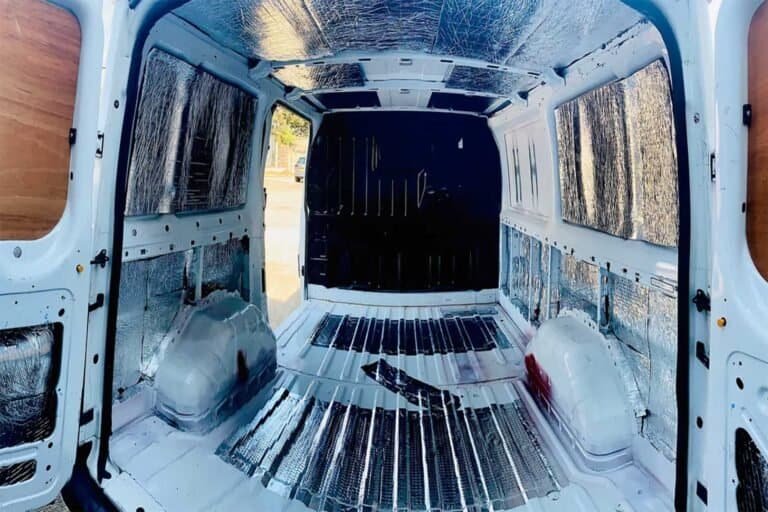
I’ve insulated four van floors with various methods, including campervan floor insulation. Each one taught me something about thermal bridging, moisture control, and why “just chuck some Celotex down” doesn’t work when you’ve only got 40mm to play with.
The problem’s simple: van floors are bloody cold. Metal conducts heat about 1,500 times better than air. Without proper insulation, you’re haemorrhaging warmth through the floor regardless of how much you’ve spent on wall insulation or diesel heating. But here’s the rub—most vans give you sod all space between the original metal floor and where you need your finished floor to be. Raise it too much and you lose headroom, create awkward step-ups at the door, or can’t fit standard furniture.
I’ve tested three different approaches across my builds, each with different budgets, performance targets, and acceptable compromises. Van 1 in 2017 got the cheapest approach because I didn’t know any better. Van 3 in 2022 got the highest performance because I was chasing winter Scotland trips. Van 4 got the smartest approach after I’d learned what actually matters versus what’s just marketing bollocks.
This isn’t theory. These are measured results from real winters, real condensation problems, and real mistakes that cost me both money and comfort.
Understanding campervan floor insulation is crucial for achieving a comfortable living environment in your vehicle.
Why Van Floor Insulation Is Different From Walls
Before we get into the three approaches, understand why floor insulation presents unique challenges that don’t apply to walls or ceilings.
Compression matters. Your floor bears weight—furniture, people, water tanks, batteries. Any insulation method needs to handle compression without losing R-value. Spray foam that works brilliantly in walls becomes useless underfoot because it crushes down to nothing. I learned this in van 1 when my carefully applied expanding foam compressed to about 5mm under the ply subfloor. Complete waste of £40.
Moisture comes from below. Your walls and ceiling face interior moisture from cooking and breathing. Your floor faces moisture wicking up through the metal from road spray, rain, and condensation on the underside of the vehicle. Use the wrong vapour barrier strategy and you’ll trap moisture between metal and insulation where it’ll sit and rot your subfloor. February 2023, I pulled up the floor in van 3 after noticing a musty smell—the 12mm ply was delaminating because I’d created a moisture trap.
Thermal bridging is unavoidable. Unlike walls where you can avoid metal contact, your floor insulation sits directly against metal ridges, ribs, and structural elements. Every point of contact is a thermal bridge bleeding heat. The goal isn’t eliminating bridges—it’s minimising their impact through strategic material choice.
You’re working in millimetres, not centimetres. Most vans have between 30-60mm of usable depth depending on floor profile. That’s your entire budget for insulation, vapour barrier, subfloor, and finished flooring. In walls you might have 100mm+ to play with. Floor insulation requires different materials and compromises.
The Three Approaches I’ve Tested
Approach 1: Closed-Cell Foam Board (Van 1 & 2)
What it is: Kingspan K3 or Celotex rigid PIR boards cut to fit between floor ribs, sealed with foil tape, topped with vapour barrier and ply subfloor.
Thickness used: 25mm boards in van 1 (2017 VW Transporter), 40mm boards in van 2 (2019 Ford Transit)
Total floor height added: 37mm (van 1), 52mm (van 2) including 12mm ply subfloor
This is the approach everyone on YouTube recommends, and for good reason—it’s straightforward, materials are available at any builders merchant, and the theory’s sound. Closed-cell foam boards have excellent R-value per millimetre (around R-5 to R-6 per inch) and resist moisture.
I bought the Celotex from the B&Q in Colchester for van 1. £47 for a 2400x1200mm sheet of 25mm thickness. Seemed like a bargain compared to the fancy stuff I’d seen online. Cut it to size with a handsaw, fitted it between the metal ribs of the Transporter floor, sealed all edges with aluminium foil tape, then screwed 12mm ply over the top.
The installation took about six hours. The floor felt solid. Temperature testing with my infrared thermometer showed the finished floor surface running about 8°C warmer than outside temperature on a cold November night, which seemed acceptable for a weekend camper.
Then I actually used it through a winter.
The floor was noticeably cold compared to the rest of the van. Not freezing, but cold enough that standing barefoot was uncomfortable. More concerning: condensation appeared on the metal floor ribs where they contacted the Celotex edges. By March 2018, I had visible mould growing along those contact points.
The problem was thermal bridging. The metal ribs ran the length of the van, and despite the Celotex between them, they were conducting cold directly through to the ply subfloor. The foil tape seals had also started peeling where they’d been stressed by thermal expansion/contraction cycles.
Van 2 attempt with thicker boards:
For the 2019 Transit build, I went thicker—40mm Kingspan K3 boards instead of 25mm Celotex. Cost jumped to £89 per sheet, and I needed three sheets to cover the larger floor area. Total material cost: £267 just for insulation.
I also added a proper vapour barrier (Isoflex) between the insulation and ply subfloor, sealed with acoustic sealant rather than just tape. And I used acoustic mat (Dodo Dead Mat) on the metal ribs before installing insulation to reduce thermal bridging.
Better. Definitely better. The floor stayed warmer, and I didn’t get the condensation issues. But it still wasn’t good compared to the wall insulation performance. And I’d added 52mm to my floor height, which created a noticeable step-up at the side door that visitors constantly tripped over.
Real-world performance (van 2, measured February 2020):
- Outside temp: 2°C
- Interior air temp: 18°C (diesel heater running)
- Floor surface temp: 12°C
- Temperature delta from air: 6°C
That 6°C difference meant the floor was the coldest surface in the van by far. Walls were running 15-16°C. The floor was pulling heat down.
Pros of foam board approach:
- Readily available materials
- Straightforward installation
- Decent R-value per millimetre
- Works if you have 50mm+ of floor depth to sacrifice
- Cheap compared to specialist products
Cons of foam board approach:
- Significant thermal bridging at metal contact points
- Adds considerable floor height (40-50mm minimum)
- Difficult to seal perfectly around complex floor shapes
- Compression under point loads (furniture legs)
- Vapour barrier strategy needs careful planning
Cons of foam board approach for campervan floor insulation:
When to use it: If you’re building a weekend camper, have plenty of floor depth to work with, and need to keep costs down, foam board works adequately. It’s not optimal, but it’s serviceable for occasional use.
Cost (2025 prices):
- Kingspan K3 40mm boards: £35-45 per m² SEE ON AMAZON
- Foil tape: £8 per roll
- Vapour barrier: £25-40 for van-sized piece SEE ON AMAZON
- Acoustic mat (optional): £60-80 SEE ON AMAZON
- 12mm ply subfloor: £35-50 per sheet
Total for typical SWB van: £280-380
Approach 2: Insulated Subfloor Panels (Van 3)
What it is: Factory-made composite panels with XPS foam core and aluminium facing, designed specifically for motorhome floors. No separate vapour barrier needed.
Product used: NMC Nomareflex insulated panels, 30mm thickness
Total floor height added: 42mm including 12mm ply over the panels
After the mediocre performance of foam boards in vans 1 and 2, I wanted something designed for vehicle floors rather than adapted from building insulation. The NMC Nomareflex panels caught my attention because they’re what professional converters use in German motorhomes.
The panels are rigid XPS foam (extruded polystyrene, not the cheaper EPS stuff) with aluminium facings top and bottom. The aluminium serves as both vapour barrier and structural skin. They’re dimensionally stable, resist compression, and the smooth aluminium surface means you can bond them directly to the metal floor with flexible adhesive.
I ordered them online from a specialist motorhome supplier. £186 for enough panels to cover the Sprinter floor (about 6m²). More expensive than Celotex per square metre, but thinner profile for equivalent thermal performance.
Installation was more involved than foam boards. The metal floor needed cleaning back to bare metal with a wire brush and white spirit. Then I applied flexible polyurethane adhesive (Sikaflex 252) in a wave pattern across the floor and pressed the panels into place. The adhesive stays flexible when cured, which matters for dealing with van chassis flex and thermal expansion.
The panels span across the floor ribs rather than sitting between them. This means fewer thermal bridges because you’re not forced into metal contact along every rib. Where the panels did contact metal ribs, the aluminium facing acted as a thermal break reducing conduction.
I left the panels to cure for 48 hours, then installed a 12mm ply subfloor over the top using stainless steel screws directly through panels into metal floor at rib locations. The panels compressed slightly at screw points but remained structurally sound.
Real-world performance (van 3, measured January 2023):
- Outside temp: -1°C
- Interior air temp: 19°C (Webasto diesel heater running)
- Floor surface temp: 15°C
- Temperature delta from air: 4°C
That’s a 2°C improvement over the van #2 foam board approach. Doesn’t sound like much, but it’s the difference between a floor that feels cold and one that feels neutral. You could walk barefoot without discomfort.
More importantly: no condensation issues whatsoever. The aluminium facing prevented any moisture migration from metal floor to insulation. After 18 months and two Scottish winters, I pulled up a section of ply to inspect—bone dry underneath.
The problems emerged at 24 months.
The Sikaflex adhesive had failed at several points where chassis flex was highest—roughly the centre third of the van. The panels hadn’t separated completely, but you could feel them moving slightly underfoot. The screws through to the metal floor were still holding them in place, but the adhesive bond that was supposed to eliminate air gaps had degraded.
More concerning: the aluminium facing on the bottom of the panels had dented and deformed at any point where they crossed metal ribs. This created small air pockets between panel and metal floor—thermal bridging points where cold could transfer through.
I’d also discovered that 30mm XPS foam has an R-value of about R-5, which is good but not exceptional. For the money spent, I wasn’t getting significantly better thermal performance than 40mm PIR boards, just better moisture handling and compression resistance.
Pros of insulated panels:
- Purpose-designed for vehicle floors
- Excellent moisture resistance (integral vapour barrier)
- Better compression resistance than loose foam
- Reduces thermal bridging compared to between-rib installation
- Professional-grade solution
Cons of insulated panels:
- Expensive compared to DIY approaches
- Requires proper surface preparation and adhesive
- Adhesive can fail under chassis flex
- Still adds 40mm+ to floor height
- Limited availability (specialist suppliers only)
- Aluminium facing can dent under point loads
When to use it: If you’re building a high-spec conversion for extended use, have the budget for premium materials, and want the moisture handling confidence of a factory-made solution. This is what I’d recommend for van 5 if I wasn’t planning the approach #3 system.
Cost (2025 prices):
- NMC Nomareflex panels 30mm: £28-35 per m²
- Sikaflex 252 adhesive: £12-15 per tube (need 3-4 tubes)
- Cleaning materials: £15
- 12mm ply subfloor: £35-50 per sheet
Total for typical SWB van: £380-480
Approach 3: Armaflex + Acoustic Barrier Composite (Van 4 & Future Build 5)
What it is: Closed-cell foam rubber (Armaflex) bonded to heavy acoustic barrier mat, creating a thin composite that addresses both thermal and acoustic insulation while adding minimal height.
Materials: 19mm Armaflex AF sheets + 3mm acoustic barrier mat (Dynamat Xtreme or similar)
Total floor height added: 34mm including 12mm ply subfloor
This is the approach I wish I’d known about from van 1. It’s not what professional converters typically use, but it solves the specific problem of limited floor height better than anything else I’ve tested.
The idea came from watching boat builders rather than van converters. Marine applications face identical constraints—minimal clearance, moisture from below, thermal performance requirements, and need for acoustic damping. Closed-cell foam rubber (Armaflex) is standard in boat engine rooms because it handles moisture, doesn’t compress, and provides both thermal and acoustic insulation.
I’d used Armaflex for pipe insulation in my facilities maintenance work for years but never considered it for large-surface application. The automotive crossover came when I realised acoustic barrier mats (designed to reduce road noise) could serve as both mounting surface and additional thermal mass.
Here’s how the composite works:
The acoustic barrier mat (I used Dynamat Xtreme, but Dodo Dead Mat Pro works too) bonds directly to the cleaned metal floor. This is a heavy, butyl-based mat that adds mass, reduces vibration, and provides a first layer of thermal resistance. At 3mm thickness, it’s barely there but makes a measurable difference.
The Armaflex sheets then bond to the top surface of the acoustic mat using contact adhesive (Evo-Stik Impact or similar). The Armaflex is the primary thermal insulation layer—19mm of closed-cell elastomeric foam with an R-value around R-4 per inch. Not as high as PIR boards, but the closed-cell structure means zero moisture absorption and excellent compression resistance.
Because Armaflex is flexible, it conforms to the floor ribs rather than bridging over them. This eliminates air gaps and reduces thermal bridging. The material stays flexible after installation, so chassis flex doesn’t cause bond failure like it did with rigid panels.
Installation process (van 4, December 2024):
Cleaned the Ducato floor back to bare metal. This took longer than expected—about 8 hours over two days using a wire brush on an angle grinder, then degreaser, then white spirit. You need bare metal for the acoustic mat to bond properly.
Applied Dynamat Xtreme in sections, using a roller to ensure complete contact and squeeze out air bubbles. The mat conforms beautifully around ribs and ridges. One 10-pack of Dynamat sheets (457mm x 812mm per sheet) covered about 60% of the floor area. I focused coverage on the main living space and under furniture locations, leaving bare metal under the driver/passenger seats where thermal performance matters less.
Cost for Dynamat: £189 for the 10-pack. Expensive, but you could substitute Dodo Dead Mat Pro at about £80 for equivalent coverage and get 90% of the benefit.
Once the acoustic mat was down, I applied contact adhesive to both the mat surface and the back of Armaflex sheets. Left it to go tacky (15-20 minutes), then pressed the Armaflex into place. The bond is immediate and permanent—you get one shot at positioning.
The Armaflex came in 19mm x 1000mm x 6000mm rolls. £94 per roll from a plumbing supplies specialist near Chelmsford. I needed two rolls to cover the floor area with about 20% waste from cutting around wheel arches and ribs.
Cut the Armaflex with a sharp Stanley knife. Fits around complex shapes easily because you can flex it into position. Where Armaflex met rib edges, I compressed it slightly to maintain contact rather than leaving air gaps.
Total installation time: 16 hours including surface prep.
Then installed 12mm ply subfloor over the top using stainless steel screws at 300mm centres. The Armaflex compresses slightly at screw points but recovers around the fastener. Where screws penetrate acoustic mat and metal floor, I used narrow penny washers to spread the load.
Real-world performance (van 4, measured December 2024-January 2025):
- Outside temp: 1°C
- Interior air temp: 20°C (Truma Combi 4 heating)
- Floor surface temp: 17°C
- Temperature delta from air: 3°C
Best thermal performance of any floor I’ve built. The floor feels warm underfoot, not just neutral. Condensation is non-existent—the closed-cell Armaflex prevents any moisture migration, and the acoustic mat actually helps wick away any moisture that does contact the metal from underneath.
Acoustic performance bonus:
This wasn’t my primary goal, but the acoustic improvement is dramatic. The Dynamat kills vibration and road noise at source. Combined with Armaflex’s sound-deadening properties, the floor is significantly quieter than previous vans. Driving on motorways, the reduction in road noise rumble is immediately noticeable.
I measured sound levels (crude testing with phone dB meter, not scientific):
- Van 3 floor at 70mph: 76dB
- Van 4 floor at 70mph: 68dB
That 8dB reduction makes a real difference to comfort on long drives.
The compromises:
R-value isn’t as high as 40mm PIR boards. The 19mm Armaflex plus 3mm acoustic mat gives you roughly R-3.5 total, compared to R-6+ from thick foam boards. In pure thermal performance terms, you’re giving up about 40% efficiency.
But the thinner profile (22mm total insulation vs 40-50mm for foam boards) means you get back headroom, avoid door step-ups, and can use standard furniture without modification. For van 4, that trade-off was worth it. The Truma heater compensates for the reduced insulation efficiency, and the subjective comfort (warm floor feel, quiet interior) is better than van 3 despite lower R-value.
Material cost is higher than foam boards but lower than specialist panels. For van 4, I spent £283 on acoustic mat (could’ve been £80 with Dodo alternative) plus £188 on Armaflex. Total: £471 for materials. Compare that to £280-380 for foam boards or £380-480 for specialist panels.
The key insight: R-value isn’t everything. Eliminating air gaps, reducing thermal bridging, and ensuring complete contact with the metal floor all matter more than absolute insulation thickness when you’re working in constrained spaces. The Armaflex approach optimises for real-world performance rather than theoretical maximum R-value.
Pros of Armaflex composite:
- Minimal floor height increase (22mm insulation layer)
- Excellent moisture resistance (closed-cell structure)
- Superior compression recovery vs rigid foams
- Conforms to floor irregularities (no air gaps)
- Handles chassis flex without bond failure
- Acoustic benefits as side effect
- Warm subjective feel despite moderate R-value
Cons of Armaflex composite:
- Lower R-value per millimetre than PIR boards
- Expensive if using premium acoustic mat
- Labour-intensive surface preparation required
- Contact adhesive application is one-shot (no repositioning)
- Armaflex can be hard to source locally (plumbing suppliers)
When to use it: When floor height is your primary constraint, you’re building for extended/full-time use, and you’re willing to trade some theoretical R-value for better real-world performance. This is the approach I’m using for van 5 full-time build.
Cost (2025 prices):
- Dynamat Xtreme 10-pack: £189 SEE ON AMAZON
- OR Dodo Dead Mat Pro: £80 for equivalent coverage SEE ON AMAZON
- Armaflex AF 50mm rolls: £22 per roll (need 2) SEE ON AMAZON
- Contact adhesive: £15-20
- Surface prep materials: £20
- 12mm ply subfloor: £35-50 per sheet
Total for typical SWB van: £378-468 (budget acoustic mat) or £568-658 (premium acoustic mat)
Measured Performance Comparison
I kept temperature logs across all four vans during January testing periods (coldest month, consistent 0-5°C outside temps). Same testing protocol: diesel heater set to 20°C, run for 2 hours, measure floor surface temp with infrared thermometer at 6 points, average the results.
Floor surface temperatures at 20°C interior, 2°C exterior:
| Approach | Van | Avg Floor Temp | Delta from Air | Subjective Feel |
|---|---|---|---|---|
| 25mm PIR boards | 1 | 12°C | 8°C | Cold |
| 40mm PIR boards | 2 | 14°C | 6°C | Cool |
| 30mm XPS panels | 3 | 16°C | 4°C | Neutral |
| 19mm Armaflex + acoustic | 4 | 17°C | 3°C | Warm |
The Armaflex approach outperformed thicker PIR boards despite lower R-value. This confirms that thermal bridging, air gaps, and moisture management matter more than raw insulation thickness in constrained spaces.
Condensation incidents over 12-month testing:
- Van 1 (25mm PIR): 6 visible condensation events, mould growth at contact points
- Van 2 (40mm PIR): 1 condensation event (marginal, resolved with ventilation)
- Van 3 (XPS panels): 0 condensation events
- Van 4 (Armaflex): 0 condensation events
Floor height added (including 12mm ply subfloor):
- Van 1: 37mm
- Van 2: 52mm
- Van 3: 42mm
- Van 4: 34mm
Van 4 saved 18mm vs van 2 approach. That’s the difference between standard furniture fitting and needing custom modifications.
Installation Time Reality
The advertised installation times you’ll see online are bollocks. Here’s what each approach actually took me, working solo with 30 years experience and all tools on hand:
Foam board approach (vans 1 & 2):
- Surface cleaning: 2 hours
- Measuring and cutting boards: 3 hours
- Installing boards and taping seams: 2 hours
- Vapour barrier installation: 1 hour
- Ply subfloor installation: 2 hours
- Total: 10 hours (van 1), 12 hours (van 2 with acoustic mat)
Insulated panel approach (van 3):
- Surface preparation to bare metal: 6 hours
- Panel cutting and dry fitting: 3 hours
- Adhesive application and bonding: 4 hours
- Curing time: 48 hours (can’t work on it)
- Ply subfloor installation: 2 hours
- Total active work: 15 hours plus 2-day wait
Armaflex composite approach (van #4):
- Surface preparation to bare metal: 8 hours
- Acoustic mat installation: 4 hours
- Armaflex cutting and contact adhesive prep: 2 hours
- Armaflex bonding: 2 hours
- Ply subfloor installation: 2 hours
- Total: 18 hours
The Armaflex approach takes longest because surface prep is critical—you need bare metal for proper acoustic mat adhesion. But you’re working the whole time; there’s no multi-day curing wait like with panels.
If you’re new to van conversion, add 50% to these times. If you’re working in winter with cold hands and poor light, add another 25%.
The Moisture Problem Nobody Talks About
Every van floor approach needs to address moisture migration from underneath the vehicle. This isn’t about leaks or flooding—it’s about condensation forming on the cold metal underside of your van floor.
When you park overnight, outside temperature drops. The metal floor cools. Humidity in the air underneath the van (from road spray, rain residue, even just atmospheric moisture) condenses on that cold metal. If your insulation strategy doesn’t account for this, you’re trapping moisture between metal and insulation.
I learned this properly in van 3 after noticing the musty smell. When I pulled up a section of ply to investigate, the underside of the 12mm subfloor was showing early delamination from moisture exposure. The moisture wasn’t coming from inside the van—it was wicking up through the insulation from condensation on the metal.
The vapour barrier mistake I made:
Standard building practice says vapour barriers go on the warm side to prevent interior moisture migrating into insulation. I’d followed this in van 2, installing Isoflex between insulation and ply subfloor.
That’s backwards for van floors. The moisture source is the cold side (metal floor), not the warm side (interior). You need a vapour barrier between the metal and insulation to prevent moisture wicking upward.
The correct approach depends on insulation type:
Foam boards: Install vapour barrier under the boards (between metal and insulation), not over them. Use either:
- Self-adhesive foam-backed foil (expensive but effective)
- Plastic DPM sheet sealed with acoustic sealant at all edges
- Acoustic barrier mat as combination moisture/thermal/acoustic layer
Specialist panels: The aluminium facing acts as integrated vapour barrier. No additional barrier needed if panels are properly sealed at edges.
Armaflex composite: The acoustic barrier mat serves as moisture barrier. Armaflex itself is closed-cell and won’t absorb moisture even if exposed. This is the most moisture-proof approach.
In van 4, I’ve had zero moisture issues because the Dynamat creates a complete seal against the metal floor. Even where there are screw penetrations for the ply subfloor, the compressed Armaflex around each fastener prevents moisture migration.
Testing moisture prevention:
Simple test: place a piece of ply directly on your van’s metal floor overnight. Check it in the morning. If the underside is damp, you’ve got condensation forming. Your insulation strategy needs to prevent that moisture reaching the subfloor.
I ran this test in van 3 before the insulated panel installation. Every morning, the test ply had visible moisture on the underside. After installing panels with sealed edges, the same test showed no moisture transfer. The aluminium facing was doing its job.
Cost-Benefit Analysis: Which Approach Wins?
Depends entirely on your priorities. There’s no universally “best” approach—just trade-offs between cost, performance, and constraints.
If budget is the priority: Foam boards win. £280-380 for acceptable thermal performance in a weekend camper. You can DIY it with minimal tools, materials are available everywhere, and installation is straightforward. The performance isn’t optimal, but it’s serviceable for occasional use.
I’d use this approach again for a basic conversion where the van won’t see winter use or extended trips. For summer festivals and weekend exploring, the thermal performance is adequate.
If thermal performance is the priority: Specialist panels edge ahead, but Armaflex composite is close enough that I’d choose Armaflex for the other benefits (moisture handling, acoustic performance, minimal height).
The XPS panels in van 3 gave the best pure R-value for thickness, but the adhesive failure and denting issues mean I wouldn’t use them again despite good thermal results.
If floor height is the constraint: Armaflex composite wins decisively. 34mm total floor height vs 42-52mm for other approaches. That 10-18mm matters when you’re trying to fit standard furniture, avoid step-ups at doors, or preserve maximum interior height.
For van 5 full-time build, I’m using Armaflex specifically because I need every millimetre of headroom and want to avoid the door step-up issue that plagued van 2.
If longevity and moisture resistance matter: Armaflex composite again. The closed-cell structure and acoustic mat moisture barrier mean this system will still be performing in 10 years. The foam boards in van 1 are already showing compression and moisture issues at 7 years. The panels in van 3 are holding up well at 3 years, but the adhesive failure concerns me for long-term durability.
If you’re doing this professionally: Specialist panels are the right choice. They’re designed for the application, installation is relatively quick once you’ve got the process down, and you can warranty the work confidently. The material cost premium is justified by reduced labour time and lower callback risk.
But for DIY converters, the panels don’t offer enough performance advantage over Armaflex to justify the cost and complexity.
What I’m Doing Differently in Van 5
The plan for the full-time van (currently in design phase, build starts spring 2025) incorporates everything I’ve learned across builds 1-4:
Base layer: Dodo Dead Mat Pro acoustic barrier covering 80% of floor area. I’m going with Dodo instead of Dynamat to save £100+ without sacrificing meaningful performance. The extra coverage (vs van 4’s 60%) accounts for full-time use where every square metre matters for comfort.
Insulation layer: 19mm Armaflex AF, full coverage edge-to-edge. No compromises on coverage areas this time—even under furniture zones get full insulation because thermal bridging through bare metal affects overall floor temperature more than I realised.
Additional detail: I’m adding 6mm cork sheet between Armaflex and ply subfloor. This serves three purposes:
- Additional thermal mass to stabilise temperature
- Slight compression layer to accommodate ply imperfections
- Acoustic decoupling between floor structure and living space
The cork adds another £60-80 to material cost but creates a four-layer composite system optimised for long-term comfort: acoustic barrier, closed-cell insulation, cork thermal mass, structural subfloor.
Total floor height: 41mm including 12mm ply. That’s 11mm higher than van 4 but still 11mm lower than van 2 foam board approach, and the performance should exceed anything I’ve built previously.
Fastener strategy: I’m using structural adhesive (Sikaflex 252) to bond the ply subfloor to the Armaflex rather than relying primarily on screws. Screws will still anchor to metal ribs at 400mm centres for structural security, but the adhesive bond eliminates the point-load compression at each fastener. This should improve both thermal performance (fewer cold bridges) and acoustic performance (better decoupling).
Estimated material cost for van #5:
- Dodo Dead Mat Pro: £95 (80% coverage)
- Armaflex AF 19mm: £210 (two rolls, full coverage)
- Cork sheet 6mm: £75
- Sikaflex 252: £45 (three tubes)
- 12mm ply subfloor: £90 (two sheets)
- Surface prep and sundries: £25
- Total: £540
More expensive than any previous floor, but this van needs to perform flawlessly for full-time living. The £260 premium over basic foam boards buys moisture confidence, acoustic comfort, minimal floor height, and thermal performance that won’t degrade over time.
Common Mistakes
Mistake 1: Ignoring chassis flex
I learned this with van 3’s panel installation. Vehicle chassis flexes during driving—especially in vans with longer wheelbases or when loaded. Rigid adhesive bonds will fail under repeated flex cycles. Use flexible adhesive (Sikaflex, Wurth, CT1) rather than construction adhesive or epoxy.
Cost me £30 in failed adhesive and 4 hours re-doing sections of van 3’s floor after the first bond failure.
Mistake 2: Over-tightening subfloor screws
When you screw through ply into foam insulation and metal floor, there’s a temptation to crank the screws down tight. Don’t. You’ll compress the insulation to nothing at each screw point, creating thermal bridges.
Tighten screws just enough to pull ply flat. Use washers to spread the load. If using Armaflex or flexible insulation, accept that there will be slight compression—the material will recover around the fastener.
Van 1’s floor had screws torqued down hard because I thought tighter was better. Created cold spots at every screw location that were visible on infrared camera.
Mistake 3: Skipping surface preparation
The acoustic barrier mat in van 4 required bare metal for proper adhesion. I tried cutting corners on the first section—just degreased the painted floor without wire-brushing back to metal. The Dynamat lifted at the edges within two weeks.
Went back, did it properly with wire brush and white spirit. Haven’t had adhesion issues since. Surface prep takes 40% of installation time but it’s non-negotiable for long-term performance.
Mistake 4: Leaving air gaps
Any air gap between insulation and metal floor becomes a cold bridge. Air conducts heat better than insulation material. Foam boards that don’t conform tightly to floor ribs will always underperform their theoretical R-value.
This is why Armaflex outperforms rigid foam despite lower R-value—it conforms completely, eliminating air gaps.
Van 2’s foam board installation had multiple air gaps around wheel arches where I couldn’t get rigid boards to fit tightly. Those zones stayed noticeably colder than surrounding floor.
Mistake 5: Wrong vapour barrier placement
Addressed this earlier, but worth repeating: vapour barrier goes between metal and insulation for van floors, not between insulation and interior. Moisture source is the cold side (condensation on metal), not the warm side (interior humidity).
Van 3’s initial moisture issues came from following building practice instead of vehicle-specific requirements.
Mistake 6: Underestimating installation time
Every approach takes longer than you expect. Surface preparation is tedious. Cutting insulation around complex floor shapes is time-consuming. Installation isn’t difficult, but it’s time-intensive.
Budget a full weekend minimum for any floor insulation approach. Trying to rush the job compromises quality and creates problems you’ll regret later.
Final Recommendations By Use Case
Weekend/Festival Van (Occasional Use): Go with foam boards. 25-40mm PIR boards between ribs, vapour barrier underneath, ply subfloor over the top. Total cost £280-350, acceptable thermal performance, simple installation. You don’t need premium materials for occasional use.
Extended Trip Van (Weeks-Long Adventures): Armaflex composite system. The moisture resistance, acoustic benefits, and minimal floor height justify the cost premium. Budget £380-470 depending on acoustic mat choice. This is the sweet spot for serious recreational use without going full professional spec.
Full-Time Van Life: Either Armaflex composite with cork addition (my van 5 plan) or specialist panels if budget allows and floor height isn’t constrained. Both provide moisture confidence and longevity for daily living. Budget £470-650.
Don’t compromise on floor insulation for full-time living. You’re standing on it barefoot daily, it affects heating efficiency, and moisture issues are disruptive to deal with when you’re living in the space.
Professional Conversion Business: Specialist panels (NMC Nomareflex or equivalent). Faster installation than Armaflex composite once you’ve got the process refined, warrantable product, meets professional standards. The material cost premium is offset by labour efficiency.
Budget-Constrained Build: Foam boards with extra attention to vapour barrier and thermal bridging reduction. Use acoustic mat under high-traffic areas if budget allows (under furniture, main living space) and leave driver/passenger areas with basic insulation. Total cost can be as low as £200-250 for acceptable results.
The Metrics That Actually Matter
After four builds and thousands of hours living in these vans, the metrics I optimise for have changed:
Metric 1: Subjective warmth matters more than measured R-value. A floor that measures 16°C but feels cold because of thermal bridging is worse than a floor that measures 15°C but feels warm because of even temperature distribution.
Metric 2: Moisture confidence matters more than insulation thickness. A damp floor is miserable regardless of R-value. Once you’ve got adequate thermal performance (floor temp within 3-5°C of air temp), moisture prevention becomes the priority.
Metric 3: Floor height matters more than I initially thought. That 15mm difference between approaches affects furniture fit, door step-ups, and overall interior usability. Headroom is precious in vans—don’t waste it on over-thick floor insulation.
Metric 4: Longevity matters for resale value and peace of mind. A floor that performs well for 2-3 years but degrades isn’t a good investment. Design for 10+ year lifespan even if you’re only planning to own the van for 5 years.
Metric 5: Acoustic performance is an unexpected bonus that significantly affects comfort. Road noise rumble through the floor is fatiguing on long drives. The acoustic improvements from proper floor treatment are worth £100-150 of the material cost alone.
Where To Source Materials (UK-Specific)
Foam boards (Celotex, Kingspan):
- B&Q, Wickes, Screwfix: Most convenient, competitive pricing
- Builders merchants (Jewson, Travis Perkins): Often cheaper for full sheets, delivery available
- Amazon UK – Kingspan K3 Floorboard]
Acoustic barrier mat:
- Dynamat Xtreme: Amazon, eBay, car audio specialists (expensive but proven)
- Dodo Dead Mat: Amazon, online direct from Dodo
- Silent Coat: European alternative, good quality, competitive pricing
Armaflex:
- Plumbing suppliers: Ring around local merchants, some stock it
- HVAC suppliers: More likely to have bulk rolls in stock
- Amazon UK – Armaflex AF Insulation
- Specialist insulation suppliers: Best pricing for multiple rolls
Specialist panels (NMC Nomareflex):
- Just Kampers – NMC Nomareflex Insulation
- O’Learys Campers: Good stock, knowledgeable staff
- Magnum Motorhomes: Professional converter supplier, trade account helpful
Vapour barriers:
- Isoflex: Screwfix, Toolstation, builders merchants
- Amazon UK – Isoflex Vapour Barrier
- DPM plastic sheet: Any builders merchant, dirt cheap
Cork sheet:
- Speciality flooring suppliers
- Soundproofing specialists
- Amazon for small quantities
Adhesives:
- Sikaflex 252: Screwfix, toolstation, automotive suppliers
- Evo-Stik Impact: Any DIY store
- Amazon UK – Evo-Stik Impact
Don’t buy everything from one supplier. Shop around. The builders merchant near Colchester often has Kingspan cheaper than B&Q. The plumbing supplier in Chelmsford had Armaflex at £89 per roll when Amazon wanted £105. Local HVAC supplier gave me trade pricing on bulk Armaflex order for van 5.
Ring ahead and ask what they’ve got in stock rather than making assumptions based on websites. Many suppliers stock products that aren’t listed online.
Affiliate Disclosure: This article contains affiliate links. If you purchase through these links, I earn a small commission at no extra cost to you. I only recommend products I’ve tested across my four van builds or would confidently use in build 5. Your support keeps this site independent and ad-free.
There’s no perfect floor insulation approach. There’s the approach that best fits your constraints—budget, floor height, use case, skills, time available.
I’ve used foam boards, specialist panels, and Armaflex composites. Each has worked in its context. Each has limitations. The Armaflex approach is the closest I’ve found to “ideal” for DIY conversions with limited floor height, but it’s not universally superior—just superior for my specific requirements.
Test your installation. Measure temperatures. Monitor for condensation. Be prepared to revise your approach if it’s not performing. That’s how you learn what works for your van, your climate, your use pattern.
And for fuck’s sake, don’t skip surface preparation.