
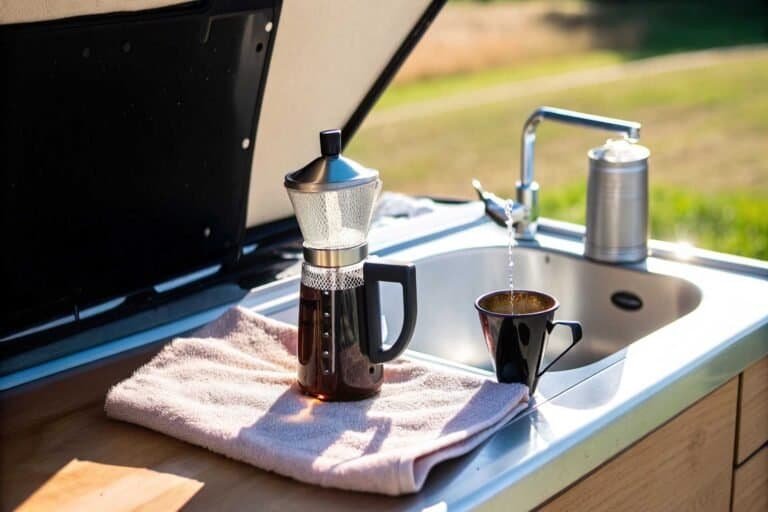
A decent camping coffee maker isn’t just another bit of kit; for most of us living the van life in the UK, it’s a non-negotiable part of the morning ritual. It’s what stands between a groggy, grumpy start and a perfect morning watching the mist burn off a Scottish loch.
The best ones are compact, don’t need any electric hook-up, and are a doddle to clean with just a splash of water.
Why Your Coffee Maker Is a Crucial Piece of Vanlife Gear
Picture this: you wake up to the sound of rain drumming on the roof of your van, somewhere deep in the Peak District. Before you even think about waterproofs or walking routes, you reach for your coffee maker. In the tight quarters of a campervan, every single item has to earn its keep. Space is the ultimate luxury, power is finite, and water is a precious resource you have to haul and manage yourself.
This is why choosing the right camping coffee maker is a decision that genuinely shapes your day-to-day life on the road. This isn’t about being fancy; it’s about practicality, comfort, and that simple joy of a cracking cup of coffee, no matter how remote your park-up is.
More Than Just a Drink
In a van, your coffee maker becomes a cornerstone of your morning routine. It’s the first step in setting a good tone for the day, a small moment of normality and craft in the glorious chaos of life on four wheels. Get the right one, and the ritual is seamless. Get the wrong one, and you’re starting your day with faff, mess, and a disappointing brew.
You have to think about the unique constraints of life in a van:
- Limited Space: Every cubic centimetre counts. That bulky kitchen coffee machine you had in your flat? Forget it.
- Power Conservation: Your leisure battery is your lifeline. An appliance that drains it in minutes is a liability, especially when you’re properly off-grid.
- Water Scarcity: Using litres of water to brew or clean is a non-starter when your onboard tank is all you’ve got for the next few days.
- Durability: British roads can be bumpy. Your gear needs to survive vibrations, temperature swings, and being chucked in a cupboard over and over again.
The Growing Need for Decent Off-Grid Coffee
This focus on reliable, simple gear isn’t just a niche van thing anymore. Camping and caravanning have absolutely exploded in the UK, fuelling demand for quality kit among fellow vanlifers. Recent industry analysis forecasts the whole sector will grow by around 9% in the next few years, driven by a massive surge in people wanting to escape to nature.
This boom has a direct knock-on effect on coffee habits. One survey found that a whopping 68% of campers rank coffee as their number one morning essential, with loads of them specifically looking for portable makers that don’t need an electric pitch. You can read more about these market trends and how they’re shaping outdoor gear.
A great camping coffee maker doesn’t just make coffee; it makes vanlife better. It respects your limits on space, power, and water while delivering that perfect cup that feels like home, wherever you’ve parked for the night.
Comparing the Most Popular Camping Coffee Makers
Picking a camping coffee maker is a bit like choosing a walking route in the Peak District. They all get you to a good place, but the journey there is wildly different. To cut through the options, let’s break down the main contenders for vanlife coffee. This isn’t just a list of specs; it’s a real-world look at how each one holds up in the cramped, power-conscious world of a campervan.
We’ll look at the big four: the AeroPress, the stove-top Moka pot, the pour-over dripper, and the classic French press. Each has its own personality and its own set of compromises. Think of it like this: the AeroPress is the ingenious multi-tool you never knew you needed, while the Moka pot is the trusty old Land Rover—a bit clunky, but iconic and utterly reliable.
The AeroPress: A Vanlife Favourite
There’s a reason the AeroPress has a cult following in the vanlife community. It’s ridiculously compact, lightweight, and made from a tough, travel-proof plastic that won’t shatter when it inevitably falls out of a high cupboard. It’s pure genius.
Its magic is in its versatility. Using air pressure, it brews a smooth, rich, low-acid coffee that can be anything from a short, intense espresso-style shot to a longer Americano just by adding more hot water.
But where it truly wins for vanlife is the cleanup. After brewing, you just push the plunger all the way through, and the used grounds pop out in a dry, self-contained puck. It’s clean, simple, and uses almost zero water—a massive win when you’re trying to make your water tank last. The travel-friendly Aeropress Go Coffee Maker packs all these features into an even smaller, all-in-one travel case, making it a top pick.
The only real drawback is volume. It’s designed to make one strong cup at a time, so if you’re brewing for two or more, you have to repeat the process. But given it takes under two minutes per cup, it’s a pretty minor hassle for most.
The Stove-Top Moka Pot: A Robust Classic
The Moka pot is a design classic, the undisputed king of strong, Italian-style coffee made on a hob. You just place it on your gas stove, and it uses steam pressure to force water up through the coffee grounds, creating a bold, rich, and concentrated brew.
Made from aluminium or stainless steel, these things are practically indestructible. That’s a huge plus for life on the road. They come in all sorts of sizes, from a single-cup model to larger versions that can serve a whole crew, making them a great shout if you often travel with others. The coffee it makes is powerful and full-bodied, sitting somewhere between a proper espresso and a strong filter coffee.
The catch? Cleaning a Moka pot is more involved. You have to wait for it to cool down before you can unscrew the parts, and rinsing out the wet, sludgy grounds definitely uses more water than an AeroPress. It also takes a bit of practice to get the heat and timing right to avoid a bitter, burnt flavour.
Pour-Over and French Press: Simplicity vs. Volume
Pour-over drippers and French presses are two sides of the same simple, non-electric coin. Both are capable of making a fantastic cup of coffee, but they solve different problems.
Pour-Over Drippers: This is the ultimate minimalist choice. A simple cone (you can get plastic, ceramic, or collapsible silicone ones) sits right on your mug. You pop a paper filter inside, add your grounds, and slowly pour hot water over them. The result is a clean, bright, and nuanced cup of coffee. They take up virtually no space and are dead easy to clean—just lift out the filter and bin it. The only real downside is needing a constant supply of disposable paper filters.
French Press (Cafetière): A French press is your best bet for making a larger batch of coffee all at once. Just add grounds and hot water, let it steep for four minutes, then press the plunger. It produces a full-bodied, textured coffee with a satisfying richness. For vanlife, the stainless steel models are ideal as they’re unbreakable and often double-walled to keep the coffee warm. The biggest headache is the cleanup, which involves scraping out a load of wet grounds and uses a fair bit of your precious water.
Key Takeaway: The best camping coffee maker for you boils down to your priorities. If you value speed, versatility, and an almost water-free cleanup, the AeroPress is tough to beat. If you need to brew for a few people and want something bombproof, a Moka pot or a stainless steel French press is a solid choice.
To make this decision a bit easier, I’ve put together a quick comparison table weighing up the key factors for life on the road.
Camping Coffee Maker Comparison for UK Vanlife
| Maker Type | Best For | Space Required | Power/Heat Source | Brew Time | Cleanup Effort |
|---|---|---|---|---|---|
| AeroPress | Solo travellers, espresso-style coffee, minimal water use | Minimal | Kettle/hob | 1-2 mins | Very Low |
| Moka Pot | Strong, rich coffee for 1-4 people, durability | Small-Medium | Gas hob | 4-6 mins | Medium |
| Pour-Over | Clean & bright coffee, ultimate space-saving | Almost none | Kettle/hob | 3-4 mins | Very Low |
| French Press | Brewing for multiple people, full-bodied flavour | Medium | Kettle/hob | 4-5 mins | High |
Ultimately, the right coffee maker is the one that fits into your daily routine without causing a fuss. For me, the easy cleanup of the AeroPress makes it the winner for daily use, but I’ll always have a soft spot for the ritual of a Moka pot.
As you can see, if you’re running a simple, off-grid setup with limited power and a careful eye on your water tank, the non-electric options like the Moka pot and pour-over are fantastic, reliable choices.
Right, let’s get into the nitty-gritty of making a decent brew in your van. The Instagram version of vanlife is all perfect park-ups and effortless sunsets. The reality? It’s a constant, relentless game of managing your resources.
That beautiful cup of coffee you’re dreaming of while parked up in the wilds of the Peak District depends entirely on navigating a few harsh realities you never even think about in a house.
Making great coffee on the road boils down to solving the ‘big four’ challenges: space, power, water, and weight. These are the factors that decide whether a coffee maker becomes your trusty travel companion or just dead weight gathering dust in a cupboard. This is where you stop dreaming about vanlife and start actually living it.
The Power Problem
Your leisure battery is the beating heart of your entire off-grid setup. Guarding its charge is priority number one, always. This is precisely why that fancy home espresso machine or a pod-based system is a complete non-starter for wild camping.
Those things are unbelievably power-hungry, often pulling over 1,000 watts just to heat water. Running one for a few minutes could easily drain 10-15% of a standard 100Ah leisure battery’s usable juice. Do that every morning, and you’ll be frantically searching for a campsite with electric hook-up by day three.
Off-grid brewing means forgetting electricity and embracing the simple, reliable heat of your gas hob. This logic also applies when you’re choosing between a hand grinder and an electric one — a good manual grinder is the undisputed champion for life on the road.
The golden rule of vanlife power is brutally simple: if it has an electric heating element, it’s a potential battery killer. Stick to appliances that use gas for heat, and you’ll keep your fridge cold and your lights on for much, much longer.
Conserving Every Precious Drop of Water
You develop a new respect for water when your entire supply is sloshing around in a tank under your sink. Every drop is precious. A coffee maker that’s a pain to clean becomes a serious liability, fast.
A classic French press, for instance, is a nightmare. You’re scraping out sludgy, wet grounds and then using a ton of your precious water to rinse the glass and plunger properly. It feels wasteful because it is.
Let’s put some real numbers on it:
- French Press: After scraping out the messy grounds, you’ll easily use 300-500ml of water for a proper clean.
- AeroPress: The grounds pop out in a dry, self-contained puck. A quick wipe and a tiny rinse are all it needs, often using less than 50ml of water.
That difference might seem small, but over a week of wild camping, it adds up to several litres of your finite supply. Choosing a water-efficient brewer is one of those small, smart decisions that genuinely extends your freedom between fill-ups.
Making Smart Choices for Space and Weight
Every single thing you bring into your van has to earn its keep. Your living area is tiny, and every kilogram you add eats into your fuel efficiency and your vehicle’s payload limit. Clunky, fragile, or heavy items have no place in a well-sorted van.
Your coffee maker needs to be compact, tough, and lightweight. This is why the minimalist options are so popular on the road:
- Pour-Over Drippers: Some are just a simple cone that sits on your mug, taking up virtually no space in a drawer.
- Moka Pots: They’re robust, self-contained units that pack away neatly and can take a few knocks.
- AeroPress: It was literally designed for travel. It’s a lightweight plastic cylinder that you can squeeze into any gap in a cupboard.
Of course, you can’t make hot coffee without hot water. Getting your water to temperature efficiently is another key part of this puzzle. To learn more about that, check out our guide on finding the best camping kettle for your hob.
By thinking hard about these four constraints, you can pick a coffee setup that genuinely supports your adventures, rather than complicating them.
How to Brew the Perfect Cup of Coffee in Your Van
Having the right bit of kit is only half the battle. Your technique is what really separates a rich, satisfying brew from a cup of bitter disappointment. A few small details can make all the difference, and mastering them will turn your morning routine into a genuine craft you can perfect anywhere in the UK.
This isn’t about becoming some kind of world-class barista. It’s about getting your head around the simple science of extraction—how water, coffee grounds, and time all play together. Once you’ve got the hang of it, you’ll be able to knock out a brilliant cup of coffee on a single gas hob, with nothing more than a hand grinder and your chosen brewer.
Mastering the Fundamentals
Before we get into specific methods, let’s nail the three things that apply to pretty much every style of coffee making. Get these right, and you’re 90% of the way there.
- The Grind: Freshly ground beans are non-negotiable if you want the best flavour. For vanlife, a decent manual burr grinder is your best mate. The consistency of your grind is absolutely key—go too fine and you’ll end up with a bitter, over-extracted coffee; too coarse and it’ll just be weak and watery.
- Water Temperature: Chucking boiling water straight onto your coffee will scorch the grounds, leaving a nasty burnt taste. The sweet spot is somewhere between 90-96°C. An easy rule of thumb on the road is to bring your kettle to a boil, then just let it sit for about 30-45 seconds before you pour.
- Brew Time: This is simply how long the water is in contact with the coffee grounds. It varies massively between methods, from just a minute for an AeroPress to a full four minutes for a French press. Using the timer on your phone is the easiest way to keep it consistent.
Think of brewing coffee like making the perfect toast. The grind is the thickness of your bread, the water temperature is how hot the grill is, and the brew time is how long you leave it under. Tweak those three things, and you’re in complete control of the final result.
Brewing with an AeroPress
The AeroPress is a vanlife favourite for a good reason—it’s quick, forgiving, and an absolute doddle to clean up. Here’s a simple, reliable method that never fails.
- Grind: You want a fine, espresso-like grind. Around 17 grams (which is about one heaped AeroPress scoop) is a great starting point.
- Assemble: Pop a paper filter into the cap, twist it onto the main chamber, and stick the whole thing straight onto your favourite mug.
- Brew: Add your coffee grounds, then pour in your hot water (not boiling!) up to the number 2 or 3 mark. Start a timer and give it a gentle stir for about 10 seconds.
- Plunge: Insert the plunger and press down firmly and steadily. This should take you about 20-30 seconds.
- Serve: You’ve now got a concentrated shot of coffee. Just top it up with more hot water for an Americano, or add some hot milk for a surprisingly good flat white.
Brewing with a Stove-Top Moka Pot
For that strong, rich, Italian-style coffee, you just can’t beat the sight and sound of a Moka pot bubbling away on the hob.
- Grind: Use a medium-fine grind, a bit coarser than you would for an espresso. It should feel roughly like table salt.
- Fill: Fill the bottom chamber with cold water, right up to the little safety valve. Don’t cover the valve.
- Add Coffee: Fill the filter basket with your grounds, but—and this is important—do not tamp or press them down. Just level it off gently.
- Brew: Screw the top chamber on good and tight and place the Moka pot on your gas hob over a medium-low heat. I always leave the lid open so I can see what’s happening.
- Listen: After a few minutes, the coffee will start to gurgle and stream into the top chamber. As soon as it turns a light, honey colour and begins to sputter, take it straight off the heat.
- Serve: Pour it out immediately. This stops the brewing process and prevents that horrible burnt taste from developing.
Keeping Your Coffee Gear Clean on the Road
In the tight quarters of a van, cleanliness isn’t just about being tidy—it’s about hygiene. Let a coffee maker go uncleaned and you’ll quickly ruin your morning brew with the taste of stale, rancid oils. Worse, it becomes a perfect breeding ground for mould, which is a real headache you don’t want in a small living space.
Keeping your kit clean on the road, with limited water and resources, is all about building simple but effective habits. A quick daily rinse is the most important thing you can do. It stops those coffee oils and fine grounds from building up, which means you have to do a proper deep clean far less often.
The aim is to get into a sustainable routine that guarantees a great cup of coffee every single morning without hammering your precious water supply. It’s a small bit of effort that protects both your gear and your morning ritual.
The Daily Rinse Routine
Your best defence against grime is a consistent rinse right after you’ve brewed up. Think of it like washing your plate after dinner—the longer you leave it, the harder it is to clean. This quick task is your most powerful tool.
The process is dead simple and uses minimal water:
- Get Rid of the Grounds: First things first, responsibly chuck your used coffee grounds. With an AeroPress, this is as easy as popping out the dry puck. For a Moka pot or French press, you’ll need to scoop them into your compost or bin.
- A Quick Rinse: Use a small splash of hot water from your kettle to rinse the main parts. Give it a good swirl to dislodge any leftover bits.
- Wipe and Dry: Give everything a quick wipe with a dedicated cloth. Most importantly, let it air dry completely before you pack it away. Storing gear while it’s still damp is a surefire way to invite mould into your life.
The Van-Friendly Deep Clean
Even if you rinse it daily, coffee oils will eventually build up and make your coffee taste bitter. A periodic deep clean is essential to descale and degrease your camping coffee maker, but you don’t need harsh chemicals to get it done.
A simple mix of citric acid or white vinegar and water is perfect for the job. These natural descalers are cheap, effective, and completely van-friendly.
A proper deep clean restores your coffee maker to its best, ensuring every brew tastes fresh and flavourful. It’s a vital bit of maintenance for the life of your gear and the quality of your morning coffee on the road.
For a deeper dive into managing your whole system, our guide on campervan water tank cleaning has practical advice that’ll help keep all your water-related kit in top condition.
Troubleshooting Common Coffee Maker Problems
Over time, even the toughest coffee maker can develop little issues. Knowing how to spot and fix them will save you from the horror of a coffeeless morning.
- Worn-Out Seals: The rubber gaskets on a Moka pot or AeroPress are crucial for creating pressure. If you start noticing leaks or a weak brew, it’s probably time to replace the seal. Keep a spare in your van—they’re cheap and easy to fit.
- Clogged Filters: Metal filters on a French press or some pour-overs can get clogged up with fine grounds and oils. A good scrub with a stiff brush and your cleaning solution will usually clear them right out.
- Sticking Plunger: If your AeroPress plunger gets stiff and hard to push, just rub a tiny amount of a neutral oil (like rapeseed oil) around the rubber seal. It’ll restore its smooth action instantly.
Adopt these simple cleaning and maintenance habits, and your coffee maker will be a reliable mate for years of travel.
Right then, let’s talk about the cash and the conscience. Your vanlife coffee maker can be a one-off purchase that’ll see you through a decade of muddy adventures, or it can be a constant source of waste and repeat spending. Figuring out the true cost isn’t just about the price on the tag; it’s about durability, long-term value, and whether your choice actually fits the sustainable, self-sufficient life we’re all aiming for on the road.
A cheap plastic dripper might only cost a tenner, but if it cracks after one bumpy ride through the Highlands, you’re back to square one, brewing gritty cowboy coffee in a saucepan. A solid stainless steel Moka pot, on the other hand, might cost a bit more upfront but will probably still be going strong when your van finally gives up the ghost. That’s the heart of making a proper investment in your gear.
Budget vs Premium: The Real Cost
When you break it down, there’s a clear trade-off between what you pay now and how reliable your gear will be in six months. That budget-friendly plastic pour-over looks tempting, but it comes with the hidden cost of constantly buying paper filters. A premium hand-pumped espresso maker is a serious initial outlay, but it uses zero disposable parts.
Here’s a rough breakdown of what your money gets you:
- Budget-Friendly Options (£10-£30): This is where you’ll find your basic plastic pour-over drippers and smaller French presses. They’ll make you a coffee, no doubt, but most aren’t built for the relentless vibration and rough handling of life on the road.
- Mid-Range Workhorses (£30-£60): The AeroPress and a quality Moka pot live here. This is the sweet spot for most vanlifers, offering a fantastic balance of performance, durability, and price.
- Premium & Specialised Gear (£60+): This bracket includes high-end manual grinders and portable espresso makers like the Wacaco. They’re built like tanks and deliver incredible coffee but require a bigger chunk of your budget.
The smartest purchase is rarely the cheapest one. It’s the one that works every single time, stands up to being knocked about in a drawer, and won’t need replacing next year. Think of it as investing in countless good mornings parked up with a great view.
Sustainability: A Win for Your Wallet and the Planet
In a van, sustainability isn’t just about sorting your recycling. It’s about choosing gear that lasts, cuts down on waste, and, crucially, minimises your reliance on precious resources like battery power. This is where a non-electric coffee maker really proves its worth.
By choosing a manual brewer, you’re not just saving your leisure battery for more important things (like charging your phone or running the diesel heater). You’re choosing a simpler, more resilient way to live. If your whole electrical system decides to have a tantrum, you can still fire up the gas hob and make a fantastic brew. That self-sufficiency is the very core of vanlife. Of course, if you’re building a powerful electrical setup, you need to know its limits; our guide to the top campervan portable power stations is essential reading.
Choosing gear made from proper materials like stainless steel or tough, BPA-free plastics means you’re creating less rubbish. A quality coffee maker should be a ‘buy-it-for-life’ item, not another bit of plastic destined for a landfill. Pair it with a reusable metal filter and some locally roasted beans, and your daily coffee ritual becomes a small but genuinely meaningful act of sustainability. It’s the final piece of the puzzle, ensuring your gear is not just functional, but built for the long haul.
Still Got Questions About Van Coffee?
Right then, let’s wrap this up. After years on the road and countless conversations at lay-bys and campsites, a few questions about coffee setups come up again and again. Here’s the straight answer to the most common ones.
What’s the Easiest Coffee Maker to Clean in a Van?
For sheer, bone-idle simplicity, nothing beats an AeroPress or a basic pour-over dripper. They have hardly any parts and you can give them a proper clean with just a splash of water, which is a massive win when you’re trying to conserve your supply.
The real genius of the AeroPress is how it deals with the used grounds. You just push the plunger and the coffee pops out in a solid, dry puck. You can flick it straight into the bin or your compost—no mess, no fuss. In a tiny living space, that’s worth its weight in gold.
Can I Use My Electric Coffee Maker with a Van Inverter?
Technically, yes. Realistically, absolutely not. We strongly advise against it for almost every UK van setup unless you’ve spent a fortune on a monster power system.
Coffee machines with heating elements are ridiculously power-hungry, often pulling over 1000 watts. That kind of draw will drain your leisure batteries faster than you can say “flat white,” making it completely useless for wild camping or any time you’re not plugged into the mains. Just use your gas hob to heat the water.
Our Take: For a sustainable off-grid setup, just forget about any coffee maker with an electric heating element. The power demand is simply too high for a standard leisure battery system to cope with.
Do I Really Need a Special Grinder for Vanlife?
A manual hand grinder is, without a doubt, the best tool for the job. It uses zero electricity, it’s small enough to chuck in any drawer, and it gives you the freshest grounds possible for a proper-tasting brew. Look for one with ceramic burrs; they give a much more consistent grind.
Of course, you can just use pre-ground coffee. It’ll do the job. But it’s a compromise on flavour, as it starts going stale the second you open the bag, especially with the temperature swings inside a van.
Which Coffee Maker Is the Most Durable for Bouncing Around in a Van?
If you’re looking for something that can survive being rattled around in a cupboard for years, a stainless steel French press or a classic Moka pot is hard to beat. They’re made of metal, they’re simple, and they can take a proper beating.
That said, the AeroPress is also ridiculously tough. It’s made from a BPA-free plastic that’s pretty much indestructible, which is exactly why it’s become such a favourite with long-term travellers who need gear they can rely on, day in, day out.
Ready to build a van that’s as practical as it is adventurous? Find tested builds, real costs, and gear reviews at The Feral Way. Start your journey at https://www.theferalway.com.