
Van 2, I connected everything, tested everything, used the van for six months, and thought I’d done a brilliant job. Then a mate who’s an auto-electrician came to look at my work and asked: “Where’s your bonding?”
I stared at him blankly.
“Your chassis bonding. Earth bonding. You know, connecting all your metal bits to earth so you don’t get electrocuted.”
I didn’t have any. My 230V system had an earth wire running from the shore power inlet to the consumer unit to the sockets. Job done, right? Wrong.
He showed me the problem: my water pipes were metal. My gas pipes were metal. My sink was stainless steel. My battery negative was connected to chassis. My 230V earth was connected to chassis. But none of the metalwork was deliberately connected together. If a live wire touched the sink and I grabbed a tap while standing on wet ground, I could complete the circuit through my body.
That conversation cost me two days of work bonding everything properly. But it potentially saved my life.
This is the stuff nobody talks about on YouTube build videos. Nobody photographs their bonding straps for Instagram. It’s not sexy. It’s not visible. But it’s absolutely critical for safety in any campervan with 230V electrics, metal plumbing, or gas systems.
What Actually Is Earthing and Bonding?
These terms get used interchangeably but they’re technically different things:
Earthing (also called grounding) means connecting your electrical system to earth—literally the ground beneath your feet. In a house, this is a copper rod driven into the soil or a connection to the metal water supply pipes that go into the ground. In a campervan, “earth” is the metal chassis of the vehicle.
Bonding means connecting all the metalwork in your van together so it’s all at the same electrical potential (the same voltage). This includes water pipes, gas pipes, metal sinks, shower trays, metal furniture, the chassis, and the earth conductor of your 230V system.
The difference: Earthing connects your electrical system to a reference point (the chassis/ground). Bonding connects all metal parts together so there can’t be a voltage difference between them.
Why both matter: If you only earth your 230V system but don’t bond the metalwork, a fault could make your sink live at 230V while your tap is at 0V (chassis potential). Touch both simultaneously and you complete the circuit. 230V through your heart. Very bad.
If you bond everything together, the sink and tap are at the same potential. A fault might make them both live at 230V, but there’s no voltage difference between them, so no current flows through you when you touch both. The RCD detects the fault (current flowing to earth) and trips, cutting the power before you’re injured.
That’s the theory. Let me show you how it works in practice.
Why Campervans Need Special Attention
Houses have earthing sorted by the electricity supplier. The incoming supply has an earth connection that’s tied to the metal water pipes or an earth rod. Everything in the house connects back to this earth.
Campervans are different. They’re not connected to the ground (they’re on rubber tires). The chassis becomes the earth reference point. But the chassis isn’t always a good conductor—there’s paint, underseal, rust, and joints that create resistance.
Plus, campervans have complications houses don’t:
Metal water pipes that you touch regularly. In a house, copper water pipes are bonded to earth. In a van, if you don’t bond them deliberately, they’re floating at some undefined potential.
Metal gas pipes carrying flammable fuel. Gas regulations require bonding of metal gas pipework to prevent static electricity buildup and arcing that could ignite gas.
230V electrical system that might only be used occasionally. The shore power inlet, consumer unit, and sockets all need earthing. But you’re not always plugged into shore power, so sometimes the earth is active (connected to campsite earth via shore power) and sometimes it’s not.
12V electrical system with chassis return. Many people connect their 12V system negative to chassis to save weight on return cables. This is fine, but it means the chassis is part of your electrical system and needs proper connections.
Metal body panels you touch constantly. The door handles, window frames, body panels—all metal, all potentially at chassis potential, all things you touch when getting in/out of the van.
Get the earthing and bonding wrong and you create scenarios where you can get shocked, equipment can be damaged, or faults don’t trip protection devices when they should.
The Regulations: What You’re Actually Required to Do
Understanding Campervan Earthing and Bonding is vital for ensuring safety and compliance with regulations related to Campervan Earthing and Bonding safety systems.
The relevant regulations for Campervan Earthing and Bonding are:
BS 7671:2018+A2:2022 (18th Edition Wiring Regulations):
- Section 411.3.1.2: All exposed metalwork must be connected to the main earthing terminal
- Section 544.1: Earthing conductors must be adequate size and mechanically protected
- Section 411.3.1.1: Earth fault loop impedance must be low enough that protective devices operate within required time
BS EN 1648-2:2018 (Leisure accommodation vehicles):
- Section 9.4.5: All metal pipes (water and gas) must be bonded to the protective earthing system
- Section 9.4.6: Metal chassis, body panels, and structural elements must be electrically continuous
- Section 8.4.4: Bonding conductors must be minimum 4mm² cross-sectional area
Let me translate what that actually means for your van build:
You must connect:
- All metal water pipes
- All metal gas pipes
- Metal sinks, shower trays, and taps
- The chassis
- The 230V system earth
- Metal body panels (if insulated from chassis by paint/rubber)
- Battery negative (if you’re using chassis return for 12V)
You must use:
- Minimum 4mm² cable for bonding (6mm² is better)
- Green/yellow insulated cable (makes it obvious it’s earth bonding)
- Proper mechanical connections (bolts, not self-tappers)
- Bare metal contact points (no paint or rust between conductor and metal)
You must achieve:
- Resistance of less than 0.1Ω between any two bonded metal parts
- Earth fault loop impedance low enough that your RCD trips in under 40 milliseconds if there’s a fault
I’m not a qualified electrician. I’m a facilities maintenance worker who’s learned to read regulations and apply them to my own builds. If you want definitive legal interpretation, consult a qualified electrician or the IET who publish BS 7671.
But that’s what the regulations require, in language that’s actually comprehensible.
Van 2 Bonding Disaster (And What I Learned)
Let me walk you through what I got wrong in van 2 and how I fixed it. This might save you making the same mistakes.
What I had:
- 230V shore power system with consumer unit and RCD
- Earth wire from shore inlet to consumer unit to sockets
- Metal water pipes (stainless steel)
- Metal sink
- Brass taps
- Copper gas pipes
- 12V system with battery negative connected to chassis via a single bolt
- Inverter with earth terminal connected to chassis via another bolt
What I thought: The earth wire connects everything to the chassis. The chassis is metal. Everything metal touches the chassis eventually. Job done.
What was actually happening:
The earth wire from my 230V system connected to the consumer unit earth bar. From there, I had an earth cable running to a bolt on the chassis. This was my “earth point.”
But that bolt had paint underneath it. Paint is an insulator. So my “earth connection” had maybe 50Ω resistance to the chassis. Not a dead short, but not a good connection either.
My water pipes ran from the tank (plastic) to the tap (brass) through stainless steel pipes. The pipes were held in place with plastic clips. There was no electrical connection between the pipes and the chassis. The pipes were floating at some undefined potential.
My sink was stainless steel, sitting on a wooden worktop, electrically isolated from everything.
My gas pipes were copper, running from the gas locker (where the bottle sits) to the hob. The gas bottle regulator was connected to the bottle (metal) which sat in a metal locker. But the locker wasn’t deliberately bonded to anything.
The scenarios this created:
Scenario 1: A fault in my inverter causes the live conductor to touch the metal case. The inverter’s earth wire (connected to chassis via a painted bolt) has high resistance. Current can’t flow freely to earth. The RCD doesn’t trip because it’s not seeing enough current leakage. The inverter case is now live at 230V. I touch it and become the path to earth. 230V through my body to chassis ground.
Scenario 2: The live wire in a socket works loose and touches the back box (metal). The back box is earthed, but the earth connection has high resistance due to paint under the bolts. Not enough current flows to trip the RCD quickly. The back box sits at some intermediate voltage (maybe 100V). I touch the back box while holding the metal tap. Voltage difference between my hands. Current flows through my chest.
Scenario 3: Static electricity builds up on the metal gas pipes (this can happen through gas flow). The pipes aren’t bonded to chassis. The potential difference between pipes and chassis could arc, creating a spark. Near flammable gas. Really bad.
None of these scenarios happened to me. I was lucky. But they were all possible because I hadn’t bonded the metalwork properly.
How to Bond Everything Properly: The Actual Process
Right. Let’s do this correctly. I’ll walk you through the process I followed to fix van 2 and what I’ve done on Builds 3 and 4 from the start.
Step 1: Establish Your Main Earth Point
You need one central point where everything connects. This is called the main earthing terminal (MET) in the regulations.
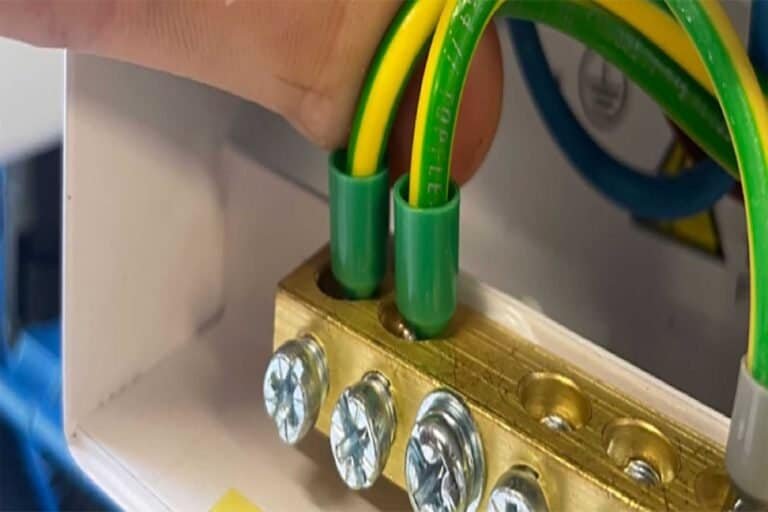
In a campervan, I use the negative busbar that’s part of my 12V system. This is a brass bar with multiple connection points, already bolted to the van floor with good chassis contact.
From this busbar, I run:
- 12V system negative connections
- 230V earth conductor
- All bonding conductors for metalwork
Everything comes back to this one point. This ensures everything is at the same potential (same voltage).
If you don’t have a negative busbar (maybe you’re only installing 230V without a 12V system), you can use a dedicated earth bar. These cost about £12 from electrical wholesalers—just a brass bar with 6-12 screw terminals, mounted on an insulating base.
Critical: The earth bar or busbar must have a good connection to the chassis. This means:
- Choose a mounting location on bare metal (not on painted panels or wooden furniture)
- Sand the metal to bright, clean surface (remove paint, rust, underseal)
- Bolt the busbar down with at least two M8 bolts
- Use star washers under the bolt heads to bite through any remaining contamination
- Test resistance from the busbar to another known chassis point—should be less than 0.1Ω
I mount my busbar on the van floor near the battery, bolted directly to the floor ribs (structural metal, not just body panels). Two M8 bolts with star washers. The resistance from my busbar to the chassis at the front of the van is 0.04Ω. That’s a proper connection.
Step 2: Connect the 230V Earth System
Your 230V system already has an earth conductor (green/yellow wire) running from the shore inlet through the consumer unit to the sockets. This must connect to your main earth point.
From the consumer unit earth bar, run 6mm² green/yellow cable to your main earth point (the busbar). This is your 230V earth connection.
Why 6mm²? The regulations say bonding conductors must be at least as large as the main earthing conductor. Your shore power cable is 2.5mm² with a 1.5mm² earth conductor (in 3-core Arctic flex, the earth is often slightly smaller than live/neutral). The bonding conductor should be bigger, hence 6mm².
I actually use 10mm² for this connection because I had it left over from another job. Bigger is fine—there’s no “too big” for earth conductors, only “too small.”
Testing the connection:
With your multimeter set to resistance (Ω) mode:
- Touch one probe to the earth pin of a socket
- Touch the other probe to bare chassis metal
- Should read less than 1Ω (ideally less than 0.5Ω)
If you read high resistance (more than 5Ω), trace back through the connections. You probably have paint under a bolt somewhere or a loose terminal.
Step 3: Bond the Water Pipes
This is where it gets hands-on. Every piece of metal water pipe needs an electrical connection back to the main earth point.
Method 1: Pipe bonding clamps
These are brass or copper clamps that fit around pipes and have a screw terminal for connecting bonding wire. They cost about £4-6 each from plumbers merchants or electrical wholesalers.
I use 15mm pipe bonding clamps (Just Kampers stocks them, or CEF electrical factors). They fit standard 15mm copper or stainless pipe, which is what most campervan water systems use.
Installation:
- Clean the pipe surface where the clamp will sit (remove any dirt, grease, or oxidation)
- Fit the clamp around the pipe and tighten the screws so it grips firmly (don’t overtighten on stainless pipe—you can deform it)
- Connect 4mm² or 6mm² green/yellow cable from the clamp terminal to your main earth point
- Test resistance from the clamp to earth point—should be less than 0.1Ω
Where to install clamps:
You need bonding clamps at:
- The point where water enters your system (usually at the pump or inlet from tank)
- The point where water exits (taps, shower head)
- Any metal sections that are electrically isolated from each other (e.g., if you have plastic push-fit connectors breaking up metal runs)
My Ducato system has:
- One clamp on the metal pipe exiting the water pump
- One clamp on the cold water pipe near the sink tap
- One clamp on the hot water pipe near the sink tap
- One clamp on the shower pipe
All four clamps have 6mm² green/yellow cable running back to the busbar. Total cable used: about 8 metres. Total clamps: 4 × £5 = £20.
Method 2: Earth tags under pipe fittings
If your water pipes use compression fittings or threaded fittings, you can use ring terminals crimped onto bonding cable and installed under the fitting nut.
This works but has a downside: if you ever need to disconnect the fitting for maintenance, you break the bonding connection. I prefer bonding clamps because they’re independent of the plumbing connections.
Testing water bonding:
Touch multimeter probes to:
- Tap body (metal part) and earth point: less than 0.1Ω
- Tap body and sink (if metal): less than 0.1Ω
- Shower head and earth point: less than 0.1Ω
- Shower tray (if metal) and earth point: less than 0.1Ω
If any of these read high resistance, trace the bonding cables and check connections.
Step 4: Bond the Gas Pipes
This is not optional. Gas regulations (BS EN 1949:2011+A2:2013 – Installation of LPG systems in leisure accommodation vehicles) specifically require bonding of metal gas pipes.
The reason: static electricity can build up on gas pipes through gas flow. If the pipes aren’t bonded to chassis, a potential difference can develop. This could arc (create a spark) at pipe joints or connections. Near flammable gas. You can see why this is a problem.
Gas bonding requirements:
- All metal gas pipes must be bonded
- Bonding conductor must be minimum 4mm² (I use 6mm²)
- Connection must be made at the gas bottle/regulator end and at the appliance end
- Flexible gas hoses (rubber/braided) don’t need bonding (they’re non-conductive) but the metal fittings at each end do
My Ducato gas system bonding:
Gas bottle (metal) → Regulator (metal) → Copper pipe → Hob (metal)
I have bonding clamps at:
- The gas locker (clamp on the metal locker structure, which the bottle sits in)
- The copper pipe near where it enters the van
- The copper pipe just before the hob connection
Each clamp has 6mm² green/yellow cable back to the busbar.
Critical point about gas certification:
The actual gas pipe connections (bottle to regulator, regulator to pipe, pipe to hob) must be done or inspected by a Gas Safe registered engineer. That’s the law.
But the bonding connections (electrical cables connected to the gas pipes) can be done by you. They’re part of the electrical system, not the gas system.
When the Gas Safe engineer does your certification, they’ll check that the gas pipes are properly bonded. If they’re not, you’ll fail the inspection. Do the bonding before you call the engineer.
Step 5: Bond Metal Sinks, Shower Trays, and Other Metalwork
Any metal surface you might touch while also touching something else metal needs bonding.
Metal sinks:
If your sink is stainless steel (like mine), it needs a bonding connection. The sink sits on a wooden worktop, electrically isolated from everything unless you bond it deliberately.
I use a small earth tag (ring terminal crimped onto 6mm² cable) bolted to the underside of the sink bowl. Most stainless steel sinks have a mounting hole or bracket that you can use. If not, drill a small hole (3-4mm) in the sink rim (not the bowl itself—you’ll create a leak point).
M4 or M5 bolt with nut and washers, ring terminal under the bolt head, cable running to the busbar.
Test: Touch multimeter probes to the sink surface and your tap. Should read less than 0.1Ω. If it does, the sink and tap are bonded together through the water pipes and sink bonding cable.
Metal shower trays:
Same principle. If you have a metal shower tray, it needs bonding. Ring terminal bolted to the tray structure, cable to busbar.
Metal furniture or body panels:
This gets into grey area. The regulations say “exposed conductive parts” must be bonded. What counts as “exposed”?
Clearly exposed: Metal sinks, taps, shower trays—things you touch regularly that are large metal surfaces.
Probably should be bonded: Metal furniture frames, metal bed frames, metal storage boxes.
Probably don’t need bonding: Body panels, window frames—these are usually connected to chassis through their mounting points anyway.
I take a pragmatic approach: If it’s large metal, I might touch it while touching something else metal, and it’s not obviously connected to chassis through mounting bolts, I bond it.
My metal bed frame: bonded (ring terminal bolted to frame, cable to busbar).
My stainless steel worktop edges: not bonded (they’re screwed to wooden units that sit on the van floor, so they’re in contact with chassis through the mounting screws, and I tested resistance to verify this).
Window frames: not bonded (they’re bolted to the van body, which is chassis, so they’re inherently bonded).
When in doubt, test with a multimeter. If resistance to chassis is less than 1Ω, it’s probably adequately bonded through its mounting. If resistance is high (more than 5Ω), add a deliberate bonding cable.
Step 6: Bond the 12V Battery Negative (If Using Chassis Return)
Many people connect 12V battery negative to chassis to save weight on return cables. This is fine, but the connection must be proper.
Bad connection: 10mm² cable with ring terminal, bolted to painted chassis with a self-tapping screw. Resistance: 20Ω or more. This creates voltage drop, reduces charging efficiency, and can cause weird electrical gremlins.
Good connection: 25mm² cable with ring terminal, bolted to bare metal chassis with M8 bolt, star washer, and nut. Resistance: less than 0.05Ω. This is a solid connection.
I use two M8 bolts through a chassis cross-member (structural metal that runs across the van width). Sand the metal to bright surface. Bolt through with large washers both sides, star washers under the bolt heads, and nylock nuts. Two ring terminals (one for battery negative, one for the busbar) stack on one bolt.
Test this connection under load. With the battery connected and equipment running (lights, fridge, pump), measure voltage at:
- Battery negative terminal: 0V (by definition)
- Chassis at the connection point: should be 0V (or within 0.02V)
- Chassis at the front of the van (far from connection): should still be within 0.05V
If you’re seeing more than 0.1V difference between different chassis points, you have resistance in the chassis itself (paint, rust, poor joints between body panels). Add bonding straps between sections.
Step 7: Bond the Inverter Earth Connection
If you have an inverter, it has an earth terminal that must connect to chassis. This protects you if there’s a fault on the AC output side.
The inverter earth terminal should have 6mm² or 10mm² green/yellow cable running to your main earth point (the busbar).
Do not rely on the inverter’s metal case touching the van floor or mounting bracket as the earth connection. These are mechanically adequate but electrically poor. You need a deliberate cable.
I made this mistake in van 2. The inverter was bolted to the van floor with rubber vibration mounts. The rubber mounts insulated it electrically. When I tested, the resistance from inverter case to chassis was 50kΩ. Completely useless as an earth.
Added a proper earth cable (10mm² green/yellow from inverter earth terminal to busbar). Resistance dropped to 0.03Ω. Problem solved.
Step 8: Create a Bonding Diagram
This sounds tedious but it’s genuinely useful. Draw a simple diagram showing:
- Main earth point (busbar) location
- Every bonding cable and what it connects to
- Cable sizes
- Test resistances
When you need to troubleshoot a fault in two years’ time, or when you’re selling the van and the buyer asks about bonding, you have documentation.
I use LibreOffice Draw (free software) to create simple diagrams. Draw the van outline, mark the busbar location, draw lines for each bonding cable with labels like “6mm² GY to sink” or “4mm² GY to gas pipe @ hob.”
Print it, laminate it, stick it inside a cupboard door. Future you will thank present you.
Testing Your Bonding: The Actual Numbers
You can’t just assume bonding is adequate because you’ve connected cables. You must test with a multimeter.
Equipment needed:
- Multimeter capable of measuring low resistance (sub-1Ω)
- Long test leads (the probes need to reach from one end of the van to the other)
The cheap £15 multimeters from Screwfix work but they’re not great at measuring very low resistance. If you’re serious about testing, spend £40-60 on a decent meter (Fluke, Uni-T, or similar brands).
Test 1: Bonding continuity
Set multimeter to resistance (Ω) mode with the lowest range (usually 200Ω or 2000Ω range).
Touch probes to pairs of bonded items and record resistance:
- Sink to tap: <0.1Ω target
- Tap to shower head: <0.1Ω
- Sink to gas pipe: <0.1Ω
- Gas pipe to chassis: <0.1Ω
- Any metal item to busbar: <0.1Ω
If you’re reading 0.3Ω or higher, check your connections. Clean the contact points, tighten terminal screws, and re-test.
Test 2: Earth continuity from 230V sockets
This tests that your 230V earth system is properly connected to chassis:
- Touch one probe to earth pin of a 230V socket
- Touch other probe to bare chassis metal (door hinge, seat mount, anywhere that’s definitely chassis)
- Should read less than 1Ω (ideally less than 0.5Ω)
This test confirms that if a fault occurs making a 230V appliance live, current can flow through the earth conductor to chassis and then to the campsite ground via the shore power earth. This is what trips the RCD.
Test 3: Earth fault loop impedance
This is a more advanced test that requires specialist equipment (earth loop testers cost £200+). It measures the total resistance of the fault current path:
Shore power live → Fault → Earth conductor → Chassis → Shore power earth → Campsite transformer
For an RCD to trip in 40 milliseconds, this total loop impedance needs to be low enough that at least 30mA flows when a fault occurs.
In practice, if your bonding continuity tests show less than 0.1Ω between bonded items, and your earth continuity test shows less than 1Ω from sockets to chassis, your loop impedance will be adequate.
If you want to be absolutely certain, have an electrician test it with proper loop testing equipment. My auto-electrician charges £40 for this test as part of a habitation inspection.
What to do if tests fail:
High resistance between bonded items (more than 1Ω):
- Check cable connections are tight
- Check terminals are crimped properly
- Check bonding clamps are gripping the pipes (tighten clamps)
- Check contact points are clean (sand away paint, rust, grease)
High resistance from 230V earth to chassis (more than 2Ω):
- Check the main earthing conductor (6mm² cable from consumer unit to busbar) is properly connected at both ends
- Check the busbar-to-chassis connection is on bare metal with proper bolts
- Check there’s no paint or rust under the busbar mounting bolts
Can’t get resistance below 5Ω no matter what:
- You might have a chassis grounding problem. The chassis itself might have high resistance between panels due to paint, rubber mounts, or poor joints.
- Solution: Add bonding straps between chassis sections (short lengths of 10-16mm² cable with ring terminals, bolting different chassis points together)
The Chassis Return Debate: Should You Use It?
There’s an ongoing debate in the van conversion world: Should you use chassis as the return path for your 12V system (chassis return) or run dedicated negative cables (isolated return)?
Let me explain both approaches and their implications for bonding.
Chassis return:
Battery negative connects to chassis via a thick cable (25mm²). All 12V loads have positive cables from the fuse box, and their negative connections just bolt to the nearest chassis point. Current returns to the battery through the metal chassis.
Advantages:
- Saves weight (no need for long negative cables)
- Saves money (less cable to buy)
- Simplifies wiring (fewer cables to route)
Disadvantages:
- Requires good chassis bonding (resistance between chassis points affects performance)
- Can create ground loops (electrical noise in audio systems)
- Makes fault-finding harder (hard to trace current paths through chassis)
- Voltage drop if chassis has poor conductivity
Isolated return:
Battery negative connects to a busbar. All loads have both positive and negative cables running from fuse box/busbar. No current flows through chassis.
Advantages:
- No reliance on chassis conductivity
- Easy to trace faults (you can see/measure all current paths)
- No ground loops
- Clear, predictable voltage drop (easy to calculate)
Disadvantages:
- More cable required (heavier, more expensive)
- More complex wiring (more cables to route and manage)
My approach:
I use a hybrid. High-current loads (fridge, heater, inverter) have dedicated positive and negative cables. This avoids putting 5-10A through chassis connections.
Low-current loads (lights, water pump, USB sockets) use chassis return. These draw 0.5-2A each, which is fine through chassis.
The battery negative still connects to chassis (for bonding purposes and to establish a common reference point), but most current flows through dedicated cables rather than through the chassis itself.
Bonding implications:
If you use chassis return, your chassis bonding becomes part of your electrical current path, not just a safety system. This means:
- Chassis connections must be very low resistance (less than 0.05Ω)
- You might need multiple chassis bonding points (if panels are isolated from each other by rubber mounts or paint)
- Voltage drop through chassis becomes an issue if connections are poor
If you use isolated return, your chassis bonding is purely for safety. It doesn’t carry operational current (except during faults), so resistance requirements are less strict (though still important for safety).
What About Galvanic Corrosion?
This is a concern people raise: “If you bond dissimilar metals together (steel chassis, copper pipes, stainless sink, brass taps), won’t they corrode from galvanic action?”
Short answer: In theory yes, in practice it’s not usually a problem in campervans.
Long answer:
Galvanic corrosion occurs when two different metals are in electrical contact in the presence of an electrolyte (water, salt spray). The more reactive metal corrodes, protecting the less reactive metal.
Example: Steel and copper bonded together in a marine environment (salt water spray). The steel will corrode preferentially, protecting the copper.
In a campervan:
- There’s no continuous electrolyte (no salt water spray bathing all the bonded connections)
- The current flow through bonding cables is zero (or near-zero) except during faults
- The metals are mostly protected by paint, insulation, or location inside the van
I’ve had bonded systems in vans for 8+ years now (van 2 is still running with the bonding I added in 2019). I haven’t seen any galvanic corrosion issues.
The theoretical risk exists but the practical risk is very low. The safety benefits of bonding far outweigh the minimal corrosion risk.
If you’re paranoid about it:
- Use stainless steel bonding clamps on copper pipes (both are relatively noble metals, less potential difference)
- Keep connections dry (they’re inside the van, so this is usually easy)
- Use heat-shrink or tape over any exposed bonding connections to exclude moisture
But honestly, I wouldn’t worry about it. Just bond everything properly and move on.
The Tools and Parts You Actually Need
Here’s what I bought to properly bond Build #4:
Cable:
- 6mm² green/yellow earth cable: £1.20/metre (bought 15m, used 12m, cost £18)
Connectors:
- Ring terminals for 6mm² cable M8 size: £1.50 for 10-pack
- Bonding clamps 15mm pipe size: £5 each × 6 = £30
Hardware:
- M8 bolts, washers, star washers, nuts: £8 for assorted pack
- M5 bolts (for sink bonding): £3 for pack
Tools already owned:
- Hydraulic crimping tool (£90, but I already had this from electrical work)
- Wire strippers (£12)
- Spanners M8 and M10 (part of general tool set)
- Multimeter (£40 for a decent one)
- Sandpaper/wire brush (for cleaning contact points)
Total additional cost for bonding: £60-70 (assuming you already have basic tools and crimper).
If you need to buy a crimping tool and multimeter, add £130. But these are tools you’ll use for the entire electrical installation, not just bonding.
The parts cost is minimal. The time investment is significant—probably 6-8 hours to bond a van properly including testing. But it’s time well spent.
Common Bonding Mistakes (That I Made or Have Seen)
Mistake 1: Bonding with undersized cable
I’ve seen people use 1.5mm² or 2.5mm² cable for bonding “because it’s only carrying fault current, not continuous current.”
Wrong. The regulations specify minimum 4mm² for bonding conductors. This isn’t arbitrary—it’s based on the current that needs to flow during a fault to ensure protective devices (RCDs, fuses) trip quickly.
Use 4mm² minimum, 6mm² is better, 10mm² for main earth connections.
Mistake 2: Paint under connection points
Bolting bonding cables to painted chassis or painted metal surfaces. The paint is an insulator. Your “connection” has high resistance.
Always sand to bare metal before making bonding connections. Takes 30 seconds with sandpaper or a wire brush. Makes the difference between a 0.05Ω connection and a 20Ω connection.
Mistake 3: Using self-tapping screws for earth connections
Self-tappers work loose with vibration. They create poor electrical contact because the thread cuts through metal and leaves gaps.
Use proper bolts (M6, M8, or M10) with nuts and washers both sides. The bolt goes through the metal, nut tightens on the other side, creates solid compression and electrical contact.
Mistake 4: Assuming the chassis is a good conductor
Modern vans have paint, underseal, rubber isolation mounts, and composite panels. The chassis might not conduct electricity well between different sections.
Test resistance between different chassis points. If it’s more than 0.5Ω, add bonding straps between sections.
Mistake 5: Not bonding the gas system
“It’s only a small camping gaz bottle, do I really need to bond it?”
Yes. The regulations don’t have a minimum gas system size. If you have metal gas pipes, bond them. The risk of static discharge creating a spark near gas is not worth taking.
Mistake 6: Bonding but not testing
You can’t know if bonding is adequate just by looking at it. Connections might look good but have high resistance due to dirt, corrosion, or poor crimps.
Test every bonding connection with a multimeter. Record the results. Re-test after driving 500 miles (connections can loosen with vibration).
When You Might Not Need Bonding
Let’s be realistic. Not every campervan needs elaborate bonding:
You might not need bonding if:
- You have no 230V system (no shore power, no inverter)
- You have no metal water pipes (all plastic push-fit plumbing)
- You have no metal gas pipes (using flexible hose all the way from regulator to hob)
- You have no metal sinks, taps, or shower trays (all plastic/composite)
- Your 12V system uses isolated return (no chassis connections)
In that scenario, there’s no exposed metalwork that could become live during a fault, and no current paths through the chassis. Bonding doesn’t add safety because there’s nothing to bond.
But this describes almost no campervans I’ve seen. Most have at least some metal plumbing or a 230V system, which means bonding is required.
You definitely need bonding if:
- You have shore power capability (consumer unit, sockets)
- You have an inverter (230V output from 12V system)
- You have metal water or gas pipes
- You have metal sinks, taps, or shower equipment
- You use chassis return for 12V system
That describes 90%+ of campervan builds. If that’s you, do the bonding properly.
Final Thoughts: The Invisible Safety System
Bonding is invisible. When it’s done right, nothing happens. Your van works exactly the same whether bonding is adequate or not—right up until the moment there’s a fault, and then bonding is the difference between “the RCD tripped and cut power before I was injured” and “I got electrocuted.”
It’s like the earth stake on a house. You never think about it. It sits there for years doing nothing. And then one day there’s a fault and it saves your life.
I’ve wired four vans. The bonding work in my Ducato took me two full days (including testing and documentation). That’s two days I didn’t spend building furniture or installing solar panels or any of the visible stuff.
But it’s two days I’ll never regret. Because I know if something goes wrong—if a wire chafes through, if the inverter develops a fault, if I drill through a cable (again)—the bonding system will protect me.
Do it properly. Test it thoroughly. Document it clearly. Then forget about it and enjoy your van, knowing the invisible safety system is there if you need it.
Affiliate Disclosure: This article contains affiliate links to Just Kampers and Amazon UK. If you purchase through these links, I earn a small commission at no extra cost to you. I only recommend products I’ve tested across my four van builds or would confidently use in my next build. The bonding clamps, earth cable, and testing equipment mentioned are what I actually use—nobody paid me to recommend them. Your support keeps this site independent and ad-free.