
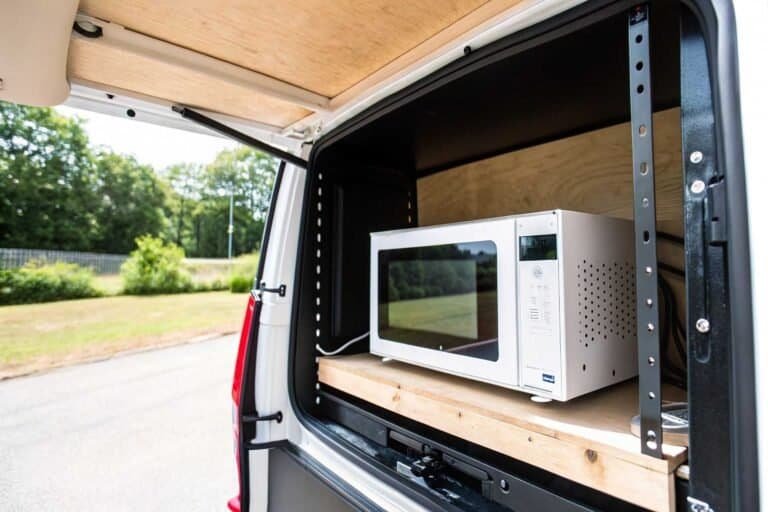
Thinking about putting a microwave in your campervan? It’s one of those additions that can feel like a total game-changer, especially for whipping up quick meals. But—and it’s a big but—it only works if you’ve got the power to back it up.
For most of us travelling in the UK, this boils down to two options: either you’re the type to stick to campsites and use their shore power, or you’re ready to get serious and build a hefty off-grid electrical system. We’re talking a powerful inverter and a big bank of lithium batteries. The convenience is real, but so is the massive power draw.
Is a Campervan Microwave Right for Your Build?
Deciding to install a microwave is a classic battle between pure convenience and sheer complexity.
On one hand, the thought of reheating last night’s chilli in 90 seconds after a long, wet day of driving is incredible. On the other, it’s easily one of the most power-hungry appliances you can possibly add to your van.
So, the real question isn’t just if you should get one. It’s how on earth you plan to power it. Your answer will shape your entire electrical system and, honestly, your whole style of travel.
Microwave Power Options at a Glance
To cut through the noise, here’s a quick look at how you’ll be powering a microwave on the road. Each method suits a different type of vanlifer, so be honest about which one you are.
| Power Method | Best For | Pros | Cons |
|---|---|---|---|
| Campsite Shore Power | Weekend warriors & campsite regulars. | Simple, cheap, no complex electrics needed. | Completely reliant on campsites; no off-grid use. |
| Inverter & Battery Bank | Full-timers & dedicated wild campers. | True off-grid freedom; use it anywhere. | Very expensive, complex installation, heavy. |
| 12V Microwave | Niche users with specific needs. | Runs directly from leisure battery. | Rare, expensive, often underpowered, still drains battery fast. |
Ultimately, for most people, the choice is between relying on campsites or going all-in on an off-grid setup. Let’s dig into what that actually means.
The Two Main Power Scenarios
For UK vanlifers, your choice really comes down to two paths. The first, and by far the simplest, is just relying on campsite shore power. If you know you’ll be staying at established sites with 230V electric hook-ups most of the time, running a standard domestic microwave is dead easy. No complex off-grid gear needed.
The second path is for the off-gridders. This means building a really robust electrical system capable of handling huge electrical loads. To run a typical 700-800W microwave away from a campsite hook-up, you’re going to need:
- A high-capacity leisure battery bank. We’re talking 200Ah or more of lithium (LiFePO4) as a realistic minimum.
- A powerful pure sine wave inverter. Don’t even think about anything less than 1500W.
- A solid way to recharge those batteries, like a big solar array or a battery-to-battery charger for when you’re driving.
The real challenge of an off-grid campervan microwave isn’t the appliance itself. It’s the massive electrical infrastructure you have to build just to support its brief but intense power draw. This is a system-level decision, not just an appliance choice.
Evaluating Your Travel Style
Before you commit, have an honest chat with yourself about how you actually travel.
Are you a weekend warrior who sticks to well-equipped holiday parks? A shore-power setup will serve you perfectly and won’t break the bank. Or are you planning long stints wild camping in the Scottish Highlands, miles from anywhere? If that’s the case, the big investment in a powerful off-grid system might be worth it.
Think about real-world situations. A microwave is a lifesaver on a rainy travel day when you can’t be bothered setting up the gas stove. It’s perfect for making a quick bowl of porridge before a hike. But, if you’re someone who loves cooking fresh meals from scratch and enjoys the ritual of using a gas hob, a microwave might just become an expensive, oversized bread bin that’s sucking your precious power for no good reason.
The goal here is to match the appliance to your actual needs, not just the romantic idea of instant convenience.
Right then, let’s talk microwaves. Putting one in a house is easy. You find one you like, plug it into the wall, job done. Shoving one into a campervan, however, opens up a whole new can of worms. It’s not just about zapping your leftovers; it’s about finding an appliance tough enough for life on the road that won’t murder your van’s precious electrical system.
The very first decision you need to make is about power. Now, you might hear whispers of incredibly rare and eye-wateringly expensive 12V microwaves. Honestly, forget them. For 99% of us in the UK, the choice is a standard 230V domestic microwave. This immediately links your microwave plans to your power setup. You’re either running it off a campsite hook-up or, for off-grid freedom, you’ll need a chunky inverter and a healthy battery bank to back it up.
Power Wattage: Less Is More
When it comes to campervan appliances, our usual home-kitchen logic gets flipped on its head. More power is not better. A higher wattage microwave cooks faster, sure, but it puts a massive strain on your electrical system. That 900W or 1000W beast in your kitchen would be a system-killer in a van.
Instead, you want to be looking for models in the 700W to 800W range. This lower power draw is much kinder to your leisure batteries and inverter. It drastically reduces the risk of tripping your whole system, while still being perfectly capable of heating a meal. A quick but important tip: the power rating on the box is its output (cooking power). The actual input power it consumes will be higher. Always check the appliance’s data plate for the real number.
Honestly, choosing a lower-wattage microwave is one of the smartest moves you can make. It’s the difference between a system that just works and one that’s constantly on the brink of collapse, especially when you’re off-grid and every single amp matters.
As you can see, it’s all about finding that sweet spot between power draw, physical size, and the type of controls that can handle life on the move.
Size, Weight, and Keeping It Cool
Next up are the physical realities. Your van kitchen has a fixed amount of space, so get the tape measure out. This is a non-negotiable step before you even dream of hitting the “buy now” button.
- External Dimensions: Measure the cabinet or shelf where it’s going to live. And I mean meticulously. Don’t just measure for the microwave itself; you have to leave room for ventilation. You’ll need a gap of at least 5-10 cm around the sides, top, and back to stop it from overheating.
- Internal Capacity: For most van conversions, around 20 litres is the sweet spot. That’s big enough for a normal dinner plate but small enough that it doesn’t swallow your entire kitchen.
- Weight: Every single kilogram counts in a van build. Most of these compact microwaves weigh between 10-12 kg. That’s a manageable weight, but it’s something you absolutely must account for in your vehicle’s overall payload calculations.
Dials vs. Digital: Durability on the Road
Finally, you need to think about how the microwave will handle the rattles and bumps of van life. A campervan is a pretty harsh environment, and delicate electronics are often the first things to give up.
This is where simple trumps sophisticated, every single time. Look for a microwave with good, old-fashioned manual dial controls for power and time. They are far more durable than a model with a sensitive digital touchpad and a dozen fancy pre-programmed functions. The mechanical nature of dials means there’s just less to go wrong when you’re bouncing down a bumpy track in the Peak District. Plus, they’re much easier to use with wet or cold hands.
Choosing a campervan microwave is a balancing act. You’re hunting for a low-wattage, compact, and tough little unit that does what you need without overwhelming your power system or gobbling up space. Get these practical things right, and you’ll have a genuinely useful tool rather than a constant source of frustration.
Calculating Your Power Needs for an Off-Grid Microwave
Alright, this is where your dream of instant off-grid porridge meets the cold, hard reality of electrical engineering. You can’t just plug a standard 230V microwave into your 12V system and hope for the best. It takes a serious, well-planned electrical setup to handle the brief but absolutely colossal power demand.
Let’s break down the maths with a real-world example so you can see exactly what you’re getting into. Honestly, understanding these numbers is the single most important step in deciding if a campervan microwave is genuinely feasible for your adventures.
The Shocking Reality of 12V Current Draw
Those numbers on the front of a microwave? They’re deceptive. An “800W” label refers to its cooking power (the output), not how much electricity it actually consumes (the input). Because of inefficiencies, the actual input wattage is always higher—think around 1200W for a typical 800W model.
This is where Ohm’s Law delivers a bit of a wake-up call. To figure out what that 1200W demand looks like to your 12V leisure batteries, we use a simple formula:
Watts / Volts = Amps
For our 1200W microwave, the sum is 1200W / 12V = 100 amps. That is a gigantic amount of current to pull from a leisure battery, even if it’s just for a few minutes. To put that in perspective, a typical 12V campervan fridge might only draw 3-4 amps.
Don’t underestimate this figure. A 100-amp draw will instantly overwhelm a small or poorly specified electrical system. This isn’t a ‘nice-to-have’ calculation; it’s the fundamental reason you need a powerful and often expensive setup to run a microwave off-grid.
Sizing Your Inverter: Continuous vs Peak Power
The inverter is the heart of your off-grid 230V system, taking 12V DC power from your batteries and flipping it into 230V AC for your appliances. For a power-hungry beast like a microwave, you need to look closely at two key ratings.
- Continuous Power: This is the maximum wattage the inverter can supply consistently. It absolutely must be higher than your microwave’s actual input wattage. For a 1200W appliance, a 1500W continuous rating is the bare minimum.
- Peak (or Surge) Power: When they first kick on, microwaves have a massive initial power spike that can be double the continuous draw. Your inverter needs a peak rating high enough to handle this, otherwise it will just shut down to protect itself. A 1500W inverter will often have a 3000W peak rating, which is what you’re looking for.
Choosing an undersized inverter is a classic, costly mistake. If you try to run a 1200W microwave on a 1000W inverter, it simply won’t work. The inverter will trip immediately, leaving you with cold soup and a lot of frustration. A 2000W pure sine wave inverter is an even safer, more robust choice that gives you plenty of headroom.
Why Your Battery Bank is Crucial
That huge 100-amp draw has to come from somewhere, and that somewhere is your leisure battery bank. A standard 100Ah lead-acid battery is completely unsuitable for this job. You can only safely drain a lead-acid battery to about 50% of its capacity, giving you just 50Ah of usable power. Attempting to pull 100 amps from it would cause a massive voltage drop and likely destroy the battery.
This is exactly why Lithium Iron Phosphate (LiFePO4) batteries have become the go-to for any serious off-grid power system. They can handle incredibly high discharge rates and can be safely drained much deeper, often down to 80-90% of their capacity.
So, what size do you actually need? For that 100-amp draw, a 200Ah LiFePO4 battery is a realistic starting point. This ensures the battery’s built-in management system (BMS) can handle the current and that you have enough capacity to run the microwave without completely crippling your power supply for the rest of the day.
To figure out the right battery size for your entire setup, not just the microwave, check out our detailed guide on What size leisure battery do i need.
To pull it all together, here’s a look at the minimum electrical system you’d need to reliably run a standard 800W microwave off-grid. This isn’t about being flashy; it’s about being safe and functional.
Sample Inverter and Battery Sizing for an 800W Microwave
| Component | Minimum Specification | Reasoning |
|---|---|---|
| Microwave | 700-800W (approx. 1200W input) | A manageable power draw that balances performance and electrical strain. |
| Inverter | 1500W-2000W Pure Sine Wave | Safely handles the continuous load and the massive initial startup surge. |
| Battery Bank | 200Ah LiFePO4 | Provides enough usable capacity and can sustain the high 100A current draw without damage. |
| Wiring | Heavy Gauge (e.g., 35mm² or larger) | Absolutely essential to safely carry the high current between the battery and inverter without overheating. |
In short, powering a microwave off-grid isn’t just about buying the appliance itself. It’s about designing and investing in an entire electrical system built specifically to handle its demanding nature.
Getting Your Microwave Installed Safely and Securely
Right, you’ve picked your microwave and figured out the power system. Now for the bit that really matters in a moving vehicle: physically getting it mounted in your van.
This isn’t just about making things look tidy. A loose 10 kg microwave can become a lethal projectile in a sudden stop or a sharp turn. The goal here is to build a housing so solid it feels like part of the van’s structure, not just something you’ve plonked on a shelf.
We need to create a dedicated cabinet or reinforced shelf designed to withstand the constant vibrations and forces of life on the road.
Building a Bombproof Housing
Simply placing your microwave on a shelf and hoping for the best is a genuine recipe for disaster. You need a secure, custom-built enclosure.
Start by framing out a sturdy box from quality plywood—at least 12mm is a good starting point, though I’d go for 15mm if you have it. This housing needs to be screwed firmly into the van’s structural ribs or a solid part of your existing cabinetry. Whatever you do, don’t rely on just a few screws into thin wall panels; they will rip out.
To hold the microwave itself in place, you’ve got a few options, and I recommend using more than one:
- Batten Straps: Once the microwave is in, secure wooden battens across the top, screwing them into the sides of the cabinet. This stops it from jumping upwards on bumpy roads.
- Metal Brackets: Use strong L-brackets inside the cabinet. Screw them into both the cabinet wall and, if possible and safe, the microwave’s casing itself.
- Non-Slip Matting: Line the base of the cabinet with high-friction rubber matting to stop it from sliding about.
The aim is to make the appliance completely immovable in all directions: up, down, forwards, backwards, and sideways. Give it a good shove when you’re done. If it moves, it’s not secure enough.
Ensuring Proper Ventilation
Overheating is a serious fire risk in a tight space like a campervan. Microwaves kick out a lot of heat and need clear airflow to get rid of it safely. Ignoring the manufacturer’s ventilation requirements is not an option.
As a general rule, you must leave a clear air gap of at least 5-10 cm around the back, sides, and top of the unit. You can achieve this by drilling ventilation holes or installing small grilles in the cabinet walls, allowing cool air to be drawn in and hot air to escape. Never, ever block the appliance’s own vents.
Building a secure cabinet is half the battle; ensuring it breathes is the other. Proper ventilation is non-negotiable for preventing overheating and ensuring the longevity and safety of your campervan microwave setup.
Nailing the Electrical Wiring
The wiring for your microwave’s inverter is one of the most critical—and dangerous if done wrong—parts of the installation. We’ve talked about the massive current draw, and using undersized cables here is an absolute fire hazard. They will overheat, melt, and potentially burn your van down.
You must use heavy-gauge cable between your leisure battery and your inverter. For a 1500-2000W inverter, you’re often looking at 35mm² or even 50mm² cable, especially if the run is more than a metre or two. It’s absolutely vital to keep the cable run as short as you possibly can to minimise voltage drop and improve efficiency. Our guide to installing a 12V and 240V campervan system covers this topic in much more detail if you need a deeper dive.
Crucially, you must install appropriate circuit protection. This means putting a correctly sized fuse or circuit breaker on the positive cable, as close to the battery as possible. This device is your system’s lifeline. To make sure you pick the right components, it’s worth spending some time understanding overcurrent protection devices and how they protect your entire electrical system from dangerous short circuits or overloads.
Right then, let’s talk about the easiest way to get a microwave humming away in your campervan. It’s the method that avoids multi-thousand-pound electrical installs and a world of technical headaches.
Forget the off-grid dream for a moment. The simplest, cheapest, and most straightforward route is to lean on the UK’s brilliant campsite infrastructure and use shore power.
This approach completely changes the game. Instead of designing a complex off-grid system powerful enough to handle a microwave, you just use a standard domestic one. All your van needs is a basic 230V electrical system: a consumer unit, a few properly wired sockets, and an external hook-up point to plug into the campsite’s post.
The good news is that the UK is perfectly set up for this. Campsites with electric hook-ups are absolutely everywhere, from the Cornish coast to the Scottish Highlands. For weekend trips, week-long holidays, or even longer tours where you’re moving between sites every few days, this is an incredibly reliable way to travel.
How Shore Power Makes Everything Simple
Connecting to shore power, or a ‘mains hook-up’ as it’s often called, is like plugging your van directly into the national grid. You get a steady, reliable supply of 230V AC power, which is exactly what your household microwave is designed for.
This tactic has some massive advantages:
- No Inverter Needed: You can completely skip the powerful, expensive pure sine wave inverter needed to run a microwave off your batteries.
- No Battery Drain: The microwave pulls its power directly from the campsite, leaving your leisure batteries completely untouched. This means you don’t need a huge, costly lithium battery bank.
- Seriously Cost-Effective: A simple hook-up system costs a fraction of a full off-grid power setup capable of handling a microwave.
- Simplicity and Reliability: It’s a proven, dead-simple system. You plug in your hook-up lead, flip a switch in your van, and you have power. It just works. Every time.
This method lets you enjoy the convenience of quick meals without the hefty financial investment and technical complexity that an off-grid system demands. Honestly, it perfectly suits the way a huge number of UK van owners actually travel.
Shore power is the ultimate shortcut to microwave convenience in a campervan. It leverages the UK’s fantastic campsite network, saving you thousands of pounds and a world of electrical headaches.
The Reality of UK Van Travel
The sheer number of electric hook-ups has a massive influence on how UK campervans are built and used. Many of us find we rarely need to be fully self-sufficient for more than a day or two, which can make a full-blown off-grid microwave setup a completely unnecessary expense.
This practical approach is why most popular compact microwaves for vans are in the 700–800W bracket. They’re powerful enough for proper cooking but don’t overload a standard campsite supply. It’s also why so many UK converters and buyer’s guides focus on having a solid hook-up system rather than a massive battery bank. For more insights on the UK’s robust touring vehicle market, the National Caravan Council provides some great data at thencc.org.uk.
Before you commit to a multi-thousand-pound electrical system, be realistic about your plans. If you see yourself spending most of your nights at sites with amenities, a simple and affordable shore power setup is without a doubt the smartest choice for your campervan microwave.
Weighing the True Cost Against the Alternatives
The convenience of a microwave is tempting, but it’s a luxury that comes at a price far beyond the £70 appliance you stick in the cupboard. The real cost depends entirely on which power route you go down: the simple, budget-friendly shore power setup, or the complex and eye-wateringly expensive off-grid system.
The financial difference between these two paths isn’t a small gap. It’s a chasm.
Let’s put some real numbers on it. A basic shore-power-only installation, with an external hook-up point and a consumer unit, might set you back a couple of hundred quid if you’re handy with the tools. Add the cost of a compact 700W microwave, and you’re all in for a very manageable sum. This is the practical, no-nonsense choice for campsite regulars.
The Off-Grid Investment
The alternative—powering that same microwave from your batteries—is a completely different financial league. This isn’t a small upgrade; it’s a fundamental redesign of your electrical system.
You’ll need a high-capacity lithium battery bank (at least 200Ah), a powerful pure sine wave inverter (think 1,500–2,000W), and probably upgraded solar or a better B2B charger to keep it all topped up. This system can easily add several thousand pounds to your build. That’s a huge investment, especially when you see industry commentary highlighting that buyer priorities in 2025 are leaning towards budget-conscious choices and practical upgrades.
The big question is this: is 90 seconds of convenience worth a multi-thousand-pound electrical system? For a handful of vanlifers, the answer is a definite yes. For most of us, simpler, cheaper, and more versatile cooking alternatives make far more sense.
Practical Low-Power Alternatives
Before you commit to the cost and complexity of a campervan microwave, it’s worth looking at the fantastic ways you can heat food that are much kinder to your budget and batteries. Honestly, these options align perfectly with a more traditional (and, dare I say, rewarding) vanlife cooking experience.
- Omnia Oven: This ingenious stovetop oven sits right on your gas hob and can bake, roast, and reheat almost anything you’d put in a conventional oven. It uses a tiny bit of gas and is a cult classic for a reason.
- 12V Travel Cookers: Gadgets like slow cookers or lunchbox heaters plug directly into a 12V socket. Sure, they take longer, but their power draw is absolutely tiny and easily managed by even a modest solar setup.
- Thermal Cookers: These non-electric “haybox” cookers are brilliant. You bring your food to a boil on the hob, then pop the pot into the insulated container where it continues to cook for hours using zero energy. Perfect for stews and curries.
Ultimately, the decision comes down to your priorities. If your travel style and budget can handle the electrical demands, a microwave offers unmatched speed. For most people, though, the charm and efficiency of these alternatives, combined with some thoughtful van life meal planning, provide all the cooking capability you’ll ever need on the road.
Microwave FAQs: Your Questions Answered
Right, let’s get into the questions I hear all the time. No fluff, just the straight answers you need when you’re trying to figure this all out.
So, Can I Just Bung a Normal Household Microwave in My Van?
Yes, you absolutely can. In fact, it’s what most of us do. But—and this is a big but—you can’t just plug it in and hope for the best unless you’re hooked up to campsite mains.
For this to work off-grid, your van’s electrical system needs to be properly beefy. We’re not talking about a basic weekend setup here. You’ll need a serious battery bank, realistically 200Ah of lithium as a bare minimum, and a high-quality pure sine wave inverter that can handle at least 1500W. Anything less and you’re just going to be tripping your system every time you try to heat up some soup.
What Size Inverter Do I Actually Need for an 800W Microwave?
This is where a lot of people get it wrong. You see “800W” on the microwave and think an 800W or 1000W inverter will do the job. It won’t.
For an 800W microwave, you need a pure sine wave inverter with a continuous rating of at least 1500W. This might seem like massive overkill, but it’s essential. Microwaves have a huge start-up surge—a split-second power demand that can be almost double their running wattage. A smaller inverter will see that surge, panic, and immediately shut down. A 2000W model is an even safer bet, giving you plenty of headroom to handle that initial kick without breaking a sweat.
Don’t just match your inverter to the microwave’s running power. You have to account for the massive initial power surge. A 1500W-2000W unit is the only reliable choice if you want your microwave to actually work off-grid.
Are 12V Microwaves a Better Bet Then?
Honestly? No. While you can find dedicated 12V microwaves, they’re generally not a smart choice for most UK vanlifers.
For a start, they’re incredibly hard to get hold of, cost a fortune compared to a standard 230V model from Argos, and are often disappointingly underpowered.
But the real killer is the current they draw. They might be “12V,” but they pull a monstrous amount of amps—often 60-70 amps—directly from your leisure batteries. That kind of current puts an immense strain on your entire 12V system. For the vast majority of builds, sticking with a standard, affordable 230V microwave powered by an efficient inverter is the more reliable, cost-effective, and sensible way to go.
At The Feral Way, we provide tested, real-world advice to help you build a campervan that truly works for your UK adventures. For more no-nonsense guides on van conversions and life on the road, explore our resources at https://www.theferalway.com.