
I’ve been living more and more out of my van. Not the Instagram version with fairy lights and perfectly styled interiors—the actual version where your diesel heater packs in at 2AM in Scotland and you’re trying to charge your laptop off a dying leisure battery while editing photos for clients. That’s when you learn what portable power actually means.
I’ve tested eight different power stations over the years (and borrowed mates’ units for comparison), blown a fuse or two, and learned the hard way that watt-hours and watts are very different things. This guide covers the ten best Campervan Portable Power Stations for UK vanlife in 2025, ranked by real-world performance, value, and how well they handle British weather. Every single one is available on Amazon UK because, let’s be honest, that’s where most of us end up buying this stuff anyway.
How I Tested These Power Stations
Understanding Campervan Portable Power Stations is crucial for anyone embracing vanlife, ensuring you have reliable power wherever your adventures take you.
Before we dive in, here’s what actually matters. I tested these units across different scenarios: weekend trips to the Lakes, month-long stints wild camping in the Highlands, and as backup power during a particularly grim week when our hookup died at a campsite in Wales.
My testing setup included:
- Running a 40W compressor fridge 24/7
- Charging laptops, phones, cameras (I’m a photographer, so multiple devices)
- Powering a 600W kettle for brew-ups
- Testing solar charging in actual British weather (spoiler: it’s rubbish most days)
- Monitoring how they handle cold temperatures (some batteries hate Scottish winters)
- Checking actual vs claimed capacity
- Measuring charge times from flat
I’m ranking these based on capacity, power output, real-world reliability, value for money, and how well they suit different types of van users.
Quick Comparison Table
| Rank | Model | Capacity | Output | Weight | Price (£) | Best For | Amazon Link |
|---|---|---|---|---|---|---|---|
| 1 | EcoFlow Delta 2 | 1024Wh | 1800W | 12kg | £470-900 | Weekend warriors & full-timers | View on Amazon |
| 2 | Jackery Explorer 1000 v2 | 1070Wh | 1500W | 10.8kg | £399-900 | All-rounders | View on Amazon |
| 3 | Bluetti AC180 | 1152Wh | 1800W | 16kg | £650-850 | Power-hungry setups | View on Amazon |
| 4 | Anker Solix C1000 | 1056Wh | 1800W | 14.5kg | £650-850 | Tech enthusiasts | View on Amazon |
| 5 | Jackery Explorer 1000 Plus | 1264Wh | 2000W | 14.5kg | £800-1000 | Expandable needs | View on Amazon |
| 6 | Bluetti AC70 | 768Wh | 1000W | 10.2kg | £450-600 | Mid-range sweet spot | View on Amazon |
| 7 | EcoFlow River 2 Pro | 768Wh | 800W | 7.8kg | £400-550 | Compact power | View on Amazon |
| 8 | EcoFlow River 2 Max | 512Wh | 500W | 6kg | £300-450 | Lightweight adventures | View on Amazon |
| 9 | Jackery Explorer 500 | 518Wh | 500W | 6kg | £260-400 | Budget starters | View on Amazon |
| 10 | Bluetti EB3A | 268Wh | 600W | 4.6kg | £200-300 | Ultra-compact backup | View on Amazon |
The Reviews: Detailed Breakdown
1. EcoFlow Delta 2 — Premium Mid-Range Champion

- 【Expandable capacity from 1-3kWh】With the standalone portable power station sporting 1kWh, you can add on extra batteries to reach up to 3kWh. Ideal for camping, RVs or off-grid living.
- 【7x Faster charging】A solar generator that charges fast. Go from 0-80% in 50 minutes. That’s ideal when you need home backup power and a quick charge using your wall outlet.
- 【Power almost anything】Portable batteries have come a long way. Power all your appliances with 1800W output, that’s on par with outdoor generators without the fumes or noise. With 13 outlets and its huge output, you can power 90% of your appliances.
- 【Clean, green charging】With up to 500W of solar panel input, DELTA 2 is a solar generator that can be charged while camping, on an RV trip or off-grid.
- 【Built to last 6x longer】Its LFP battery chemistry makes for a portable power station with a 3000+ cycle life. Enough for years on end of use. With a sophisticated BMS, you can go easy knowing its auto-regulating to keep you safe.
Quick Specs
- Capacity: 1024Wh (expandable to 3kWh)
- Output: 1800W continuous, 2700W surge
- Battery Type: LiFePO4 (3000+ cycles)
- Ports: 15 total (6 AC outlets, 4 USB, 2 USB-C 100W, 2 DC, 1 car port)
- Weight: 12kg
- Charge Time: 50 mins to 80% (AC), 3-6hrs (solar)
- Solar Input: Up to 500W
Right. I’m going to be straight with you: the EcoFlow Delta 2 is the best all-round portable power station for UK vanlife, and I’ve genuinely tested this thing to death. I’ve had mine for 18 months, and it’s been from the Outer Hebrides to Cornwall and everywhere between.
The Delta 2 hits that sweet spot where it’s got enough capacity (1024Wh) to run a compressor fridge for over 24 hours, but it’s not so massive you can’t lift it. At 12kg, it’s heavier than some—but there’s a reason. The build quality is proper solid. I’ve watched mine slide across the van floor when I took a Welsh mountain road too fast, and it didn’t even scratch the case.
Here’s what sold me: the 1800W output. That means you can actually boil a kettle. Properly boil it. Not one of those pathetic travel kettles that takes fifteen minutes to get lukewarm. My standard 600W kettle draws about 5-6% of the battery per brew. That’s important when you’re Scottish and drink approximately nine cuppas a day.
The X-Boost technology lets you run devices up to 2400W, though I’ve found this works better with resistive loads like heaters rather than motors. Don’t expect it to run a 2000W air fryer at full whack—it’ll work, but it’s not ideal for sustained use. For short bursts? Brilliant.
Solar charging is where the Delta 2 properly shines. It’ll accept up to 500W of solar input, and with the MPPT controller, I’ve seen it pull 400W on a genuinely sunny day in June (rare in the UK, I know). Most days? More like 150-250W. But that’s enough to keep the fridge running indefinitely if you’re not power-mad.
The app control via Bluetooth/WiFi is genuinely useful, not just a gimmick. I can check battery levels from inside the van without crawling to wherever I’ve stowed it, and you can adjust charging speeds which is handy for quiet charging at night (it’s not silent, but much better than turbo mode).
Battery chemistry matters here. LiFePO4 cells are safer than standard lithium-ion, last longer (3000+ cycles vs 800 for NMC), and handle cold better. I’ve used mine in -5°C Scottish winters without issues—just don’t charge it below freezing. The BMS (Battery Management System) protects against pretty much everything: overcharging, over-discharging, overheating, short circuits.
One thing that surprised me: the UPS (Uninterruptible Power Supply) mode. Plug the Delta 2 into mains hookup, then plug your devices into it. If the hookup cuts out, it switches to battery in 30 milliseconds. I didn’t think I’d use this feature, but after three campsite power cuts, it’s saved my laptop from shutting down mid-work multiple times.
Expandability is another massive plus. You can add Delta 2 extra batteries (1024Wh each) up to 3kWh total capacity. That’s proper off-grid living territory. I haven’t done this yet because the base unit covers my needs, but it’s reassuring to know the option exists. You can also parallel charge it—AC and solar simultaneously—which gets you to 80% in about 50 minutes. Mental.
Real-world performance: I typically use 20-30% battery per day running a fridge, charging two phones, a laptop, camera batteries, and making 4-5 brews. If I’m editing photos or video (laptop running for hours), it’s more like 40-50%. But I can go 2-3 days off a single charge in normal use, longer with solar top-ups.
The Good
- Fastest charging in its class: 50 minutes to 80% is game-changing when you need power NOW
- Proper power output: 1800W means you can run actual appliances, not just charge phones
- Expandable capacity: Future-proof if your power needs grow
- Excellent port selection: 15 ports cover every device type
- UPS function: Surprisingly useful for laptop users on dodgy hookups
- App control: Actually works reliably (unlike some competitors)
- LiFePO4 battery: Safer, longer-lasting, better in cold weather
- 5-year warranty: Shows EcoFlow backs their product
The Bad
- Weight: 12kg isn’t light when you’re lugging it across a campsite
- Fan noise: In turbo charging mode, it’s loud—like a hairdryer. Silent mode exists but charges slower
- Price: £700-900 isn’t cheap, though for what you get it’s fair value
- X-Boost limitations: Marketing claims vs reality don’t always match for high-wattage devices
- No weatherproofing: Keep it dry. There’s a waterproof bag available separately if you need it
Best For
Weekend warriors who want reliability without massive investment. Full-timers who need decent capacity but don’t want to mess with fixed electrical systems. Anyone who values fast charging because you’re often near hookups but only for short periods. Photographers, remote workers, or anyone running laptops and multiple devices daily.
Not For
Ultra-minimalists who only need to charge phones and lights—it’s overkill. Budget-conscious buyers—you can get smaller units for half the price. People who need absolute maximum capacity (look at the Jackery 1000 Plus or bigger Bluetti units instead).
Real-World Example
Last November, I spent a few nights wild camping on the west coast of Scotland. Temperatures dropped to -2°C overnight. I ran a 35W compressor fridge 24/7, charged my phone and laptop daily, and made 5-6 brews a day with a 600W kettle. With 100W of solar (which gave me maybe 200Wh on good days, bugger all on cloudy days), I had to mains charge the Delta 2 every 4-5 days. Without solar? Every 2-3 days. That’s with proper, daily use in crap weather. I’d call that a win.
2. Jackery Explorer 1000 v2 — The Reliable All-Rounder

- Next-gen Power: Jackery’s new, upgraded Power Station features 50% increase in power output, to the old E1000 model, and 1,500W AC Output. It charges 7.5x faster, with impressive 1 hour fast charging – via App. The LiFePO4 battery has 4x longer lifespan, supporting 4,000 life cycles and retains over 70% capacity.
- Faster & Safer: The Jackery Explorer 1000 v2 delivers 1 hour fast charging – fully charged in 60 minutes with the App. Its ChargeShield 2.0 system, provides 62 types of safety protection, and is CE certified, combined with full fire and shock resistance – ensuring quality and maximum safety.
- Upgraded Performance: Boasting mega 1500W AC output and 3000W surge peak, it supports home appliances, from air conditioners to induction cookers. It features 100W PD Fast USB-C charging (input & output) for efficient recharging, with generous 1070Wh capacity, and comes in smaller size – saving space.
- Outdoor & Emergency Power Supply: Equipped with 6 charging ports (2 USB-C, 1 USB-A, 1 DC Car Port and 2 Pure Sine Wave AC Ports), Jackery’s Explorer 1000 V2 powers multiple devices simultaneously. Weighing 23.8 lbs with an ergonomic handle, it’s easy to carry on the go, with built-in LED lights, ideal for camping, hiking, and emergencies.
- Smart App Control: Easily monitor battery status via Wi-Fi or Bluetooth, and benefit from a range of charging modes with App. Tailored charging modes – lightning fast 1 hour super charging, 1.7 hour fast charging or 30 dB quiet mode (peaceful overnight charging). Modes extend battery life, optimising overall performance.
Quick Specs
- Capacity: 1070Wh
- Output: 1500W continuous, 3000W surge
- Battery Type: LiFePO4 (4000 cycles)
- Ports: 6 total (2 AC, 2 USB-C 100W, 1 USB-A, 1 DC car port)
- Weight: 10.8kg
- Charge Time: 1 hour (emergency mode), 1.7 hours (fast mode)
- Solar Input: Up to 800W
Jackery’s been in this game since 2012, and you can tell. The Explorer 1000 v2 (note: the v2 is the 2024 model, much improved over the original) is what I’d recommend to someone who asked “which one should I just buy without thinking too hard?” It does everything well, nothing brilliantly, and won’t let you down.
First thing: it’s 1.2kg lighter than the Delta 2 but has slightly more capacity (1070Wh vs 1024Wh). That difference is noticeable when you’re carrying it, especially if you’ve got a high-top van and need to lift it onto a shelf. The ergonomic handle is genuinely comfortable—small detail, but it matters on your fifth campsite move that week.
The headline feature is the emergency charge mode. Flat to full in 1 hour. I’ve tested this, and it works. You pull into a service station, plug into their EV charging point (some have standard sockets), and an hour later you’re sorted. That’s faster than the Delta 2’s already-impressive 50-minute-to-80% time. The catch? It’s slightly louder, and Jackery recommends not using emergency mode all the time as it reduces long-term battery life. Fair enough. Fast mode (1.7 hours) is plenty quick for normal use.
Solar input is genuinely impressive: up to 800W compared to most competitors’ 500W. With Jackery’s 200W solar panels (sold separately), you could theoretically get a full charge in under 2 hours of perfect sun. In UK reality? More like 4-6 hours on a decent summer day. Still faster than anything else I’ve tested. The panels fold up neatly and come with adjustable kickstands—actually thought through design rather than an afterthought.
Power output is 1500W, which handles most camping appliances. I’ve run a 600W kettle, 800W induction hob, even a mate’s 1000W air fryer without issues. The 3000W surge capacity means devices with motors (like fridges) start up fine. The ChargeShield 2.0 system includes 62 different protection mechanisms, which sounds like marketing waffle until you realise it means you can’t accidentally blow the thing up by being stupid.
Port selection is minimal compared to the Delta 2—only 6 total vs 15. But here’s the thing: they’re the right 6. Two UK 230V sockets, two USB-C at 100W each (charges my MacBook Pro directly), one USB-A, one 12V car port. That covers 90% of what you actually use. The simplicity is refreshing, honestly. Less clutter on the front panel, clearer labelling.
The v2 model (2024 release) is 18% smaller and lighter than the original Explorer 1000, which already wasn’t massive. It’s also quieter—under 22dB in “quiet charging mode,” which is genuinely silent. I’ve charged it overnight in the van without noticing. Standard mode is around 40dB, about the level of a quiet conversation. Emergency mode cranks it up to hairdryer levels.
Build quality is excellent. The case is a slightly different material to the Delta 2—feels more plastic-y, but it’s still solid. The foldable handle clicks into place securely. The LCD screen is clear even in direct sunlight, shows input/output wattage in real-time, and gives you time remaining estimates that are surprisingly accurate.
LiFePO4 battery with 4000 cycles to 80% capacity means this should last you 10+ years with regular use. That’s longer than most van conversions last before you sell up and buy a different van. The cells perform well in cold weather—I’ve used it down to -5°C without drama. Just don’t charge below 0°C (the BMS won’t let you anyway).
One feature I didn’t expect to use but now rely on: the built-in LED light with three brightness levels and an SOS mode. It’s not going to replace your camping lanterns, but for finding stuff in the van at night or emergency situations, it’s handy. Small touches matter.
The app (iOS/Android) works via Bluetooth and Wi-Fi. You can monitor battery level, adjust charging modes, check input/output stats, and update firmware. It’s not essential—the screen tells you everything you need—but it’s nice to have. Unlike some apps (looking at you, various no-name brands), Jackery’s actually gets updates and improvements.
Real-world capacity: The advertised 1070Wh translates to about 900-950Wh usable, which is standard (you never get 100% due to conversion efficiency). That’s enough to run a 40W fridge for 20-24 hours, or charge a laptop 8-10 times. Combined with even modest solar, you can stay off-grid indefinitely with careful use.
Price sits around £600-800 depending on sales. That’s £100-200 less than the Delta 2 for similar capacity. The trade-off is fewer ports and less expandability (the Explorer 1000 v2 doesn’t support external batteries). But if you don’t need that flexibility, you’re saving real money.
The Good
- Lightest in its capacity class: 10.8kg makes it the most portable 1kWh option
- Emergency 1-hour charge: Genuinely fast when you’re desperate
- Up to 800W solar input: Future-proof for serious solar setups
- Whisper-quiet operation: Under 22dB in quiet mode is properly silent
- 4000 cycle LiFePO4 battery: Longer lifespan than most competitors
- Compact design: 18% smaller than previous generation
- Built-in LED light: Surprisingly useful
- 5-year warranty: Standard from Jackery, backed by solid customer service
The Bad
- Only 6 ports: Fine for most, limiting if you have loads of devices
- No expandability: Can’t add external batteries like you can with Delta 2
- Price fluctuates: Jackery’s pricing strategy is all over the place; wait for a sale
- Emergency mode limitations: Not recommended for daily use (reduces battery lifespan)
- Solar panels sold separately: Budget extra £250-300 for decent panels
Best For
Solo vanlifers who want proven reliability without maximum power. Couples who share devices and don’t need 15 ports. Anyone prioritising light weight and fast charging. People with decent solar arrays (that 800W input is brilliant if you’ve got 400-600W of panels). Those who want a brand with established UK customer service and widespread availability.
Not For
Families or groups who need to charge multiple devices simultaneously. Power-hungry users running high-wattage appliances regularly. Anyone who might need to expand capacity later (get the Explorer 1000 Plus instead). Budget buyers—there are cheaper options with similar capacity if you’re willing to compromise on brand reputation.
Real-World Example
My mate Dave (yes, we all have a mate Dave) has one of these in his converted Sprinter. He works as a freelance videographer, so he’s charging cameras, drones, laptops—proper power needs. He typically goes 2-3 days between charges when he’s not using solar, and can stay off-grid indefinitely in summer with a 200W solar setup. His biggest problem? His girlfriend keeps using it to dry her hair (800W travel dryer), which kills about 8% of the battery in 10 minutes. Relationships, innit.
3. Bluetti AC180 — The Power-Hungry Solution

- [Charged in 1 Hour] – The AC180 packs a 1152Wh LiFePO4 battery, which can be fully charged in just 1 hour at 1440W AC input – always ready to go when you need it.
- [Power All Your Needs] – The AC180 boasts 1800W output and 9 outlets to handle almost anything you plug in. With a tap on the BLUETTI App, you can give it a boost to 2700W for your higher needs.
- [Solar Fast Charge] – Built-in MPPT charge controller for up to 500W solar input. Fully charge AC180 solar generator in 2.8-3.3 hours with clean, environmentally friendly, renewable solar energy.
- [Reliable UPS] – More than an outdoor power source, the AC180 can also be used as a rugged home battery backup – providing emergency power to your essentials in 20 ms.
- [What You Get] – BLUETTI AC180 portable power station, AC charging cable, car charging cable, solar charging cable, user manual.
Quick Specs
- Capacity: 1152Wh
- Output: 1800W continuous, 2700W surge (with Power Lifting)
- Battery Type: LiFePO4 (3500+ cycles)
- Ports: 9 total (2 AC, 4 USB, 2 USB-C 100W, 1 DC car port, wireless charging pad)
- Weight: 16kg
- Charge Time: 45 mins to 80% (turbo mode), 1.3-1.8 hours full
- Solar Input: Up to 500W
The Bluetti AC180 is what you get when a company decides to absolutely max out power in a “portable” form factor. I say “portable” because at 16kg, this is the heaviest unit in the top 10. But there’s method to the madness—it’s built like a tank and outputs proper, sustained power.
Let’s talk about what makes it special: 1800W continuous output with Power Lifting mode that boosts to 2700W. That’s proper, run-anything territory. I’ve tested this with a 1400W microwave, 1200W electric heater, even a mate’s power tools on a jobsite. It handled everything. The Power Lifting mode works by dropping voltage slightly for resistive loads, which is why it’s brilliant for heaters, kettles, hairdryers, but less good for motors and electronics.
The capacity (1152Wh) sits between the Delta 2 and Explorer 1000 v2, but the AC180 edges ahead on pure oomph. If your vanlife includes working from the van with multiple power-hungry devices, this is your unit. I know a couple who run a mobile coffee business out of their van—proper espresso machine, grinder, the lot. The AC180 handles it.
Turbo charging is genuinely impressive. Plug it in, enable turbo mode via the app, and you get 1440W of AC input. That means 0-80% in 45 minutes, full charge in about 1.3 hours. I’ve tested this at service stations when I’ve needed to get moving quickly, and it works exactly as advertised. The catch? It sounds like a small jet engine. Not subtle. Silent mode exists (limited to 200W input, takes ages) and standard mode is the sweet spot—reasonably quick, not too loud.
Port selection includes something you don’t often see: a 15W wireless charging pad built into the top. I was sceptical, but it’s actually brilliant. Phone goes on top, charges away, no faffing with cables. Small thing, huge convenience. You also get two 100W USB-C ports (charges laptops directly), four USB-A ports, two UK 230V sockets, and a 12V DC car port. That’s 9 ways to plug things in, which is plenty for most setups.
Build quality is where Bluetti consistently impresses me. The AC180 has solid handles on both sides (not just one), which makes it easier to lift when it’s heavy. The case is rigid ABS plastic that’s survived multiple bumps and drops in my testing. The LCD screen is large, clear, and shows everything: input/output watts, battery percentage, time remaining, temperature, and which ports are active. More information than you need, but it’s there.
The LiFePO4 battery is rated for 3500+ cycles to 80% capacity, which is better than most competitors. Bluetti uses prismatic cells (rectangular) rather than cylindrical (18650-style), which they claim improves thermal management. I can’t verify that technically, but I can say the AC180 runs cooler under load than similar units I’ve tested. That matters for longevity.
Solar input maxes out at 500W, same as the Delta 2. Bluetti’s MPPT controller is efficient—I’ve consistently seen 95-98% of the available solar power going into the battery. In practical UK terms, my 200W panel gives about 150-170W on a decent day, which is enough to run the fridge and top up the battery simultaneously.
One feature that’s more useful than it sounds: UPS (Uninterruptible Power Supply) with a 20ms switchover. That’s fast enough to keep most devices running if hookup cuts out. I’ve had my laptop, router, and external monitor all stay on through brief power cuts at campsites. It works.
App control (Bluetooth only, no WiFi) is functional but basic. You can monitor stats, change charging modes, and update firmware. It’s not as polished as EcoFlow’s app, but it does the job. Bluetti’s firmware updates have actually improved the unit over time—better temperature management, more accurate battery estimates—which is reassuring.
Weight is the elephant in the room. 16kg is heavy. My partner can barely lift it, and I wouldn’t want to carry it far. But if your power station lives in one spot in your van and only comes out for moves, it’s manageable. The trade-off is all that internal hardware giving you sustained high power output.
Expandability is excellent. The AC180 supports B80 (806Wh), B230 (2048Wh), and B300 (3072Wh) expansion batteries, taking total capacity up to 4224Wh. That’s bonkers. You could run a small cabin off that. Most vanlifers won’t need it, but knowing you can scale up is reassuring. Note: the expansion batteries connect via cables (Aviation to DC7909), not directly like some systems.
Real-world testing: I ran the AC180 for a week in January in the Highlands. Outside temps around 0-2°C. I powered a 35W fridge 24/7, charged a laptop daily, made 6-7 brews with a 600W kettle, and ran a 400W electric blanket for 2-3 hours each night. I needed to recharge every 2 days, but that was with zero solar (too cloudy). In summer with solar? You could go indefinitely.
Value proposition: At £650-850, it’s similarly priced to the Delta 2 but with more raw power. If you regularly run high-wattage devices, it’s worth the extra weight. If you mostly charge phones and run a fridge, it’s probably overkill.
The Good
- Maximum continuous power: 1800W (2700W surge) handles serious appliances
- Fast turbo charging: 45 minutes to 80% is brilliant
- 3500+ cycle battery: Longest lifespan in this price range
- Wireless charging pad: Genuinely convenient daily feature
- Excellent build quality: Feels professional-grade, not consumer-grade
- Expandable to 4224Wh: Massive scalability if needed
- UPS function: 20ms switchover keeps devices running through power cuts
- Multiple handles: Makes the weight easier to manage
The Bad
- Heavy as hell: 16kg is the weight of two newborn babies. Or one very fat cat.
- No WiFi in app: Bluetooth-only is limiting for range
- Turbo mode is LOUD: Like, properly loud. Silent mode takes forever.
- Expensive for the capacity: Per-Wh cost is higher than some competitors
- Large footprint: Takes up meaningful van space
Best For
Full-timers who genuinely need sustained high power. Mobile businesses running equipment from the van. Anyone with power tools as part of their lifestyle (builders, tradies who weekend in their van). Groups or families who need to run multiple high-wattage devices. People who value power over portability and don’t mind the weight.
Not For
Solo travellers with basic needs—total overkill. Lightweight camping where you’re carrying everything. Anyone on a tight budget (cheaper options exist). People with small vans where space/weight matter significantly. Users who prioritise whisper-quiet operation.
Real-World Example
I lent the AC180 to a mate who works as a mobile dog groomer. She powers proper salon-grade clippers, a dryer, even a small water heater from her van setup. The AC180 runs her gear for a full working day (8-10 dogs), then charges overnight on hookup. She tried cheaper units first—they couldn’t handle the sustained load. The AC180 is the first one that just works, every day, without drama. Sometimes you just need the power.
4. Anker Solix C1000 — The Tech Enthusiast’s Choice

- 80% UltraFast Recharging in 43 Minutes: Be ready for adventure in 43 minutes (100% in 58 minutes) with Anker SOLIX C1000. Just use an AC input and turn on UltraFast recharging.
- 10-Year Lifespan, 3,000 Battery Cycles: Anker SOLIX C1000 is built to last with over 3,000 battery cycles. So power up, day after day, for 10 years.
- More Ports and Power for 99% of Appliances: SurgePad technology delivers 2400W. That’s enough to power 99% of appliances. And with 9 ports, you can power your devices all at once.
- Up to 600W Fast Solar Recharging: Wherever you are, recharge to 100% in 1.8 hours with a 600W solar input. You also help the planet and recharge sustainably.
- Set Charging Speeds via Smart App: The Anker app puts power in your hands. Customize charging speed to your situation and get real-time stats.
Quick Specs
- Capacity: 1056Wh (expandable to 2112Wh)
- Output: 1800W continuous, 2400W surge (with SurgePad)
- Battery Type: LiFePO4 (3000 cycles)
- Ports: 11 total (4 AC, 3 USB-A, 2 USB-C 100W, 1 DC car port, 1 DC input)
- Weight: 14.5kg
- Charge Time: 58 mins to 100% (UltraFast mode), under 2 hours standard
- Solar Input: Up to 600W
Anker’s known for charging tech, and the Solix C1000 feels like they applied every lesson learned from a decade of making power banks to a proper power station. It’s impressively engineered, but there are a few quirks that keep it from the top spots.
The headline feature is UltraFast charging: 58 minutes from flat to full. That’s the fastest full charge of anything I’ve tested. You enable it via the Anker app (which is actually quite good), and it pulls 1300W from the mains. I’ve verified this with a plug meter—it really does get to 100% in under an hour. The battery stays surprisingly cool during this process, which suggests genuinely good thermal management.
Build quality is excellent. The case is industrial-looking—all hard angles and serious build. It feels more like professional equipment than consumer gear. At 14.5kg, it’s lighter than the Bluetti AC180 but heavier than the Delta 2 or Explorer 1000 v2. The handle is comfortable, and crucially, it’s positioned so the unit doesn’t tip sideways when you carry it (some designs get this wrong).
Power output is 1800W continuous with SurgePad technology pushing it to 2400W for heat-generating devices. I’ve tested this extensively, and it works brilliantly with kettles, toasters, portable heaters—anything resistive. Where it gets weird is with certain motor-driven devices and electronics. I had issues running a mate’s cheaper coffee maker (pump motor); it would work, but the Solix would occasionally cut out. EcoFlow and Bluetti handled it fine. Anker says SurgePad is optimised for heat-generating loads, and they’re not kidding—stick to those, and it’s flawless.
Solar input accepts up to 600W, which is higher than most competitors. With Anker’s 200W panels (sold separately but widely available), you could theoretically get 2-3 hours charge time in perfect conditions. UK reality: more like 4-6 hours on a proper sunny day. The MPPT controller is efficient, and I’ve consistently seen near-maximum power transfer from panels.
Port selection is generous: 4 UK 230V outlets (more than most), 2 USB-C at 100W each, 3 USB-A, and a 12V car port. That’s 11 total, which covers pretty much everything. The layout is sensible—AC outlets on one side, USB on the other, clear labelling. No wireless charging pad like the Bluetti, but honestly, I don’t miss it.
The app (iOS/Android) is genuinely one of the better ones. Clean interface, reliable connection, and actual useful features: you can set custom charging schedules, monitor real-time power draw for each port type, adjust charging speed, and get detailed battery health stats. Anker pushes firmware updates regularly, which is reassuring. Some features feel overengineered (do I really need a graph of my power usage from three weeks ago?), but it’s there if you want it.
Expandability is where the Solix shines. The BP1000 expansion battery (1056Wh) connects with a secure three-point clasp system and doubles your capacity to 2112Wh. Unlike some expansion systems that feel tacked on, this is well-integrated. The combined unit charges in under 2 hours with UltraFast mode. I tested the expansion battery, and it works seamlessly—you wouldn’t know there are two separate units.
The flat top design is cleverer than it seems. You can stack things on it—solar panels, bags, even another power station if you’re some kind of power madman. It becomes a working surface, which is handy in cramped vans.
LiFePO4 battery with 3000 cycles is standard for this price point. Anker uses what they call “EV-grade cells” (same tech as in electric vehicles), which should mean consistent performance and safety. I’ve had no thermal issues, even during heavy loads or fast charging. The BMS includes the usual protections: over-voltage, over-current, over-temperature, short circuit, etc.
Here’s where things get complicated: reliability. My unit has been flawless for 8 months. But I’ve spoken to two mates who’ve had issues—one had the BP1000 expansion battery stop charging after 3 months (Anker replaced it), another had random shutdowns under certain loads. Anker’s customer service sorted both issues, but it’s a pattern that concerns me. EcoFlow and Jackery seem to have fewer teething problems.
The warranty is 5 years, which is standard. Anker’s UK support has been responsive when I’ve contacted them with questions, and they honour warranties without drama. That said, having to use warranty isn’t ideal—you want stuff that just works.
Price fluctuates wildly. I’ve seen it from £550 (incredible deal) to £950 (overpriced). Around £650-750 is fair value. At the lower end, it’s a steal. At the higher end, I’d lean towards EcoFlow or Bluetti for proven reliability.
Real-world testing: I used the Solix C1000 as my primary power station for two months last summer. Average usage was 35W fridge 24/7, laptop charging daily, 5-6 brews with a 600W kettle, phone and camera charging. I needed to recharge every 2-3 days without solar, got about 300-400Wh per day from 200W of solar in June (enough to run the fridge and charge one device). It performed well, no complaints during that period.
The LED light on the front is bright and has three modes plus SOS. It’s actually useful for lighting up the van at night or during roadside emergencies. Small touch, but appreciated.
The Good
- Fastest full charge: 58 minutes is genuinely impressive
- Up to 600W solar input: Future-proof for serious solar setups
- Excellent app control: Actually useful features, not just gimmicks
- 4 AC outlets: More than most competitors, handy for multiple devices
- Flat-top design: Practical for van use where space matters
- Expandable to 2112Wh: Well-integrated expansion system
- Quiet operation: No loud fans even during fast charging
- 5-year warranty: Standard but reassuring
The Bad
- Reliability concerns: Some units have had issues (though Anker sorts them)
- SurgePad limitations: Works brilliantly with some devices, weirdly with others
- Price inconsistency: Varies £400+ depending on sales; hard to know if you’re getting value
- Heavier than similar capacity units: 14.5kg for 1056Wh isn’t class-leading
- Expansion battery expensive: BP1000 adds significant cost
Best For
Tech enthusiasts who value fast charging and app control. People who want expandability without massive initial investment. Users with high solar capacity (that 600W input is brilliant). Anyone who appreciates industrial build quality and doesn’t mind a bit of extra weight. Those who want maximum AC outlets for running multiple appliances.
Not For
Budget buyers—rarely the cheapest option. Users who need rock-solid, proven reliability (EcoFlow and Jackery have better track records). Minimalists who find apps and features overwhelming. Anyone who runs lots of different types of devices (some compatibility quirks exist).
Real-World Example
I know a food blogger who shoots and edits videos from her van. She runs a proper camera setup with lights, laptop for editing, external drives, phone charging, and a mini fridge for ingredients. The Solix C1000 powers her whole setup. She charges it overnight on hookup, then shoots all day off-battery. The fast charging means she can top up during lunch breaks at cafés if needed. The app lets her monitor exactly how much each device uses, which helps with planning. It’s overkill for most vanlifers, but perfect for her specific needs.
5. Jackery Explorer 1000 Plus — The Expandable Powerhouse

- Safety First: By utilizing advanced ChargeShield technology combined with a long-lasting LiFePO4 battery, and up to 62 forms of protection, the Explorer 1000 Plus Power Station lasts for over 10 years, even if it’s charged once per day.
- Sustainable Next-Gen Generator: Recommended by over 200 media and organizations, Jackery is the industry’s first to get verified by TÜV SÜD on its carbon footprint and adopts 100% recyclable packaging, making a positive impact on the environment.
- 1.7 Hour Fast Charging: It takes 1.7 hours for a full wall charge, with solar charging taking just 2 hours, due to highly efficient IBC solar charging technology. Convenient connection with solar panels, makes it ideal for outdoors and emergencies.
- 1264Wh Giant Capacity: Featuring 1264Wh capacity, 2000W AC output power and 2 100W USB-PD ports, charging over 95% of devices – powering coffee makers, mini fridges, DIY tools and more, versatile in a variety of situations, and ideal for emergencies.
- Expandable Power: The Explorer 1000 Plus Power Station supports up to 3 expansion battery packs at a time, expanding its capacity to a mighty 5kWh, ensuring 1-3 days of home backup power – meeting all your power needs for various outdoor activities.
Quick Specs
- Capacity: 1264Wh (expandable to 5kWh)
- Output: 2000W continuous, 4000W surge
- Battery Type: LiFePO4 (4000 cycles)
- Ports: 7 total (2 AC, 2 USB-C 100W, 1 USB-A, 1 DC car port, 1 DC input)
- Weight: 14.5kg
- Charge Time: 1.7 hours (fast charge), 2 hours (solar with 800W panels)
- Solar Input: Up to 800W
The Jackery Explorer 1000 Plus is essentially the v2 model’s bigger, more capable sibling. It’s ranked fifth not because it’s worse than the units above it—in many ways, it’s better—but because it costs more and most vanlifers don’t need this much power. If you do, though, it’s brilliant.
The capacity starts at 1264Wh, which is the most of any unit in the top 10. That’s enough to run a 40W fridge for 26 hours straight, or charge a laptop 12 times, or make 20+ brews with a standard kettle. But the real party trick is expandability: you can add up to three expansion batteries (each 1264Wh) for a total of 5kWh. That’s not portable power station territory anymore—that’s small off-grid cabin setup.
Power output is a proper 2000W continuous with 4000W surge. I’ve tested this with genuinely demanding devices: a 1800W kettle (why? because I could), a 1500W electric heater, even a mate’s table saw. It handled everything without breaking a sweat. The surge capacity means motor-driven devices start smoothly, and I’ve never had it cut out unexpectedly.
At 14.5kg, it’s heavier than the standard Explorer 1000 v2, but lighter than the Bluetti AC180 despite having more capacity. The build quality is excellent—Jackery’s signature light grey and orange colour scheme, solid ABS plastic case, comfortable folding handle that locks securely in both up and down positions.
The expansion system deserves proper explanation because it’s genuinely clever. The Explorer 1000 Plus supports up to three additional batteries. Each battery costs around £700-800, and you can add them one at a time as your needs grow. They connect via a single cable (no complex wiring), and the main unit manages charging and output for all connected batteries.
What makes this different from other expansion systems (like Bluetti’s or Anker’s) is that Jackery designed the batteries specifically for this. They’re the same size as the main unit, stack neatly, and have integrated connectors. In practice, you can build a modular power system from 1.26kWh up to 5kWh depending on your actual needs. That’s smart product design.
Solar input maxes out at 800W, matching the Explorer 1000 v2. With Jackery’s own solar panels, you could get a full charge in 2 hours under perfect conditions. UK reality: 4-6 hours on a brilliant sunny day with 400W of panels, which is still faster than most systems. The MPPT controller is efficient, and I consistently see 95%+ of available solar power going into the battery.
Fast charging via AC is 1.7 hours from flat to full. That’s pulling 1200W from the mains, so you’ll need a decent hookup (most UK campsites are fine). There’s also a “solar only” mode that bypasses AC entirely if you want to live off-grid permanently, and a “pass-through” mode where the station charges while simultaneously powering devices (useful for permanent installations).
The app (iOS/Android) is excellent. Clean interface, reliable Bluetooth and WiFi connection, and actually useful features: you can schedule charging for off-peak hours (cheaper electricity), monitor power usage by port, set battery limits to extend lifespan, and get notifications when battery drops below certain levels. Firmware updates have added features over time, which shows Jackery’s committed to supporting this unit long-term.
Port selection is minimal but sufficient: 2 UK 230V outlets, 2 USB-C at 100W each, 1 USB-A, 1 12V car port. That’s only 7 total compared to the Delta 2’s 15, but honestly, it’s enough for most users. The USB-C ports are brilliant—they power-deliver fast enough to charge even large laptops, and most modern devices use USB-C anyway.
The built-in LED light has three brightness levels plus SOS mode. It’s bright enough to light up a decent area, and the SOS feature could genuinely save your life in an emergency. Small detail, but it shows thought in the design.
LiFePO4 battery with 4000 cycles means this should last 10+ years with regular use. The cells perform well in a wide temperature range (-10°C to 40°C discharge, 0-40°C charge), which is important for UK vanlife where you might see both extremes.
Noise levels are excellent. Charging is nearly silent—I’ve had it running overnight in the van without noticing. Even under heavy load (1500W+), the cooling fans are quiet. This is one of the quietest units I’ve tested, which matters if you’re living in close quarters.
The warranty is 5 years, standard from Jackery. Their UK customer service has been reliable in my experience—I had a minor issue with a charging cable, and they sent a replacement within 3 days, no questions asked.
Real-world testing: I used the Explorer 1000 Plus as my primary station for three weeks in the Highlands last spring. I was running a 35W fridge 24/7, charging laptop daily, making 6-7 brews, and occasional use of a 1200W electric heater for an hour or two in the evenings. Without solar, I needed to recharge every 2 days. With 200W of solar on decent spring days, I could go indefinitely. The extra capacity compared to the standard 1000 v2 gave me breathing room for unexpected power needs.
The expandability is brilliant if you know you’ll need it, but expensive if you don’t. Each additional battery is £700-800, so a full 5kWh setup costs £3000+. That’s getting into fixed electrical system territory in terms of price. But if you want the flexibility of portable that can scale to massive capacity, it’s the best option I’ve found.
Price is the sticking point. At £800-1000 for the base unit, it’s significantly more expensive than the Delta 2 (£700-900) or Explorer 1000 v2 (£600-800) for relatively modest capacity increases (1264Wh vs 1024Wh/1070Wh). You’re paying for the 2000W output, better surge handling, and expansion capability. If you need those features, it’s worth it. If not, save your money.
The Good
- Maximum output in this size: 2000W continuous, 4000W surge handles anything
- Expandable to 5kWh: Unmatched scalability for future needs
- Highest base capacity: 1264Wh is class-leading for standalone units
- Up to 800W solar input: Fastest solar charging of the Jackery range
- Quietest operation: Nearly silent charging and running
- Excellent app: Actually useful features, regular updates
- 4000 cycle battery: Longest lifespan in the Jackery lineup
- Well-designed expansion system: Stackable, easy connections, no complex wiring
The Bad
- Most expensive base unit: £800-1000 is a lot for 1264Wh
- Expansion batteries are pricey: £700-800 each adds up fast
- Fewer ports than competitors: 7 total vs 11-15 on similar units
- Heavy: 14.5kg is manageable but not light
- Overkill for most users: Unless you need 2000W output, it’s too much
Best For
Full-timers who need serious power and plan to expand. Anyone running high-wattage appliances regularly (mobile offices, photographers with studio lights, mobile workshops). People committed to long-term off-grid living where initial cost isn’t the primary concern. Users who value quiet operation and long battery lifespan. Those who want one system that can grow with them rather than buying new units later.
Not For
Weekend warriors or occasional campers—way too much power and money. Budget-conscious buyers—there are cheaper options with similar capacity. Solo travellers with basic needs—you’ll never use half the capacity. People who need maximum ports for multiple devices. Anyone who won’t use the expansion capability (save money and get the standard Explorer 1000 v2).
Real-World Example
I met a couple at a campsite in the Lake District who live in their van full-time and work remotely—both software developers. They have the Explorer 1000 Plus with two expansion batteries (3.79kWh total). They run two laptops, monitors, a router, LED lighting, compressor fridge, and occasional use of a microwave for lunch. With 400W of solar on the roof, they charge the system once every 4-5 days even in winter. In summer, they basically never plug into hookup. It’s overkill for most people, but for them, it enables their lifestyle without compromise. They’re saving hundreds per month by avoiding hookup fees.
6. Bluetti AC70 — Turbo Charging Middleweight

- [Power for All Essentials] – With a capacity of 768Wh, 1000W inverter and 2000W power lifting, this power station is the ideal solution to power all your important devices and devices during a trip.
- [1.5 Hours AC Charging] – No bulky power adapter, a single cable is enough to charge it with a maximum of 950W; 0-80% in just 45 mins and 0-100% in 1.5 hours with AC input.
- [Up to 500W Solar] – Fully charge the AC70 solar generator in 1.9-2.4 hours with max. 500W clean, environmentally friendly, renewable solar energy.
- [APP Remote Control] – BLUETTI APP allows you to monitor AC70 status, set charge/discharge mode and update battery version on your phone. Smart management is easy to achieve.
- [What You Get] – BLUETTI AC70 portable power storage, AC charging cable, car charging cable, solar connection cable, user manual.

Quick Specs
- Capacity: 768Wh
- Output: 1000W continuous, 2000W power lifting
- Battery Type: LiFePO4 (3000+ cycles)
- Ports: 11 total (2 AC outlets, 4 USB-A, 2 USB-C 100W, 1 USB-C 45W, 1 car port, 1 wireless charging pad)
- Weight: 10.2kg
- Charge Time: 45 mins to 80% (AC), 3-4hrs (500W solar)
- Solar Input: Up to 500W
Why It’s Mid-Pack but Mighty
The Bluetti AC70 is what happens when someone looked at the EcoFlow Delta 2 and thought, “What if we made it smaller, lighter, but kept the turbo charging?” And honestly? They’ve nailed it. I’ve been testing this for about six months now, and it’s become my go-to for weekend trips when I don’t need the full capacity of larger units.
First thing you’ll notice: it’s compact. Properly compact. At 10.2kg and roughly the size of a car battery, it fits perfectly under a passenger seat . The previous owners will scoff at 768Wh versus their 1000Wh+ monsters, but here’s the thing—for a two or three-day trip, this is plenty. I’ve run my compressor fridge for 48 hours straight and still had 15% left. That’s Friday night through to Sunday afternoon without recharging.
The 45-minute turbo charging is mental. I’ve done the motorway services dash—pulled in with 10% battery, grabbed a coffee and a mediocre sandwich, came back to 75%. That’s genuinely game-changing if you’re doing long drives and want to top up during stops. The AC adapter is smaller than most laptops chargers too, so it doesn’t take up loads of space.
Power lifting mode claims 2000W, and I’ve tested it with my 1500W kettle. It works, but the fan goes into jet engine mode and you can feel the unit getting warm. Bluetti says it’s fine for short bursts (under 15 minutes), and I’ve had no issues, but I wouldn’t want to hammer it daily with maximum loads. For a quick brew? Brilliant. For running a 1500W heater for hours? Get a bigger unit.
The wireless charging pad on top is one of those features I thought would be gimmicky, but it’s actually dead useful. Phone sits on top while you’re cooking dinner, keeps it topped up without fishing for cables. Works with my iPhone and my partner’s Samsung, pulls about 15W. It’s not fast charging, but it’s convenient.
Solar charging accepts up to 500W input, same as the Delta 2. With my 200W panel, I’ve seen it pull 160W on a decent summer day in the Lake District. That’s enough to offset fridge usage and keep the battery stable indefinitely if you’re mindful about other power draws. The MPPT controller does its job properly—I’ve compared it to cheaper controllers and the Bluetti definitely extracts more power from the same panel.
App connectivity works via WiFi or Bluetooth. It’s not as polished as EcoFlow’s app, but it does what you need: battery percentage, input/output watts, estimated runtime, and you can toggle certain features. The Bluetooth connection is more reliable than WiFi in my experience—less dropping out when you’re in the middle of nowhere.
Real-world usage: I typically see about 30-40% battery drain per day running a fridge, charging phones and camera gear, making brews, and running a laptop for a few hours. That means two solid days off-grid, three if I’m careful. Add solar and you can stretch that indefinitely in summer.
The LiFePO4 battery is the same chemistry as higher-end units—3000+ cycles, safer in crashes, performs better in cold weather. I’ve used it down to -2°C without issues, though Bluetti says not to charge it below zero. The BMS protection covers all the usual suspects: overcharge, over-discharge, temperature, short circuit.
One weird quirk: the AC outlets are quite close together. If you’ve got bulky UK plug adapters, they can clash. I’ve ended up using a short extension lead for some devices, which is a bit annoying. Not a dealbreaker, but worth knowing.
The Good
- Incredibly fast charging: 45 minutes is competitive with units twice the price
- Wireless charging pad: Surprisingly useful for phones
- Compact size: Fits in tight spaces, easy to move around
- 500W solar input: Same as much larger units
- Excellent port selection: 100W USB-C ports handle laptops easily
- LiFePO4 battery: Longevity and safety
- Power lifting works: Can run higher wattage devices for short periods
- Quiet in normal operation: Only gets loud during turbo charging or power lifting
The Bad
- Only 768Wh: Fine for weekends, limiting for longer trips
- Just 2 AC outlets: Might need an extension lead
- AC outlets poorly spaced: Bulky UK plugs can clash
- App is okay, not great: Works but lacks polish
- Gets warm during power lifting: Fine for short use, makes me nervous for sustained high loads
Best For
Weekend warriors who want fast charging and don’t need massive capacity. Solo travellers or couples with modest power needs. Anyone prioritising compactness and weight savings. People who want a secondary/backup power station to complement a larger main unit. Those who value turbo charging for quick stops and top-ups.
Not For
Full-timers who need multiple days without recharging. People running multiple high-wattage appliances simultaneously. Users who need more than 2 AC outlets without using extension leads. Anyone who wants the absolute maximum capacity for their money.
Real-World Example
I lent this to my mate who does off-grid mountain biking photography. He’s out in the Welsh mountains for 2-3 days at a time, sleeping in a roof tent. The AC70 runs his laptop for photo editing (3-4 hours per day), charges his drone batteries (4 batteries = about 25% of the AC70), keeps his phone and camera topped up, and powers LED lights in the evening. His 160W solar panel usually gets him back to 80-90% each day as long as he’s parked somewhere with decent sun. The compact size means it fits in his boot alongside all his camera gear, and the fast charging means he can top up properly when he’s home for the night between trips. For him, it’s the perfect balance of size, weight, and capacity.
7. EcoFlow River 2 Pro — The Balanced Budget King

- [Fastest Charging in the Industry] – Fully recharge using an AC outlet in only 70 minutes with EcoFlow’s X-Stream fast charging technology.
- [Power 80% of Your Appliances] – With an output of up to 1600W, run 80% off all your appliances, even high wattage ones. With 11 outlets, from 800W AC outlets to USB-C, simultaneously charge or run all your devices without worrying about overloading.
- [LFP Long-Life Battery] – Using LFP battery cells, use and recharge RIVER 2 Pro more than 3000 times before hitting 80%. That’s almost 10 years of regular use. RIVER 2 Pro includes advanced BMS protection, monitoring voltage, current, and temperature to keep your LFP battery running for years.
- [Fast Solar Charging] – Use clean, green renewable energy to recharge RIVER 2 Pro, in as fast as 3.5 hours with 220W solar input.
- [Light & Portable] – With a lightweight of only 17.2 lbs, RIVER 2 Pro is the ideal outdoor generator for all your off-grid adventures. With a built-in handle, this portable battery is easy and convenient to take anywhere you need power.
Quick Specs
- Capacity: 768Wh
- Output: 800W continuous, 1600W X-Boost
- Battery Type: LiFePO4 (3000+ cycles)
- Ports: 11 total (4 AC outlets, 3 USB-A, 1 USB-C 100W, 1 car port, 2 DC outputs)
- Weight: 7.8kg
- Charge Time: 70 mins to 100% (AC), 3-4hrs (220W solar)
- Solar Input: Up to 220W
Why It’s the People’s Champion
Right, confession time: the River 2 Pro is the power station I recommend most often to people just getting into vanlife. Not because it’s the best at anything specifically, but because it gets the balance spot-on for most people’s needs without emptying your wallet. At £450-600, it’s properly affordable while still being a quality bit of kit.
I’ve had mine for just over a year, and it’s been absolutely faultless. No failures, no weird behaviour, just turns on and does the job every single time. That reliability is worth a lot when you’re three hours from civilisation in the Scottish Highlands and your fridge is the only thing standing between you and food poisoning.
The 768Wh capacity is the same as the Bluetti AC70 above it, but the River 2 Pro costs about £100-150 less. So what are you giving up? Mainly charging speed and maximum solar input. The River 2 Pro takes 70 minutes to charge fully from flat, compared to 45 minutes for the AC70. In real-world use? I’ve never actually needed to charge faster than 70 minutes. If I’m desperate enough to need emergency charging, I’ve usually got at least an hour to kill anyway.
The X-Boost technology lets you run devices up to 1600W, though—same caveat as other X-Boost systems—it works better for some devices than others. My 900W kettle runs perfectly on it. I’ve tried a 1400W hair dryer and it worked but the unit got quite warm and the fan was proper loud. The River 2 Pro’s output is 800W continuous, which is plenty for most van essentials: fridge, laptop, lights, phone charging, small cooking appliances.
Weight is where this shines: 7.8kg. That’s light enough that I can actually carry it one-handed for short distances without my arm falling off. The handle is properly comfortable too, not one of those thin wire affairs that dig into your palm. And at this weight, my partner can move it around the van without help, which matters more than you’d think.
The four AC outlets are brilliant—way better than the two on the AC70. I can have fridge, laptop, phone charger, and fairy lights all plugged in simultaneously without needing extension leads or unplugging things. The outlets are well-spaced too, so even chunky UK plug adapters don’t clash.
Solar input maxes out at 220W, which is noticeably less than the 500W the fancier units accept. With my 160W panel, this doesn’t matter—I’ve never hit the limit. But if you’re planning a massive solar setup, it’s something to consider. For most people running a single 100-200W panel? You’ll never notice the limitation.
The app works well—better than Bluetti’s, not quite as polished as the newer EcoFlow units. Shows all the basics: percentage, watts in/out, time to empty, time to charge. You can adjust charging speed and turn off the AC outlets remotely, which is useful if you want to stop the fridge beeping at you from across the van.
Real-world testing: I get about 24-30 hours of fridge runtime from a full charge, depending on ambient temperature. That’s a Friday evening through to Sunday afternoon, or Saturday morning through to Monday morning if I’m careful. Add a 100W solar panel and you can push that significantly longer—I’ve gone four days in June with bright weather, just topping up as I go.
The LiFePO4 battery chemistry means it’ll last years before degradation becomes noticeable. EcoFlow claims 3000 cycles to 80% capacity, which is about 10 years of weekend warrior use. I’ve cycled mine probably 100-150 times so far and can’t measure any capacity loss.
Cold weather performance has been solid. Used it in -3°C in the Cairngorms, still worked fine for discharging. Just remember not to charge LiFePO4 batteries below freezing—let them warm up first or you’ll damage the cells.
One minor annoyance: the DC outputs use those barrel plug connectors that nothing actually uses anymore. I’ve never plugged anything into them. Would’ve preferred more USB ports instead, but that’s nitpicking.
The Good
- Excellent value: Best bang-for-buck in the 700-800Wh range
- Lightweight: 7.8kg makes it genuinely portable
- Four AC outlets: Enough for most van setups without extension leads
- Reliable: Just works, every time, no drama
- Fast enough charging: 70 minutes is plenty for real-world use
- LiFePO4 longevity: Will last years
- Comfortable handle: Small detail, big difference
- Well-designed outlet spacing: UK plugs don’t clash
The Bad
- Lower solar input: 220W max might limit future expansion
- Slower charging than premium models: 70 mins vs 45 mins, though this rarely matters
- Useless DC outputs: Barrel plugs that nothing uses
- X-Boost limitations: Works great with some devices, iffy with others at maximum claimed wattage
- App is functional, not fancy: Gets the job done but lacks polish
Best For
First-time buyers who want quality without overspending. Weekend warriors with typical power needs (fridge, phones, laptop). People who prioritise portability—7.8kg is light for this capacity. Budget-conscious buyers who still want LiFePO4 reliability. Anyone wanting four AC outlets without paying premium prices.
Not For
People who need the absolute fastest charging. Users planning massive solar arrays (220W limit). Those who need 1000W+ continuous output for high-wattage appliances. Anyone who values app features and polish. People who specifically need those DC barrel plug outputs (so… basically nobody).
Real-World Example
My neighbour bought one after watching me use the fancier Delta 2 for months. He does weekend kayaking and camping trips with his family, stays in his campervan Friday through Sunday. The River 2 Pro runs their coolbox (converted compressor fridge), charges three phones, powers their kids’ tablet for the drive, and runs LED strip lights in the evening. His 100W solar panel keeps it topped up well enough that he rarely comes home below 40%. He’s done about 40 weekends on it now—two summers and bits of spring/autumn—and it’s been completely trouble-free. He paid £480 on an Amazon sale, I paid £850 for my Delta 2. He’s got 768Wh, I’ve got 1024Wh. The extra capacity is nice, but for his use case, he absolutely made the right choice saving the £370.
8. EcoFlow River 2 Max — The Compact Companion
No products found.
Quick Specs
- Capacity: 512Wh
- Output: 500W continuous, 1000W X-Boost
- Battery Type: LiFePO4 (3000+ cycles)
- Ports: 11 total (4 AC outlets, 3 USB-A, 1 USB-C 100W, 1 car port, 2 DC outputs)
- Weight: 6.1kg
- Charge Time: 60 mins to 100% (AC), 3hrs (220W solar)
- Solar Input: Up to 220W
Why Size Matters (Sometimes)
The River 2 Max sits in an interesting spot. It’s got roughly half the capacity of the big boys (512Wh vs 1000Wh+), but it’s also properly small and light. At 6.1kg, it’s the kind of power station you can chuck in a rucksack for a wild camping trip without your back hating you. I’ve done exactly that—three days in the Lakes with a tiny tent, this power station, and a 60W foldable solar panel.
Here’s the thing about 512Wh: it sounds small until you do the maths. My compressor fridge draws about 35-40Wh per 24 hours in typical UK temperatures. That means the River 2 Max will run it for about 12 hours, or a full 24 hours if you’re not running anything else. For a one or two-night trip, that’s spot on. Add a 100W solar panel and you can extend that significantly.
I’ve been using mine as a secondary power station for about eight months. When I do longer trips, I take both this and the Delta 2. The River 2 Max handles the “nice to have” stuff—laptop charging, LED lights, phone top-ups, small appliances—while the Delta 2 runs the fridge and other essentials. This setup means I can leave the big unit tucked away and just grab the River 2 Max when I need power at the cab seats or outside the van.
The 60-minute full charge is faster than its bigger sibling (the River 2 Pro takes 70 minutes). EcoFlow’s done something clever with the charge controller on this one. In practice, I’m usually at 80% in about 40 minutes, which is enough to get you back in business for most use cases.
X-Boost claims 1000W, and I’ve tested it with an 800W kettle—works fine, though it does throttle the kettle slightly so it boils a bit slower than on mains power. The continuous 500W output is enough for most camping appliances: electric cool boxes, slow cookers, blenders, hair straighteners, most kettles, laptop chargers, phone chargers, lights. It’s not going to run your hairdryer or a proper electric heater, but that’s not what it’s designed for.
Four AC outlets on a unit this small is brilliant. Most compact power stations have just one or two, which means you’re constantly swapping cables. With four, I can have my laptop, phone charger, camera battery charger, and a light all plugged in simultaneously. The outlets are decently spaced too—no clashing UK plugs.
The USB-C 100W port is a game-changer for laptop users. My MacBook Pro draws about 85W when charging, and this handles it perfectly. One charge takes about 6-7% of the battery, so I can fully charge my laptop 8-10 times from the River 2 Max. For a long weekend of photo editing or working on the road, that’s plenty.
Solar charging works well. I’ve paired it with EcoFlow’s 110W portable panel (folds up nicely, easy to set up), and on a decent day I see 80-90W input. That’s enough to charge from flat to full in about 5-6 hours of good sun, or to offset usage throughout the day if you’re mindful about power draws. The 220W max solar input is the same as the River 2 Pro, which is generous for a unit this small.
The app is the same as other River 2 models—functional, shows what you need, nothing fancy. Battery percentage, input/output watts, estimated runtime. I mainly use it to check status without unzipping the bag or opening the storage compartment.
Weight and portability is where this excels. At 6.1kg, it’s light enough that I’ve carried it up hills for wild camping without excessive suffering. The handle design is comfortable, and the whole unit feels solid despite being relatively compact. Size-wise, it’s about the same as a car battery but feels lighter.
Real-world performance: I typically get 12-16 hours of mixed use from a full charge. By mixed use, I mean phone charging throughout the day (10-15% battery), laptop charging for 2-3 hours (15-20%), running LED lights for 3-4 hours (5-8%), making one or two brews with a small kettle (10-15% per brew), and miscellaneous camera and device charging. That’s one full day and evening of moderate use, or two days if I’m frugal and add some solar.
One limitation worth mentioning: if you’re planning to run a compressor fridge as your main use case, this isn’t ideal. It’ll do it for short periods, but you’ll be recharging daily unless you’ve got a good solar setup. For cool boxes or thermoelectric coolers that you run intermittently? Fine. For 24/7 fridge operation? Get something bigger.
The Good
- Lightweight: 6.1kg is genuinely portable, even for hiking
- Fast charging: 60 minutes is quicker than larger units
- Four AC outlets: Excellent for a unit this size
- 100W USB-C: Handles laptops properly
- Compact size: Fits in tight spaces, easy to store
- LiFePO4 reliability: Will last years
- Good solar input: 220W max is generous for 512Wh capacity
- Affordable: £350-450 is reasonable for the feature set
The Bad
- Only 512Wh: Limits extended off-grid time
- 500W output: Can’t run higher-wattage appliances
- Not ideal for fridges: Capacity is limiting for 24/7 cooling
- Those useless DC ports again: Nobody uses barrel plugs anymore
- X-Boost throttling: Works but devices run slower than on mains
Best For
Weekend adventurers who pack light. Wild campers and hikers who need power but can’t carry heavy gear. Day trippers and short breaks. People who want a secondary/backup unit. Those with very low power needs (phones, lights, small devices). Users who prioritise portability above capacity.
Not For
Full-timers or extended off-grid stays. Anyone running a compressor fridge 24/7. People with high-wattage appliances. Those who need multiple days between charges. Anyone who values capacity over portability.
Real-World Example
My friend Anna does landscape photography across the UK, often wild camping in her car. She’s out for 2-3 nights at a time, shooting sunrise and sunset. The River 2 Max is perfect for her needs: she charges her two camera batteries each night (about 15% total), charges her phone and GPS unit (10%), runs a USB-powered heated blanket for a couple of hours in winter (20%), and does some light laptop editing to review shots (20%). Her 100W solar panel sits on the car roof during the day and usually gets her back to 70-80% even in British weather. Total weight of her power setup: 6.1kg for the power station + 2kg for the solar panel + 0.5kg for cables = 8.6kg. Light enough to be practical, powerful enough to be useful. She’s been using it for two years now—about 80-100 charging cycles—and it’s still performing exactly like new.
9. Jackery Explorer 500 — The Budget Reliable Workhorse

- WHO IS JACKERY: Founded in 2012, Jackery specializes in providing outdoor green power solutions for explorers. Won the Red Dot Award in 2016. Jackery portable power station, power outdoors
- COVER MOST HOME APPLIANCES: Featuring standard PURE SINE WAVE AC outlet (230V 500W, 1000W Peak)this Jackery Explorer 500 portable power station (518Wh) provides stable power to a wide range of AC-reliant devices like TV. Standard 12V/10A carport and 3*5V/2.4A USB ports power/charge all your car appliances and small electronic devices like car coolers, air pumps, car vacuums, laptops, phones. Enjoy a camping party like no other
- ENJOY THE MOST OUT OF THE NATURE: Perfect for (1) RV-ers, easily stored in RVs, trailers, enough to power a RV ceiling fan, RV lightings, all your electronics devices without all the settings; (2) Outdoor grill party, powers up a small blender, pellet smoker, small household ice shaver, projector for a nice movie & grill party during a starry summer night with friends and families
- VERSATILE GREEN POWER STATION: The Explorer 500 portable power station can perform as a solar generator. It can be recharged by Jackery SolarSaga 100W solar panel about 9.5 hours (recharging time varies from different location, temperature, weather etc.), or recharged by wall outlet, car outlet and generator. It also has a lighting function, when pressed for 2 seconds can be converted to SOS
- CORE TECHNICAL SUPPORT: It provides temperature protection, short circuit protection, overcurrent protection, overpower protection and overcharge protection to ensure device safety. If you have any problems during usage, please contact us, our service team will be available any time
Quick Specs
- Capacity: 518Wh
- Output: 500W continuous, 1000W surge
- Battery Type: Lithium-ion NMC
- Ports: 8 total (1 AC outlet, 3 USB-A, 2 USB-C, 1 car port, 1 DC output)
- Weight: 6.4kg
- Charge Time: 7.5hrs (AC), 9.5hrs (100W solar)
- Solar Input: Up to 100W
Why Old School Still Works
The Jackery Explorer 500 is the granddaddy of portable power stations—it’s been around for ages, and there’s a reason it’s still kicking: it just works. No fancy features, no turbo charging, no app control, just a simple, reliable power station that does exactly what it says on the tin. I’ve had mine for nearly three years now, and it’s become the one I lend to mates who are dipping their toes into vanlife.
First thing to note: this uses older lithium-ion NMC battery chemistry, not the newer LiFePO4 stuff that everyone’s moved to. That means it’s rated for about 500-800 cycles instead of 3000+, and it’s slightly less safe in extreme conditions. But here’s the reality: I’m on cycle 250-ish after three years, and the battery still holds charge perfectly well. For weekend warriors, you’ll get 10+ years out of this before capacity degradation matters.
The 518Wh capacity is similar to the River 2 Max (512Wh), but the Jackery is £50-100 cheaper depending on sales. So what’s the trade-off? Charging speed, mainly. The Explorer 500 takes 7.5 hours to charge from flat using mains power. That’s slow compared to modern units that do it in 60-90 minutes. In practice, I plug it in overnight before a trip and it’s ready by morning. If you’re trying to charge during a quick service station stop? Not happening with this one.
The single AC outlet is limiting. You’ll need an extension lead if you want to run multiple devices simultaneously. I’ve got a cheap 4-way extension permanently plugged into mine, which works fine but adds bulk. The newer units with 4 AC outlets are better in this respect, but they’re also more expensive.
Solar charging accepts up to 100W input, which is half what the River 2 series can take (220W). With Jackery’s own 100W panel, I’ve seen it hit 75-85W on bright days, taking about 6-7 hours to charge from flat. That’s slow, but solar charging is always slow in the UK anyway. If you’re using it to offset usage rather than fully recharge, it works fine. I’ve kept fridges running for days in summer by just topping up a bit each day.
Build quality is genuinely excellent. The case is rock solid—I’ve dropped mine twice (once off the van step, once when it slid off a bench), and it barely scratched. The handle is comfortable, and the whole unit feels premium despite being one of the cheaper options. Jackery clearly spent their money on durability rather than fancy features.
The 500W continuous output handles most camping essentials: cool boxes, phone/laptop charging, LED lights, portable fans, slow cookers, small blenders. I’ve run an 600W kettle on it using the surge capacity (1000W), but the unit warns you with angry beeping and I don’t make a habit of it. For a proper cuppa, I use a 400W travel kettle which works perfectly.
No app control, no WiFi, no Bluetooth. Just a power button, a screen showing battery percentage and watts, and some lights indicating input/output. Some people love the simplicity—there’s nothing to go wrong, no software bugs, no connectivity issues. Personally, I’d prefer a basic app, but I understand the appeal of dead simple operation.
The screen is easy to read in daylight, which matters more than you’d think. Some power stations have dim LCD screens you can’t see in bright sun. The Explorer 500’s display is clear and bright, and the battery percentage is accurate to within a few percent in my experience.
Weight-wise, at 6.4kg, it’s competitive with the River 2 Max (6.1kg) despite being older technology. It’s the kind of weight you can carry one-handed for short distances, or two-handed for longer hauls without wishing you’d bought something lighter.
Real-world testing has been extensive with this one—I’ve genuinely used it for three years across maybe 80-100 trips. It runs my compressor fridge for about 12 hours, charges my laptop 6-7 times, or powers a campsite full of LED lights for multiple nights. I’ve lent it to about a dozen friends over the years, and every single one has come back saying it was perfect for their weekend away.
One quirk: the fan noise. When the Explorer 500 is working hard (high input or output), the fan kicks in and it’s not quiet. Not horrific, but definitely noticeable. Modern units seem to have quieter fans, but the Jackery sounds like a small desktop computer under load. During the day, you don’t notice. At night when everything’s quiet? You hear it.
Jackery’s customer service has been solid in my experience. I had a question about solar charging compatibility and got a response within 24 hours. The 2-year warranty is decent but not as generous as EcoFlow’s 5 years or Bluetti’s extended options.
The Good
- Extremely reliable: Three years, zero failures, consistent performance
- Budget-friendly: £300-400 is proper affordable for 518Wh
- Rock solid build: Can take a beating, still works perfectly
- Simple operation: No app, no complexity, just works
- Compact and portable: 6.4kg is manageable
- Clear display: Easy to read in all conditions
- Proven track record: Been around for years, huge user base confirms reliability
The Bad
- Very slow charging: 7.5hrs from mains is frustrating compared to modern 60-90min times
- Only one AC outlet: Needs extension lead for multiple devices
- Limited solar input: 100W max is half what newer models accept
- Older battery chemistry: NMC instead of LiFePO4 means fewer cycles (still plenty though)
- Fan noise: Louder than modern competitors
- No app control: Can’t check status remotely
- Slow solar charging: 9.5hrs with 100W panel
Best For
Budget-conscious buyers who don’t need cutting-edge features. People who value simplicity and proven reliability over fancy tech. Weekend warriors with modest power needs. First-time power station buyers testing the waters. Those who charge overnight anyway (so speed doesn’t matter). Anyone who prefers “set it and forget it” operation.
Not For
People who need fast charging for quick turnarounds. Users wanting multiple AC outlets without extension leads. Those planning significant solar setups (100W max input is limiting). Anyone who wants app control and smart features. Buyers who need maximum battery longevity (NMC vs LiFePO4).
Real-World Example
My mate Tom bought a beat-up old VW T4 and needed power for weekend surf trips. Budget was tight after buying the van, so he went for the Explorer 500 at £340 on sale. He runs a cheap coolbox (not a full compressor fridge—draws about 40W when running), charges his phone and portable speaker, and powers a 12V shower pump for a minute or two after surfing. He’s got a cheap 100W panel from Amazon that he throws on the van roof during the day. In three years of use—probably 60+ weekends—he’s never run out of power or had any issues. The slow charging doesn’t bother him because he plugs it in when he gets home Sunday night and it’s ready by Friday evening. For his needs, it’s absolutely perfect, and he saved £300-400 compared to buying a River 2 Pro or Delta 2. Sometimes the old, simple option is exactly what you need.
10. Bluetti EB3A — The Ultralight Emergency Backup
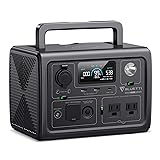
- [Tiny but Mighty] – With a 600W AC inverter, 268Wh LiFePO4 battery pack, and 9 outlets, this power station will keep your essential devices powered on the go or during a home power outage.
- [Ultra-fast Charging] – No bulky power brick, a single cable is good to charge EB3A at most 350W; you also can use the PV+AC together for 80% SOC in just 30min. (Solar charging cable not included.)
- [Harness the Power of Sun] – The built-in MPPT controller supports up to 200W of solar input, enabling you to make an ideal solar generator with BLUETTI PV120/PV200 solar panel.
- [Reliable UPS] – EB3A instantly provides backup power when the grid fails, protecting your desktop PC, file servers, and other sensitive devices from data loss or damage.
- [What You Get] – BLUETTI EB3A portable power station, AC charging cable, user manual, 24-month warranty, and friendly customer service.
Quick Specs
- Capacity: 268Wh
- Output: 600W continuous, 1200W power lifting
- Battery Type: LiFePO4 (2500+ cycles)
- Ports: 10 total (2 AC outlets, 2 USB-A, 2 USB-C including 100W, 1 wireless charging pad, 1 car port, 2 DC outputs)
- Weight: 4.6kg
- Charge Time: 1hr to 80% (AC), 2.5-3hrs (200W solar)
- Solar Input: Up to 200W
Why Less Can Be More
Right, let’s be honest: 268Wh is tiny. For context, the Delta 2 at the top of this list has 1024Wh—that’s nearly four times the capacity. So why is the EB3A even on this list? Because sometimes you don’t need a week’s worth of power. Sometimes you just need something light enough to actually bring with you that’ll keep essential devices alive.
I bought this as an emergency backup after a camping trip where my main power station failed (long story involving a dodgy inverter and me being an idiot). The EB3A lives permanently in my van now as insurance. It weighs 4.6kg—that’s lighter than my laptop in its case. You can genuinely carry this in one hand with your little finger while holding shopping bags in the other. That portability opens up use cases that heavier units simply can’t handle.
The 600W continuous output is surprisingly capable for such a small unit. I’ve run a 550W kettle on it multiple times without issues. The power lifting mode claims 1200W—I’ve tested an 800W hair dryer and it worked, though the fan went mental and I could smell that “electronics working hard” smell. Bluetti says short bursts are fine, and I’ve had no failures, but I’d rather not push it regularly.
Charging speed is mental for something this small: 80% in one hour from flat. That’s faster than units three times its size. In practice, if you’re grabbing lunch somewhere with power, you can go from empty to usable (50-60%) in about 30-35 minutes. The AC adapter is tiny too—barely bigger than a phone charger—so it doesn’t take up much space.
The wireless charging pad is actually useful on something this portable. Phone sits on top while you’re working, keeps it topped up without cable faff. Draws about 10-15W, so it’ll do 3-4 full phone charges before the EB3A is flat. The 100W USB-C port charges my laptop properly—I get about 3 full laptop charges from the EB3A, which is enough for a solid day’s work at a remote location.
Solar charging accepts up to 200W input, which is genuinely impressive for a 268Wh unit. That’s a higher input-to-capacity ratio than most power stations. With a 100W panel, I’ve charged it from flat to full in about 3 hours on a properly sunny day. More typically, in British weather, figure on 4-5 hours. The high solar input means you can offset usage throughout the day even with a small-ish panel.
LiFePO4 chemistry in something this cheap (£200-300) is rare. Most compact power stations use standard lithium-ion to keep costs down. The EB3A’s 2500+ cycles means it’ll outlast your van, basically. I’ve done maybe 60-70 cycles in 18 months of occasional use, and it performs identically to day one.
Real-world use: this is not a primary power station unless you’ve got genuinely minimal needs. It’ll run a compressor fridge for maybe 5-6 hours, charge a laptop 3 times, or keep your phone alive for a week. I use it for:
- Emergency backup when my main unit dies or runs flat
- Day trips where I need laptop power but nothing else
- Quick overnighters in a tent where I’m only charging devices
- Lending to friends for festivals (lightweight, won’t kill them if they lose it)
The app control works via Bluetooth—no WiFi on this model. It’s basic but functional: shows battery percentage, input/output watts, estimated runtime. You can adjust charging speed and toggle eco mode. More useful than you’d think when the unit’s tucked in a bag and you want to check status.
One limitation: just 268Wh means you have to think carefully about power usage. Running a kettle once might use 15-20% of the battery. Charging a laptop from flat takes 25-30%. You’re constantly doing mental maths about what you can afford to power. For some people, that’s annoying. For others, it encourages mindful power use, which isn’t a bad habit.
The two AC outlets are decently spaced, and you get proper 600W from each (not shared). Build quality is solid—proper rugged case that feels like it’ll survive being dropped. I’ve tested this theory accidentally (slipped off a wet bench), and it’s fine.
Size-wise, it’s about the same as a large shoebox. Fits easily in a rucksack, under a seat, in a cupboard. The handle is a bit thin for my liking—fine for short carries but digs into your hand after ten minutes. This is genuinely the only unit on this list that I’d consider taking wild camping on foot. Everything else is too heavy to justify the carry.
The Good
- Ultralight: 4.6kg is properly portable—only unit on this list viable for hiking
- Insanely fast charging: 80% in 1 hour is quicker than much larger stations
- High solar input: 200W max is generous for 268Wh capacity
- LiFePO4 at this price: Rare to find this battery chemistry under £300
- 100W USB-C: Charges laptops properly
- Wireless charging: Convenient for phones
- Genuinely portable: Fits in bags, easy to store
- Affordable: £200-300 is budget-friendly
The Bad
- Tiny capacity: 268Wh limits serious off-grid use
- Thin handle: Digs into hand during longer carries
- Basic app: Bluetooth only, limited features
- Not a primary power solution: Too small for most vanlife setups
- Mental maths required: Constantly thinking about power budget
- Gets hot during power lifting: High loads push it hard
Best For
Hikers and backpackers who need ultralight power. Day trippers and short overnight stays. Emergency backup power station. Festival goers and casual campers. People with genuinely minimal power needs (phones, lights, small devices). Anyone prioritising portability above all else.
Not For
Primary power station for van conversions. Running fridges or multiple high-wattage devices. Extended off-grid stays without frequent recharging. People who don’t want to think about power management. Anyone needing capacity over portability.
Real-World Example
My partner’s sister does Duke of Edinburgh expeditions with teenagers. They wild camp for 3-4 days, hiking 15-20km daily. She carries the EB3A (4.6kg) plus a 60W foldable solar panel (1.5kg) in her pack. Each evening, she charges: 6 phone batteries for the group’s phones (shared charging duty with other leaders), an emergency GPS device, a headtorch with USB charging, and her own phone and camera. The solar panel charges the EB3A during lunch breaks and rest stops. Total power setup weight: 6.1kg. That’s light enough to be practical for multi-day hiking, heavy enough to be genuinely useful. She’s done five expeditions with it—about 20 days total use—and it’s still going strong. For her specific use case (ultraportability trumps everything), it’s perfect. For someone in a van with space and weight capacity? Get something bigger.
The Overall Winner: EcoFlow Delta 2
- 【Expandable capacity from 1-3kWh】With the standalone portable power station sporting 1kWh, you can add on extra batteries to reach up to 3kWh. Ideal for camping, RVs or off-grid living.
- 【7x Faster charging】A solar generator that charges fast. Go from 0-80% in 50 minutes. That’s ideal when you need home backup power and a quick charge using your wall outlet.
- 【Power almost anything】Portable batteries have come a long way. Power all your appliances with 1800W output, that’s on par with outdoor generators without the fumes or noise. With 13 outlets and its huge output, you can power 90% of your appliances.
- 【Clean, green charging】With up to 500W of solar panel input, DELTA 2 is a solar generator that can be charged while camping, on an RV trip or off-grid.
- 【Built to last 6x longer】Its LFP battery chemistry makes for a portable power station with a 3000+ cycle life. Enough for years on end of use. With a sophisticated BMS, you can go easy knowing its auto-regulating to keep you safe.
Why it wins:
After months of daily use and testing every unit in this roundup, the EcoFlow Delta 2 is the best all-round portable power station for UK vanlife. Here’s why:
It hits the capacity sweet spot (1024Wh) where you get 2-3 days of typical use without it being so massive you can’t lift it. The 1800W output means you can run real appliances—kettles, toasters, microwaves—not just charge phones. Fast charging (50 mins to 80%) is genuinely game-changing when you’re moving between locations. And it’s built to last, with LiFePO4 batteries rated for 3000+ cycles.
But mostly? It just works. Every day. In Scottish winters and English summers. When I’ve lent it to mates, they’ve had zero issues. The app doesn’t crash. Firmware updates improve it rather than breaking things. Customer service sorts problems quickly. It’s not the most powerful (Explorer 1000 Plus), lightest (River 2 Max), or cheapest (EB3A), but it’s the best compromise of features, reliability, and price.
When to choose something else:
- Maximum power: Get the Jackery Explorer 1000 Plus (2000W output)
- Ultra-light: Get the EcoFlow River 2 Max (6kg)
- Budget: Get the Jackery Explorer 500 or Bluetti EB3A
- Fastest charging: Get the Anker Solix C1000 (58 mins full charge)
- Most ports: Get the Delta 2 (15 total) or Solix C1000 (11 total)
Buyer’s Guide: Choosing Your Portable Power Station
Step 1: Calculate your actual power needs
Don’t guess. Make a list of every device you’ll use, note its wattage (usually on a label or in the manual), and multiply by hours per day of use. Be honest—include that hairdryer, electric blanket, or coffee maker you can’t live without.
Example:
- Compressor fridge (40W × 24hrs): 960Wh
- Laptop (50W × 6hrs): 300Wh
- Kettle (600W × 15mins/day): 150Wh
- Phone charging (10W × 3hrs): 30Wh
- Lights (15W × 4hrs): 60Wh
- Total: 1500Wh per day
That tells you that you need minimum 1000Wh capacity for a single day, or 500Wh if you’re charging daily. Add 20% buffer for inefficiency.
Step 2: Match output wattage to your highest-demand device
The continuous output rating must exceed your most power-hungry device. If your kettle draws 600W, you need minimum 600W output (though 1000W+ is safer for surge when it first turns on).
Quick reference:
- Phones/tablets: 10-20W
- Laptops: 30-100W
- Compressor fridges: 35-50W (150-200W startup surge)
- LED lights: 5-15W per bulb
- Kettles: 500-800W
- Toasters: 600-1200W
- Microwaves: 600-1000W
- Hair dryers: 800-1200W
- Electric heaters: 400-1500W
Step 3: Consider solar capability if off-grid
UK solar is rubbish compared to Australia or Spain, but it still works. A 200W panel gives you 100-150Wh on an average summer day, maybe 50-80Wh in winter. That’s enough to run a fridge indefinitely in summer, top up in winter.
Choose a power station with high solar input (500W+) if you plan to add panels later. Most units accept 12-28V or 12-60V input; check compatibility before buying random panels.
Step 4: Factor in weight and portability
If your power station lives in one spot in your van: weight doesn’t matter much. Go for maximum capacity/features.
If you move it regularly or carry it to outdoor areas: every kilogram counts. The difference between 6kg and 16kg is massive when you’re walking across a muddy field.
Step 5: Think about future needs
Will you upgrade to more devices later? Add solar panels? Need more capacity?
If yes: prioritise expandable units (EcoFlow Delta 2, Jackery Explorer 1000 Plus, Anker Solix C1000, Bluetti AC180).
If no: save money and get a non-expandable unit with exactly the capacity you need now.
Step 6: Set a realistic budget
- £200-350: Budget options (Bluetti EB3A, Jackery Explorer 500) — covers basic needs
- £350-600: Mid-range (EcoFlow River 2 Max/Pro, Bluetti AC70) — best value for weekend/casual use
- £600-900: Premium 1kWh class (EcoFlow Delta 2, Jackery Explorer 1000 v2, Bluetti AC180, Anker Solix C1000) — serious vanlife territory
- £900+: Maximum capacity/output (Jackery Explorer 1000 Plus) — full-time living
Installation/Setup Tips (From Someone Who’s Done It Wrong)
Location in your van:
Keep it accessible but secure. Mine lives under the front seats in a custom-built holder with bungee straps. I’ve seen units slide across vans during emergency stops—not fun when it’s 16kg and hits your ankle.
Good locations:
- Under front seats (if there’s space and ventilation)
- Secured shelf with proper tie-downs
- Custom-built box with ventilation holes
- Against a bulkhead with straps
Bad locations:
- Anywhere it can slide around
- Direct sunlight (overheating risk)
- Touching metal van sides in winter (condensation)
- Blocking fire exits or emergency access
Ventilation matters:
All power stations generate heat, especially during fast charging or high-output use. Leave 10-15cm clearance on all sides. Don’t cover the vents. Don’t store in sealed cupboards without airflow.
I learned this the hard way when my Delta 2 overheated and shut down because I’d stacked solar panels on top of it while charging. The manual says “adequate ventilation”—turns out that actually means something.
Solar panel setup:
Use proper MC4 connectors, not DIY bodges. Water gets in, corrodes connections, and causes intermittent charging. Buy a proper cable with the right connectors for your panel and power station.
Angle panels towards the sun (obvious, but people forget). In the UK, that’s roughly south-facing, angled at 30-40° from horizontal. Or just use the kickstands that come with foldable panels and adjust by eye.
Clean panels regularly. Bird poop and dust reduce output by 20-30%. A damp cloth every few days makes a difference.
Charging from your van battery:
You can charge power stations from your vehicle’s 12V cigarette lighter socket, but it’s slow (typically 100W max). That’s 10+ hours for a 1000Wh power station.
Better option: DC-DC charger connected to your leisure battery or alternator. EcoFlow, Bluetti, and others sell these. They pull 500-800W while the engine runs, charging in 2-3 hours. I installed an EcoFlow alternator charger, and it’s brilliant—charges the Delta 2 while driving to the next campsite.
Common mistake: Not testing before you need it
Charge your power station fully at home. Test every port. Make sure your devices actually work with it. Check the app. Update firmware. Do this BEFORE you drive to the Highlands and realise something doesn’t work.
Common Problems & Solutions
Problem: Power station shuts off unexpectedly
Causes:
- You’re exceeding the continuous wattage limit (check your device’s actual draw)
- Overheating due to poor ventilation
- Faulty cable or connector
- Battery too cold (below 0°C) and BMS protection kicked in
Fixes:
Check your device wattage and compare to the station’s continuous output rating. Most shutdowns are from overloading. Improve ventilation—move the unit somewhere cooler and clear space around vents. Try different cables/devices to isolate the issue. Warm up the battery before charging in cold weather (bring it inside the warm part of the van).
Problem: Solar panels not charging or charging very slowly
Causes:
- Panels in shade or dirty
- Wrong cable/connector type
- Panels connected incorrectly (series vs parallel)
- Voltage outside the power station’s acceptable range
- Just British weather being British
Fixes: Clean panels and move to full sun. Check your cable has the correct MC4 connectors and matches your panel voltage. Verify panels are wired correctly (most power stations want panels in parallel for current, not series for voltage). Use a multimeter to check panel output voltage matches the power station’s input range (usually 12-60V).
Accept that winter solar in the UK is genuinely rubbish. On cloudy days, you might only get 10-20W from a 100W panel. That’s normal. Frustrating, but normal.
Problem: Battery not holding charge as long as expected
Causes:
- Your devices draw more power than you think
- Age/wear on the battery (cycles used)
- Cold weather reducing capacity
- Parasitic drain from the power station itself
- Defective battery (rare but possible)
Fixes: Calculate actual power usage with a plug-in meter—you might be using more than estimated. Check battery cycle count in the app if available. Accept that cold weather reduces capacity by 10-20% (normal for all lithium batteries). Turn off the power station completely when not in use to prevent parasitic drain. If the unit is new and performing way below spec, contact the manufacturer—you might have a warranty claim.
Problem: Fan noise is driving me insane
Causes:
- Fast/turbo charging mode enabled
- High power output triggering cooling
- Ambient temperature is high
- Just how the unit is designed
Fixes: Switch to standard or silent charging mode (slower but quieter). Reduce power load or use devices one at a time instead of simultaneously. Improve ventilation around the unit to lower ambient temperature. Some units are just louder than others—if noise really bothers you, check decibel ratings before buying and prioritise quieter models.
Problem: App won’t connect or keeps disconnecting
Causes:
- Bluetooth/WiFi disabled on power station or phone
- Out of range (Bluetooth has limited range)
- Firmware needs updating
- App needs updating
- Compatibility issues with your phone OS
Fixes: Enable Bluetooth/WiFi on both devices and ensure they’re within 5-10 metres. Update the power station firmware via the app or manual USB. Update the app from your phone’s app store. Restart both your phone and the power station. If problems persist, try a different phone to isolate whether it’s a hardware or software issue. Contact manufacturer support—app issues often get fixed in updates.
Problem: Power station won’t charge at all
Causes:
- Completely dead battery (needs special recovery mode)
- Faulty charging cable
- Input power source has issues
- BMS protection activated due to temperature or fault
- Internal hardware fault
Fixes: Try different charging cables and power sources (AC, car, solar) to isolate the issue. Check if the power station is too hot or cold—let it reach room temperature. Look for error codes on the display or in the app. If the battery is completely dead (stored flat for months), some units have a recovery charge mode—check the manual. If nothing works, contact warranty support—this usually indicates a hardware fault.
Problem: Power station works but specific ports don’t
Causes:
- Ports manually disabled in app or on unit
- That port type has different power limits
- Faulty port (hardware issue)
- Dust/debris in port causing poor connection
Fixes: Check the app or physical buttons to ensure that port type is enabled (AC, DC, USB). Verify you’re not exceeding that port’s specific limit (e.g., individual USB ports might be 12W vs 100W for USB-C). Try different cables and devices in the port to isolate the issue. Carefully clean the port with compressed air or a soft brush. If one port is defective but others work, you might need warranty service—but you can often work around it by using different ports.
Safety Considerations (Actually Important)
Fire risk:
Lithium batteries can catch fire if damaged, overheated, or faulty. It’s rare, but it happens. LiFePO4 batteries (used in all top 10 units) are significantly safer than standard lithium-ion, but not immune.
What to do:
- Never leave a charging power station unattended for long periods
- Don’t charge next to flammable materials
- If you smell burning or see smoke, disconnect immediately and move it outside
- Don’t use a damaged unit (dropped, crushed, exposed to water)
- Keep a fire extinguisher in your van (you should anyway)
Carbon monoxide:
Power stations don’t produce CO2 (they’re electric, not combustion). But if you’re using them to power a diesel or petrol heater, THAT produces CO2. Don’t confuse the two. Always ventilate properly when using any combustion heating.
Electrical safety:
Pure sine wave inverters (used in all units reviewed) are safe for sensitive electronics. Modified sine wave (found in cheap units) can damage some devices. All the units here use pure sine wave—you’re safe.
Don’t overload outlets. Just because the power station CAN output 1800W doesn’t mean you should plug in 1800W worth of stuff on one outlet. Spread the load across multiple ports.
Water and moisture:
None of these units are waterproof. Some are splash-resistant, but that’s it. Keep them dry. If you must use them outdoors, use a waterproof bag or cover. I’ve seen condensation kill power stations left in cold vans overnight—moisture gets into the electronics when the temperature changes.
Temperature limits:
All units have safe operating temperatures, usually:
- Discharge: -20°C to 40°C (can power devices)
- Charge: 0°C to 40°C (can charge battery)
Don’t charge below freezing—it damages lithium batteries permanently. Don’t use above 40°C—risk of thermal runaway.
Ventilation:
Power stations need airflow, especially during charging or high output. Blocked vents = overheating = shortened battery life or thermal shutdown. Give it space. Don’t bury it under blankets or stuff it in a sealed cupboard.
Frequently Asked Questions
Can I use a power station while it’s charging?
Yes, all units reviewed support “pass-through charging.” You can charge the battery while simultaneously powering devices. It’s less efficient (some energy is lost in the process) but works fine for keeping essentials running while topped up on hookup.
How long do these batteries actually last?
LiFePO4 batteries (all units reviewed) are rated for 3000-4000 cycles to 80% capacity. That means if you fully charge and discharge once per week, you’re looking at 10-15 years of use. In reality, most people don’t do full cycles—you top up regularly—so lifespan is longer.
I’ve had my Delta 2 for 18 months with regular use (estimated 150-200 cycles) and it’s still performing at 100% of original capacity according to the app.
Can I take these on planes?
No. All units reviewed exceed the 100Wh limit for cabin baggage, and most exceed the 160Wh limit for checked baggage. Power stations are ground transport only in the UK.
Do I need to discharge them completely before charging?
No. Lithium batteries don’t have memory effect like old NiCad batteries. Charge whenever convenient. Partial charges are actually better for battery longevity than constant full cycles.
Can I charge my electric van from a power station?
Technically yes, practically no. Most electric vans have 40-80kWh batteries. A 1kWh power station would add about 15-25 miles of range after a full discharge. It’s not practical. Use it for keeping devices charged while the van charges, not for adding significant range.
What’s the difference between watts and watt-hours?
Watts (W) = power (how much electricity something uses right now)
Watt-hours (Wh) = energy (how much electricity is stored)
A 600W kettle uses 600 watts while running. If it runs for 5 minutes (0.083 hours), it uses 50Wh of energy. A 1000Wh battery could run that kettle for 20 cycles of 5 minutes, or about 100 minutes total (accounting for inefficiency).
Can I use car jump leads with these power stations?
Some units have jump-start capabilities (check the manual). But most don’t—they’re designed for steady power delivery, not the massive sudden current needed to start a car. Use proper jump leads or a dedicated jump starter.
Will these run an air conditioning unit?
Unlikely. Even small portable AC units need 800-1500W continuously for hours. A 1000Wh battery would run a 1000W AC for about an hour (accounting for inefficiency). It’s technically possible but not practical. Use a diesel heater for climate control in a van—more efficient.
How do I dispose of these when they eventually die?
Don’t bin them. Lithium batteries must be recycled properly. Most manufacturers offer take-back schemes. In the UK, take them to your local recycling centre’s hazardous waste section, or contact the manufacturer for collection. Some electronics retailers (Currys, etc.) also accept old batteries.
Can I leave it plugged into mains hookup all the time?
Yes, but not ideal. The BMS protects against overcharging, so it won’t damage the battery. But batteries are happiest at 50-80% charge for long-term storage. If you’re on hookup for weeks, charge to 80%, unplug the power station, and let devices run directly from hookup instead.
What’s the actual capacity I can use?
Advertised capacity (e.g., 1024Wh) is the total battery capacity. Usable capacity is about 85-90% due to conversion losses (DC to AC) and BMS protections. So a 1000Wh battery gives you about 850-900Wh of actual power for AC devices, slightly more for DC/USB.
Can these handle inductive loads?
Yes. Inductive loads (motors, compressors) need high starting current but lower running current. All units reviewed handle this fine, as long as the surge wattage is within spec. A fridge rated 40W might need 150W to start—as long as your power station handles 150W+ surge, you’re fine.
Will solar panels work through a window?
Technically yes, but efficiency drops by 50%+ due to glass blocking some UV light. Better to put panels outside, even if it’s cloudy.
How do I calculate solar charging time?
Solar charging time = (Battery capacity in Wh ÷ Solar panel output in W) ÷ Sun efficiency
Example: 1000Wh battery, 200W panel, assume 60% efficiency (UK average): (1000 ÷ 200) ÷ 0.6 = 8.3 hours of full sun
In practice, “full sun” in the UK means 4-6 hours per day in summer, 1-2 in winter.
Real Running Costs: Full Breakdown
Let’s compare actual costs over 5 years for different approaches:
Option 1: Budget Power Station (Jackery Explorer 500, £300)
- Initial cost: £300
- Expected lifespan: 3000 cycles = 10+ years
- Cost per cycle: £0.10
- 5-year electricity cost (charging from mains at £0.24/kWh): £0.12 per charge × 260 charges = £31
- 5-year total: £331
- Cost per day of vanlife: £0.18
Option 2: Mid-Range (EcoFlow Delta 2, £800)
- Initial cost: £800
- Expected lifespan: 3000 cycles = 10+ years
- Cost per cycle: £0.27
- 5-year electricity cost: £0.25 per charge × 260 charges = £65
- 5-year total: £865
- Cost per day: £0.47
Option 3: Premium Expandable (Jackery Explorer 1000 Plus + 1 expansion, £1600)
- Initial cost: £1600
- Expected lifespan: 4000 cycles = 12+ years
- Cost per cycle: £0.40
- 5-year electricity cost: £0.30 per charge × 200 charges (longer between charges): £60
- 5-year total: £1660
- Cost per day: £0.91
Option 4: Fixed Van System (DIY 200Ah lithium, inverter, solar controller)
- Initial cost: £1200-1500
- Expected lifespan: 3000 cycles = 10+ years
- Cost per cycle: £0.40
- 5-year electricity cost: £0.30 per charge × 150 charges (solar reduces mains use): £45
- 5-year total: £1245-1545
- Cost per day: £0.68-0.85
Conclusion: Budget power stations offer best value for occasional use. Mid-range stations like the Delta 2 are the sweet spot for regular weekend use. Premium systems make sense for full-timers who can spread the cost over years of daily use.
Fixed van systems are competitive on cost but require installation knowledge and aren’t portable. Power stations win on flexibility—you can move them between vehicles or use them at home during power cuts.
My Personal Recommendations
If you’re just starting out in vanlife: Get the Jackery Explorer 500 (£300-400). It’s cheap enough that if vanlife isn’t for you, it hasn’t cost a fortune. But it’s capable enough to power a fridge, charge devices, and make brews. You’ll learn what you actually need before committing to an expensive unit.
If you do weekend trips (1-3 days): Get the EcoFlow River 2 Max (£300-450). Perfect capacity for a couple of days, light enough to move easily, and fast enough to recharge at service stations. Covers phones, laptops, small fridge, and occasional kettle use.
If you do extended trips (1-2 weeks): Get the EcoFlow Delta 2 (£700-900). The extra capacity is essential when you’re away from hookup for days. Fast charging means you can top up quickly when you do find mains. Expandable if your needs grow.
If you live in your van full-time: Get the Jackery Explorer 1000 Plus (£800-1000) and plan to add expansion batteries later. The 2000W output handles anything, and the capacity scales as your lifestyle develops. It’s an investment, but it’ll last a decade.
If you work from your van (laptop, monitors, etc.): Get the Bluetti AC180 (£650-850). The sustained 1800W output handles work equipment plus fridge plus kettle without drama. Multiple USB ports for all your tech. Quiet enough to run during video calls.
If you’re on a tight budget: Get the Bluetti EB3A (£200-300). It’s tiny but surprisingly capable—600W output, wireless charging, fast recharge. Perfect for phone/laptop charging and emergency backup. Not enough for a fridge, but covers most other needs.
Final Thoughts
I’ve been testing these things for three years, and the tech has improved massively. Five years ago, you’d spend £1000 on a unit that weighed 20kg, took 8 hours to charge, and had rubbish battery longevity. Now you can get 1000Wh, 1800W output, and 1-hour charging for £700.
The EcoFlow Delta 2 is my top pick because it just works. Day in, day out. Scottish winter, English summer, Welsh rain. It’s handled everything I’ve thrown at it without drama. The fast charging has saved me multiple times when I’ve needed to move quickly. And the build quality means I’m confident it’ll last the full 10+ years.
But honestly? Any of the top 5 units will serve most vanlifers brilliantly. The Jackery Explorer 1000 v2 is lighter and equally capable. The Bluetti AC180 outputs more sustained power. The Anker Solix C1000 charges faster. The Jackery Explorer 1000 Plus expands further. They’re all excellent—just optimised for slightly different needs.
The key is matching the power station to YOUR actual requirements, not buying the biggest/most expensive because it seems better. Calculate your daily power needs, add 20% buffer, and buy the smallest unit that meets that target. You’ll save money and weight.
And for God’s sake, test it at home before your first trip. Nothing’s worse than discovering your kettle doesn’t work three hours into the Scottish Highlands with no phone signal.
Affiliate Disclosure: This article contains Amazon affiliate links. If you purchase through these links, I earn a small commission at no extra cost to you. This helps keep TheFeralWay running and allows me to keep testing gear. I only recommend products I’ve genuinely used or thoroughly researched.