
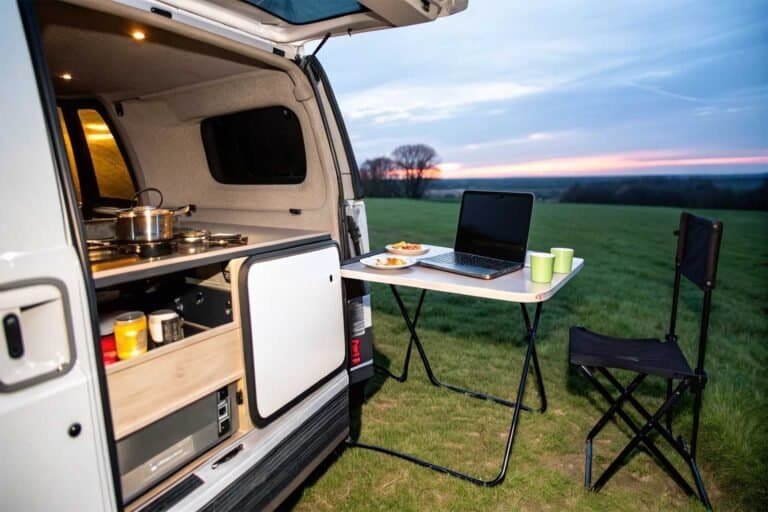
A portable camping table seems like such a minor bit of kit. An afterthought, even. But trust me, after years on the road, I can tell you it’s one of the most foundational pieces of gear for a comfortable, organised vanlife. It’s the simple upgrade that turns a patch of grass into a proper kitchen, a cramped passenger seat into a mobile office, or a lonely car park into a social hub for sharing a meal under the stars.
The Underrated Hero of Vanlife Gear
Picture this: you’re trying to balance a spitting-hot stove on your van floor, or worse, type an important email with your laptop perched precariously on your knees. It’s awkward, inefficient, and exactly the kind of chaos a good portable camping table is designed to eliminate. For us vanlifers, this single piece of equipment solves a thousand real-world problems you don’t even know you’ll have yet.
This guide isn’t just a list of Amazon links. It’s a proper, UK-focused breakdown of what actually works in the real world of British vanlife, where space is tight and every bit of gear has to earn its place.
Why a Decent Table is Non-Negotiable
For newcomers to vanlife, underestimating the need for a stable, flat surface is one of the most common vanlife beginner mistakes. It’s the difference between a frantic, messy setup and a calm, functional home on wheels.
A dedicated table gives you:
- A Proper Kitchen: A safe, stable spot to chop veg, prep food, and put your stove without risking a fire or a lap full of boiling pasta.
- A Mobile Office: A comfortable, ergonomic workspace for your laptop that won’t leave you with a bad back after a day’s work.
- A Social Centre: A place to gather for meals, play cards, or just sit and have a proper morning brew with a view.
- Basic Organisation: It keeps your keys, phone, and headtorch off the damp ground or cluttered van floor, where they inevitably get stepped on or lost.
The right table isn’t just about convenience; it’s about creating a more liveable, organised, and genuinely enjoyable environment in a tiny space. It’s the unsung hero that brings a touch of civility to the feral way of life.
Finding the Right Portable Table Style
Choosing the right portable camping table isn’t about finding the best one, but the best one for your van and how you use it. Like every other bit of kit you cram into your rig, it’s a constant battle between packed size, stability, and sheer ease of use. Getting your head around the main styles is the first step to spending your money wisely.
Think of it like picking a tool for a job. You wouldn’t use a delicate paintbrush to hammer in a nail. In the same way, the ultralight table that’s perfect for a solo hiker probably isn’t the right choice for a family cooking station outside a long-wheelbase Sprinter. Let’s break down the most common designs you’ll actually find out there.
The Roll-Top Table
The roll-top is a proper vanlife favourite for one simple reason: packability. The tabletop is made of interconnected aluminium or wooden slats that roll up like a bamboo placemat. The legs fold down into a compact frame, and the whole lot disappears into a long, thin carry bag that’s dead easy to stash in tight spots.
But, and it’s a big but, this design has its compromises. That slatted surface isn’t perfectly flat, which means a wine glass or a small bottle can wobble if you place it over one of the gaps. It’s absolutely fine for a dinner plate or a camping stove, but it can be a right pain if you’re trying to write or use a mouse.
- Pros: Packs down incredibly small, lightweight, and is surprisingly sturdy once you get it all clipped together.
- Cons: The uneven surface is a nuisance for certain tasks, and assembly takes a minute longer than other styles.
The Folding ‘Suitcase’ Table
This is the classic you probably picture when you think of a camping table. A single, solid tabletop folds in half, closing up like a briefcase with the legs usually tucked away inside. This style gives you a completely flat and very stable surface, making it the undisputed champion for serious cooking prep, working on a laptop, or playing a board game.
The downside is purely a question of space. Even when it’s folded, a suitcase table has a large, flat footprint. Finding a home for a 60cm x 60cm square in an already packed van can be a real challenge. It often needs a dedicated slot under a bed or against a wall.
For anyone building a custom interior, factoring in storage for a specific table can be a game-changer. Our guide to designing van conversion furniture offers practical tips on integrating gear into your layout seamlessly.
Flat-Pack and Ultralight Designs
At the more specialist end of things, you’ve got flat-pack and ultralight tables. Flat-pack tables are often made of multiple rigid panels that slot together. They can offer great stability but usually come with a more complex, fiddly assembly. They’re a niche but clever solution for very specific builds.
Ultralight tables are really engineered for hikers, but they have their place in minimalist van setups. These are often low-slung, fabric-topped tables designed to hold little more than a book and a brew. They pack down to almost nothing but don’t have the height or strength for most daily vanlife tasks.
Camping Table Styles at a Glance
This table gives a quick rundown of where each style shines and where it falls short in a typical van setup. Think of the scores as a rough guide – a “2” for packability isn’t bad if you have a massive garage space, but it’s a deal-breaker in a VW Caddy.
| Table Type | Best For | Packability Score (1-5) | Stability Score (1-5) |
|---|---|---|---|
| Roll-Top | All-round use where space is tight | 5 | 3 |
| Folding Suitcase | Cooking, work, and group meals | 2 | 5 |
| Flat-Pack | Custom van builds with specific storage | 3 | 4 |
| Ultralight | Minimalist setups, side trips | 5 | 2 |
Ultimately, the scores highlight the trade-off. Need ultimate stability for your cooking setup? The suitcase table wins, but you’ll have to find room for it. Desperate to save every last centimetre? The roll-top is your friend, as long as you can live with a slightly wobbly pint glass.
How to Choose the Right Materials
When you’re squeezed into a campervan, the material of your portable table isn’t just about looks. It dictates how heavy it is, how well it’ll survive being thrown in the back of the van, and whether it’ll survive the famously damp UK climate. Get this right, and you’ll have a reliable surface that stands up to years of abuse. Getting it wrong means ending up with a warped, rusty, or dented bit of kit that’s more hassle than it’s worth.
Think of it like choosing the right pan for the job. You wouldn’t use a delicate non-stick for a searing-hot stir-fry, and you shouldn’t pick a table material that can’t handle a hot stove or a sudden downpour. The main players are aluminium, steel, and wood (usually bamboo), and each has a very different personality.
This decision tree should simplify things, breaking down the choice by what you’ll actually be doing with it.
As the guide shows, if cooking is your main game, stability and heat resistance are everything. For everything else, it’s usually a trade-off between weight and packability.
Aluminium: The Lightweight Champion
Aluminium is what you’ll find on most modern roll-top and folding tables, and for good reason. It hits that sweet spot between strength and low weight, making it perfect for vanlifers who count every single kilogram. It’s like a good hiking pole – strong enough for the task without weighing you down.
- Pros: Naturally rust-resistant (a massive plus in the UK), incredibly lightweight, and dead easy to clean.
- Cons: It can dent more easily than steel and might feel a bit less solid if you’re loading it up with really heavy gear.
Steel: The Heavy-Duty Workhorse
If you need a table that feels absolutely rock-solid and can handle anything you throw at it (or on it), steel is your best bet. A steel-framed table is the Land Rover of the camping world—it’s heavier and less nimble, but you can depend on it completely. It’s the one to go for if you’re supporting a big, heavy stove or need a makeshift workshop surface on the road.
The trade-off is the weight. It’s significant. And you have to make sure it has a decent powder coating to stop rust from creeping in after a few wet weekends.
Wood and Bamboo: The Aesthetic Choice
Wooden tables, especially those made from bamboo, just bring a warmer, more natural feel to your camp setup. Bamboo is a fantastic choice; it’s sustainable, relatively light, and durable enough for life on the road. Plus, it just looks great in photos.
The catch is that wood needs a bit more looking after. You have to keep it dry and it might need an occasional coat of oil to stop it from swelling or warping in the damp. It’s a lot less forgiving than aluminium if you accidentally leave it out in the rain overnight.
Your choice of material directly impacts your table’s lifespan and how useful it is day-to-day. Aluminium is the pragmatic all-rounder, steel is for heavy-duty specialists, and bamboo is for those who prioritise aesthetics and don’t mind a bit of extra maintenance.
Getting the Perfect Size for Your Van
In a campervan, space is the ultimate currency. Every centimetre is prime real estate, so getting a table that fits your specific van isn’t just important—it’s everything. Before you even think about buying, get the tape measure out and find its home.
Don’t just guess. Measure the actual gap beside your bed, the dead space under a bench seat, or the exact height of your garage area. A table that’s 5cm too long is completely useless, no matter how light or clever it is. This one simple step will save you the soul-crushing hassle of having to send it back.
Understanding the Deployed Footprint
Beyond its packed-down size, you need to think about the table’s deployed footprint—the actual space it eats up when it’s fully set up. This is the bit people forget until it’s too late. A massive table might seem like a luxury, but if it blocks the sliding door or stops you from getting to the fridge, it’s just a pain in the neck.
Picture this: it’s hammering down with rain in the Peak District and you’re stuck inside. Your table needs to work in that tight space. Think about where you and your chairs will actually go. Can you shuffle past it without knocking everything over? Planning your interior is critical, and a decent guide on designing the perfect campervan layout can help you visualise how all the pieces of the puzzle fit together.
The best portable camping table isn’t just one that fits when it’s packed away; it’s one that fits your life when it’s actually in use, both inside and outside the van.
Matching Table Height to Your Needs
The final piece of the sizing puzzle is height. It’s a small detail that makes a massive difference to comfort. Get it wrong, and you’ll either be stooping over your dinner or eating with your knees jammed under your chin.
There are really only two heights you need to think about:
- Dining Height (approx. 70-75 cm): This is your standard table height, perfect for eating a proper meal with normal camping chairs. It puts you in a decent position for dining or even bashing out a few emails on the laptop.
- Coffee Table Height (approx. 40-50 cm): A lower table is ideal for a more relaxed vibe. It’s spot-on for chucking your drinks, books, or snacks on when you’re kicking back in low-slung chairs, creating a lounge feel without dominating your pitch.
Loads of modern tables now come with adjustable legs, giving you the best of both worlds. This feature is an absolute godsend for levelling your surface on the wonky, uneven ground that’s standard issue at most UK campsites and wild spots.
Smart Storage and Security on the Road
Nothing kills the peaceful vibe of a remote road trip quite like the relentless rattle of badly stowed gear. A loose portable camping table is one of the worst offenders, turning a smooth drive into a noisy, irritating ordeal. Sorting this out is one of the first quality-of-life upgrades you’ll make.
The simplest solutions are often the best. A couple of decent bungee cords or, even better, some sturdy cam buckle straps will pin a folded table flat against an interior wall in your van’s garage. It’s cheap, quick, and surprisingly effective at stopping the racket.
For those with a more permanent build, a custom storage solution is an absolute game-changer. Take a proper look at all the unused dead space in your layout.
A shallow, slide-out tray built under a fixed bed frame is a popular and brilliant modification. It keeps the table completely out of sight, secure, and easily accessible without having to unpack half your van to get to it.
Keeping Your Gear Safe at the Campsite
Once you’re parked up for the night, security becomes the next thing to think about. While a camping table isn’t exactly a high-value target for professional thieves, opportunistic theft is a real thing. Losing your main surface for cooking and relaxing is a massive headache you don’t need.
A simple deterrent is usually all it takes for a bit of peace of mind. A basic bicycle cable lock is the perfect tool for the job. You can easily loop it through the table’s frame and lock it to a solid point on your van.
- Tow Hitch: An excellent, solid anchor point that’s always there.
- Alloy Wheel: Just thread the lock through one of the spokes.
- Roof Rack Ladder: Another secure and convenient spot to attach it to.
Taking this small step stops someone from casually wandering off with your gear while you’re out on a hike or asleep for the night. And while you’re thinking about your table, don’t forget the bigger picture of your van’s security; knowing where to find reliable automotive locksmith services is a crucial bit of knowledge for staying safe on the road.
Long-Term Care and Clever DIY Mods
A good portable camping table isn’t just another bit of kit; it’s an investment in your sanity on the road. Look after it, and it’ll survive years of dodgy campsites, sudden downpours, and the general abuse that comes with vanlife.
The basic maintenance is dead simple but weirdly easy to forget. After a muddy weekend, give the legs and joints a proper clean. It stops dirt from grinding away at the mechanisms. A quick wipe-down prevents that horrible gritty feeling in the folding parts and stops premature wear and tear.
Weatherproofing for the UK Climate
Let’s be honest, the biggest enemy of your outdoor gear in the UK is the damp. Different materials need different approaches to keep them happy, especially when they spend half their life folded away in a van that’s seen its fair share of condensation.
- Bamboo and Wood Tops: These look great but need the most attention. To stop them swelling or warping from morning dew or an unexpected shower, give the surface a light sand and a coat of clear decking oil or sealant once a year. It creates a waterproof barrier that makes moisture bead right off.
- Steel Frames: Keep an eye out for any chips or deep scratches in the powder coating. These are ground zero for rust. Dab a bit of outdoor metal paint on any exposed bits to keep corrosion from getting a foothold.
- Aluminium Components: Aluminium won’t rust, but the joints can still get stiff and seize up with grit and corrosion. A quick spray of silicone lubricant (like GT85 or WD-40 Specialist Silicone) into the hinges once or twice a year will keep everything moving like it should.
A bit of proactive care goes a very long way. Spending 30 minutes on maintenance each season means your table is always ready to go. It’s much better than discovering a rusty, seized-up mess right when you need it for your dinner.
Clever DIY Table Modifications
Once you’ve got your table, the real fun starts. The vanlife community is brilliant at hacking and adapting gear to solve real-world problems, and a simple table is a blank canvas for some genuinely clever mods.
These tweaks are popular because they integrate the table right into your van, saving precious floor space and making setup ridiculously fast. Here are a few ideas you see everywhere:
- Exterior Fold-Down Table: The classic. Mount a sturdy table directly to the outside of your van using heavy-duty hinges and solid latches. You get an instant outdoor kitchen counter without taking up a single square inch inside.
- Rear Door Swing-Out Table: This is a smart one. Attach a custom-built table to a swing-arm bracket on one of your back doors. It gives you a solid work surface without needing to set anything up on the ground.
- Sink Topper Conversion: Got a sink? You’ve got potential counter space. Cut a bit of lightweight plywood or a decent chopping board to the exact size of your sink basin. Instantly, a single-use area becomes a vital bit of extra prep space.
Common Questions About Camping Tables
Even after you’ve narrowed it down, a few practical questions always linger. Getting these final details sorted is the difference between buying a table that becomes part of your core kit and buying one that just gets in the way. Let’s tackle the most common ones I hear from fellow vanlifers.
What’s the Best Height for a Portable Camping Table?
The honest answer? It completely depends on what you’ll be doing.
For a proper dining setup with standard camping chairs, you’ll want a table around 70-75 cm tall. This height feels natural and ergonomic, letting you eat a meal without hunching over. It’s basically a normal dining table experience, just with a much better view.
If you’re after a more relaxed vibe, a lower height of 40-50 cm is spot-on. This is perfect for a coffee table or a side table to hold your drinks and books while you’re kicking back in a lower-slung chair.
A lot of the best tables have adjustable legs, which is a game-changer. This feature is a lifesaver for getting a level surface on the typically uneven ground you find when wild camping across the UK.
How Much Weight Should a Good Camping Table Hold?
A decent portable camping table should easily handle a weight capacity of at least 25-30 kg. That’s more than enough to support a typical camping stove, a couple of plates loaded with food, drinks, and even a laptop if you need to get a bit of work done.
But if your plans involve using it as a workbench for heavier gear or supporting a big cast-iron cooking setup, you’ll need to look for a heavy-duty model. Steel-framed tables can often hold 50 kg or more, but just remember the trade-off: what you gain in strength, you pay for in pack size and weight.
Are Roll-Top Tables Stable Enough for Cooking?
For the most part, yes. Modern aluminium roll-top tables are surprisingly sturdy for how light they are, thanks to clever cross-bracing in their design. They’re perfectly fine for putting a self-contained canister stove on top to boil the kettle or cook a simple meal.
That said, if you’re using a larger, dual-burner stove or doing anything vigorous like kneading dough, a solid, single-piece folding “suitcase” table will always give you more stability and peace of mind. It just eliminates that slight wobble from the equation entirely.
At The Feral Way, we believe in sharing practical, road-tested advice to make your vanlife journey smoother. Explore our other guides and build ideas at https://www.theferalway.com to get your van ready for any adventure.