
Tag

off-grid power

Browsing

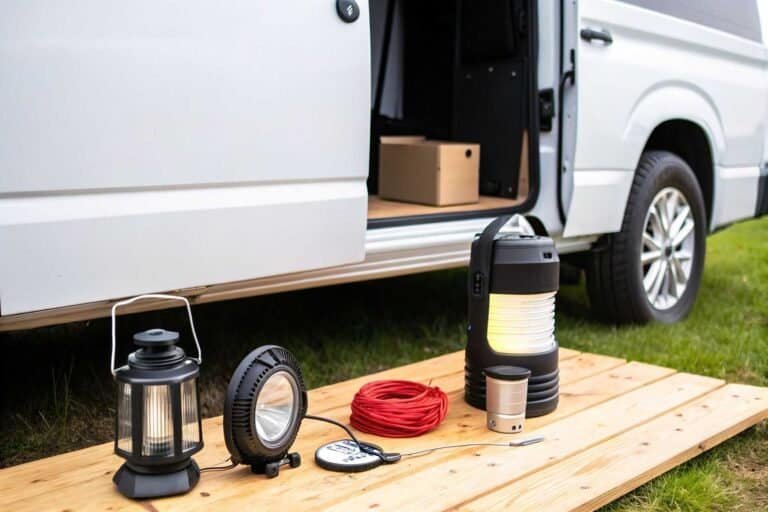
Forget fumbling around in the dark with a rubbish torch. I’ve been there, trying to cook dinner with my phone clenched between my teeth. The right portable camping light is one of the most important bits of kit you’ll own. It’s what turns a cold, dark van into somewhere you actually want to be.

Why Your Campervan Lighting Actually Matters

Most of us learn the hard way. Tangled wires that get caught on everything, batteries that die just when you need them most, and lights that are either blindingly harsh or so dim you can’t see the chopping board. It’s a pain, and it can properly ruin an otherwise perfect evening parked up somewhere lovely.

A good lighting setup isn’t just an accessory you pick up at the last minute; it’s a critical system, just like your electrics or your water.

This guide is full of practical, no-nonsense advice drawn from years of actually living this life. Whether you’re trying to find your way in a pitch-black Peak District lay-by or just making things feel a bit cosier on a rainy Tuesday, the right gear is essential. We’ll help you spend your money wisely on a portable camping light that won’t let you down.

More of Us Are Hitting the Road

Think of your lighting like you would at home. You wouldn’t use one massive, harsh ceiling light for your entire house, would you? Your van’s no different. You need layers: some general light, some focused light for tasks like cooking, and some accent light to make it feel homely.

At the end of the day, your adventures deserve to be well-lit. We’ll cover everything you need to know, focusing on what really matters:

  • Practicality: Choosing lights that solve real problems on the road.
  • Efficiency: Understanding how much power they drain from your precious leisure battery.
  • Durability: Picking gear that can handle being bounced around on British roads.
  • Atmosphere: Using light to make your van feel less like a vehicle and more like home.

Decoding the Types of Portable Camping Lights

Choosing the right portable camping light isn’t about finding one single light to do everything. It’s about building a small, versatile lighting kit where each piece has a specific job. Think of it like a mechanic’s toolbox; you wouldn’t use a sledgehammer to tighten a tiny screw, and you wouldn’t use a book light to investigate a strange noise in the woods.

Different situations in and around your van demand completely different kinds of light. Getting this right means you’ll have the perfect glow whether you’re cooking under the awning, fixing a blown fuse in the dark, or just settling down with a book. Let’s break down the main players.

Headlamps: The Hands-Free Hero

Let’s be honest, the humble headlamp is probably the single most essential portable camping light you can own. It’s your hands-free problem solver, strapped to your head and pointing exactly where you’re looking. This makes it utterly invaluable for countless van life tasks.

Imagine trying to check your engine oil at a dark service station or pack away your levelling ramps well after the sun has set. A headlamp leaves both hands free to get the job done quickly and safely. Honestly, it’s the first light you should pack.

Lanterns: The Social Centrepiece

If the headlamp is the essential tool, the lantern is the heart of your mobile home. A good LED lantern casts a wide, 360-degree glow that’s perfect for creating a social, communal atmosphere. It’s the light you plonk on the table for a game of cards or hang from your awning for a late-night dinner.

Modern lanterns are a million miles from the old gas-powered hissers you might remember. They offer adjustable brightness, warm colour tones, and often come with handy extras like a built-in power bank for topping up your phone. Their job is to provide widespread, soft light that makes your little patch of the world feel inviting.

A key advantage of modern lighting is its incredible efficiency.

String Lights: For Atmosphere and Ambience

Don’t write off string lights as just a pretty accessory for the Instagram crowd. While they absolutely excel at creating a cosy, warm vibe inside your van, they are also incredibly practical. They provide a beautiful, low-level, diffused light that’s perfect for relaxing in the evening without the harsh glare of a single, bright source.

And the best part? They draw next to no power, so you can often leave them on for hours without even thinking about your leisure battery. Look for USB-powered versions on a flexible copper wire; they are dead easy to shape around windows, shelves, or your sleeping area, adding a genuine touch of home to your van.

Spotlights and Torches: For Security and Precision

Sometimes, you just need a powerful, focused beam of light. This is where a spotlight or a high-powered torch comes in. It’s your go-to tool for security and seeing what’s happening a long way off. It’s what you’ll grab to investigate that strange noise outside or to light up a path on a late-night walk to the loo block.

While a lantern illuminates a general area, a spotlight cuts right through the darkness with a tight, concentrated beam. It’s not for everyday use, but when you need to see what’s at the far end of a dark field, nothing else will do. Many modern torches also come with multiple modes, including a strobe for emergencies.

Magnetic and Puck Lights: The Versatile Problem Solvers

These little, often puck-shaped lights are the unsung heroes of a well-lit van. Many come with built-in magnets, which is a game-changer. It means you can stick them directly onto any metal surface inside your van—the ceiling, a door, or under a cabinet.

This makes them absolutely perfect for targeted task lighting exactly where you need it, whenever you need it.

  • Kitchen Prep: Stick one under an overhead cabinet to properly light up your chopping board.
  • Reading Nook: Pop one on the van wall next to your bed for a personal reading light.
  • The ‘Garage’: Illuminate the dark corners of your storage area to find that one specific bit of gear you need.

Their versatility and tiny size mean you can move them around as your needs change, filling in any dark spots your main lighting doesn’t reach. They are a simple but brilliant addition to any van.

To make things clearer, here’s a quick rundown of how these different lights stack up in a vanlife context.

Portable Camping Light Comparison for Vanlife

Light TypeBest ForTypical LumensVanlife Use-Case
HeadlampHands-free tasks, repairs100 – 400Fixing the engine, late-night pack-ups, finding the loo.
LanternArea and social lighting200 – 800On the table for dinner, hanging from the awning.
String LightsAmbience, low-level light50 – 200Inside the van for a cosy evening vibe, around the bed.
Spotlight/TorchLong-distance, security500 – 2,000+Investigating noises, navigating dark paths.
Puck/MagneticSpecific task lighting80 – 150Under-cabinet for cooking, reading light, garage storage.

As you can see, each light has a distinct role. Building a small collection—say, a headlamp each, a good lantern, and a few puck lights—will cover almost every situation you’ll encounter on the road.

Right, let’s talk about the specs you see on the box of a portable camping light. It can feel like you need a physics degree to understand what you’re buying. Terms like lumens, Kelvin, and beam angle get thrown around, but what do they actually mean when you’re trying to cook dinner in a drizzly lay-by in the Brecon Beacons?

Let’s cut through the jargon. Think of these numbers not as boring technical details, but as the control dials for the atmosphere inside your van. Getting them right is the difference between a van that feels like a cold, clinical workshop and one that feels like a proper home on wheels. Once you get your head around the basics, you’ll know exactly what to look for.

Lumens: Your Brightness Dial

The first and most common term you’ll see is lumens (lm). In simple terms, it’s just a measure of brightness. More lumens means more light. Easy.

It’s tempting to think that bigger is always better, but for life on the road, the real game-changer isn’t maximum brightness—it’s adjustable brightness. A light that can crank out 500 lumens is brilliant for lighting up an awning while you’re cooking or digging through the back of the van for that thing you know you packed. But inside? That same light would feel like an interrogation lamp and absolutely hammer your leisure battery.

This is why dimmability is your best friend.

A light that can be dialled right down to a gentle 20 or 30 lumens is worth its weight in gold. It’s enough of a glow to see where you’re going without tripping over the dog, but it creates a properly chilled-out vibe and sips power, making your battery last so much longer.

The market has caught on to this. While you can still buy basic torches, the real action is in versatile lanterns that offer a massive brightness range. The ability to go from a powerful 500-lumen area light down to a 20-lumen glow that will last for over 100 hours is exactly the kind of smart adaptability that makes van life easier.

Colour Temperature: Setting the Vibe

Next up is colour temperature, measured in Kelvin (K). This has nothing to do with how hot the light gets; it’s all about describing how ‘warm’ or ‘cool’ the light looks. It’s purely about the mood.

  • Warm White (2,700K – 3,500K): This is that cosy, yellowish glow you’d get from an old-school light bulb or a sunset. It’s calming, relaxing, and exactly what you want for winding down with a book and a cuppa in the evening.
  • Cool White (4,000K – 6,500K+): This is a crisp, almost bluish-white light, much closer to daylight. It’s brilliant for anything task-focused because it helps you concentrate and makes colours look sharper. This is the colour you want for your kitchen area or if you’re fixing something.

Loads of modern portable lights now let you switch between colour temperatures, which is the best of both worlds. You can have a bright, cool light on for chopping veg, then switch it over to a soft, warm glow to chill out afterwards—all from the same unit.

Beam Type: Flood vs. Spot

Finally, you need to think about the beam type, which is all about how the light is spread out. There are two main types you’ll come across, and they do very different jobs.

Floodlight: A flood beam throws a wide, even spread of light over a big area, a bit like a security light in a garden. This is exactly what you want from a lantern. It’s perfect for lighting up the whole van interior or your outdoor seating area. Think broad, general illumination.

Spotlight: A spot beam does the opposite. It concentrates all its power into a narrow, intense ray of light that travels a long way. This is your classic torch beam, ideal for pinpointing something specific in the dark, whether that’s the next trail marker on a night walk or a weird noise you heard at the edge of your park-up.

A truly useful portable camping light will often combine these. You might get a main floodlight for area lighting, a powerful spotlight for distance, and often a red light mode to help you see in the dark without ruining your night vision. This kind of multi-tool approach means one light can do the job of three, saving you precious space and a bit of cash.

Solving the Off-Grid Power Challenge

Power is the lifeblood of a good van trip. It’s what separates a cosy, well-lit home on wheels from a cold, dark metal box after the sun goes down. And when it comes to your portable camping light, how you power it is just as crucial as how bright it is. Get this right, and you’ll have reliable light on tap, no stress involved.

For a lot of people just starting out, the go-to solution is a multipack of AA batteries from the supermarket. They seem cheap and easy, but trust me, it’s a false economy. You’ll burn through them faster than you think, the cost adds up over a long trip, and they’re a disaster for the environment. Think of them as an emergency backup, not a sustainable power strategy for life on the road.

The much smarter, and ultimately cheaper, solution is to go rechargeable. The UK campervan scene is booming, and rechargeable lanterns are dominating the outdoor market for a reason. Spending £15-£40 upfront on a decent rechargeable light can easily save you over £100 a year on disposable batteries. That’s a tank of diesel or a few good meals out.

Embracing USB and Your Leisure Battery

The real game-changer for modern van life is the universal adoption of USB charging. Pretty much every decent portable camping light these days comes with a built-in lithium-ion battery that you can top up with a standard USB cable. This simple fact unlocks a powerful and incredibly efficient way to manage your lighting.

Your van’s leisure battery is the heart of your off-grid electrical system. It’s a hefty, deep-cycle battery designed to provide a steady flow of 12V power for everything from your fridge to your phone charger. By wiring a few 12V USB sockets directly to this battery, you create convenient charging hubs around your living space.

This setup means you can top up your portable lights during the day while you’re driving, or whenever your solar panels are soaking up the sun. It’s a seamless system that ensures your lights are always juiced up and ready for the evening, all powered by your central electrical hub. It’s a far more elegant solution than fumbling for fresh batteries in the dark. If you’re still designing your van’s electrical system, our guide can help you choose the best campervan batteries and inverter setup for what you need.

What About Solar Lights in the UK?

You’ll see plenty of portable lights with little solar panels built into the top. The concept is brilliant: free, endless power from the sun. But let’s be realistic about where we live. While a built-in panel might give you a decent trickle charge on a glorious summer’s day in Cornwall, it’s going to seriously struggle during a week of classic British cloud and drizzle in the Lake District.

My advice? Think of those integrated solar panels as a nice bonus for topping up the battery, not as a primary charging method. They’re a useful supplement, for sure, but you should never rely on them as the only way to power your main lights. Your leisure battery will always be your most dependable off-grid power source.

The Art of Energy Budgeting

To make sure you never get caught in the dark, you need to do a bit of what I call ‘energy budgeting’. It sounds more complicated than it is. Really, it’s just about getting a handle on how much power your lights use and how long your battery can keep them going.

Think of your leisure battery like a water tank. Every device you turn on is like opening a tap. A bright light on full blast is a fully open tap, draining the tank quickly. A dim reading light is just a slow drip.

To figure this out, you just need two numbers:

  1. Light Power Draw (Watts): The manufacturer should list this in the specs.
  2. Battery Capacity (Amp-hours): This will be printed on the side of your leisure battery.

Using a simple formula (Watts ÷ Volts = Amps), you can work out how many amps your light draws per hour. This lets you estimate how long you can run your lights before you need to think about recharging your leisure battery.

A simple energy audit is one of the most empowering things you can do in your van. Knowing that you can run your two favourite lanterns on a low setting for eight hours and only use 5% of your battery gives you incredible peace of mind on a long, dark winter’s night.

Getting your head around these three things—brightness, colour, and beam—is key to choosing a light that not only fits your power budget but also helps create the right atmosphere in your van.

Mounting and Placement for a Smarter Van Interior

A powerful portable camping light is only half the battle; where you put it makes all the difference. Get it wrong, and you’ll cast weird shadows right where you’re trying to chop veg, get blinded every time you sit up in bed, or leave half the van in gloomy darkness.

Smart mounting isn’t about having the fanciest lights. It’s about turning a few individual units into a proper, functional lighting system that makes your small space feel usable and genuinely inviting.

Think of it like lighting a room in your house. You’d never just stick a single, harsh bulb in the middle of the ceiling and call it a day. You need layers. The same logic applies to your van, and the key is flexibility – your lighting needs change completely from cooking dinner to chilling out with a book.

Creating a Flexible Mounting System

The beauty of a campervan is that it’s mostly a giant metal box. This is brilliant news for anyone with magnetic lights. A lot of modern portable lanterns and puck lights have seriously strong magnets built right in, letting you just snap them onto the ceiling, doors, or any bit of exposed metalwork. It’s the simplest, most versatile mounting solution out there, period.

But what about all the lovely wood cladding or carpeted panels you’ve spent ages fitting? This is where a bit of DIY genius comes in. Grab some strong adhesive and stick a few thin metal plates or discs wherever you might need a light. On the side of a kitchen cabinet, above the sliding door, near your bedhead – anywhere. Suddenly, your magnetic portable camping light works everywhere, giving you total control.

Beyond magnets, a few other bits of kit are dead useful:

  • Carabiner Clips: A simple hook or carabiner is brilliant. Hang a lantern from a pop-top roof strut, an awning rail, or even just a cord strung across the van.
  • Adjustable Straps: Some lights come with built-in straps. These are great for wrapping around cabinet handles, headrests, or the grab handles above the doors for a secure, temporary fix.
  • Gorilla Pods: Don’t laugh. A small, flexible tripod is surprisingly handy for wrapping a light around an awkward spot to get the angle just right.

Layering Light for Different Activities

Once you’ve got your mounting options sorted, you can think strategically. The real goal is to create different ‘zones’ of light for specific activities. This simple trick makes your van feel bigger, more organised, and a hell of a lot more liveable. It’s a core principle in designing the perfect campervan layout that so many people miss.

Think about the main areas in your van:

  1. Galley (Task Lighting): Chopping onions in the dark is a recipe for disaster. You need bright, direct, shadow-free light right on your worktop. Stick a puck light or a small bar light directly under your overhead cabinets. A cooler, white light is best here to see what you’re doing.
  2. Seating/Dining Area (Social Lighting): This is where you want a warmer, more inviting glow. A central lantern on the table or hung from the ceiling casts a wide, sociable light that’s perfect for a meal or a game of cards. Dimmability is an absolute must-have here to set the mood.
  3. Sleeping Area (Ambient Lighting): Harsh, direct light is the enemy when you’re trying to wind down. A string of USB-powered fairy lights tucked around the bed frame or a lantern turned down to its lowest setting creates a soft, relaxing vibe. A warm white colour is ideal for helping your brain switch off.

By layering your lighting, you create a dynamic interior. You can have a bright, functional kitchen area while the rest of the van remains a cosy, dimly lit den—all controlled with the placement of a few portable units. This adaptability is the hallmark of a well-thought-out van build.

Choosing Lights That Survive UK Weather

Let’s be honest, the Great British weather is famously unpredictable. One minute you’re enjoying a bit of sunshine, the next you’re wrestling with an awning in a sudden downpour. Your portable camping light needs to be tough enough to handle everything, from a summer shower to the persistent damp of a winter trip. Durability isn’t a luxury here; it’s a core feature that saves you money and a lot of faff.

Investing in a well-built light means you won’t be buying a replacement every season. It needs to survive not just the rain, but also the inevitable knocks, drops, and bumps that come with life on the road in a ridiculously compact space.

Decoding Water Resistance Ratings

When you’re looking at the packaging, you’ll probably see something called an IP rating. This looks like impenetrable technical jargon, but it’s actually a dead simple code that tells you how well a gadget is protected against solids (the first number) and liquids (the second number). For a portable camping light, it’s that second number you really care about.

You’ll often see “IPX4”. The ‘X’ just means it hasn’t been rated for dust protection, which is fine for a light. It’s the ‘4’ that’s the key part.

  • IPX4: Protected against splashing water from any direction.
  • IPX5: Protected against low-pressure water jets from any direction.
  • IPX6: Protected against powerful water jets.
  • IPX7: Can be submerged in up to 1 metre of water for 30 minutes.

For most UK van life scenarios, an IPX4 rating is the perfect sweet spot. This means your light will happily survive being left out in the rain while you’re cooking under the awning. More importantly, it means it can handle the heavy condensation that often builds up inside a van overnight, especially in the colder months. As anyone who has spent time living in a van knows, managing damp is a constant battle. Making sure your gear can withstand it is just as important as knowing how to insulate a van for UK weather in the first place.

Built to Survive Bumps and Drops

Beyond just shrugging off water, your light needs to be physically tough. Life in a van is full of movement. Things get knocked off tables, slide out of cupboards, and occasionally get dropped on hard ground during a late-night setup. A flimsy, brittle plastic case just won’t cut it.

Look for lights with robust features that show the manufacturer has actually thought about how people use them in the real world.

A shockproof design isn’t just a marketing term; it’s a feature that acknowledges the reality of van life. A light protected by a rubberised casing or a sturdy metal frame is far more likely to survive a fall from your camping table onto gravel.

When you’re shopping, check for these simple durability markers:

  • Materials: Look for tough ABS plastic, aluminium, or rubberised sections.
  • Lens Protection: Is the plastic lens recessed to protect it from direct impacts?
  • Sealed Components: Check that battery compartments and charging ports have tight-fitting rubber covers to keep moisture out.

Choosing a durable, weatherproof portable camping light gives you peace of mind. It becomes a reliable tool you know will work when you need it most, regardless of what the British weather decides to throw at you.

Frequently Asked Questions

When you’re wading through the world of portable lighting, a few questions always seem to pop up. Here are the straight-up answers to the queries we hear most from fellow UK van lifers, so you can get your lighting sorted without any faff.

How Many Lumens Do I Really Need for My Campervan?

Honestly, there’s no magic number; it’s all about what you’re doing. For general ambient light to stop you from bumping into things, a lantern chucking out 150-200 lumens is usually spot on. If you’re settling down with a book, a more focused beam of around 80-100 lumens is more than enough.

For proper task lighting – think chopping onions or fixing something under the awning – you’ll want a bit more oomph, somewhere in the 300-500 lumen range. My best advice? Go for versatility. A good portable camping light with a dimmer switch or multiple settings is worth its weight in gold. It lets you go from a soft glow to a powerful work light in seconds, which is also a brilliant way to manage your power.

Can I Charge My Portable Lights from My Van’s Solar Setup?

Absolutely. In fact, this is one of the best parts of having a proper off-grid system. The vast majority of modern portable camping lights now charge via a standard USB cable, just like your phone. If you’ve got a solar panel feeding a leisure battery, you’ve almost certainly got 12V USB sockets dotted around your van.

Just plug your light straight into one of them. It’ll happily sip away at the free energy your panels are pulling from the sun during the day. Some lights even come with their own tiny built-in solar panels, which are fine for a slow top-up on a bright day, but don’t rely on them as your main charging source here in the UK – you’ll be waiting a while.

Are LED String Lights Practical for Van Life?

Not only are they practical, they’re brilliant. While they’re famous for creating that cosy, Instagram-worthy vibe, their real value is in their utility. They provide a fantastic low-level, widespread ambient light that’s perfect for evenings when a harsh, direct glare would just kill the mood.

Because they draw such a tiny amount of power, you can leave them on for hours without giving your leisure battery a second thought. My tip is to look for USB-powered, warm-white versions on a flexible wire. They’re dead easy to shape around windows, shelves, or your bed frame and instantly make the space feel more like a home.

What Does an IPX4 Rating Mean?

In simple terms, an IPX4 rating means the light is protected against splashing water from any direction. For most UK van life situations, this is exactly what you need. It’ll handle being used in the rain under an awning and won’t flinch at the condensation that inevitably builds up inside a van on a cold morning.

You couldn’t chuck an IPX4-rated light in a river, but it’s more than tough enough to cope with the typical damp and drizzle you’ll face on a British road trip. It’s the standard level of water resistance you should be looking for in a reliable portable camping light.


At The Feral Way, we provide tested, no-nonsense guides to help you build a campervan that truly works for life on the road. Find more practical advice and real-world build guides at https://www.theferalway.com.
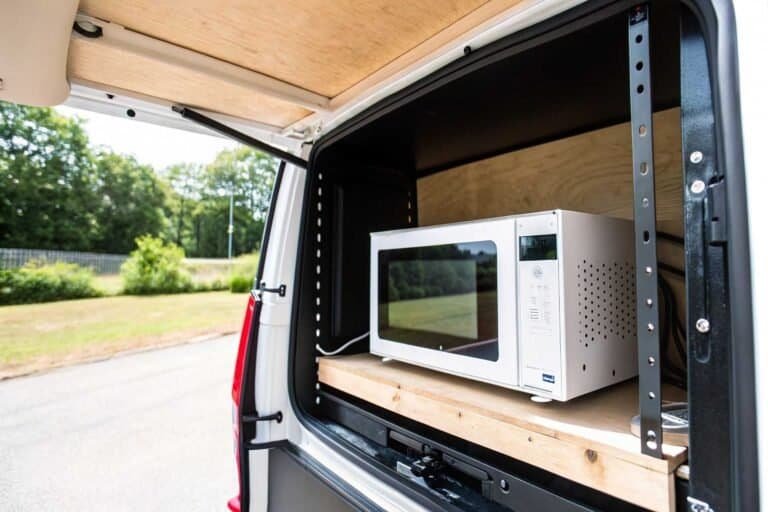
Thinking about putting a microwave in your campervan? It’s one of those additions that can feel like a total game-changer, especially for whipping up quick meals. But—and it’s a big but—it only works if you’ve got the power to back it up.

For most of us travelling in the UK, this boils down to two options: either you’re the type to stick to campsites and use their shore power, or you’re ready to get serious and build a hefty off-grid electrical system. We’re talking a powerful inverter and a big bank of lithium batteries. The convenience is real, but so is the massive power draw.

Is a Campervan Microwave Right for Your Build?

Deciding to install a microwave is a classic battle between pure convenience and sheer complexity.

On one hand, the thought of reheating last night’s chilli in 90 seconds after a long, wet day of driving is incredible. On the other, it’s easily one of the most power-hungry appliances you can possibly add to your van.

So, the real question isn’t just if you should get one. It’s how on earth you plan to power it. Your answer will shape your entire electrical system and, honestly, your whole style of travel.

Microwave Power Options at a Glance

To cut through the noise, here’s a quick look at how you’ll be powering a microwave on the road. Each method suits a different type of vanlifer, so be honest about which one you are.

Power MethodBest ForProsCons
Campsite Shore PowerWeekend warriors & campsite regulars.Simple, cheap, no complex electrics needed.Completely reliant on campsites; no off-grid use.
Inverter & Battery BankFull-timers & dedicated wild campers.True off-grid freedom; use it anywhere.Very expensive, complex installation, heavy.
12V MicrowaveNiche users with specific needs.Runs directly from leisure battery.Rare, expensive, often underpowered, still drains battery fast.

Ultimately, for most people, the choice is between relying on campsites or going all-in on an off-grid setup. Let’s dig into what that actually means.

The Two Main Power Scenarios

For UK vanlifers, your choice really comes down to two paths. The first, and by far the simplest, is just relying on campsite shore power. If you know you’ll be staying at established sites with 230V electric hook-ups most of the time, running a standard domestic microwave is dead easy. No complex off-grid gear needed.

The second path is for the off-gridders. This means building a really robust electrical system capable of handling huge electrical loads. To run a typical 700-800W microwave away from a campsite hook-up, you’re going to need:

  • A high-capacity leisure battery bank. We’re talking 200Ah or more of lithium (LiFePO4) as a realistic minimum.
  • A powerful pure sine wave inverter. Don’t even think about anything less than 1500W.
  • A solid way to recharge those batteries, like a big solar array or a battery-to-battery charger for when you’re driving.

The real challenge of an off-grid campervan microwave isn’t the appliance itself. It’s the massive electrical infrastructure you have to build just to support its brief but intense power draw. This is a system-level decision, not just an appliance choice.

Evaluating Your Travel Style

Before you commit, have an honest chat with yourself about how you actually travel.

Are you a weekend warrior who sticks to well-equipped holiday parks? A shore-power setup will serve you perfectly and won’t break the bank. Or are you planning long stints wild camping in the Scottish Highlands, miles from anywhere? If that’s the case, the big investment in a powerful off-grid system might be worth it.

Think about real-world situations. A microwave is a lifesaver on a rainy travel day when you can’t be bothered setting up the gas stove. It’s perfect for making a quick bowl of porridge before a hike. But, if you’re someone who loves cooking fresh meals from scratch and enjoys the ritual of using a gas hob, a microwave might just become an expensive, oversized bread bin that’s sucking your precious power for no good reason.

The goal here is to match the appliance to your actual needs, not just the romantic idea of instant convenience.

Right then, let’s talk microwaves. Putting one in a house is easy. You find one you like, plug it into the wall, job done. Shoving one into a campervan, however, opens up a whole new can of worms. It’s not just about zapping your leftovers; it’s about finding an appliance tough enough for life on the road that won’t murder your van’s precious electrical system.

The very first decision you need to make is about power. Now, you might hear whispers of incredibly rare and eye-wateringly expensive 12V microwaves. Honestly, forget them. For 99% of us in the UK, the choice is a standard 230V domestic microwave. This immediately links your microwave plans to your power setup. You’re either running it off a campsite hook-up or, for off-grid freedom, you’ll need a chunky inverter and a healthy battery bank to back it up.

Power Wattage: Less Is More

When it comes to campervan appliances, our usual home-kitchen logic gets flipped on its head. More power is not better. A higher wattage microwave cooks faster, sure, but it puts a massive strain on your electrical system. That 900W or 1000W beast in your kitchen would be a system-killer in a van.

Instead, you want to be looking for models in the 700W to 800W range. This lower power draw is much kinder to your leisure batteries and inverter. It drastically reduces the risk of tripping your whole system, while still being perfectly capable of heating a meal. A quick but important tip: the power rating on the box is its output (cooking power). The actual input power it consumes will be higher. Always check the appliance’s data plate for the real number.

Honestly, choosing a lower-wattage microwave is one of the smartest moves you can make. It’s the difference between a system that just works and one that’s constantly on the brink of collapse, especially when you’re off-grid and every single amp matters.

As you can see, it’s all about finding that sweet spot between power draw, physical size, and the type of controls that can handle life on the move.

Size, Weight, and Keeping It Cool

Next up are the physical realities. Your van kitchen has a fixed amount of space, so get the tape measure out. This is a non-negotiable step before you even dream of hitting the “buy now” button.

  • External Dimensions: Measure the cabinet or shelf where it’s going to live. And I mean meticulously. Don’t just measure for the microwave itself; you have to leave room for ventilation. You’ll need a gap of at least 5-10 cm around the sides, top, and back to stop it from overheating.
  • Internal Capacity: For most van conversions, around 20 litres is the sweet spot. That’s big enough for a normal dinner plate but small enough that it doesn’t swallow your entire kitchen.
  • Weight: Every single kilogram counts in a van build. Most of these compact microwaves weigh between 10-12 kg. That’s a manageable weight, but it’s something you absolutely must account for in your vehicle’s overall payload calculations.

Dials vs. Digital: Durability on the Road

Finally, you need to think about how the microwave will handle the rattles and bumps of van life. A campervan is a pretty harsh environment, and delicate electronics are often the first things to give up.

This is where simple trumps sophisticated, every single time. Look for a microwave with good, old-fashioned manual dial controls for power and time. They are far more durable than a model with a sensitive digital touchpad and a dozen fancy pre-programmed functions. The mechanical nature of dials means there’s just less to go wrong when you’re bouncing down a bumpy track in the Peak District. Plus, they’re much easier to use with wet or cold hands.

Choosing a campervan microwave is a balancing act. You’re hunting for a low-wattage, compact, and tough little unit that does what you need without overwhelming your power system or gobbling up space. Get these practical things right, and you’ll have a genuinely useful tool rather than a constant source of frustration.

Calculating Your Power Needs for an Off-Grid Microwave

Alright, this is where your dream of instant off-grid porridge meets the cold, hard reality of electrical engineering. You can’t just plug a standard 230V microwave into your 12V system and hope for the best. It takes a serious, well-planned electrical setup to handle the brief but absolutely colossal power demand.

Let’s break down the maths with a real-world example so you can see exactly what you’re getting into. Honestly, understanding these numbers is the single most important step in deciding if a campervan microwave is genuinely feasible for your adventures.

The Shocking Reality of 12V Current Draw

Those numbers on the front of a microwave? They’re deceptive. An “800W” label refers to its cooking power (the output), not how much electricity it actually consumes (the input). Because of inefficiencies, the actual input wattage is always higher—think around 1200W for a typical 800W model.

This is where Ohm’s Law delivers a bit of a wake-up call. To figure out what that 1200W demand looks like to your 12V leisure batteries, we use a simple formula:

Watts / Volts = Amps

For our 1200W microwave, the sum is 1200W / 12V = 100 amps. That is a gigantic amount of current to pull from a leisure battery, even if it’s just for a few minutes. To put that in perspective, a typical 12V campervan fridge might only draw 3-4 amps.

Don’t underestimate this figure. A 100-amp draw will instantly overwhelm a small or poorly specified electrical system. This isn’t a ‘nice-to-have’ calculation; it’s the fundamental reason you need a powerful and often expensive setup to run a microwave off-grid.

Sizing Your Inverter: Continuous vs Peak Power

The inverter is the heart of your off-grid 230V system, taking 12V DC power from your batteries and flipping it into 230V AC for your appliances. For a power-hungry beast like a microwave, you need to look closely at two key ratings.

  • Continuous Power: This is the maximum wattage the inverter can supply consistently. It absolutely must be higher than your microwave’s actual input wattage. For a 1200W appliance, a 1500W continuous rating is the bare minimum.
  • Peak (or Surge) Power: When they first kick on, microwaves have a massive initial power spike that can be double the continuous draw. Your inverter needs a peak rating high enough to handle this, otherwise it will just shut down to protect itself. A 1500W inverter will often have a 3000W peak rating, which is what you’re looking for.

Choosing an undersized inverter is a classic, costly mistake. If you try to run a 1200W microwave on a 1000W inverter, it simply won’t work. The inverter will trip immediately, leaving you with cold soup and a lot of frustration. A 2000W pure sine wave inverter is an even safer, more robust choice that gives you plenty of headroom.

Why Your Battery Bank is Crucial

That huge 100-amp draw has to come from somewhere, and that somewhere is your leisure battery bank. A standard 100Ah lead-acid battery is completely unsuitable for this job. You can only safely drain a lead-acid battery to about 50% of its capacity, giving you just 50Ah of usable power. Attempting to pull 100 amps from it would cause a massive voltage drop and likely destroy the battery.

This is exactly why Lithium Iron Phosphate (LiFePO4) batteries have become the go-to for any serious off-grid power system. They can handle incredibly high discharge rates and can be safely drained much deeper, often down to 80-90% of their capacity.

So, what size do you actually need? For that 100-amp draw, a 200Ah LiFePO4 battery is a realistic starting point. This ensures the battery’s built-in management system (BMS) can handle the current and that you have enough capacity to run the microwave without completely crippling your power supply for the rest of the day.

To figure out the right battery size for your entire setup, not just the microwave, check out our detailed guide on What size leisure battery do i need.

To pull it all together, here’s a look at the minimum electrical system you’d need to reliably run a standard 800W microwave off-grid. This isn’t about being flashy; it’s about being safe and functional.

Sample Inverter and Battery Sizing for an 800W Microwave

ComponentMinimum SpecificationReasoning
Microwave700-800W (approx. 1200W input)A manageable power draw that balances performance and electrical strain.
Inverter1500W-2000W Pure Sine WaveSafely handles the continuous load and the massive initial startup surge.
Battery Bank200Ah LiFePO4Provides enough usable capacity and can sustain the high 100A current draw without damage.
WiringHeavy Gauge (e.g., 35mm² or larger)Absolutely essential to safely carry the high current between the battery and inverter without overheating.

In short, powering a microwave off-grid isn’t just about buying the appliance itself. It’s about designing and investing in an entire electrical system built specifically to handle its demanding nature.

Getting Your Microwave Installed Safely and Securely

Right, you’ve picked your microwave and figured out the power system. Now for the bit that really matters in a moving vehicle: physically getting it mounted in your van.

This isn’t just about making things look tidy. A loose 10 kg microwave can become a lethal projectile in a sudden stop or a sharp turn. The goal here is to build a housing so solid it feels like part of the van’s structure, not just something you’ve plonked on a shelf.

We need to create a dedicated cabinet or reinforced shelf designed to withstand the constant vibrations and forces of life on the road.

Building a Bombproof Housing

Simply placing your microwave on a shelf and hoping for the best is a genuine recipe for disaster. You need a secure, custom-built enclosure.

Start by framing out a sturdy box from quality plywood—at least 12mm is a good starting point, though I’d go for 15mm if you have it. This housing needs to be screwed firmly into the van’s structural ribs or a solid part of your existing cabinetry. Whatever you do, don’t rely on just a few screws into thin wall panels; they will rip out.

To hold the microwave itself in place, you’ve got a few options, and I recommend using more than one:

  • Batten Straps: Once the microwave is in, secure wooden battens across the top, screwing them into the sides of the cabinet. This stops it from jumping upwards on bumpy roads.
  • Metal Brackets: Use strong L-brackets inside the cabinet. Screw them into both the cabinet wall and, if possible and safe, the microwave’s casing itself.
  • Non-Slip Matting: Line the base of the cabinet with high-friction rubber matting to stop it from sliding about.

The aim is to make the appliance completely immovable in all directions: up, down, forwards, backwards, and sideways. Give it a good shove when you’re done. If it moves, it’s not secure enough.

Ensuring Proper Ventilation

Overheating is a serious fire risk in a tight space like a campervan. Microwaves kick out a lot of heat and need clear airflow to get rid of it safely. Ignoring the manufacturer’s ventilation requirements is not an option.

As a general rule, you must leave a clear air gap of at least 5-10 cm around the back, sides, and top of the unit. You can achieve this by drilling ventilation holes or installing small grilles in the cabinet walls, allowing cool air to be drawn in and hot air to escape. Never, ever block the appliance’s own vents.

Building a secure cabinet is half the battle; ensuring it breathes is the other. Proper ventilation is non-negotiable for preventing overheating and ensuring the longevity and safety of your campervan microwave setup.

Nailing the Electrical Wiring

The wiring for your microwave’s inverter is one of the most critical—and dangerous if done wrong—parts of the installation. We’ve talked about the massive current draw, and using undersized cables here is an absolute fire hazard. They will overheat, melt, and potentially burn your van down.

You must use heavy-gauge cable between your leisure battery and your inverter. For a 1500-2000W inverter, you’re often looking at 35mm² or even 50mm² cable, especially if the run is more than a metre or two. It’s absolutely vital to keep the cable run as short as you possibly can to minimise voltage drop and improve efficiency. Our guide to installing a 12V and 240V campervan system covers this topic in much more detail if you need a deeper dive.

Crucially, you must install appropriate circuit protection. This means putting a correctly sized fuse or circuit breaker on the positive cable, as close to the battery as possible. This device is your system’s lifeline. To make sure you pick the right components, it’s worth spending some time understanding overcurrent protection devices and how they protect your entire electrical system from dangerous short circuits or overloads.

Right then, let’s talk about the easiest way to get a microwave humming away in your campervan. It’s the method that avoids multi-thousand-pound electrical installs and a world of technical headaches.

Forget the off-grid dream for a moment. The simplest, cheapest, and most straightforward route is to lean on the UK’s brilliant campsite infrastructure and use shore power.

This approach completely changes the game. Instead of designing a complex off-grid system powerful enough to handle a microwave, you just use a standard domestic one. All your van needs is a basic 230V electrical system: a consumer unit, a few properly wired sockets, and an external hook-up point to plug into the campsite’s post.

The good news is that the UK is perfectly set up for this. Campsites with electric hook-ups are absolutely everywhere, from the Cornish coast to the Scottish Highlands. For weekend trips, week-long holidays, or even longer tours where you’re moving between sites every few days, this is an incredibly reliable way to travel.

How Shore Power Makes Everything Simple

Connecting to shore power, or a ‘mains hook-up’ as it’s often called, is like plugging your van directly into the national grid. You get a steady, reliable supply of 230V AC power, which is exactly what your household microwave is designed for.

This tactic has some massive advantages:

  • No Inverter Needed: You can completely skip the powerful, expensive pure sine wave inverter needed to run a microwave off your batteries.
  • No Battery Drain: The microwave pulls its power directly from the campsite, leaving your leisure batteries completely untouched. This means you don’t need a huge, costly lithium battery bank.
  • Seriously Cost-Effective: A simple hook-up system costs a fraction of a full off-grid power setup capable of handling a microwave.
  • Simplicity and Reliability: It’s a proven, dead-simple system. You plug in your hook-up lead, flip a switch in your van, and you have power. It just works. Every time.

This method lets you enjoy the convenience of quick meals without the hefty financial investment and technical complexity that an off-grid system demands. Honestly, it perfectly suits the way a huge number of UK van owners actually travel.

Shore power is the ultimate shortcut to microwave convenience in a campervan. It leverages the UK’s fantastic campsite network, saving you thousands of pounds and a world of electrical headaches.

The Reality of UK Van Travel

The sheer number of electric hook-ups has a massive influence on how UK campervans are built and used. Many of us find we rarely need to be fully self-sufficient for more than a day or two, which can make a full-blown off-grid microwave setup a completely unnecessary expense.

This practical approach is why most popular compact microwaves for vans are in the 700–800W bracket. They’re powerful enough for proper cooking but don’t overload a standard campsite supply. It’s also why so many UK converters and buyer’s guides focus on having a solid hook-up system rather than a massive battery bank. For more insights on the UK’s robust touring vehicle market, the National Caravan Council provides some great data at thencc.org.uk.

Before you commit to a multi-thousand-pound electrical system, be realistic about your plans. If you see yourself spending most of your nights at sites with amenities, a simple and affordable shore power setup is without a doubt the smartest choice for your campervan microwave.

Weighing the True Cost Against the Alternatives

The convenience of a microwave is tempting, but it’s a luxury that comes at a price far beyond the £70 appliance you stick in the cupboard. The real cost depends entirely on which power route you go down: the simple, budget-friendly shore power setup, or the complex and eye-wateringly expensive off-grid system.

The financial difference between these two paths isn’t a small gap. It’s a chasm.

Let’s put some real numbers on it. A basic shore-power-only installation, with an external hook-up point and a consumer unit, might set you back a couple of hundred quid if you’re handy with the tools. Add the cost of a compact 700W microwave, and you’re all in for a very manageable sum. This is the practical, no-nonsense choice for campsite regulars.

The Off-Grid Investment

The alternative—powering that same microwave from your batteries—is a completely different financial league. This isn’t a small upgrade; it’s a fundamental redesign of your electrical system.

You’ll need a high-capacity lithium battery bank (at least 200Ah), a powerful pure sine wave inverter (think 1,500–2,000W), and probably upgraded solar or a better B2B charger to keep it all topped up. This system can easily add several thousand pounds to your build. That’s a huge investment, especially when you see industry commentary highlighting that buyer priorities in 2025 are leaning towards budget-conscious choices and practical upgrades.

The big question is this: is 90 seconds of convenience worth a multi-thousand-pound electrical system? For a handful of vanlifers, the answer is a definite yes. For most of us, simpler, cheaper, and more versatile cooking alternatives make far more sense.

Practical Low-Power Alternatives

Before you commit to the cost and complexity of a campervan microwave, it’s worth looking at the fantastic ways you can heat food that are much kinder to your budget and batteries. Honestly, these options align perfectly with a more traditional (and, dare I say, rewarding) vanlife cooking experience.

  • Omnia Oven: This ingenious stovetop oven sits right on your gas hob and can bake, roast, and reheat almost anything you’d put in a conventional oven. It uses a tiny bit of gas and is a cult classic for a reason.
  • 12V Travel Cookers: Gadgets like slow cookers or lunchbox heaters plug directly into a 12V socket. Sure, they take longer, but their power draw is absolutely tiny and easily managed by even a modest solar setup.
  • Thermal Cookers: These non-electric “haybox” cookers are brilliant. You bring your food to a boil on the hob, then pop the pot into the insulated container where it continues to cook for hours using zero energy. Perfect for stews and curries.

Ultimately, the decision comes down to your priorities. If your travel style and budget can handle the electrical demands, a microwave offers unmatched speed. For most people, though, the charm and efficiency of these alternatives, combined with some thoughtful van life meal planning, provide all the cooking capability you’ll ever need on the road.

Microwave FAQs: Your Questions Answered

Right, let’s get into the questions I hear all the time. No fluff, just the straight answers you need when you’re trying to figure this all out.

So, Can I Just Bung a Normal Household Microwave in My Van?

Yes, you absolutely can. In fact, it’s what most of us do. But—and this is a big but—you can’t just plug it in and hope for the best unless you’re hooked up to campsite mains.

For this to work off-grid, your van’s electrical system needs to be properly beefy. We’re not talking about a basic weekend setup here. You’ll need a serious battery bank, realistically 200Ah of lithium as a bare minimum, and a high-quality pure sine wave inverter that can handle at least 1500W. Anything less and you’re just going to be tripping your system every time you try to heat up some soup.

What Size Inverter Do I Actually Need for an 800W Microwave?

This is where a lot of people get it wrong. You see “800W” on the microwave and think an 800W or 1000W inverter will do the job. It won’t.

For an 800W microwave, you need a pure sine wave inverter with a continuous rating of at least 1500W. This might seem like massive overkill, but it’s essential. Microwaves have a huge start-up surge—a split-second power demand that can be almost double their running wattage. A smaller inverter will see that surge, panic, and immediately shut down. A 2000W model is an even safer bet, giving you plenty of headroom to handle that initial kick without breaking a sweat.

Don’t just match your inverter to the microwave’s running power. You have to account for the massive initial power surge. A 1500W-2000W unit is the only reliable choice if you want your microwave to actually work off-grid.

Are 12V Microwaves a Better Bet Then?

Honestly? No. While you can find dedicated 12V microwaves, they’re generally not a smart choice for most UK vanlifers.

For a start, they’re incredibly hard to get hold of, cost a fortune compared to a standard 230V model from Argos, and are often disappointingly underpowered.

But the real killer is the current they draw. They might be “12V,” but they pull a monstrous amount of amps—often 60-70 amps—directly from your leisure batteries. That kind of current puts an immense strain on your entire 12V system. For the vast majority of builds, sticking with a standard, affordable 230V microwave powered by an efficient inverter is the more reliable, cost-effective, and sensible way to go.


At The Feral Way, we provide tested, real-world advice to help you build a campervan that truly works for your UK adventures. For more no-nonsense guides on van conversions and life on the road, explore our resources at https://www.theferalway.com.