
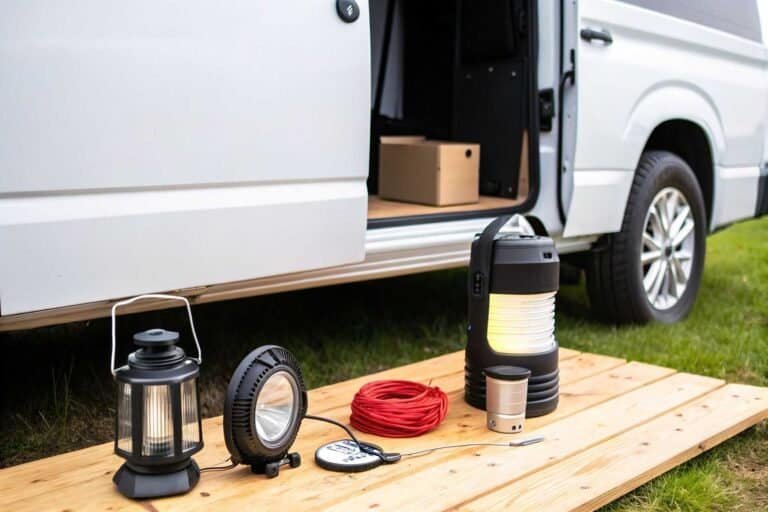
Forget fumbling around in the dark with a rubbish torch. I’ve been there, trying to cook dinner with my phone clenched between my teeth. The right portable camping light is one of the most important bits of kit you’ll own. It’s what turns a cold, dark van into somewhere you actually want to be.
Why Your Campervan Lighting Actually Matters
Most of us learn the hard way. Tangled wires that get caught on everything, batteries that die just when you need them most, and lights that are either blindingly harsh or so dim you can’t see the chopping board. It’s a pain, and it can properly ruin an otherwise perfect evening parked up somewhere lovely.
A good lighting setup isn’t just an accessory you pick up at the last minute; it’s a critical system, just like your electrics or your water.
This guide is full of practical, no-nonsense advice drawn from years of actually living this life. Whether you’re trying to find your way in a pitch-black Peak District lay-by or just making things feel a bit cosier on a rainy Tuesday, the right gear is essential. We’ll help you spend your money wisely on a portable camping light that won’t let you down.
More of Us Are Hitting the Road
Think of your lighting like you would at home. You wouldn’t use one massive, harsh ceiling light for your entire house, would you? Your van’s no different. You need layers: some general light, some focused light for tasks like cooking, and some accent light to make it feel homely.
At the end of the day, your adventures deserve to be well-lit. We’ll cover everything you need to know, focusing on what really matters:
- Practicality: Choosing lights that solve real problems on the road.
- Efficiency: Understanding how much power they drain from your precious leisure battery.
- Durability: Picking gear that can handle being bounced around on British roads.
- Atmosphere: Using light to make your van feel less like a vehicle and more like home.
Decoding the Types of Portable Camping Lights
Choosing the right portable camping light isn’t about finding one single light to do everything. It’s about building a small, versatile lighting kit where each piece has a specific job. Think of it like a mechanic’s toolbox; you wouldn’t use a sledgehammer to tighten a tiny screw, and you wouldn’t use a book light to investigate a strange noise in the woods.
Different situations in and around your van demand completely different kinds of light. Getting this right means you’ll have the perfect glow whether you’re cooking under the awning, fixing a blown fuse in the dark, or just settling down with a book. Let’s break down the main players.
Headlamps: The Hands-Free Hero
Let’s be honest, the humble headlamp is probably the single most essential portable camping light you can own. It’s your hands-free problem solver, strapped to your head and pointing exactly where you’re looking. This makes it utterly invaluable for countless van life tasks.
Imagine trying to check your engine oil at a dark service station or pack away your levelling ramps well after the sun has set. A headlamp leaves both hands free to get the job done quickly and safely. Honestly, it’s the first light you should pack.
Lanterns: The Social Centrepiece
If the headlamp is the essential tool, the lantern is the heart of your mobile home. A good LED lantern casts a wide, 360-degree glow that’s perfect for creating a social, communal atmosphere. It’s the light you plonk on the table for a game of cards or hang from your awning for a late-night dinner.
Modern lanterns are a million miles from the old gas-powered hissers you might remember. They offer adjustable brightness, warm colour tones, and often come with handy extras like a built-in power bank for topping up your phone. Their job is to provide widespread, soft light that makes your little patch of the world feel inviting.
A key advantage of modern lighting is its incredible efficiency.
String Lights: For Atmosphere and Ambience
Don’t write off string lights as just a pretty accessory for the Instagram crowd. While they absolutely excel at creating a cosy, warm vibe inside your van, they are also incredibly practical. They provide a beautiful, low-level, diffused light that’s perfect for relaxing in the evening without the harsh glare of a single, bright source.
And the best part? They draw next to no power, so you can often leave them on for hours without even thinking about your leisure battery. Look for USB-powered versions on a flexible copper wire; they are dead easy to shape around windows, shelves, or your sleeping area, adding a genuine touch of home to your van.
Spotlights and Torches: For Security and Precision
Sometimes, you just need a powerful, focused beam of light. This is where a spotlight or a high-powered torch comes in. It’s your go-to tool for security and seeing what’s happening a long way off. It’s what you’ll grab to investigate that strange noise outside or to light up a path on a late-night walk to the loo block.
While a lantern illuminates a general area, a spotlight cuts right through the darkness with a tight, concentrated beam. It’s not for everyday use, but when you need to see what’s at the far end of a dark field, nothing else will do. Many modern torches also come with multiple modes, including a strobe for emergencies.
Magnetic and Puck Lights: The Versatile Problem Solvers
These little, often puck-shaped lights are the unsung heroes of a well-lit van. Many come with built-in magnets, which is a game-changer. It means you can stick them directly onto any metal surface inside your van—the ceiling, a door, or under a cabinet.
This makes them absolutely perfect for targeted task lighting exactly where you need it, whenever you need it.
- Kitchen Prep: Stick one under an overhead cabinet to properly light up your chopping board.
- Reading Nook: Pop one on the van wall next to your bed for a personal reading light.
- The ‘Garage’: Illuminate the dark corners of your storage area to find that one specific bit of gear you need.
Their versatility and tiny size mean you can move them around as your needs change, filling in any dark spots your main lighting doesn’t reach. They are a simple but brilliant addition to any van.
To make things clearer, here’s a quick rundown of how these different lights stack up in a vanlife context.
Portable Camping Light Comparison for Vanlife
| Light Type | Best For | Typical Lumens | Vanlife Use-Case |
|---|---|---|---|
| Headlamp | Hands-free tasks, repairs | 100 – 400 | Fixing the engine, late-night pack-ups, finding the loo. |
| Lantern | Area and social lighting | 200 – 800 | On the table for dinner, hanging from the awning. |
| String Lights | Ambience, low-level light | 50 – 200 | Inside the van for a cosy evening vibe, around the bed. |
| Spotlight/Torch | Long-distance, security | 500 – 2,000+ | Investigating noises, navigating dark paths. |
| Puck/Magnetic | Specific task lighting | 80 – 150 | Under-cabinet for cooking, reading light, garage storage. |
As you can see, each light has a distinct role. Building a small collection—say, a headlamp each, a good lantern, and a few puck lights—will cover almost every situation you’ll encounter on the road.
Right, let’s talk about the specs you see on the box of a portable camping light. It can feel like you need a physics degree to understand what you’re buying. Terms like lumens, Kelvin, and beam angle get thrown around, but what do they actually mean when you’re trying to cook dinner in a drizzly lay-by in the Brecon Beacons?
Let’s cut through the jargon. Think of these numbers not as boring technical details, but as the control dials for the atmosphere inside your van. Getting them right is the difference between a van that feels like a cold, clinical workshop and one that feels like a proper home on wheels. Once you get your head around the basics, you’ll know exactly what to look for.
Lumens: Your Brightness Dial
The first and most common term you’ll see is lumens (lm). In simple terms, it’s just a measure of brightness. More lumens means more light. Easy.
It’s tempting to think that bigger is always better, but for life on the road, the real game-changer isn’t maximum brightness—it’s adjustable brightness. A light that can crank out 500 lumens is brilliant for lighting up an awning while you’re cooking or digging through the back of the van for that thing you know you packed. But inside? That same light would feel like an interrogation lamp and absolutely hammer your leisure battery.
This is why dimmability is your best friend.
A light that can be dialled right down to a gentle 20 or 30 lumens is worth its weight in gold. It’s enough of a glow to see where you’re going without tripping over the dog, but it creates a properly chilled-out vibe and sips power, making your battery last so much longer.
The market has caught on to this. While you can still buy basic torches, the real action is in versatile lanterns that offer a massive brightness range. The ability to go from a powerful 500-lumen area light down to a 20-lumen glow that will last for over 100 hours is exactly the kind of smart adaptability that makes van life easier.
Colour Temperature: Setting the Vibe
Next up is colour temperature, measured in Kelvin (K). This has nothing to do with how hot the light gets; it’s all about describing how ‘warm’ or ‘cool’ the light looks. It’s purely about the mood.
- Warm White (2,700K – 3,500K): This is that cosy, yellowish glow you’d get from an old-school light bulb or a sunset. It’s calming, relaxing, and exactly what you want for winding down with a book and a cuppa in the evening.
- Cool White (4,000K – 6,500K+): This is a crisp, almost bluish-white light, much closer to daylight. It’s brilliant for anything task-focused because it helps you concentrate and makes colours look sharper. This is the colour you want for your kitchen area or if you’re fixing something.
Loads of modern portable lights now let you switch between colour temperatures, which is the best of both worlds. You can have a bright, cool light on for chopping veg, then switch it over to a soft, warm glow to chill out afterwards—all from the same unit.
Beam Type: Flood vs. Spot
Finally, you need to think about the beam type, which is all about how the light is spread out. There are two main types you’ll come across, and they do very different jobs.
Floodlight: A flood beam throws a wide, even spread of light over a big area, a bit like a security light in a garden. This is exactly what you want from a lantern. It’s perfect for lighting up the whole van interior or your outdoor seating area. Think broad, general illumination.
Spotlight: A spot beam does the opposite. It concentrates all its power into a narrow, intense ray of light that travels a long way. This is your classic torch beam, ideal for pinpointing something specific in the dark, whether that’s the next trail marker on a night walk or a weird noise you heard at the edge of your park-up.
A truly useful portable camping light will often combine these. You might get a main floodlight for area lighting, a powerful spotlight for distance, and often a red light mode to help you see in the dark without ruining your night vision. This kind of multi-tool approach means one light can do the job of three, saving you precious space and a bit of cash.
Solving the Off-Grid Power Challenge
Power is the lifeblood of a good van trip. It’s what separates a cosy, well-lit home on wheels from a cold, dark metal box after the sun goes down. And when it comes to your portable camping light, how you power it is just as crucial as how bright it is. Get this right, and you’ll have reliable light on tap, no stress involved.
For a lot of people just starting out, the go-to solution is a multipack of AA batteries from the supermarket. They seem cheap and easy, but trust me, it’s a false economy. You’ll burn through them faster than you think, the cost adds up over a long trip, and they’re a disaster for the environment. Think of them as an emergency backup, not a sustainable power strategy for life on the road.
The much smarter, and ultimately cheaper, solution is to go rechargeable. The UK campervan scene is booming, and rechargeable lanterns are dominating the outdoor market for a reason. Spending £15-£40 upfront on a decent rechargeable light can easily save you over £100 a year on disposable batteries. That’s a tank of diesel or a few good meals out.
Embracing USB and Your Leisure Battery
The real game-changer for modern van life is the universal adoption of USB charging. Pretty much every decent portable camping light these days comes with a built-in lithium-ion battery that you can top up with a standard USB cable. This simple fact unlocks a powerful and incredibly efficient way to manage your lighting.
Your van’s leisure battery is the heart of your off-grid electrical system. It’s a hefty, deep-cycle battery designed to provide a steady flow of 12V power for everything from your fridge to your phone charger. By wiring a few 12V USB sockets directly to this battery, you create convenient charging hubs around your living space.
This setup means you can top up your portable lights during the day while you’re driving, or whenever your solar panels are soaking up the sun. It’s a seamless system that ensures your lights are always juiced up and ready for the evening, all powered by your central electrical hub. It’s a far more elegant solution than fumbling for fresh batteries in the dark. If you’re still designing your van’s electrical system, our guide can help you choose the best campervan batteries and inverter setup for what you need.
What About Solar Lights in the UK?
You’ll see plenty of portable lights with little solar panels built into the top. The concept is brilliant: free, endless power from the sun. But let’s be realistic about where we live. While a built-in panel might give you a decent trickle charge on a glorious summer’s day in Cornwall, it’s going to seriously struggle during a week of classic British cloud and drizzle in the Lake District.
My advice? Think of those integrated solar panels as a nice bonus for topping up the battery, not as a primary charging method. They’re a useful supplement, for sure, but you should never rely on them as the only way to power your main lights. Your leisure battery will always be your most dependable off-grid power source.
The Art of Energy Budgeting
To make sure you never get caught in the dark, you need to do a bit of what I call ‘energy budgeting’. It sounds more complicated than it is. Really, it’s just about getting a handle on how much power your lights use and how long your battery can keep them going.
Think of your leisure battery like a water tank. Every device you turn on is like opening a tap. A bright light on full blast is a fully open tap, draining the tank quickly. A dim reading light is just a slow drip.
To figure this out, you just need two numbers:
- Light Power Draw (Watts): The manufacturer should list this in the specs.
- Battery Capacity (Amp-hours): This will be printed on the side of your leisure battery.
Using a simple formula (Watts ÷ Volts = Amps), you can work out how many amps your light draws per hour. This lets you estimate how long you can run your lights before you need to think about recharging your leisure battery.
A simple energy audit is one of the most empowering things you can do in your van. Knowing that you can run your two favourite lanterns on a low setting for eight hours and only use 5% of your battery gives you incredible peace of mind on a long, dark winter’s night.
Getting your head around these three things—brightness, colour, and beam—is key to choosing a light that not only fits your power budget but also helps create the right atmosphere in your van.
Mounting and Placement for a Smarter Van Interior
A powerful portable camping light is only half the battle; where you put it makes all the difference. Get it wrong, and you’ll cast weird shadows right where you’re trying to chop veg, get blinded every time you sit up in bed, or leave half the van in gloomy darkness.
Smart mounting isn’t about having the fanciest lights. It’s about turning a few individual units into a proper, functional lighting system that makes your small space feel usable and genuinely inviting.
Think of it like lighting a room in your house. You’d never just stick a single, harsh bulb in the middle of the ceiling and call it a day. You need layers. The same logic applies to your van, and the key is flexibility – your lighting needs change completely from cooking dinner to chilling out with a book.
Creating a Flexible Mounting System
The beauty of a campervan is that it’s mostly a giant metal box. This is brilliant news for anyone with magnetic lights. A lot of modern portable lanterns and puck lights have seriously strong magnets built right in, letting you just snap them onto the ceiling, doors, or any bit of exposed metalwork. It’s the simplest, most versatile mounting solution out there, period.
But what about all the lovely wood cladding or carpeted panels you’ve spent ages fitting? This is where a bit of DIY genius comes in. Grab some strong adhesive and stick a few thin metal plates or discs wherever you might need a light. On the side of a kitchen cabinet, above the sliding door, near your bedhead – anywhere. Suddenly, your magnetic portable camping light works everywhere, giving you total control.
Beyond magnets, a few other bits of kit are dead useful:
- Carabiner Clips: A simple hook or carabiner is brilliant. Hang a lantern from a pop-top roof strut, an awning rail, or even just a cord strung across the van.
- Adjustable Straps: Some lights come with built-in straps. These are great for wrapping around cabinet handles, headrests, or the grab handles above the doors for a secure, temporary fix.
- Gorilla Pods: Don’t laugh. A small, flexible tripod is surprisingly handy for wrapping a light around an awkward spot to get the angle just right.
Layering Light for Different Activities
Once you’ve got your mounting options sorted, you can think strategically. The real goal is to create different ‘zones’ of light for specific activities. This simple trick makes your van feel bigger, more organised, and a hell of a lot more liveable. It’s a core principle in designing the perfect campervan layout that so many people miss.
Think about the main areas in your van:
- Galley (Task Lighting): Chopping onions in the dark is a recipe for disaster. You need bright, direct, shadow-free light right on your worktop. Stick a puck light or a small bar light directly under your overhead cabinets. A cooler, white light is best here to see what you’re doing.
- Seating/Dining Area (Social Lighting): This is where you want a warmer, more inviting glow. A central lantern on the table or hung from the ceiling casts a wide, sociable light that’s perfect for a meal or a game of cards. Dimmability is an absolute must-have here to set the mood.
- Sleeping Area (Ambient Lighting): Harsh, direct light is the enemy when you’re trying to wind down. A string of USB-powered fairy lights tucked around the bed frame or a lantern turned down to its lowest setting creates a soft, relaxing vibe. A warm white colour is ideal for helping your brain switch off.
By layering your lighting, you create a dynamic interior. You can have a bright, functional kitchen area while the rest of the van remains a cosy, dimly lit den—all controlled with the placement of a few portable units. This adaptability is the hallmark of a well-thought-out van build.
Choosing Lights That Survive UK Weather
Let’s be honest, the Great British weather is famously unpredictable. One minute you’re enjoying a bit of sunshine, the next you’re wrestling with an awning in a sudden downpour. Your portable camping light needs to be tough enough to handle everything, from a summer shower to the persistent damp of a winter trip. Durability isn’t a luxury here; it’s a core feature that saves you money and a lot of faff.
Investing in a well-built light means you won’t be buying a replacement every season. It needs to survive not just the rain, but also the inevitable knocks, drops, and bumps that come with life on the road in a ridiculously compact space.
Decoding Water Resistance Ratings
When you’re looking at the packaging, you’ll probably see something called an IP rating. This looks like impenetrable technical jargon, but it’s actually a dead simple code that tells you how well a gadget is protected against solids (the first number) and liquids (the second number). For a portable camping light, it’s that second number you really care about.
You’ll often see “IPX4”. The ‘X’ just means it hasn’t been rated for dust protection, which is fine for a light. It’s the ‘4’ that’s the key part.
- IPX4: Protected against splashing water from any direction.
- IPX5: Protected against low-pressure water jets from any direction.
- IPX6: Protected against powerful water jets.
- IPX7: Can be submerged in up to 1 metre of water for 30 minutes.
For most UK van life scenarios, an IPX4 rating is the perfect sweet spot. This means your light will happily survive being left out in the rain while you’re cooking under the awning. More importantly, it means it can handle the heavy condensation that often builds up inside a van overnight, especially in the colder months. As anyone who has spent time living in a van knows, managing damp is a constant battle. Making sure your gear can withstand it is just as important as knowing how to insulate a van for UK weather in the first place.
Built to Survive Bumps and Drops
Beyond just shrugging off water, your light needs to be physically tough. Life in a van is full of movement. Things get knocked off tables, slide out of cupboards, and occasionally get dropped on hard ground during a late-night setup. A flimsy, brittle plastic case just won’t cut it.
Look for lights with robust features that show the manufacturer has actually thought about how people use them in the real world.
A shockproof design isn’t just a marketing term; it’s a feature that acknowledges the reality of van life. A light protected by a rubberised casing or a sturdy metal frame is far more likely to survive a fall from your camping table onto gravel.
When you’re shopping, check for these simple durability markers:
- Materials: Look for tough ABS plastic, aluminium, or rubberised sections.
- Lens Protection: Is the plastic lens recessed to protect it from direct impacts?
- Sealed Components: Check that battery compartments and charging ports have tight-fitting rubber covers to keep moisture out.
Choosing a durable, weatherproof portable camping light gives you peace of mind. It becomes a reliable tool you know will work when you need it most, regardless of what the British weather decides to throw at you.
Frequently Asked Questions
When you’re wading through the world of portable lighting, a few questions always seem to pop up. Here are the straight-up answers to the queries we hear most from fellow UK van lifers, so you can get your lighting sorted without any faff.
How Many Lumens Do I Really Need for My Campervan?
Honestly, there’s no magic number; it’s all about what you’re doing. For general ambient light to stop you from bumping into things, a lantern chucking out 150-200 lumens is usually spot on. If you’re settling down with a book, a more focused beam of around 80-100 lumens is more than enough.
For proper task lighting – think chopping onions or fixing something under the awning – you’ll want a bit more oomph, somewhere in the 300-500 lumen range. My best advice? Go for versatility. A good portable camping light with a dimmer switch or multiple settings is worth its weight in gold. It lets you go from a soft glow to a powerful work light in seconds, which is also a brilliant way to manage your power.
Can I Charge My Portable Lights from My Van’s Solar Setup?
Absolutely. In fact, this is one of the best parts of having a proper off-grid system. The vast majority of modern portable camping lights now charge via a standard USB cable, just like your phone. If you’ve got a solar panel feeding a leisure battery, you’ve almost certainly got 12V USB sockets dotted around your van.
Just plug your light straight into one of them. It’ll happily sip away at the free energy your panels are pulling from the sun during the day. Some lights even come with their own tiny built-in solar panels, which are fine for a slow top-up on a bright day, but don’t rely on them as your main charging source here in the UK – you’ll be waiting a while.
Are LED String Lights Practical for Van Life?
Not only are they practical, they’re brilliant. While they’re famous for creating that cosy, Instagram-worthy vibe, their real value is in their utility. They provide a fantastic low-level, widespread ambient light that’s perfect for evenings when a harsh, direct glare would just kill the mood.
Because they draw such a tiny amount of power, you can leave them on for hours without giving your leisure battery a second thought. My tip is to look for USB-powered, warm-white versions on a flexible wire. They’re dead easy to shape around windows, shelves, or your bed frame and instantly make the space feel more like a home.
What Does an IPX4 Rating Mean?
In simple terms, an IPX4 rating means the light is protected against splashing water from any direction. For most UK van life situations, this is exactly what you need. It’ll handle being used in the rain under an awning and won’t flinch at the condensation that inevitably builds up inside a van on a cold morning.
You couldn’t chuck an IPX4-rated light in a river, but it’s more than tough enough to cope with the typical damp and drizzle you’ll face on a British road trip. It’s the standard level of water resistance you should be looking for in a reliable portable camping light.
At The Feral Way, we provide tested, no-nonsense guides to help you build a campervan that truly works for life on the road. Find more practical advice and real-world build guides at https://www.theferalway.com.