Tag

van life uk

Browsing

Forget fumbling around in the dark with a rubbish torch. I’ve been there, trying to cook dinner with my phone clenched between my teeth. The right portable camping light is one of the most important bits of kit you’ll own. It’s what turns a cold, dark van into somewhere you actually want to be.

Why Your Campervan Lighting Actually Matters

Most of us learn the hard way. Tangled wires that get caught on everything, batteries that die just when you need them most, and lights that are either blindingly harsh or so dim you can’t see the chopping board. It’s a pain, and it can properly ruin an otherwise perfect evening parked up somewhere lovely.

A good lighting setup isn’t just an accessory you pick up at the last minute; it’s a critical system, just like your electrics or your water.

This guide is full of practical, no-nonsense advice drawn from years of actually living this life. Whether you’re trying to find your way in a pitch-black Peak District lay-by or just making things feel a bit cosier on a rainy Tuesday, the right gear is essential. We’ll help you spend your money wisely on a portable camping light that won’t let you down.

More of Us Are Hitting the Road

Think of your lighting like you would at home. You wouldn’t use one massive, harsh ceiling light for your entire house, would you? Your van’s no different. You need layers: some general light, some focused light for tasks like cooking, and some accent light to make it feel homely.

At the end of the day, your adventures deserve to be well-lit. We’ll cover everything you need to know, focusing on what really matters:

  • Practicality: Choosing lights that solve real problems on the road.
  • Efficiency: Understanding how much power they drain from your precious leisure battery.
  • Durability: Picking gear that can handle being bounced around on British roads.
  • Atmosphere: Using light to make your van feel less like a vehicle and more like home.

Decoding the Types of Portable Camping Lights

Choosing the right portable camping light isn’t about finding one single light to do everything. It’s about building a small, versatile lighting kit where each piece has a specific job. Think of it like a mechanic’s toolbox; you wouldn’t use a sledgehammer to tighten a tiny screw, and you wouldn’t use a book light to investigate a strange noise in the woods.

Different situations in and around your van demand completely different kinds of light. Getting this right means you’ll have the perfect glow whether you’re cooking under the awning, fixing a blown fuse in the dark, or just settling down with a book. Let’s break down the main players.

Headlamps: The Hands-Free Hero

Let’s be honest, the humble headlamp is probably the single most essential portable camping light you can own. It’s your hands-free problem solver, strapped to your head and pointing exactly where you’re looking. This makes it utterly invaluable for countless van life tasks.

Imagine trying to check your engine oil at a dark service station or pack away your levelling ramps well after the sun has set. A headlamp leaves both hands free to get the job done quickly and safely. Honestly, it’s the first light you should pack.

Lanterns: The Social Centrepiece

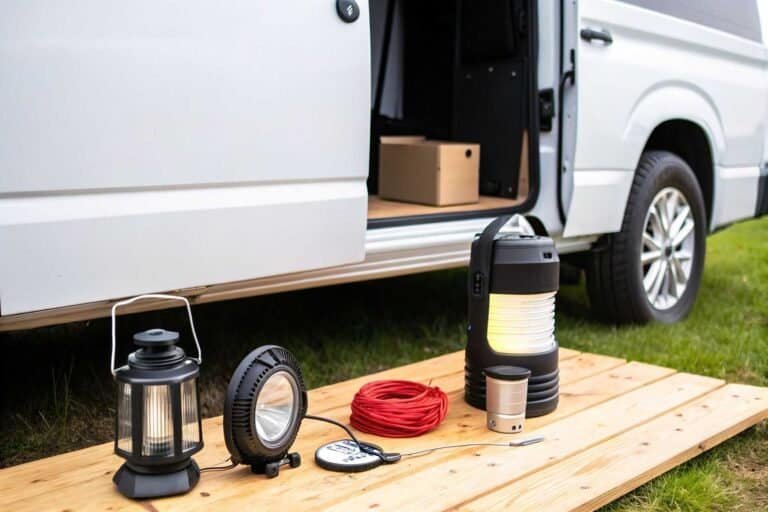
If the headlamp is the essential tool, the lantern is the heart of your mobile home. A good LED lantern casts a wide, 360-degree glow that’s perfect for creating a social, communal atmosphere. It’s the light you plonk on the table for a game of cards or hang from your awning for a late-night dinner.

Modern lanterns are a million miles from the old gas-powered hissers you might remember. They offer adjustable brightness, warm colour tones, and often come with handy extras like a built-in power bank for topping up your phone. Their job is to provide widespread, soft light that makes your little patch of the world feel inviting.

A key advantage of modern lighting is its incredible efficiency.

String Lights: For Atmosphere and Ambience

Don’t write off string lights as just a pretty accessory for the Instagram crowd. While they absolutely excel at creating a cosy, warm vibe inside your van, they are also incredibly practical. They provide a beautiful, low-level, diffused light that’s perfect for relaxing in the evening without the harsh glare of a single, bright source.

And the best part? They draw next to no power, so you can often leave them on for hours without even thinking about your leisure battery. Look for USB-powered versions on a flexible copper wire; they are dead easy to shape around windows, shelves, or your sleeping area, adding a genuine touch of home to your van.

Spotlights and Torches: For Security and Precision

Sometimes, you just need a powerful, focused beam of light. This is where a spotlight or a high-powered torch comes in. It’s your go-to tool for security and seeing what’s happening a long way off. It’s what you’ll grab to investigate that strange noise outside or to light up a path on a late-night walk to the loo block.

While a lantern illuminates a general area, a spotlight cuts right through the darkness with a tight, concentrated beam. It’s not for everyday use, but when you need to see what’s at the far end of a dark field, nothing else will do. Many modern torches also come with multiple modes, including a strobe for emergencies.

Magnetic and Puck Lights: The Versatile Problem Solvers

These little, often puck-shaped lights are the unsung heroes of a well-lit van. Many come with built-in magnets, which is a game-changer. It means you can stick them directly onto any metal surface inside your van—the ceiling, a door, or under a cabinet.

This makes them absolutely perfect for targeted task lighting exactly where you need it, whenever you need it.

  • Kitchen Prep: Stick one under an overhead cabinet to properly light up your chopping board.
  • Reading Nook: Pop one on the van wall next to your bed for a personal reading light.
  • The ‘Garage’: Illuminate the dark corners of your storage area to find that one specific bit of gear you need.

Their versatility and tiny size mean you can move them around as your needs change, filling in any dark spots your main lighting doesn’t reach. They are a simple but brilliant addition to any van.

To make things clearer, here’s a quick rundown of how these different lights stack up in a vanlife context.

Portable Camping Light Comparison for Vanlife

Light TypeBest ForTypical LumensVanlife Use-Case
HeadlampHands-free tasks, repairs100 – 400Fixing the engine, late-night pack-ups, finding the loo.
LanternArea and social lighting200 – 800On the table for dinner, hanging from the awning.
String LightsAmbience, low-level light50 – 200Inside the van for a cosy evening vibe, around the bed.
Spotlight/TorchLong-distance, security500 – 2,000+Investigating noises, navigating dark paths.
Puck/MagneticSpecific task lighting80 – 150Under-cabinet for cooking, reading light, garage storage.

As you can see, each light has a distinct role. Building a small collection—say, a headlamp each, a good lantern, and a few puck lights—will cover almost every situation you’ll encounter on the road.

Right, let’s talk about the specs you see on the box of a portable camping light. It can feel like you need a physics degree to understand what you’re buying. Terms like lumens, Kelvin, and beam angle get thrown around, but what do they actually mean when you’re trying to cook dinner in a drizzly lay-by in the Brecon Beacons?

Let’s cut through the jargon. Think of these numbers not as boring technical details, but as the control dials for the atmosphere inside your van. Getting them right is the difference between a van that feels like a cold, clinical workshop and one that feels like a proper home on wheels. Once you get your head around the basics, you’ll know exactly what to look for.

Lumens: Your Brightness Dial

The first and most common term you’ll see is lumens (lm). In simple terms, it’s just a measure of brightness. More lumens means more light. Easy.

It’s tempting to think that bigger is always better, but for life on the road, the real game-changer isn’t maximum brightness—it’s adjustable brightness. A light that can crank out 500 lumens is brilliant for lighting up an awning while you’re cooking or digging through the back of the van for that thing you know you packed. But inside? That same light would feel like an interrogation lamp and absolutely hammer your leisure battery.

This is why dimmability is your best friend.

A light that can be dialled right down to a gentle 20 or 30 lumens is worth its weight in gold. It’s enough of a glow to see where you’re going without tripping over the dog, but it creates a properly chilled-out vibe and sips power, making your battery last so much longer.

The market has caught on to this. While you can still buy basic torches, the real action is in versatile lanterns that offer a massive brightness range. The ability to go from a powerful 500-lumen area light down to a 20-lumen glow that will last for over 100 hours is exactly the kind of smart adaptability that makes van life easier.

Colour Temperature: Setting the Vibe

Next up is colour temperature, measured in Kelvin (K). This has nothing to do with how hot the light gets; it’s all about describing how ‘warm’ or ‘cool’ the light looks. It’s purely about the mood.

  • Warm White (2,700K – 3,500K): This is that cosy, yellowish glow you’d get from an old-school light bulb or a sunset. It’s calming, relaxing, and exactly what you want for winding down with a book and a cuppa in the evening.
  • Cool White (4,000K – 6,500K+): This is a crisp, almost bluish-white light, much closer to daylight. It’s brilliant for anything task-focused because it helps you concentrate and makes colours look sharper. This is the colour you want for your kitchen area or if you’re fixing something.

Loads of modern portable lights now let you switch between colour temperatures, which is the best of both worlds. You can have a bright, cool light on for chopping veg, then switch it over to a soft, warm glow to chill out afterwards—all from the same unit.

Beam Type: Flood vs. Spot

Finally, you need to think about the beam type, which is all about how the light is spread out. There are two main types you’ll come across, and they do very different jobs.

Floodlight: A flood beam throws a wide, even spread of light over a big area, a bit like a security light in a garden. This is exactly what you want from a lantern. It’s perfect for lighting up the whole van interior or your outdoor seating area. Think broad, general illumination.

Spotlight: A spot beam does the opposite. It concentrates all its power into a narrow, intense ray of light that travels a long way. This is your classic torch beam, ideal for pinpointing something specific in the dark, whether that’s the next trail marker on a night walk or a weird noise you heard at the edge of your park-up.

A truly useful portable camping light will often combine these. You might get a main floodlight for area lighting, a powerful spotlight for distance, and often a red light mode to help you see in the dark without ruining your night vision. This kind of multi-tool approach means one light can do the job of three, saving you precious space and a bit of cash.

Solving the Off-Grid Power Challenge

Power is the lifeblood of a good van trip. It’s what separates a cosy, well-lit home on wheels from a cold, dark metal box after the sun goes down. And when it comes to your portable camping light, how you power it is just as crucial as how bright it is. Get this right, and you’ll have reliable light on tap, no stress involved.

For a lot of people just starting out, the go-to solution is a multipack of AA batteries from the supermarket. They seem cheap and easy, but trust me, it’s a false economy. You’ll burn through them faster than you think, the cost adds up over a long trip, and they’re a disaster for the environment. Think of them as an emergency backup, not a sustainable power strategy for life on the road.

The much smarter, and ultimately cheaper, solution is to go rechargeable. The UK campervan scene is booming, and rechargeable lanterns are dominating the outdoor market for a reason. Spending £15-£40 upfront on a decent rechargeable light can easily save you over £100 a year on disposable batteries. That’s a tank of diesel or a few good meals out.

Embracing USB and Your Leisure Battery

The real game-changer for modern van life is the universal adoption of USB charging. Pretty much every decent portable camping light these days comes with a built-in lithium-ion battery that you can top up with a standard USB cable. This simple fact unlocks a powerful and incredibly efficient way to manage your lighting.

Your van’s leisure battery is the heart of your off-grid electrical system. It’s a hefty, deep-cycle battery designed to provide a steady flow of 12V power for everything from your fridge to your phone charger. By wiring a few 12V USB sockets directly to this battery, you create convenient charging hubs around your living space.

This setup means you can top up your portable lights during the day while you’re driving, or whenever your solar panels are soaking up the sun. It’s a seamless system that ensures your lights are always juiced up and ready for the evening, all powered by your central electrical hub. It’s a far more elegant solution than fumbling for fresh batteries in the dark. If you’re still designing your van’s electrical system, our guide can help you choose the best campervan batteries and inverter setup for what you need.

What About Solar Lights in the UK?

You’ll see plenty of portable lights with little solar panels built into the top. The concept is brilliant: free, endless power from the sun. But let’s be realistic about where we live. While a built-in panel might give you a decent trickle charge on a glorious summer’s day in Cornwall, it’s going to seriously struggle during a week of classic British cloud and drizzle in the Lake District.

My advice? Think of those integrated solar panels as a nice bonus for topping up the battery, not as a primary charging method. They’re a useful supplement, for sure, but you should never rely on them as the only way to power your main lights. Your leisure battery will always be your most dependable off-grid power source.

The Art of Energy Budgeting

To make sure you never get caught in the dark, you need to do a bit of what I call ‘energy budgeting’. It sounds more complicated than it is. Really, it’s just about getting a handle on how much power your lights use and how long your battery can keep them going.

Think of your leisure battery like a water tank. Every device you turn on is like opening a tap. A bright light on full blast is a fully open tap, draining the tank quickly. A dim reading light is just a slow drip.

To figure this out, you just need two numbers:

  1. Light Power Draw (Watts): The manufacturer should list this in the specs.
  2. Battery Capacity (Amp-hours): This will be printed on the side of your leisure battery.

Using a simple formula (Watts ÷ Volts = Amps), you can work out how many amps your light draws per hour. This lets you estimate how long you can run your lights before you need to think about recharging your leisure battery.

A simple energy audit is one of the most empowering things you can do in your van. Knowing that you can run your two favourite lanterns on a low setting for eight hours and only use 5% of your battery gives you incredible peace of mind on a long, dark winter’s night.

Getting your head around these three things—brightness, colour, and beam—is key to choosing a light that not only fits your power budget but also helps create the right atmosphere in your van.

Mounting and Placement for a Smarter Van Interior

A powerful portable camping light is only half the battle; where you put it makes all the difference. Get it wrong, and you’ll cast weird shadows right where you’re trying to chop veg, get blinded every time you sit up in bed, or leave half the van in gloomy darkness.

Smart mounting isn’t about having the fanciest lights. It’s about turning a few individual units into a proper, functional lighting system that makes your small space feel usable and genuinely inviting.

Think of it like lighting a room in your house. You’d never just stick a single, harsh bulb in the middle of the ceiling and call it a day. You need layers. The same logic applies to your van, and the key is flexibility – your lighting needs change completely from cooking dinner to chilling out with a book.

Creating a Flexible Mounting System

The beauty of a campervan is that it’s mostly a giant metal box. This is brilliant news for anyone with magnetic lights. A lot of modern portable lanterns and puck lights have seriously strong magnets built right in, letting you just snap them onto the ceiling, doors, or any bit of exposed metalwork. It’s the simplest, most versatile mounting solution out there, period.

But what about all the lovely wood cladding or carpeted panels you’ve spent ages fitting? This is where a bit of DIY genius comes in. Grab some strong adhesive and stick a few thin metal plates or discs wherever you might need a light. On the side of a kitchen cabinet, above the sliding door, near your bedhead – anywhere. Suddenly, your magnetic portable camping light works everywhere, giving you total control.

Beyond magnets, a few other bits of kit are dead useful:

  • Carabiner Clips: A simple hook or carabiner is brilliant. Hang a lantern from a pop-top roof strut, an awning rail, or even just a cord strung across the van.
  • Adjustable Straps: Some lights come with built-in straps. These are great for wrapping around cabinet handles, headrests, or the grab handles above the doors for a secure, temporary fix.
  • Gorilla Pods: Don’t laugh. A small, flexible tripod is surprisingly handy for wrapping a light around an awkward spot to get the angle just right.

Layering Light for Different Activities

Once you’ve got your mounting options sorted, you can think strategically. The real goal is to create different ‘zones’ of light for specific activities. This simple trick makes your van feel bigger, more organised, and a hell of a lot more liveable. It’s a core principle in designing the perfect campervan layout that so many people miss.

Think about the main areas in your van:

  1. Galley (Task Lighting): Chopping onions in the dark is a recipe for disaster. You need bright, direct, shadow-free light right on your worktop. Stick a puck light or a small bar light directly under your overhead cabinets. A cooler, white light is best here to see what you’re doing.
  2. Seating/Dining Area (Social Lighting): This is where you want a warmer, more inviting glow. A central lantern on the table or hung from the ceiling casts a wide, sociable light that’s perfect for a meal or a game of cards. Dimmability is an absolute must-have here to set the mood.
  3. Sleeping Area (Ambient Lighting): Harsh, direct light is the enemy when you’re trying to wind down. A string of USB-powered fairy lights tucked around the bed frame or a lantern turned down to its lowest setting creates a soft, relaxing vibe. A warm white colour is ideal for helping your brain switch off.

By layering your lighting, you create a dynamic interior. You can have a bright, functional kitchen area while the rest of the van remains a cosy, dimly lit den—all controlled with the placement of a few portable units. This adaptability is the hallmark of a well-thought-out van build.

Choosing Lights That Survive UK Weather

Let’s be honest, the Great British weather is famously unpredictable. One minute you’re enjoying a bit of sunshine, the next you’re wrestling with an awning in a sudden downpour. Your portable camping light needs to be tough enough to handle everything, from a summer shower to the persistent damp of a winter trip. Durability isn’t a luxury here; it’s a core feature that saves you money and a lot of faff.

Investing in a well-built light means you won’t be buying a replacement every season. It needs to survive not just the rain, but also the inevitable knocks, drops, and bumps that come with life on the road in a ridiculously compact space.

Decoding Water Resistance Ratings

When you’re looking at the packaging, you’ll probably see something called an IP rating. This looks like impenetrable technical jargon, but it’s actually a dead simple code that tells you how well a gadget is protected against solids (the first number) and liquids (the second number). For a portable camping light, it’s that second number you really care about.

You’ll often see “IPX4”. The ‘X’ just means it hasn’t been rated for dust protection, which is fine for a light. It’s the ‘4’ that’s the key part.

  • IPX4: Protected against splashing water from any direction.
  • IPX5: Protected against low-pressure water jets from any direction.
  • IPX6: Protected against powerful water jets.
  • IPX7: Can be submerged in up to 1 metre of water for 30 minutes.

For most UK van life scenarios, an IPX4 rating is the perfect sweet spot. This means your light will happily survive being left out in the rain while you’re cooking under the awning. More importantly, it means it can handle the heavy condensation that often builds up inside a van overnight, especially in the colder months. As anyone who has spent time living in a van knows, managing damp is a constant battle. Making sure your gear can withstand it is just as important as knowing how to insulate a van for UK weather in the first place.

Built to Survive Bumps and Drops

Beyond just shrugging off water, your light needs to be physically tough. Life in a van is full of movement. Things get knocked off tables, slide out of cupboards, and occasionally get dropped on hard ground during a late-night setup. A flimsy, brittle plastic case just won’t cut it.

Look for lights with robust features that show the manufacturer has actually thought about how people use them in the real world.

A shockproof design isn’t just a marketing term; it’s a feature that acknowledges the reality of van life. A light protected by a rubberised casing or a sturdy metal frame is far more likely to survive a fall from your camping table onto gravel.

When you’re shopping, check for these simple durability markers:

  • Materials: Look for tough ABS plastic, aluminium, or rubberised sections.
  • Lens Protection: Is the plastic lens recessed to protect it from direct impacts?
  • Sealed Components: Check that battery compartments and charging ports have tight-fitting rubber covers to keep moisture out.

Choosing a durable, weatherproof portable camping light gives you peace of mind. It becomes a reliable tool you know will work when you need it most, regardless of what the British weather decides to throw at you.

Frequently Asked Questions

When you’re wading through the world of portable lighting, a few questions always seem to pop up. Here are the straight-up answers to the queries we hear most from fellow UK van lifers, so you can get your lighting sorted without any faff.

How Many Lumens Do I Really Need for My Campervan?

Honestly, there’s no magic number; it’s all about what you’re doing. For general ambient light to stop you from bumping into things, a lantern chucking out 150-200 lumens is usually spot on. If you’re settling down with a book, a more focused beam of around 80-100 lumens is more than enough.

For proper task lighting – think chopping onions or fixing something under the awning – you’ll want a bit more oomph, somewhere in the 300-500 lumen range. My best advice? Go for versatility. A good portable camping light with a dimmer switch or multiple settings is worth its weight in gold. It lets you go from a soft glow to a powerful work light in seconds, which is also a brilliant way to manage your power.

Can I Charge My Portable Lights from My Van’s Solar Setup?

Absolutely. In fact, this is one of the best parts of having a proper off-grid system. The vast majority of modern portable camping lights now charge via a standard USB cable, just like your phone. If you’ve got a solar panel feeding a leisure battery, you’ve almost certainly got 12V USB sockets dotted around your van.

Just plug your light straight into one of them. It’ll happily sip away at the free energy your panels are pulling from the sun during the day. Some lights even come with their own tiny built-in solar panels, which are fine for a slow top-up on a bright day, but don’t rely on them as your main charging source here in the UK – you’ll be waiting a while.

Are LED String Lights Practical for Van Life?

Not only are they practical, they’re brilliant. While they’re famous for creating that cosy, Instagram-worthy vibe, their real value is in their utility. They provide a fantastic low-level, widespread ambient light that’s perfect for evenings when a harsh, direct glare would just kill the mood.

Because they draw such a tiny amount of power, you can leave them on for hours without giving your leisure battery a second thought. My tip is to look for USB-powered, warm-white versions on a flexible wire. They’re dead easy to shape around windows, shelves, or your bed frame and instantly make the space feel more like a home.

What Does an IPX4 Rating Mean?

In simple terms, an IPX4 rating means the light is protected against splashing water from any direction. For most UK van life situations, this is exactly what you need. It’ll handle being used in the rain under an awning and won’t flinch at the condensation that inevitably builds up inside a van on a cold morning.

You couldn’t chuck an IPX4-rated light in a river, but it’s more than tough enough to cope with the typical damp and drizzle you’ll face on a British road trip. It’s the standard level of water resistance you should be looking for in a reliable portable camping light.


At The Feral Way, we provide tested, no-nonsense guides to help you build a campervan that truly works for life on the road. Find more practical advice and real-world build guides at https://www.theferalway.com.

Picking a campervan satellite dish is your ticket to getting decent TV reception when you’re parked up in the middle of nowhere and the normal aerial isn’t cutting it. Your choice really boils down to two paths: a flexible, portable dish you set up on the ground, or a permanent, fixed dish bolted to your roof.

The right one for you depends entirely on how you travel, what your budget is, and how much faff you’re willing to put up with every time you park.

Choosing Your Ideal Campervan Satellite Dish

This is the first big decision, and it’s a classic vanlife trade-off: convenience versus flexibility. There’s no single right answer, just the right answer for your van and your adventures. Let’s get into the nitty-gritty of the two main setups.

Portable Ground-Mounted Systems

This is the system most people start with. It’s a standalone dish on a tripod that you lug out and set up every time you stop. It’s the go-to for weekend trips or for anyone who breaks out in a cold sweat at the thought of drilling holes in their roof.

The big win here is flexibility. If you’ve found the perfect pitch but it’s tucked under a massive oak tree blocking the southern sky, no problem. You can just run a longer cable and plant the dish in a clearing 10 metres away. They’re also usually cheaper and you can easily move the whole kit to a different van if you upgrade.

But that flexibility has its price. You have to find somewhere to store the dish, the tripod, and all the wiring inside your van, which eats into precious space. Setting it up and taking it down every time can become a real chore, especially when it’s lashing it down with rain. They’re also an easy target for strong winds or anyone who fancies nicking it while you’re out for a walk.

Fixed Roof-Mounted Systems

A fixed satellite dish is permanently installed on your van’s roof. This is the top-tier option for convenience, especially the fancy automatic ones that find the satellite for you at the push of a button. There’s zero setup, it doesn’t take up any living space, and it’s securely bolted to your vehicle.

For those considering their options, understanding the nuances of Campervan Satellite Dish Installation is essential to ensure you make the best choice for your travel needs.

For those looking to enhance their camping experience, understanding the process of Campervan Satellite Dish Installation can make a significant difference.

If you’re a full-time vanlifer or out most weekends, this is the dream. The biggest hurdles are the much higher initial cost and the fact you’re committing to a permanent, properly sealed hole in your roof. Your parking spot is also your only option; if a tree is in the way, your only choice is to move the entire van.


Portable vs Fixed Campervan Satellite Dish

To make it dead simple, here’s a head-to-head comparison. Think about what matters most to you—ease of setup, cost, or the ability to park anywhere.

FeaturePortable Ground-MountFixed Roof-Mount
ConvenienceLow – manual setup every timeHigh – always ready to go
FlexibilityHigh – can be moved to avoid obstaclesLow – limited by van’s position
Initial Cost£100 – £300£500 – £2,500+
StorageTakes up internal van spaceNone required
InstallationNone – it’s portablePermanent drilling required
SecurityVulnerable to theft and windVery secure
Best ForWeekend trips, budget builds, those who hate drilling holesFull-timers, frequent travellers, convenience seekers

Ultimately, there’s no substitute for thinking about how you actually travel. If you’re a fair-weather camper who sticks to open sites, a fixed dish is brilliant. If you love tucking yourself away in wooded spots, a portable dish will save you a lot of frustration.


A quick bit of history that’s actually useful: in February 2014, the UK’s satellite signal coverage got a massive upgrade. Before then, you often needed a huge 60cm or 75cm dish to get a reliable picture. Now, a much more compact 45cm dish is all you need for most of the UK. The Camping and Caravanning Club has a great write-up on how this changed things for tourers.

Of course, once you’ve got a signal, you need a decent screen to watch it on. To finish off your entertainment setup, check out our guide on choosing the best TV for campervans.

How to Mount and Seal a Roof Dish Without Leaks

Drilling into your campervan roof for the first time… it’s a moment that separates the casual enthusiast from the truly committed. It feels like a point of no return, but trust me, getting a professional, leak-free finish is easier than you think if you’re just methodical about it.

The long-term success of your dish installation really boils down to two things: getting the placement absolutely spot-on and creating a seal that’s completely bombproof. Nail these, and you’re set for years of trouble-free telly.

Selecting the Perfect Mounting Spot

First things first, you need to decide where this thing is going to live. This isn’t just about finding a flat bit of roof; you’ve got to think in three dimensions and consider how your van will interact with the world around it.

  • Obstruction-Free Zone: Make sure the dish has a clear 360-degree view when it’s raised. Look for potential conflicts with roof vents, skylights, and especially solar panels, which could cast a shadow on the dish or vice versa.
  • Aerodynamic Placement: If you can, position the dish behind existing roof furniture like a pop-top or a large skylight. This helps shield it from the worst of the wind resistance while driving, which reduces strain on the mountings and cuts down on wind noise.
  • Internal Access: Before you even think about drilling, get inside the van and check what’s on the other side of your chosen spot. You need to avoid drilling into structural roof supports, hidden wiring looms, or right above a cabinet where you can’t get a spanner in to tighten the bolts.

Once you’ve found that perfect spot, mark the positions for the mounting plate and where the cable will enter using a pencil. Take a deep breath—it’s time to prep the surface.

A critical mistake I’ve seen people make is rushing the prep stage. A clean, properly keyed surface is non-negotiable for a lasting bond. Taking an extra 10 minutes here will save you hours of leak-hunting and misery down the line.

Creating a Watertight Seal

The real secret to a permanent, waterproof seal isn’t just slapping on a load of sealant and hoping for the best. It’s about creating the perfect conditions for that sealant to bond properly with your roof.

Start by giving the marked area a thorough clean with an alcohol-based cleaner. This gets rid of any road grime, wax, or dirt. Next, lightly scuff the paintwork inside your marked area with fine-grit sandpaper. This process is called ‘keying’, and it gives the sealant a rough surface to physically grip onto, creating a much stronger mechanical bond.

When it comes to the sealant itself, don’t cut corners. A top-quality, flexible adhesive sealant like Sikaflex 522 is pretty much the industry standard for a reason. It’s designed to handle the vibration and temperature swings a campervan roof endures and it’s UV-stable, so the sun won’t destroy it in a year.

Apply a generous, continuous bead of sealant inside your marked area and around each drill hole. Place the mounting plate down firmly, letting the sealant squeeze out around the edges. Bolt it down from the inside, but don’t go crazy overtightening—you want the sealant to form a flexible gasket, not be squeezed out completely.

For the cable entry point, you absolutely need a dedicated gland. To prevent water getting in where the cables come through the roof, a proper seal is crucial.

Finally, just be patient. Let the sealant fully cure according to the manufacturer’s instructions. This usually means waiting at least 24 hours before you even think about hitting the road.

Wiring Your Campervan Satellite System

Right, the dish is bolted and sealed to the roof. Now for the bit that separates a pro job from a leaky disaster: getting the cables inside. The aim here is to make the wiring look like it was always part of the van – neat, tidy, and completely weatherproof.

The main artery of your system is the coaxial cable. This is what carries the signal from the dish’s LNB (the little arm at the front) down to your receiver or telly. It’s tempting to just drill a hole and squirt a load of silicone in, but that’s asking for trouble.

Trust me, the proper way is to use a waterproof cable entry gland. It’s a cheap bit of kit that creates a compression seal around the cable, making it genuinely watertight. Drill your entry hole near the dish mount, feed the cable through, fit the gland, and tighten it up. Slap a generous bead of a good sealant like Sikaflex 522 around its base for good measure. Job done, no leaks.

Powering Your Satellite System

If you’ve gone for a simple manual dish, the coaxial cable is your only worry. But if you’ve got an automatic or semi-automatic system, it needs 12V power for its motors and brainbox. This means running another cable from your leisure battery.

Don’t just tap into the nearest wire. Run a dedicated power line and always, always install an inline fuse close to the battery. This is non-negotiable; it protects the expensive satellite electronics from any power spikes. Check the manufacturer’s specs, but a 5-amp or 7.5-amp fuse is usually all you need.

My top tip is to run the 12V power cable right alongside the coaxial one, feeding both through the same entry gland if it’s big enough. It keeps the roof penetration down to a single point, which massively reduces your chances of a leak down the line.

Once the wires are inside, it’s just a case of connecting the dots.

  • Coaxial Cable: This plugs into the ‘LNB IN’ or ‘SAT IN’ port on your satellite receiver box. If your TV has a satellite tuner built-in, it might go straight into the back of that.
  • 12V Power Cable: This feeds the control box for your automated dish. Get your positive (red) and negative (black) wires the right way round or you’ll be buying a new control box.

To avoid a mess of dangling wires, use small cable clips or a bit of plastic trunking to route them neatly from the ceiling down to your TV area. A bit of planning here saves a massive headache later.

If you’re new to campervan electrics, it’s worth getting your head around the basics first. Our complete guide explaining campervan electrical systems is the perfect place to start. A tidy, well-thought-out electrical system is the foundation of a reliable van.

Finding a Signal and Aiming Your Dish

Right, so you’ve got this beautiful new satellite dish perfectly installed on your campervan. Brilliant. Now for the bit that feels like a dark art but is actually pretty simple once you’ve done it a couple of times: pointing it at a tiny metal box hovering 22,000 miles away in space.

The goal is to get a completely clear, unobstructed view of the Astra 2 satellites, which hang out in a fixed spot to the south-east.

Before you even think about touching the dish, just use your eyes. Look south. Can you see anything that might get in the way? I’m talking tall trees, buildings, or even that massive high-sided motorhome that just parked next to you. An obstructed view is the number one reason people fail to get a signal. Even a few pesky branches waving in the wind can be enough to ruin your picture, so always park in the clearest spot you can find.

The Three Key Adjustments

When you’re aiming a manual dish, you’re basically juggling three settings to get them just right. It sounds a bit technical, but it’s just logic.

You need to nail:

  • Elevation: This is simply the up-and-down angle of the dish. For most of the UK, you’ll be aiming for somewhere between 20-30 degrees up from flat.
  • Azimuth: This is the side-to-side direction. You’re pointing the dish roughly south-east to find the Astra 2 cluster.
  • Skew: This is that slight twist you can give the LNB (the little receiver arm at the front). It fine-tunes the signal polarity, and a tiny rotation here can make a massive difference to picture quality.

Honestly, the easiest way to get your bearings is with a satellite finder app on your phone. Something like Satellite Finder or SatFinder Lite uses your phone’s camera and GPS to literally show you where the satellite is in the sky. It’s a fantastic way to get a rough alignment sorted in seconds.

Once an app gets you in the ballpark, the real fine-tuning happens with your TV’s built-in signal strength meter. Slowly, and I mean slowly, sweep the dish left and right, then up and down in the tiniest of movements. Keep your eye on the signal quality bar, not just the strength. Patience is everything here; a nudge of just half a degree can be the difference between a perfect picture and that dreaded ‘No Signal’ message.

After a few trips, this whole process becomes second nature. Even with a fully manual system, you’ll soon be parking up and locking onto a signal in minutes, ready to get the kettle on before the TV guide has even loaded.

Is a Campervan Satellite Dish Your Best Option?

Let’s be honest. Before you start drilling holes in your roof for a satellite dish, you need to ask yourself if it’s genuinely the best tool for the job. For a growing number of us living the van life in the UK, the answer is a firm “no.” The romance of live TV wherever you park is strong, but the reality of modern connectivity offers far better, more versatile options.

The game-changer? Decent mobile internet. I’m not talking about tethering to your phone. I mean a proper 4G/5G router paired with a high-gain external antenna. This kind of setup can pull in a usable signal even in spots where your phone shows one lonely, flickering bar. Suddenly, your van is a proper WiFi hotspot.

This setup does more than just let you stream BBC iPlayer or Netflix on a rainy evening. It’s the difference between being connected and being isolated. It means you can work from the van, take video calls, plan your next stop, and stay in touch with family. It’s a single solution for both entertainment and the practicalities of life on the road. We’ve got a full guide on putting these systems together right here: portable WiFi for campervans.

Mobile Internet vs. Satellite TV

Think about what you actually need. A satellite dish is a one-trick pony; it gets you broadcast television. That’s it. But a dedicated internet setup gives you everything. Are you just trying to catch the evening news, or do you also need to fire off some emails, look up a route on Google Maps, and then crash out with a film?

Let’s talk brass tacks. For most of us travelling in the UK, a solid 4G setup is the smarter choice. A 2021 analysis confirmed what most of us already knew: we rarely venture so far off-grid that we lose 4G service entirely. The cost difference is stark. A complete 4G WiFi system will set you back around £350, with an unlimited data SIM costing about £20 a month. That’s a fraction of what you’d spend on satellite internet. You can dig into the details on this at Maxview.co.uk.

Now, if you’re planning to disappear into the most remote corners of the Scottish Highlands or deep into Europe where even a boosted signal gives up the ghost, that’s when satellite internet comes into play. But it’s a whole different beast.

The Rise of Satellite Internet: Starlink

For the digital nomads who genuinely depend on a bulletproof connection to make a living, Starlink has been a revelation. It offers high-speed internet almost anywhere on the planet with a clear view of the sky. Suddenly, taking a video conference from a deserted glen in Scotland isn’t just possible, it’s reliable.

But—and it’s a big but—the cost is serious. You’re looking at several hundred pounds for the hardware upfront, and the monthly subscription is significantly more than a 4G data plan. It’s also thirsty for power, which is a major headache for anyone running an off-grid electrical system.

  • Starlink Pros: Unbeatable coverage in the back of beyond. Genuinely fast internet for demanding work.
  • Starlink Cons: Eye-watering initial and monthly costs. A serious drain on your leisure battery. The hardware is bulky and a pain to store.

For most vanlifers, Starlink is total overkill. A well-thought-out 4G/5G system provides all the bandwidth you need for streaming and daily browsing at a much lower cost and with a far gentler power draw.

No matter which satellite system you choose—be it for old-school TV or cutting-edge internet—you’ll need to get good at aiming it.

This diagram shows the three crucial adjustments—elevation, azimuth, and skew—you have to nail to lock onto a signal. Getting this process down is fundamental, whether you’re trying to watch the news or join a Zoom call. At the end of the day, the right choice comes down to a hard look at your real-world needs, your budget, and how you actually travel.

Common Questions About Campervan Satellite Dishes

Even after you’ve picked a system and sketched out the installation, there are always a few nagging questions that pop into your head. It happens with every part of a van build.

Let’s run through some of the most common queries I hear from fellow vanlifers. Think of this as the stuff I wish someone had told me straight when I was first staring at satellite options, completely bewildered.

How Much Power Does a Satellite Dish Actually Use?

This is a massive deal for anyone living off-grid, and rightly so. Your power budget is everything. The answer depends entirely on what kind of dish you’ve got.

A simple, manual dish uses precisely zero power from your leisure battery. Nothing. All the work is done by your satellite receiver box or the TV’s built-in tuner, which usually sips a very small amount of 12V power.

An automated satellite dish, on the other hand, is a different beast entirely. When those motors are spinning around trying to find a signal, they can pull a chunky 4 to 6 amps. Once it’s locked on, the power draw drops to almost nothing, but that initial search can put a real dent in your battery, especially on a grey day with no solar coming in.

If you’ve got a smaller battery bank – say, around 100Ah – that initial power draw is something you really need to factor into your daily budget. Firing up an automatic dish a few times during a bleak British winter could drain your juice much faster than you’d expect.

Will My Satellite Dish Work in Bad Weather?

Mostly, yes. Modern satellite systems are surprisingly tough and will keep a solid picture through light-to-moderate rain and cloud. You might notice the signal quality percentage on your TV dip a little, but it’s rarely enough to actually break up the picture.

The exception is properly torrential, biblical-style rain or very heavy, wet snow. This can sometimes cause the signal to drop out completely, a thing called ‘rain fade’. It happens because the sheer amount of water in the air literally gets in the way of the microwave signal from space. The good news is these blackouts are usually short-lived. As soon as the worst of the storm passes, your picture will pop right back on.

Can I Use My Sky Q Box in My Campervan?

Technically, you can, but honestly, it’s usually more hassle than it’s worth. The standard LNB (the little receiver bit on the dish’s arm) on a campervan satellite isn’t compatible with the ‘wideband’ signal a Sky Q box needs to function. To get it working, you’d have to source and fit a special wideband LNB onto your dish.

Even then, Sky Q boxes are designed for a house plugged into the mains. They can be pretty power-hungry and aren’t really built for the rough-and-tumble of a 12V off-grid system. For most of us, a dedicated 12V satellite receiver or a TV with a built-in Freesat tuner is a much simpler, more robust, and more power-efficient way to get all the free-to-air UK channels.


At The Feral Way, we provide practical, road-tested advice for every stage of your van conversion journey. Explore our other guides and build your dream van with confidence. Find out more at https://www.theferalway.com.

Welcome to van life, where clever packing is just as important as your next destination. If you get your clothing wrong, you’ll either be shivering in a wet fleece on the coast or sweating through a thick cotton hoody in a surprise heatwave. Get it right, and you’ll be comfortable, dry, and ready for anything the famously unpredictable UK weather throws at you.

The secret isn’t just packing less; it’s packing smarter. It all boils down to a versatile, high-performance capsule wardrobe built on a solid layering system. Forget fashion for a moment and think function. We’re talking about durable technical fabrics like merino wool and quick-drying synthetics that earn their keep.

Building Your Foundation: A Van Life Capsule Wardrobe

Van life has a way of forcing a “less is more” philosophy on you, and nowhere is this truer than with your clothes. Forget trying to cram your entire home wardrobe into a tiny cupboard; success on the road comes from a carefully curated collection where every single item serves a purpose.

Think of it not as a closet, but as a toolkit for adventure.

Your goal is to build a van life capsule wardrobe—a small, hardworking collection of items that can be mixed and matched to create dozens of outfits. This isn’t about chasing trends. It’s about performance, durability, and versatility. In the UK’s four-seasons-in-a-day climate, that means prioritising technical fabrics and a smart layering system over bulky, single-purpose jumpers.

When preparing for van life, it’s crucial to consider your Van Life Clothing Essentials to ensure you’re equipped for the journey ahead.

Why Every Item Must Be Multi-Functional

Space is the ultimate luxury in a campervan. The average UK conversion gives you just 6 to 10 cubic metres of interior volume for everything—your bed, your kitchen, your gear, and your clothes. This brutal reality is why seasoned van lifers swear by the capsule approach, often revolving around just 8–12 core garments that can be worn in multiple ways. This strategy keeps your clothing situation from getting out of hand and aligns with a more sustainable, minimalist mindset. If you’re curious about the nitty-gritty of van layouts, you can learn more about UK van conversion trends to see just how tight these spaces are.

Getting this right transforms your limited closet space from a source of stress into a streamlined tool for any adventure. Before we get into the specifics of fabrics and layering, let’s have a quick look at the essential clothing categories you’ll need to build your own toolkit.

Quick-Look Van Life Wardrobe Essentials Checklist

This isn’t an exhaustive list, but it’s the solid foundation you’ll build everything else upon. Think of these as the non-negotiables for staying comfortable and prepared on the road in the UK.

Clothing CategoryPrimary FunctionRecommended Quantity
Base LayersMoisture-wicking and next-to-skin comfort3-4 Tops
Mid LayersInsulation and warmth1-2 Fleeces/Jumpers
Outer ShellWind and rain protection1 Waterproof Jacket
TrousersVersatility for hiking and daily wear2-3 Pairs
FootwearCovering all terrains and situations3 Pairs (Hike, Town, Camp)

With these core items in your arsenal, you’ve got the building blocks for a wardrobe that works as hard as you do, no matter what the weather forecast says.

Mastering the Art of Layering for UK Weather

If there’s one secret to staying comfortable in a van, it’s this: it’s not about having more clothes, it’s about having the right ones. Learning how to layer properly is the single most important skill for dealing with the UK’s ridiculously fickle weather. Forget those bulky jumpers that hog precious cupboard space—three or four smart layers can do the job of a dozen different items, trust me.

Think of layering as building a personal, weather-proof shelter for your body. It’s a simple, three-part system that you can adapt to pretty much any condition, from a damp Cornish morning to a blustery day in the Scottish Highlands. Getting this right is the foundation of your entire van life clothing essentials list.

The Three Layers Explained

Each layer has a very specific job. When they work together, they keep you warm, dry, and comfortable, no matter what the weather decides to throw at you.

  • Base Layer: This is your second skin. Its only job is to wick moisture (that’s sweat, folks) away from your body to keep you dry. This is where materials like merino wool or good quality technical synthetics are worth their weight in gold.
  • Mid-Layer: This is your insulation. It’s all about trapping your body heat to keep you warm. A decent fleece or a lightweight down-puffy jacket is perfect here.
  • Outer Shell: This is your shield against the elements. It protects you from wind and rain, plain and simple. A high-quality waterproof and windproof jacket isn’t just nice to have; it’s non-negotiable in the UK.

Visualising your clothes like this makes it much easier to see how a few key pieces in each category create a system that can handle anything.

Why This System Is a Game-Changer for UK Van Life

The UK’s climate makes layering an absolute necessity. I’m talking about a country where the mean annual rainfall can swing from 500 mm in the east to over 2,000 mm in the western uplands, and winter temperatures often just hover between a damp 2–7°C. This wild variability demands a clothing system that can adapt instantly, something a single thick coat just can’t do.

A proper layering system also has a massive impact on your comfort inside the van. If you’re warm, you rely less on your diesel heater. That saves fuel and helps create a more stable, less damp climate inside your tiny home. Keeping the van warm and dry is just as vital as keeping yourself warm, which is why you should also check out our guide on how to insulate a van for UK weather.

The goal is to regulate your temperature by adding or removing layers, not by blasting the heater. A good merino base layer and a fleece can often keep you perfectly comfortable on a chilly evening without ever touching the thermostat. This saves fuel and, crucially, reduces condensation—a constant battle in van life.

Ultimately, this system saves an incredible amount of space. A compressible down jacket, a thin waterproof shell, and a couple of base layers pack down to a fraction of the size of traditional coats and bulky jumpers. That frees up vital storage for the other things you actually need on the road.

Designing Your Year-Round Capsule Wardrobe

Alright, let’s get practical and start building your wardrobe piece by piece. The secret to not losing your mind over clothes in a tiny space is creating a capsule wardrobe. The goal is simple: a small, hard-working collection where everything mixes and matches. It’s how you get dozens of different outfits from just a handful of items – and it’s the only real solution to the tiny-closet problem.

The foundation of a good capsule wardrobe is a solid, neutral colour palette. Think greys, blacks, navy blues, and earthy tones like khaki or olive. These colours all work together, they’re brilliant at hiding a bit of trail dirt, and they let you add a splash of personality with a single bright item—like a beanie or a fleece—without needing a dozen different options.

Building Your Core Collection

Every van lifer needs a set of foundational items that work no matter the season. These are your ride-or-die pieces, the ones you’ll reach for day in, day out. You’re aiming for around 10-15 core items that will form the absolute backbone of your wardrobe.

Your core collection should include things like:

  • Merino Wool T-Shirts (3-4): The undisputed champions of base layers. They’re breathable, brilliant at regulating temperature, and you can wear them for days before they even think about smelling.
  • Versatile Trousers (2 pairs): One pair should be durable, quick-drying hiking trousers. The other could be a comfortable pair of stretch chinos or jeans that you can wear into town without looking like you’ve just scrambled up a mountain.
  • A Solid Mid-Layer (1-2): A quality fleece or a compressible down-puffy jacket is essential for insulation. This is a workhorse in your layering system.
  • Waterproof Outer Shell (1): As we’ve already covered, this is your non-negotiable shield against the famously reliable British weather.
  • Comfortable Leggings or Joggers (1 pair): Perfect for lounging in the van, sleeping on cold nights, or even pulling on as a thermal base layer under your trousers.
  • A “Nicer” Top (1): Have one smart-casual shirt or jumper ready for those rare pub dinners or the occasional client Zoom call.

This small collection, combined with your underwear and socks, gives you a surprisingly wide range of options for daily life on the road.

Adapting for the UK Seasons

The real beauty of a capsule wardrobe is how adaptable it is. Your core items stay put year-round; you just swap out a few small, seasonal bits and pieces. This approach saves an incredible amount of space compared to lugging around separate summer and winter wardrobes.

Think of your core wardrobe as the permanent resident of your van. The seasonal add-ons are just temporary visitors, brought in to handle specific conditions and then stored away until they’re needed again.

Here’s a look at how this works in the real world.

Core Capsule Wardrobe vs Seasonal Add-ons

This table shows how a handful of seasonal items can completely transform your core wardrobe to handle anything the UK weather throws at you.

Core Year-Round Items (Example)Summer Add-onsWinter Add-ons
Merino T-ShirtLightweight ShortsThermal Leggings
Fleece Mid-LayerSwimsuitInsulated Beanie
Hiking TrousersSun Hat or CapWarm Gloves
Waterproof JacketTank TopThick Wool Socks

As you can see, you don’t need a massive amount of gear. By adding just four items, you can comfortably handle a summer hike in the Peak District or a frosty winter evening in the Cairngorms.

This strategic approach to van life clothing essentials is what makes long-term travel in a tiny space not just possible, but comfortable too.

Choosing Footwear and Work-Ready Van Attire

Life on the road isn’t just muddy hiking trails and windswept beaches; it’s also about exploring cities, nipping into a café for a work session, and spending long days behind the wheel. Your footwear and daily clothes need to be a bridge between proper outdoor adventure and practical, everyday living. Getting this right is a huge part of feeling comfortable in the van.

Shoes are notoriously bulky, and in a small space, every single pair has to earn its keep. Most seasoned UK van lifers eventually settle on a core trio that handles pretty much anything you can throw at it.

  • Durable Hiking Boots: A non-negotiable for exploring the fells, coastal paths, and forests. Look for something properly waterproof with good ankle support – you’ll be glad of it on a boggy path in the Brecon Beacons.
  • Comfortable Town Shoes: For city days, supply runs, and long drives. This could be a pair of decent trainers or something more versatile like Blundstones that are comfy but still look smart enough for the pub.
  • Easy-on Camp Sliders: A simple pair of sliders or insulated slippers is an absolute game-changer. Perfect for quick trips out of the van to check the gas or just relaxing at a campsite without lacing up boots.

When you’re choosing what to bring, think comfort and support above all else. You spend a surprising amount of time on your feet in a small space. This guide to comfortable shoes for standing all day has some great pointers on features to look for, even though it’s not van-specific.

The Art of the ‘Zoom-Ready’ Wardrobe

For many of us, van life is tied to remote work, and that means looking presentable for video calls is a very real thing. The secret weapon here is the “Zoom mullet”—professional on top, comfy on the bottom.

This simple approach means you can stay relaxed during long work sessions but be ready for an unexpected client call in seconds. It’s all about blending professional needs with the realities of living in a tiny home. If you’re figuring out your mobile office, our ultimate guide to a work-from-van setup for 2025 is essential reading.

A smart merino wool jumper is the perfect example of this. It looks polished on camera, doesn’t wrinkle when it’s been stuffed in a cupboard, and is incredibly comfortable for driving or lounging. It’s a genuine investment piece that serves both your work life and your adventures.

Team one or two smart tops like that with comfortable, multi-purpose trousers. Something like stretch chinos looks miles better than hiking gear on a call but is still flexible enough for a long drive or a spontaneous walk. This tiny capsule wardrobe ensures you’re always prepared to blend work and travel without a second thought.

Smart Storage and Laundry on the Road

Right, you’ve nailed your van life wardrobe. That’s only half the battle. Now you’ve got to figure out how to store it all in a space that’s probably smaller than your wardrobe back home, and then somehow keep it clean.

Success here boils down to two things: clever organisation and a realistic laundry routine. Get this wrong, and your tiny home will descend into clothing chaos faster than you can say “where are my clean socks?”. With a few simple tricks, though, you can keep your minimalist wardrobe tidy, fresh, and easy to get to, freeing you up to actually enjoy the adventure.

Maximising Every Inch of Storage

Your van is full of untapped storage potential. The trick is to stop thinking horizontally, like you would in a house, and start thinking vertically. It’s all about using tools that compress and categorise your clothes, turning awkward cupboards into genuinely efficient spaces.

  • Packing Cubes: These are non-negotiable. Seriously. Use them to separate your gear—tops in one, trousers in another, socks and undies in a third. They basically act as removable drawers, letting you grab exactly what you need without digging through a mountain of clothes and messing everything up.
  • Vacuum Storage Bags: Absolutely brilliant for bulky seasonal stuff you don’t need every day, like that massive winter coat or your thermal base layers. Compressing these can free up a shocking amount of room under a bench seat or in the back of a cupboard.
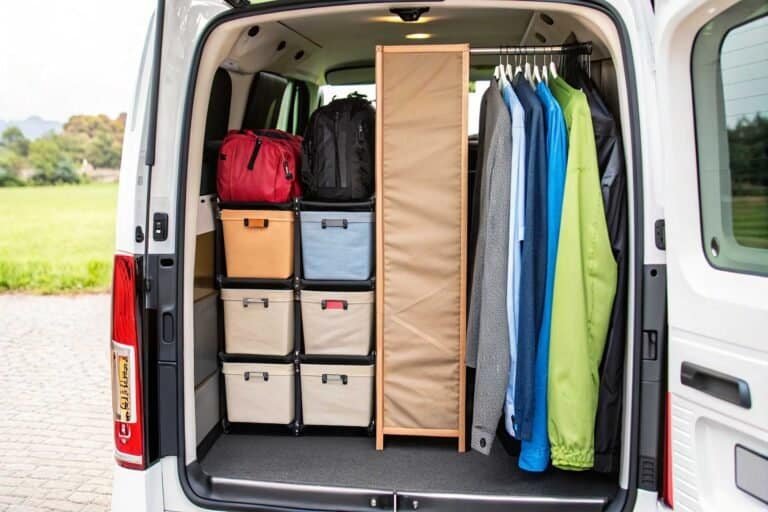
  • Vertical Organisers: Those hanging fabric shelves can transform a small, tall cupboard from a useless void into a functional wardrobe. Since most vans lack anything resembling a proper closet, learning some clever hacks for storing clothes without a traditional closet can be an absolute game-changer.

If you’re still in the build phase, you can incorporate many of these storage ideas from the get-go. For some inspiration on building clever, multi-functional spaces, have a look at our guide to van conversion furniture.

Tacking Laundry Day on the Road

How you plan to do your laundry has a direct impact on the clothes you should pack. With limited water and space, most of us in the UK van life scene end up wearing things multiple times between washes. A good rule of thumb is to plan for outer layers to last 7–14 wears, while base layers get 2–5 wears.

Even with a minimalist wardrobe, this means you’ll probably need to find a way to do laundry every 7–10 days to stay feeling fresh.

When wash day does roll around, you’ve got a few options:

  • Launderettes: The classic. They’re found in most towns and on many of the larger UK campsites. It’s the most straightforward way to get a proper wash and dry done.
  • Hand-Washing: A Scrubba Wash Bag or even just a collapsible bucket with some eco-friendly soap works wonders for small loads. It’s perfect for tackling underwear, socks, or a muddy t-shirt without needing to find a machine.
  • Portable Washers: If you have the space and the power budget, small manual or 12V washing machines are an option. They’re a bigger investment but can be worth it for long-term off-grid living.

A crucial bit of advice for dealing with damp clothes in a van: prioritise airflow. Always crack a window or run a fan when you’re drying anything inside. If you don’t, you’ll be dealing with condensation and mildew—two of a van lifer’s biggest enemies. This is where quick-drying fabrics really prove their worth.

Your Van Life Clothing Questions, Answered

Let’s be honest, moving into a van is a massive learning curve. And for all the big stuff like electrics and toilets, it’s often the small, day-to-day things like clothing that throw up the most questions. Even with the perfect capsule wardrobe, real life on the road brings up situations the guides don’t always cover.

This is where we get into the nitty-gritty. Think of this as your go-to reference for those specific, practical problems that pop up once you’re actually out there, from managing the dreaded damp to the age-old question of how many pairs of pants is actually enough.

How Many Socks and Underwear Should I Actually Pack?

This is the number one question for a reason – get it wrong, and it dictates how often you’re desperately hunting for a launderette. My solid rule of thumb after years on the road is 7 to 10 pairs of each. This gives you a full week before things get critical, plus a few essential spares for emergencies.

But the real secret isn’t the number, it’s the material. This is where you need to get specific.

  • Socks: Go for merino wool or a quality synthetic blend. They wick moisture away, dry quickly, and are naturally anti-bacterial, meaning you can often squeeze an extra day’s wear out of them if you’re in a pinch. Avoid cotton socks completely. They’re like sponges for sweat, leading to cold, damp feet and blisters. A truly miserable experience in a van.
  • Underwear: The same quick-drying principle applies. Choosing the right fabric makes hand-washing a single pair in a sink a genuinely viable option. When you’re off-grid and need a fresh pair for the morning, this is a game-changer.

Packing this amount means that running out of clean smalls is never the main reason you’re forced back to civilisation.

What Is the One Clothing Item Worth Splurging On?

If you can only invest real money in one high-quality piece of gear, make it your waterproof and windproof outer shell jacket. The UK weather is famously fickle, and a sudden downpour can completely ruin a day, not to mention make your tiny living space damp and miserable. A cheap jacket will fail, and I guarantee it will fail at the worst possible moment.

A top-tier jacket from a reputable outdoor brand like Rab, Arc’teryx, or Patagonia is more than just clothing; it’s an investment in your comfort, safety, and morale. Look for proven waterproof membranes like Gore-Tex or the brand’s own high-performance equivalent. It’s the one layer that absolutely has to work, every time.

This jacket will be one of the hardest-working items in your wardrobe. You’ll throw it on over a t-shirt on a blustery summer day on the Cornish coast and layer it over a thick fleece in the depths of a Scottish winter. Its immense value makes it the single most worthwhile splurge in your entire van life collection.

How Do I Deal with Wet Clothes Inside a Small Van?

Managing damp is one of the biggest challenges in van life. It quickly leads to condensation, musty smells, and even mildew. The key is to have a system and act fast. Never, ever just pile wet clothes in a corner and hope for the best. It’s a recipe for disaster.

First, wring out wet items as thoroughly as possible before they even cross the threshold of your van. Next, a small, retractable washing line you can string up across the van is a brilliant investment. Position it near a window or your roof vent to maximise airflow. If you have the power, pointing a small 12V fan at the clothes will speed things up dramatically.

But the most critical part of the equation is ventilation. You have to give that moist air a way to escape. Crack your windows open (wind deflectors are great for this, as you can leave them open even when it’s raining) or run your roof fan on a low setting. This constant air exchange is essential to stop your van from turning into a mobile steam room.

Are There Sustainable and Budget-Friendly Clothing Options?

Absolutely. Building a high-performance wardrobe doesn’t have to mean buying everything brand new from expensive outdoor retailers. In fact, some of the best options are also the most sustainable and affordable.

Charity shops, especially in towns near popular outdoor areas like the Lake District or Snowdonia, can be absolute goldmines for high-quality, pre-loved gear. Also, get familiar with online resale platforms like Vinted, Depop, or specialised outdoor gear exchange websites and Facebook groups. So many people buy expensive kit, use it once for a trip, and then sell it for a fraction of the original price.

This approach isn’t just lighter on your wallet; it’s significantly better for the planet.

  • Buy Second-Hand: Give quality gear a second life and save a packet.
  • Choose Sustainable Brands: If buying new, look for companies that use recycled materials and offer repair programmes, like Patagonia’s Worn Wear.
  • Repair Your Gear: Don’t bin a jacket with a broken zip or a tear. Learning a few basic repair skills extends the life of your clothing and is a core part of a sustainable mindset.

Ultimately, the most sustainable choice is to buy less, choose durable items that will last for years, and commit to repairing them when they eventually show signs of a life well-lived.


At The Feral Way, we focus on providing no-nonsense guides and tested advice to help you build a campervan that’s ready for real-world UK adventures. From electrical systems to clever storage, find everything you need to start your journey. Learn more at The Feral Way.

Right, let’s get into the most important part of any van build: the layout. This is where you turn a cold, empty metal box into a space that actually works for you. Get this right, and day-to-day life on the road is a breeze. Get it wrong, and you’ll spend the next year tripping over your own feet, wishing you’d moved the kitchen unit two inches to the left.

A good plan is your blueprint for everything. It saves you from making expensive mistakes, maximises every last bit of space, and ultimately decides whether your van is a joy to live in or a constant frustration.

Designing Your Perfect Van Furniture Layout

In this guide, we’ll explore the essentials of van conversion furniture, ensuring your van is not just functional but also comfortable and stylish.

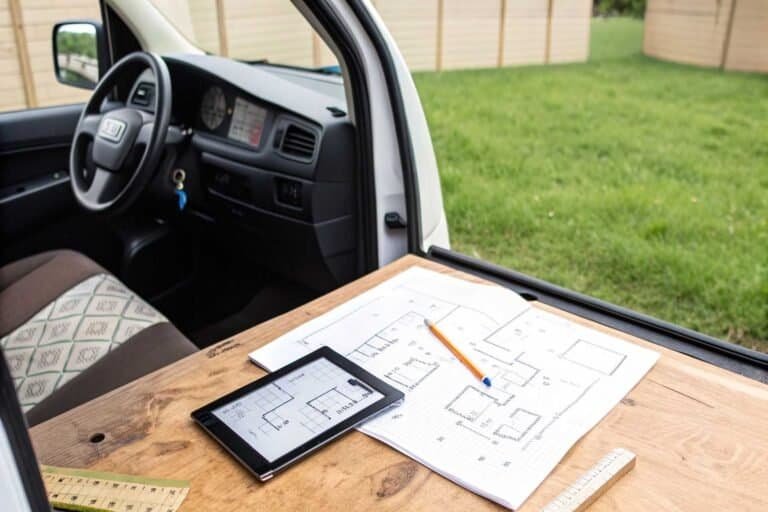
Before you even think about cutting a single piece of plywood, your first tools should be a good measuring tape, some graph paper (or an app), and a very clear idea of what you need. The goal here isn’t to copy a layout you saw on Instagram; it’s to design a space that fits your life. This is where the real adventure begins.

The UK van scene is booming. This surge is pushing suppliers to offer smarter, lighter materials that can slash build weight by 10–30%. For us in the UK, that’s a massive deal. We’re all battling with strict payload limits and Gross Vehicle Weight (GVW) rules, so every kilo saved counts.

Start with Accurate Measurements

I can’t stress this enough: your van is not a perfect rectangle. It has curved walls, wheel arches that get in the way of everything, and a roof that tapers. Measuring these quirks properly is non-negotiable.

  • Measure Everything, Everywhere: Get the length, width, and height, but do it at multiple points. Measure at floor level, halfway up the walls, and at the ceiling. They will all be different.
  • Map Your Obstacles: You need the exact location and dimensions of the wheel arches, the side door step, and any structural ribs you can’t remove. These are your fixed points.
  • Think in Layers: Remember to subtract the thickness of your insulation, vapour barrier, cladding, and flooring from your initial measurements. This gives you the actual “liveable” space you have to work with.

A classic mistake is taking one measurement and running with it. A Ford Transit, for example, has a noticeable curve in the walls. If you build a dead-straight kitchen unit based on the floor measurement, you’ll find a massive gap at the top. I’ve seen it happen.

Pro Tip: Grab some old cardboard boxes and make full-size templates for tricky areas like the space around the wheel arches or the curve of the rear doors. It lets you physically test furniture shapes in the van before you commit to expensive timber.

Visualising Your Space: From Paper to Pixels

Once you have your true dimensions, it’s time to bring the layout to life. You don’t need to be an architect for this.

For many van builders, old-school graph paper and a pencil is still the best way. Draw the van’s footprint to scale, then use little paper cut-outs for your van conversion furniture, kitchen, and seats. Sliding them around gives you a real, tangible feel for the flow of the space.

If you’re more digitally minded, free software like SketchUp is a game-changer. It lets you build a full 3D model of your van and your furniture. This is brilliant for checking things like headroom, making sure drawers can actually open fully, and just generally visualising how it will all feel. Diving into a detailed guide on designing the perfect campervan layout can give you some more advanced pointers.

No matter which method you use, it helps to have a rough idea of the dimensions of some popular vans to get you started.

Popular UK Van Interior Dimensions

Here’s a quick reference table for the typical load space dimensions of some common UK van models. These are manufacturer specs, so always double-check with your own tape measure, but they provide a solid starting point for your sketches.

Van ModelShort Wheelbase (L x W x H)Long Wheelbase (L x W x H)Typical Payload (kg)
Ford Transit Custom2.55m x 1.77m x 1.40m2.92m x 1.77m x 1.40m680 – 1,450
VW Transporter (T6.1)2.57m x 1.70m x 1.41m2.97m x 1.70m x 1.41m750 – 1,200
Mercedes Sprinter3.27m x 1.78m x 1.71m4.30m x 1.78m x 2.00m1,000 – 2,500
Renault Trafic2.53m x 1.66m x 1.38m2.93m x 1.66m x 1.38m950 – 1,250
Vauxhall Vivaro2.51m x 1.63m x 1.39m2.86m x 1.63m x 1.39m1,000 – 1,400

Remember, these figures are for an empty panel van. Your final internal dimensions will be smaller after you’ve added insulation, cladding, and flooring.

Planning Utilities Before You Build Anything

This is a big one. You have to plan where your electrics, water pipes, and gas lines will run before you build the furniture that will hide them.

Your furniture design absolutely must include access panels for maintenance. Just imagine trying to fix a leaky water pipe that’s buried behind a permanently fixed kitchen unit you’ve scribed perfectly to the wall. It’s a complete nightmare that you can easily avoid.

Design your furniture around your systems. Make sure you can get to your fuse box, water pump, and any gas shut-off valves without having to dismantle half the van. A bit of foresight here will save you a world of pain later on.

Choosing the Best Materials for Your Build

The materials you pick are the very soul of your van build. Get this right, and you’ll have furniture that’s tough, lightweight, and feels like home. Get it wrong, and you’ll be dealing with warped wood, flattened cushions, and unnecessary weight dragging you down.

This isn’t just about what looks good on Instagram; it’s about what survives the reality of UK van life – constant vibration, temperature swings, and the inevitable damp of a rainy Tuesday in Wales. Let’s get into the stuff that actually works.

Plywood: The Backbone of Your Build

Plywood is the go-to for pretty much every van build, and for good reason. It’s strong, relatively light, and you can get it anywhere. But not all ply is created equal. Picking the right sheet for the right job is critical.

  • Birch Plywood: This is the undisputed king. It’s incredibly strong, holds screws like a vice, and has a beautiful, clean finish you can leave exposed. It’s heavier and pricier, yes, but for high-stress jobs like bed frames, kitchen units, and anything structural, its durability is worth every penny.

  • Poplar Plywood: If saving weight is your number one priority, poplar ply is your best friend. It’s significantly lighter than birch but still offers decent strength. I use it for overhead lockers and cabinet doors – anywhere I can shave off kilograms without compromising integrity.

  • Standard Hardwood Plywood: This is your reliable workhorse, the stuff you’ll find in big DIY chains. It’s a good middle-ground option – more affordable than birch but a step up in strength from basic softwood ply. It’s perfect for general cabinetry and internal panels.

If you want to go deeper, this comprehensive guide to plywood types is a great resource for understanding the nitty-gritty of what makes a quality sheet.

A Quick Word on Moisture: Vans get damp. It’s a fact of life. Whatever wood you choose, sealing it is non-negotiable. A few coats of hardwax oil or a decent varnish will protect your hard work from the inevitable condensation and temperature shifts. Don’t skip this.

Beyond the Plywood Panels

While plywood makes the skeleton, other materials bring your living space to life. Thinking about these early on will save you headaches down the line.

The UK furniture market is valued at around £18.78 billion in 2025, which is great news for us. It means there’s a massive industry catering to modular and lightweight components. This competition keeps costs down and makes it easier to find specialist panels and fabrics without massive lead times, even for one-off van builds.

Worktops That Can Take a Beating

Your kitchen worktop needs to be tough. Solid wood looks incredible but it’s brutally heavy and needs constant oiling. A smart compromise is a thinner, 27mm solid wood worktop (like oak or beech), which gives you the look without the insane weight penalty of a full-size kitchen slab.

Another brilliant, and arguably more practical, option is high-quality laminate bonded onto lightweight ply. You get a durable, waterproof, and scratch-resistant surface in a massive range of finishes, all without weighing down your van.

Upholstery Foam and Fabrics

The foam for your seating and bed will make or break your daily comfort. Seriously, don’t skimp here.

  • Foam Density: For seating cushions, you absolutely need high-density foam – it’s usually blue. It provides firm support and won’t turn into a sad, flat pancake after a few months. For a mattress, a firm base layer topped with a softer memory foam gives you the perfect mix of support for your back and comfort for a good night’s sleep.

  • Fabrics: Your fabric choice needs to be tough. Look for upholstery-grade materials with a high “rub count”—they’re designed to handle daily abuse. Think about muddy boots, cooking splatters, and the general grime of life on the road. Stain-resistant or wipe-clean materials are a godsend.

Remember, your furniture is part of your van’s whole ecosystem. There’s no point having beautiful cabinets if you’re freezing cold. Head over to our article on the best insulation for campervans to make sure your build is comfortable all year round. A bit of careful planning now pays off for thousands of miles to come.

Essential Tools and Joinery Techniques for Van Life

You don’t need a pro-level workshop to build brilliant van furniture. I’ve seen some of the best builds come together on driveways and in tiny garages. The truth is, a handful of good tools and a couple of solid joinery methods are all that stand between you and a custom interior that’s strong, stylish, and free from those infuriating rattles on the road.

Building durable furniture is less about having the flashiest gear and more about knowing which tool to grab and how to join two bits of wood so they stay joined, especially when bouncing down a B-road. Let’s get into the essential kit and the techniques that will give your build a solid, long-lasting finish.

Your Core Toolkit: The Absolute Must-Haves

Forget the fantasy of a perfectly kitted-out workshop. You can accomplish almost everything you need with just a few key items.

Here’s the short list that will see you through 90% of your furniture build:

  • A Good Jigsaw: This will be your most versatile cutting tool. It’s the only way to properly scribe panels to the curved walls of your van, and it’s perfect for things like sink cut-outs and shaping corners on your units.
  • A Quality Cordless Drill/Driver: You’ll use this constantly, for everything from drilling pilot holes to driving hundreds of screws. An 18V model with a couple of batteries is a solid investment you won’t regret.
  • A Combination Square: Absolutely essential for marking accurate 90-degree and 45-degree angles. Don’t trust your eye; this little tool is the difference between square cabinets and wonky boxes.
  • A Set of Clamps: You can never have enough clamps. They are your third and fourth hands, holding everything tight while the glue sets or while you’re trying to screw two pieces together on your own.

With just these four things, you can build the entire carcass of your van’s interior. We’ve got a more detailed breakdown in our complete list of essential tools and materials for campervan conversions, which covers absolutely everything you might need.

Tools That Give You a Professional Edge

Once you’ve got the basics covered, a couple of extra tools can seriously speed up your workflow and level up the quality of your finish. These aren’t strictly necessary, but they make a huge difference.

  • A Pocket Hole Jig: This is a genuine game-changer for creating strong, hidden joints quickly. It lets you join wood at right angles without any visible screws on the outside, giving your furniture a much cleaner, more professional look.
  • A Circular Saw: While a jigsaw can technically do long cuts, a circular saw with a guide rail is unbeatable for getting perfectly straight, clean edges on big sheets of plywood. It saves a massive amount of time and sanding later on.

Fundamental Joinery for Rattle-Free Furniture

The way you join your wood is critical. Your furniture will be subjected to constant vibration and twisting forces as the van moves, so your joints need to be tough. Two simple methods will cover pretty much every situation you’ll come across.

Pocket Holes: The DIYer’s Best Friend

This technique uses a special jig to drill a hole at a steep angle into one piece of wood. You then drive a self-tapping screw through that hole and into the second piece. It creates an incredibly strong joint that’s also ridiculously fast to make.

My Experience: For the strongest possible joint, always add wood glue before you screw the pieces together. The screw acts as a powerful clamp, pulling the joint tight while the glue cures, and the glue provides the long-term rigidity that stops things from loosening over time.

This method is perfect for building cabinet carcasses, face frames, and attaching panels where you want the fixings to be completely hidden.

Butt Joints with Screws: A Simple Classic

This is the most basic joinery there is: simply butting two pieces of wood together at a right angle and screwing through one into the other. It’s not as elegant as a pocket hole, but it’s strong, fast, and absolutely fine for many applications.

This approach works best for internal structures that won’t be seen, like support battens or internal cabinet dividers. Just remember to always drill a pilot hole first to stop the wood from splitting, especially when you’re working close to the edge of a plywood sheet.

Vanlifers in the UK are increasingly focused on lightweight, modular builds. This isn’t just a trend; it’s a practical response to our strict payload limits. Industry analysis shows a big shift towards designs that reduce build weight by 10–30%. This push influences everything from material choices to the construction methods we use, making efficient joinery techniques that provide strength without bulk more critical than ever.

Getting Your Hands Dirty: Real-World Furniture Builds

Theory is one thing, but sawdust on the floor and a solid piece of furniture you built yourself is where the real satisfaction kicks in. It’s time to turn those plans and material choices into something tangible. We’ll look at how three essential pieces of van conversion furniture come together.

These are based on common, road-tested designs that I’ve seen work time and again. Think of them as reliable blueprints you can adapt to fit the unique dimensions and quirks of your own van, not as rigid instructions.

We’ll start with the heart of any good layout: the bed. Then, we’ll move on to a hardworking kitchen unit and finish with some much-needed overhead storage.

The Convertible Bed and Dinette System

Let’s be honest, a permanent fixed bed is a luxury most medium-sized vans just can’t afford. The classic solution is a clever convertible system that serves as a comfy seating and dining area by day and a spacious bed by night. The U-shaped or L-shaped lounge is popular for a reason—it’s just incredibly efficient with the space you have.

The core of this build is three simple boxes: two long benches running down the sides of the van and a shorter box connecting them at the back to form your seating. When it’s time to sleep, you bridge the gap between the benches with slats or removable panels. These rest on ledges you’ve built into the bench framework. Then, you just rearrange the seat cushions to form a surprisingly comfortable mattress. Simple, but it works.

A Few Key Pointers:

  • Bench Height: Aim for a comfortable seating height of around 45cm, and don’t forget to include the thickness of your cushions in that measurement. This is the sweet spot that lets most people sit with their feet flat on the floor.
  • Support Ledges: Grab a sturdy wooden batten (something around 40mm x 20mm is perfect) and fix it along the inside top edge of each long bench. This is what your bed slats will rest on, so glue and screw it properly—it’s taking a lot of weight.
  • Lid Access: Make your life easier by hinging the tops of the benches. This creates massive, easily accessible storage bins underneath. Piano hinges are brilliant for this as they spread the load evenly along the whole lid.
  • Table Mount: You’ll want to install a table leg mount in the floor space between the benches. Something like a Sequoia or a Lagun leg system lets you have a removable table that can be stowed away at night or when you just need more room to move.

I’d build the main structure from 15mm birch plywood. It has all the strength you need to support people sitting and sleeping, but you can build the internal framing with lightweight timber battens to keep the weight down.

A Tip from Experience: When you’re cutting the plywood panels for the benches, think about ventilation. I always use a hole saw to drill a series of large holes in the panels that face inwards. This allows air to circulate inside those big storage areas, which is absolutely crucial for preventing condensation and damp, especially if you plan on storing bedding or clothes in there.

The Compact Kitchen Galley

Your kitchen unit is probably the hardest-working piece of furniture in the entire van. It needs to house a sink, a hob, your water containers, and provide that precious bit of worktop space, all within a tiny footprint. A simple, strong cabinet is the only way to go.

The basic structure is just a box. I typically build the main carcass from 15mm or 18mm plywood to make sure it’s robust enough to handle the weight of water tanks and a solid worktop. An internal divider is a good idea to separate the “wet” area (water tanks) from the “dry” area where you might keep your gas bottle or other supplies.

Making Those Critical Cut-Outs:

Your new sink and hob will come with a paper template. Whatever you do, don’t lose it.

  1. Positioning: Lay the template on your worktop and play around with the position. Make sure you leave enough structural wood around the edges for strength. Just as important, have a quick check underneath to ensure you have enough clearance for the depth of the sink bowl and the gas fittings for the hob.
  2. Drilling Corners: Drill a pilot hole inside each corner of the template’s cut-out line. Make the hole big enough for your jigsaw blade to easily fit through.
  3. Cutting: Using a jigsaw with a fine-toothed blade (this gives a much cleaner cut on plywood), carefully follow the template line from one corner hole to the next. The key here is to go slow. Rushing is how you make mistakes you can’t undo.

For the cabinet doors, you can drop down to a lighter 12mm plywood to save a few kilograms. A set of concealed cabinet hinges and some strong magnetic catches will give you a clean, professional finish and, more importantly, stop the doors flying open every time you take a sharp corner.

Lightweight Overhead Storage Lockers

Overhead lockers are absolutely essential. They get clothes, food, and all sorts of other stuff up and out of the way, freeing up that valuable floor-level space. The real challenge here is building them strong enough to hold your gear but light enough that they don’t pose a safety risk or eat into your precious payload.

The secret is to use lighter materials and clever construction. I’ve found a combination of 12mm poplar plywood for the main body and a thinner 4mm or 6mm plywood back panel is a great recipe for saving weight. It’s that back panel, scribed perfectly to the curve of your van’s wall and ceiling, that gives the whole unit its rigidity once you fix it in place.

My Go-To Construction and Mounting Strategy:

  • First, build the locker as a simple box on your workbench. It’s far easier than trying to build it in-situ.
  • I use pocket holes and wood glue for the main joints. This creates a really strong but surprisingly lightweight frame without adding bulky timber battens.
  • For the door, go with an upward-opening design supported by gas struts or locker stays. Trust me, it’s far more convenient than a side-opening door when you’re standing right underneath it.
  • When it comes to mounting, you must secure the locker to the van’s metal ribs, not just to the wooden cladding. Use rivet nuts (also called nutserts) inserted directly into the van’s structural metalwork. This creates a rock-solid mounting point that will never, ever come loose.

How to Securely Mount Furniture in Your Van

Right, let’s talk about the single most important part of your furniture build: anchoring it so it doesn’t try to kill you. You can craft the most beautiful birch ply kitchen unit in the world, but if it isn’t bolted down properly, it’s just a massive, dangerous projectile waiting for you to brake hard.

This isn’t about stopping a few annoying rattles on a bumpy road; this is a fundamental safety issue. We need to attach every single piece of furniture directly to the van’s strong, structural metal frame—not the lovely but flimsy plywood cladding you just spent weeks installing.

Let’s be crystal clear: a few screws into your wall panels will do precisely nothing. They have zero structural integrity and will rip out with the slightest bit of force. We’re going to cover the proper methods for creating rock-solid anchor points that keep your furniture, and you, safe on the road.

Before you get the saw out, it’s worth thinking about what you should build first. Your core needs should dictate your priorities.

This simple decision tree helps you figure it out. If your main goal is having a place to sleep, the bed frame comes first. If it’s cooking, the kitchen pod is your starting point. Don’t overcomplicate it.

Finding and Using Structural Points

Your van’s chassis is its skeleton. It’s a network of vertical ribs and horizontal support beams that give the vehicle all its strength. These are the only places you should be anchoring heavy items like beds, kitchens, or overhead lockers.

Finding them is easy. Just tap along the inside of your van walls—you’ll hear a solid thud instead of a hollow echo when you’re over a rib. A strong magnet slid along the wall works just as well, as it will stick firmly to the steel frame underneath.

Once you’ve located these structural points, you’ve got a few solid options for creating a fixing point. The method you pick really depends on how heavy the furniture is and where you’re mounting it.

Common Fixing Methods

Securing your furniture properly is non-negotiable, and there are several tried-and-tested methods. Below is a quick comparison of the most common techniques I’ve used and seen in countless other builds.

Comparing Furniture Fixing Methods

Fixing MethodTools RequiredBest ForStrength Rating
Through-BoltingDrill, Spanner/Ratchet, Drill BitsSecuring heavy base units, bed frames, and kitchen pods directly to the van’s structural ribs. The gold standard for anything substantial.★★★★★ (Bombproof)
Rivet Nuts (Nutserts)Rivet Nut Tool, Drill, Drill BitsMounting overhead lockers, wall cabinets, and shelving where you can’t access the back of the metal. Creates a permanent threaded insert.★★★★☆ (Very Strong)
Self-Tapping ScrewsImpact Driver or DrillAttaching lightweight trim, cladding battens, or small, non-structural items directly into the metal frame. Never for heavy furniture.★★☆☆☆ (Light Duty Only)
Bolting to FloorDrill, Spanner/Ratchet, SealantAnchoring units to the van floor, especially when combined with wall fixings. Requires checking underneath the van for obstructions.★★★☆☆ (Good, as part of a system)

Each method has its place, but for anything that carries significant weight, through-bolting and rivet nuts are the only options I’d ever trust.

Safety First: Always Check Before You Drill
This is the golden rule. Before you drill a single hole, get under the van and check what’s on the other side. The last thing you want is to drill through your fuel tank, a brake line, or a critical wiring loom. This is a five-minute check that can save you from a catastrophic and expensive mistake.

Dealing with Those Annoying Curved Van Walls

One of the biggest headaches in any van build is that absolutely nothing is flat or straight. Trying to fix a square-backed cabinet to a curved van wall will leave you with ugly gaps and a unit that isn’t properly supported, leading to squeaks and stress fractures down the line.

The solution is simple and effective: wooden battens.

By fixing timber battens horizontally to the van’s structural ribs first, you create a perfectly flat, vertical mounting surface for your furniture to sit flush against. This makes installation a thousand times easier and adds another layer of strength to the entire structure. For a pro finish, take the time to scribe the back of the batten to match the van’s curve. This gives you a perfect, solid fit and ensures your van conversion furniture is rock-solid and completely silent on the move.

Common Questions About Van Conversion Furniture

As you get deeper into the build, you’ll start hitting the same walls everyone else does. It’s totally normal. Every single van lifer has wrestled with the exact same dilemmas over weight, the DVLA, and getting a finish on their plywood that actually lasts.

I’m going to tackle some of the most frequent questions I hear from fellow UK builders. These are clear, practical answers based on years of doing this stuff for real, designed to get you past the roadblocks and building with confidence.

How Can I Make Furniture Lighter Without Sacrificing Strength?

This is the classic van conversion balancing act, and the secret isn’t just using thicker wood everywhere. It’s about being clever with your materials and design. It’s about building smarter, not just bigger.

First up, your choice of plywood is critical. Go for lightweight poplar or a quality birch ply instead of standard MDF or those heavy, cheap sheets you see at DIY stores. Using thinner sheets, like 12mm or 15mm for the main cabinet carcasses, makes a massive difference straight away. You can then reinforce the critical stress points with internal timber battens rather than making the whole thing from heavy 18mm board.

Another fantastic technique is to build frames from aluminium angle or box section. Once you have these super-strong, feather-light frames, you can clad them with very thin plywood—maybe only 4-6mm thick. This composite approach gives you incredible rigidity for a fraction of the weight of a solid timber build.

Here’s a simple but brilliant weight-saving trick: use a hole saw to cut large circles out of any internal panels that aren’t visible, like cabinet dividers or the base of your bed. It might not look like much, but shaving off all those little bits of wood really adds up to a significant weight reduction across the entire build.

Do I Need to Inform the DVLA About My Furniture?

This is a big one for UK converters, and the short answer is: it depends on how permanent your build is. If you bolt in fixed furniture that fundamentally changes the vehicle’s purpose from a panel van to a ‘motor caravan’, then yes, you absolutely need to apply for reclassification with the DVLA.

To meet the DVLA’s official criteria for a motor caravan, your conversion generally needs to have fixed features like:

  • A bed, which can be converted from seating
  • A water storage tank and a tap
  • A fixed table and seating area
  • Permanent cooking facilities
  • At least one window on the side of the main living area

Now, if your van conversion furniture is modular and designed to be easily taken out, you might not need to re-register the vehicle. But—and this is the crucial part—you must inform your insurance provider of all modifications, no matter how temporary. They often have much stricter requirements than the DVLA, and failing to declare your conversion could completely invalidate your policy if you need to make a claim.

What Is the Best Way to Finish Plywood Furniture?

Getting a durable finish on your plywood is vital. It’s what protects your hard work from the knocks, spills, and condensation that are just part of van life.

For a beautiful, natural look, a couple of coats of a hardwax oil (like Osmo Polyx-Oil) is a brilliant choice. It soaks into the wood to protect it from within and is incredibly easy to touch up if you get a scratch. No sanding the whole thing down, just a quick dab on the affected area.

If you need something tougher and more waterproof, especially for a kitchen worktop, you can’t beat a polyurethane varnish.

For those wanting a painted finish, preparation is everything. Seriously, don’t skip this. Always start with a quality wood primer to seal the ply and stop the grain from bleeding through your paint. Once that’s dry, follow up with two or three coats of a durable satin or eggshell paint. This will give you a hard-wearing surface that’s a doddle to wipe clean.


At The Feral Way, we provide tried-and-tested advice for every stage of your UK van conversion, from initial planning to hitting the road. Check out our other guides for more no-nonsense tips at https://www.theferalway.com.
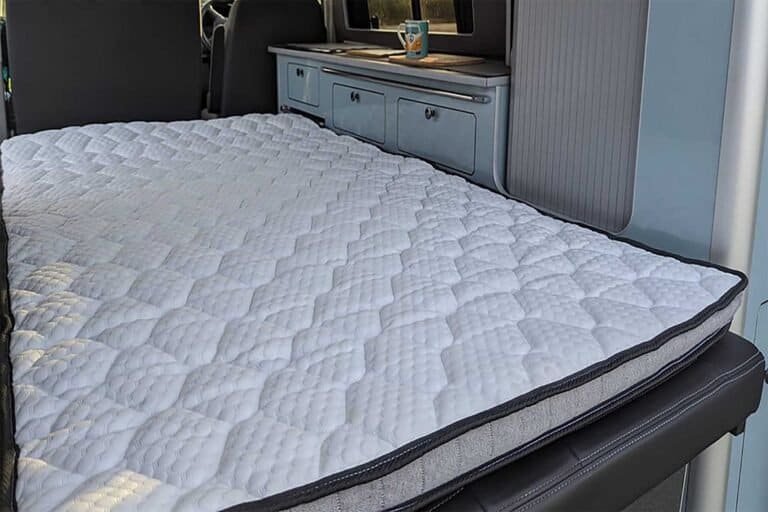
The best campervan windows for a UK build aren’t a one-size-fits-all solution. In my experience, the smartest choice always comes back to your specific build goals. You might need the incredible thermal performance of double-glazed acrylic units for winter trips, or perhaps the simplicity of a fixed window for a stealthy city van.

It really boils down to this: fixed windows are for stealth, top-hinged are for rain protection, and sliders are for convenient airflow.

How to Choose the Best Campervan Windows for a UK Build

Picking the right windows is one of those pivotal decisions in a conversion. It genuinely affects everything from your comfort and security to how the van feels to live in. Forget finding a single “best” window; the real goal is to match the right type to your specific plans, whether that’s weekend trips away or full-time van life.

The decision really hangs on three things: how you’ll use the van, your budget, and how much of the work you’re willing to do yourself. Given the UK’s famously unpredictable weather, thermal efficiency is a massive factor. A well-insulated window is the difference between waking up to dripping condensation and waking up comfortable and dry. It makes those chilly mornings far more bearable.

Matching Windows to Your Conversion Goals

The main players—fixed, sliding, and top-hinged (often called awning style)—each have a distinct job.

  • Fixed Windows are your go-to for flooding the van with light without creating weak spots for security or insulation. They’re perfect for stealth camping in towns or for parts of the van where you don’t need an opening.
  • Sliding Windows give you a simple and effective way to get some air moving. I find they’re great for cooking areas or for making sure pets have enough ventilation.
  • Top-Hinged Windows arguably offer the best of both worlds for UK conditions. You get fantastic ventilation, and the design means you can leave them open even when it’s raining—a huge plus over here.

As you weigh your options, looking into vehicle window tinting can be a game-changer for privacy and temperature control. It’s particularly useful for the UK market, where there’s a definite trend towards compact, thermally efficient windows, especially as more people try to keep their conversions under the crucial 3.5-tonne driving licence limit.

The key takeaway here is that your main goal—whether it’s maximum light, all-weather ventilation, or total stealth—points you directly to a specific type of window.

To make that choice even clearer, I’ve put together a quick-reference table that connects common conversion goals with the most suitable window style.

Quick Guide to Matching Windows with Your Van Build

Use this table to quickly match your primary conversion goal to the most suitable window type and its key advantage.

Your Primary GoalRecommended Window TypeCore Advantage
Stealth & Maximum SecurityFixed Bonded WindowNo external openings and superior structural integrity.
All-Weather VentilationTop-Hinged (Awning)Can be left open in the rain for constant airflow.
Budget DIY & Simple AirflowSliding WindowCost-effective and provides easy-to-control ventilation.
Maximum Natural LightLarge Fixed WindowUnobstructed views and excellent light transmission.
Four-Season Comfort & InsulationDouble-Glazed AcrylicSuperior thermal performance and condensation resistance.

Ultimately, choosing the right window comes down to being honest about how you’ll use your van. Match the window to your lifestyle, and you’ll have a much more comfortable and functional home on wheels.

A Detailed Comparison of Campervan Window Styles

Choosing the right windows for your campervan is about understanding the real-world compromises. I’ve seen countless builds where the choice of window created daily frustrations on the road. Each style forces a trade-off, and knowing which compromises you can live with is the key to getting it right for a UK conversion.

Let’s cut through the marketing fluff and compare the three main styles—sliding, top-hinged, and fixed—on the things that actually matter when you’re parked up in a damp Welsh valley or trying to be discreet in a city centre. We’ll look at ventilation, usability in British weather, security, insulation, and the overall feel they bring to your build.

Sliding Windows: The Classic Choice

Sliding windows are what most people picture when they think of a van window. They’re the default for many DIY builders because they’re simple, widely available, and relatively cheap. You get one fixed pane and one that slides horizontally, giving you a straightforward way to get some air moving.

Their biggest advantage is controlled, direct airflow. You can crack one open just an inch for a gentle breeze or slide it fully open to get cooking smells out fast. This makes them a solid, no-nonsense choice for a sliding door or the galley area where you need to clear the air quickly.

But their biggest weakness becomes obvious the moment it starts raining. Even a light drizzle means you have to shut a sliding window completely, as there’s nothing to stop water coming straight in. In a typical British summer, this is a massive pain when you’re desperate for ventilation but can’t risk a puddle on your worktop.

Security-wise, they can be a bit of a weak link. The simple latch mechanisms are often less secure than the multi-point locks on other styles. While many are perfectly fine, they aren’t generally considered the most robust option if security is your top priority.

Top-Hinged Windows: The All-Weather Champion

Top-hinged windows, often called awning windows, are a more premium option that are practically purpose-built for the UK climate. The whole window pane pushes outwards from the bottom, creating a built-in rain shield.

This ability to keep air flowing whatever the weather is their killer feature. For anyone planning to travel year-round in the UK, this is a game-changer. You can leave them open overnight to manage condensation or during a rainy day without a single worry about water getting in—a constant battle for many van dwellers.

Key Differentiator: The core benefit of a top-hinged window is rain-proof ventilation. While sliders force you to choose between fresh air and a dry interior, top-hinged models deliver both, making them ideal for our unpredictable climate.

They also give you a much better, completely unobstructed view compared to sliders, which always have that annoying central bar. Security is another big plus. They usually come with proper multi-point locking systems that clamp the window shut at several points around the frame, making them significantly harder to pry open.

The main downsides are cost and clearance. They’re generally a fair bit pricier than sliding windows and need clear space outside to open fully. That can be an issue in a tight car park or if you’re camped right next to another van.

Fixed Windows: For Light, Views, and Security

Fixed windows don’t open. At all. Their only jobs are to let in light and provide a view, which makes them the simplest, most secure, and best-insulating option you can get. With zero moving parts, there are no mechanisms to fail and no seals to degrade over time.

Their biggest strength is security. A properly bonded fixed window is essentially part of the van’s bodywork. There’s no entry point for a would-be thief, making them the ultimate choice for stealth camping in urban areas or for anyone who puts security above all else. They also offer the best thermal performance because there are no seals or gaps for drafts to sneak through.

Of course, the massive trade-off is the complete lack of ventilation. A van with only fixed windows would become a stuffy, condensation-filled box in no time. You absolutely have to pair them with opening windows elsewhere or a powerful roof fan to get proper air circulation.

Think of fixed windows as a strategic part of your design. Use them where you want a huge panoramic view without an opening, like in the rear doors or as a large feature window in your living area. They work brilliantly alongside a roof fan and a smaller opening window to strike the perfect balance between light, security, and airflow.

Here’s a quick summary of how these styles stack up in the real world.

FeatureSliding WindowTop-Hinged WindowFixed Window
All-Weather VentilationPoor (must be closed in rain)Excellent (can be open in rain)None
Security ProfileModerateHigh (multi-point locks)Excellent (no opening)
View ObstructionHigh (central bar)Low (unobstructed pane)None
Ease of UseSimple one-handed operationRequires pushing outN/A
Typical CostLow to ModerateModerate to HighLow

Ultimately, the best setup for your van will probably be a mix of styles. A common and very effective combination is a top-hinged window in the main living area for all-weather airflow, a slider near the kitchen for quick venting, and fixed windows in the back for maximum light and security.

Understanding Window Materials: Glass Versus Acrylic

Beyond the style of window you choose, the material it’s made from will have a massive impact on your daily comfort, van weight, and even your peace of mind. For UK van conversions, this choice almost always comes down to two main contenders: traditional tempered glass and modern double-glazed acrylic.

This isn’t a simple case of one being better than the other. Instead, it’s a classic van-build trade-off. What you gain in one area, you sacrifice in another, so getting your head around the nuances is the only way to pick the right windows for your specific build.

Thermal Performance and Condensation Control

In the damp UK climate, thermal efficiency is king. A cold window surface is a magnet for condensation, leading to drips, dampness, and a generally miserable experience on a chilly morning. This is where double-glazed acrylic truly shines.

Acrylic windows are typically built with two panes separated by a sealed air gap. This design dramatically reduces heat transfer, keeping the inner pane warmer and significantly minimising condensation. For anyone planning to camp between October and April, this feature is an absolute game-changer.

Tempered glass windows, on the other hand, are usually single-paned and offer very little insulation. They get cold fast, and on a frosty night, you’ll almost certainly wake up to streams of condensation on the inside. This can be managed with good ventilation, but acrylic offers a far more effective first line of defence against the cold.

Your window choice is a huge part of the puzzle, but it’s only one piece. Effective van insulation is the foundation of a comfortable build. For a deep dive into this topic, check out our complete guide on insulation and soundproofing for campervans.

Durability, Scratch Resistance, and Clarity

This is where tempered glass claws back a significant advantage. Glass is exceptionally hard and highly resistant to scratching. This is a huge benefit when navigating tight country lanes with overhanging branches or simply cleaning your windows after a muddy trip. With basic care, glass windows will maintain their crystal-clear clarity for the life of the van.

Acrylic, on the other hand, is a much softer material. It’s notoriously easy to scratch, and abrasive cleaners or even a gritty cloth can leave a network of fine marks that cloud the view over time. While specialist polishes can restore some clarity, you have to be far more careful with acrylic windows to keep them looking their best.

Impact Strength and Security

When it comes to resisting a direct impact, the two materials behave very differently. Tempered glass is strong but brittle. A sharp, forceful impact from a tool or a heavy object will cause it to shatter into thousands of tiny, relatively harmless cubes.

Acrylic is far more impact-resistant. It flexes and absorbs energy, making it much harder to break through completely. While it can crack under extreme force, it won’t shatter like glass, which can provide an extra layer of security. This makes it a popular choice for overlanders and those venturing into more remote areas.

The Critical Factor of Weight

For many UK converters, weight is a constant battle, especially for those aiming to keep their fully laden van under the 3.5-tonne limit for a standard driving licence. Every single kilogram saved counts.

Here, acrylic is the clear winner. A typical acrylic unit can be up to 50% lighter than a glass window of the same size, a saving that adds up quickly when you have multiple windows. This weight reduction not only helps with your payload but can also contribute to slightly better fuel economy. Glass is dense and heavy, making it a less ideal choice for builds where every gram is being scrutinised.

Performance Showdown: Glass vs Acrylic Campervan Windows

To make sense of the trade-offs, here’s a direct comparison of how the two materials stack up against each other in the real world.

Performance MetricTempered GlassDouble-Glazed Acrylic
Thermal InsulationPoor. Single-pane design is a major source of heat loss and condensation.Excellent. The air gap between panes significantly reduces heat transfer.
CondensationHigh. Gets cold quickly, attracting moisture and causing drips.Low. Inner pane stays warmer, drastically reducing condensation build-up.
Scratch ResistanceExcellent. Very hard surface, resistant to fine scratches from cleaning or branches.Poor. Soft material that scratches easily; requires special cloths and cleaners.
Clarity & ViewCrystal clear and remains so over time with minimal care.Can become hazy over time due to micro-scratches if not cared for properly.
Impact StrengthStrong but brittle. Shatters into small cubes on heavy impact.Very high. Flexes to absorb impact, making it much harder to break through.
SecurityGood, but a determined thief can shatter it relatively quickly.Better. Resists shattering, offering a greater deterrent to break-ins.
WeightHeavy. A significant factor for builds close to the 3.5-tonne limit.Very light. Up to 50% lighter than glass, saving crucial payload capacity.
CostGenerally more affordable for basic, non-opening units.More expensive, especially for high-quality, top-hinged opening windows.

Ultimately, there’s no single “best” material. The right choice depends entirely on your build priorities: if all-weather comfort and low weight are your goals, acrylic is worth the extra cost and care. If you prioritise durability, crystal-clear views, and a lower initial price, tempered glass is a solid, reliable option.

Navigating Installation and UK Legal Requirements

Alright, picking your windows is only half the battle. Fitting them properly and legally is where the real work—and the real risk—begins. I’ve seen enough horror stories of botched jobs leading to leaks, rust, and structural headaches to know that this isn’t a stage to rush. A bad install can turn your dream conversion into a damp, rusty nightmare.

Getting your head around the process and the rules before you cut a massive hole in your van is the key to a build that’s safe, compliant, and actually lasts.

There are two main ways to get windows in: bonded (glued-in) or clamp-in (frame-style). Each method demands a different approach, a different set of tools, and a different level of patience. It’s vital you know what you’re getting into.

Bonded vs Clamp-In Installation

Bonded windows give you that sleek, factory-finish look you see on modern vans. They use an incredibly powerful adhesive sealant, usually a polyurethane-based one, to glue the glass panel directly onto the van’s bodywork. It’s the go-to method for fixed glass windows if you want that clean, flush appearance.

Clamp-in windows, on the other hand, are a bit more like a sandwich. They have an inner and an outer frame. The outer frame sits against the van’s exterior panel with a seal, and the inner frame screws into it from the inside, clamping the whole unit securely into the cut-out. This is the standard system for almost all opening acrylic windows.

Crucial DIY Tip: Whatever method you choose, treating the cut metal edge is absolutely non-negotiable. After you’ve cut the hole, file the edge completely smooth and immediately coat it with a high-quality, zinc-based metal primer. This single step is your best defence against the rust that will inevitably try to form around the window aperture.

Beyond just fitting your windows, knowing the right way to get them sealed up is critical for any van builder. Trust me, being meticulous with your prep and sealing is the only way to get a watertight finish that will stand up to years of British weather.

Key UK Legal and DVLA Considerations

Getting your windows fitted correctly is about more than just keeping the rain out; it’s a critical part of making sure your conversion is road-legal and properly insured. The moment you take an angle grinder to a panel van in the UK, several regulations kick in.

First up, any glass used in a vehicle has to meet specific safety standards. You’re looking for an “E” mark (something like E43) etched onto the glass itself. This is the proof that it’s been tested and approved for automotive use, a detail that both your insurance company and your MOT tester will care about. Any reputable window sold for van conversions in the UK should have this as standard.

Secondly, adding windows is a major step towards getting your van reclassified from a ‘panel van’ (N1) to a ‘motor caravan’ with the DVLA. To meet the external feature requirements for the reclassification, your van needs to have motor caravan-style windows on at least one side of the main body.

  • DVLA Reclassification: Simply put, having proper windows is one of the key visual cues that tells the DVLA your vehicle is a campervan. It’s a box you have to tick.
  • Insurance Implications: You must tell your insurer about all modifications, and that absolutely includes adding windows. Failing to declare them can void your policy entirely. A correctly installed, E-marked window is seen as a standard and safe modification.
  • Driving Rules: While windows help make your van a camper, it’s vital to stay on top of all the legal aspects. It’s well worth reading this complete guide to UK driving laws for campervans to make sure your entire build is compliant.

Cutting the holes for windows is a real milestone in any van conversion. By taking the time to understand the installation methods and stick to the UK legal standards, you’re ensuring your build isn’t just comfortable, but also safe and properly registered for all the adventures ahead.

Which Windows Should You Actually Get for Your Van?

Theory is great, but it’s useless until you apply it to the actual plywood and metal of your own van build. The “best campervan windows” are simply the ones that solve your specific problems. So, let’s translate all that technical stuff into practical advice for the four types of van converters I see most often here in the UK.

Every build has different priorities, whether it’s pinching pennies, staying warm in a soggy November, staying invisible in Bristol, or surviving a rough track in the Peaks. Let’s match the right glass to the right mission.

The Budget DIY Builder

If you’re building a van on a tight budget, your main goal is getting on the road without re-mortgaging the house. Functionality and reliability at the lowest possible cost are king. For this, the classic, time-tested combination is a few bonded, fixed glass windows and a single opening sliding window.

Fixed glass panels are, by a country mile, the cheapest way to get light into your van. They’re also relatively straightforward to install yourself with a good tube of sealant. Pair one or two of these with a basic slider over your kitchen area for essential cooking ventilation. This setup gets you the light and airflow you desperately need, right where you need it, without the cost of fancy top-hinged units. It’s a smart, effective compromise.

The Four-Season Adventurer

Planning to chase snow in the Cairngorms or wait out a damp autumn week in the Lake District? Your number one enemy is condensation, and your biggest priority is insulation. For you, investing in premium double-glazed acrylic top-hinged windows isn’t a luxury; it’s essential kit.

That double glazing makes a massive difference, drastically cutting down heat loss and pretty much eliminating the condensation that plagues single-pane glass in our cold, damp climate. The ability to crack them open for ventilation even when it’s hammering down with rain is a game-changer for managing moisture inside the van all year round. Yes, the upfront cost stings a bit, but the payoff in comfort and usability through the UK’s challenging seasons is absolutely worth it.

Your windows don’t exist in a vacuum; they have to work with the rest of your build. This choice will impact everything from where you place insulation to how you position your furniture. For more on getting this right, check out our guide on designing the perfect campervan layout to make sure your whole setup works together.

The Stealth Urban Camper

For those of us who need to blend in on city streets, looking like a boring work van is the name of the game. Your window setup needs to be minimal and discreet. The best bet here is a strategic combo of dark-tinted fixed windows and a powerful roof fan.

A single, small, heavily tinted fixed window on the side that doesn’t face the pavement can give you a sneaky view out without screaming “campervan!” to passers-by. By skipping obvious opening windows, you seriously boost security and keep a low profile. This setup means you’re relying entirely on a good roof vent for airflow, but that’s a necessary trade-off for maximum stealth.

The Off-Grid Explorer

If your van is built to escape civilisation, your windows need to be a balance of tough, secure, and practical. You need something that can handle bumpy tracks, give you peace of mind when you’re parked miles from anywhere, and keep the air moving when you can’t just pop to a café to escape the weather.

The ideal setup here is a mix of acrylic top-hinged windows and maybe a polycarbonate fixed window. The impact resistance of acrylic offers great security against everything from stray branches to opportunistic thieves. The top-hinged design gives you that crucial rainproof ventilation, which is a lifesaver when you’re stuck inside during a three-day downpour. The aftermarket for these is strong, and kits for popular vans are easy to find. In the UK, you’ll see prices for these units range from £120 to over £1,200, all depending on the spec you go for.

Frequently Asked Questions About Campervan Windows

Getting your head around campervan windows can throw up a lot of questions, especially when you’re in the thick of a UK build. This is where we tackle the most common queries we see, giving you clear, practical answers to help you make the right call and sidestep the usual mistakes.

Do I Need Professionally Installed Windows for My UK Campervan Insurance?

This is a big worry for many, but the answer isn’t a simple yes or no. It’s true that some UK insurers feel more comfortable with professional installation, particularly on high-value conversions. A pro fit gives them a warm fuzzy feeling about your van’s structural integrity and waterproofing, which can sometimes nudge your premium down.

However, if you’re a competent DIYer, self-installation is perfectly fine for most policies. The key is being meticulous. You need to document everything. Take clear photos of the entire process, from marking the cut and treating the bare metal to applying the sealant and fitting the final trim. Just as importantly, keep every single receipt for the windows, primers, and sealants.

Crucial Insurance Tip: Always, always declare that you fitted the windows yourself when getting quotes. Be completely upfront about it. The best thing you can do is ring insurers directly and have a proper chat about their policies on self-build modifications. This is the only way to be certain you’re fully and correctly covered.

How Can I Prevent Condensation on My Campervan Windows?

In the UK’s damp climate, fighting condensation is a constant battle, but it’s one you can definitely win. Don’t make the mistake of relying on just one fix; you need a three-pronged attack to keep your interior dry and comfortable.

Your first line of defence is the window itself. Double-glazed acrylic windows are in a different league to single-pane glass for thermal insulation. They keep the interior pane much warmer, and that’s the single most effective way to stop moisture from condensing on the surface in the first place.

After that, it’s all about ventilation.

  • Active Ventilation: A good roof fan, like a MaxxAir fan, is non-negotiable. Running it on a low setting, even for short bursts, actively pulls damp air straight out of the van.
  • Passive Ventilation: You need to create a bit of cross-flow. When your roof fan is sucking air out, crack a window open on the other side of the van. This lets dry, fresh air get drawn in to replace the damp air created by cooking, breathing, and just living.
  • Night-Time Protection: When the temperature drops overnight, get your thermal blinds or insulated covers on. This adds another layer of insulation, keeping the glass surface that little bit warmer and reducing the chance of waking up to dripping windows.

If you’re battling really persistent cold and damp, a small, low-wattage portable dehumidifier can also make a world of difference.

What Are the Most Secure Types of Campervan Windows?

Security is a massive concern, whether you’re parked up in a remote lay-by or on a city street. For the best possible peace of mind, fixed, bonded windows are the most secure option you can get. With no opening latches, hinges, or mechanisms, they offer zero leverage points for a would-be thief and are permanently sealed into the van’s body.

When you do need an opening window, the security level varies quite a bit between styles. Top-hinged (or awning) windows tend to be more secure than your basic sliders. This is because they usually feature more robust, multi-point locking systems that clamp the pane to the frame in several places, making them much tougher to pry open from the outside.

The material makes a huge difference, too. While tempered glass is strong, it’s designed to shatter into a million pieces on impact. Windows made from laminated glass or tough polycarbonate are a major security upgrade. They are incredibly difficult to smash through, which is a powerful deterrent against a quick smash-and-grab break-in.

Can I Install a Window in My Van’s Sliding Door?

Yes, you absolutely can. In fact, fitting a window in the sliding door is one of the most popular and transformative jobs you can do. It completely changes the feel of your main living space, flooding it with natural light and giving you essential ventilation right where you need it most—usually near your kitchen or seating area.

The main challenge isn’t the curved surface of the door, it’s navigating what’s inside it. Before you even think about picking up a jigsaw, you have to measure with obsessive care. The inside of a sliding door is a maze of structural braces, locking mechanisms, and wiring looms. Your window cut-out has to be positioned perfectly to avoid all of these vital bits.

To make life easier, many UK aftermarket suppliers sell window kits specifically designed for the sliding doors of popular vans like the Ford Transit, VW Transporter, or Vauxhall Vivaro. These are shaped to fit perfectly within the available space, taking a lot of the guesswork out of the placement. Even so, the golden rule remains: measure three times, check the inside one more time, and only then do you cut.

Picking the right bike rack for your campervan is less about finding the “best” one and more about finding the right one for your specific van, your bikes, and how you actually travel. It’s a decision that boils down to securely getting your bikes from A to B without making your van life a complete pain. This means taking a hard look at the main players – towbar, rear door, and roof-mounted racks – and weighing them up against your real-world needs. Understanding the options available, including the variety of Campervan Bike Racks, can make a significant difference.

Why Your Bike Rack Choice Matters So Much

Choosing a bike rack isn’t just about bolting a bit of metal to your van; it’s a decision that genuinely shapes your adventures. The right one slots so seamlessly into your setup you forget it’s there. The wrong one? It becomes a daily frustration. I’m talking about the kind of frustration that comes from not being able to open your back doors for that perfect view on a remote Scottish wild camp, or realising your van is now too long to navigate the tight lanes in Cornwall.

It’s a decision that affects everything from your fuel economy to how secure you feel leaving your bikes while you pop to the pub.

And it’s a decision more and more people are making. With campervan ownership in the UK jumping by 25% to over 450,000, the demand for good kit has exploded. The UK bicycle accessories market tells the story, with vehicle bike racks alone making up a market worth around £110 million in 2024. It’s not a niche accessory anymore; a recent survey found that a massive 55% of UK campervan buyers now see bike rack compatibility as a top priority. This piece of kit has become essential.

Matching the Rack to Your Van and Lifestyle

As you consider your choices, it’s essential to explore the different types of Campervan Bike Racks available that suit various van models and travel styles.

Before you even start browsing models online, you need to have an honest chat with yourself about your setup. There is no one-size-fits-all solution here. The needs of a full-time van lifer in a long-wheelbase Fiat Ducato are worlds away from a weekend warrior in a VW Transporter.

Get these three things clear in your head first:

  • Your Van’s Design: What have you actually got? Barn doors? A tailgate? A high roof? The physical shape of your van is the first big filter. A rack that works perfectly on a Sprinter might completely block the tailgate on a T6. This choice is also tied directly to your van’s interior; our guide on designing the perfect campervan layout can help you think about how what you stick on the outside affects life on the inside.

  • The Bikes You Carry: There’s a world of difference between a lightweight road bike and a pair of chunky e-bikes. E-bikes, often weighing over 25 kg each, instantly rule out a huge number of standard door-mounted or ladder racks simply because they can’t handle the weight.

  • Your Travel Style: Are you constantly on the move, needing quick and easy access to your back doors multiple times a day? Or do you tend to set up camp for a few days at a time where rear access is less of an issue? Your daily rhythm on the road will determine which compromises are acceptable and which will drive you mad.

A classic mistake is buying a rack that looks brilliant online without thinking through the day-to-day reality. I once saw a van owner who’d fitted a side-mounted ladder rack, only to find he couldn’t open his habitation door more than a few inches. A costly and deeply frustrating oversight.

The Four Main Types of Campervan Bike Rack

Your choice will almost certainly come down to one of these four categories. Each one has a clear set of pros and cons that suit different vans and different ways of travelling.

  1. Towbar-Mounted Racks: These are the heavy lifters of the bike rack world, making them the go-to for anyone with e-bikes. By mounting directly to the chassis via the towbar, they offer incredible stability and a high weight capacity. Many of the best models can tilt or swing away, giving you access to your rear doors even with the bikes loaded on.

  2. Rear Door-Mounted Racks: Hugely popular for panel vans like the Sprinter or Ducato, these racks clamp directly onto the rear doors. They sit higher up, which is great for keeping your lights and number plate visible, but they usually have lower weight limits and can stop you from opening the doors all the way.

  3. Ladder-Mounted Racks: If your van already has a rear ladder for roof access, these can seem like a dead-simple solution. They’re really only suitable for lighter bikes and are generally less secure than other options. You absolutely have to check that your ladder is rated to carry the dynamic load of a bike bouncing around while you’re driving.

  4. Roof-Mounted Racks: This is a brilliant option if you want to keep your rear doors completely clear. The big catch? Lifting bikes, especially heavy ones, onto the roof of a tall campervan is a real physical challenge. They also increase your van’s overall height, which can be a real headache when faced with car park height barriers.

Understanding these core differences is the first step to making a good decision. To get a better feel for the models and features out there, it’s worth exploring a comprehensive range of vehicle bicycle racks to see these styles in more detail and visualise how each one might work for you.


Campervan Bike Rack Types At a Glance

Feeling a bit overwhelmed by the options? Don’t worry. This table cuts through the noise and gives you a quick, at-a-glance comparison of the main types. Think of it as a cheat sheet to help you zero in on what will actually work for your van and your adventures.

Rack TypeBest ForTypical Price RangeKey AdvantageMain Drawback
Towbar-MountedHeavy e-bikes, frequent rear door access£250 – £700High weight capacity & stabilityCan make the van significantly longer
Rear Door-MountedPanel vans (Sprinters, Ducatos), lighter bikes£200 – £500Keeps number plate/lights visibleRestricts rear door opening
Ladder-MountedVans with existing, heavy-duty ladders£80 – £200Simple, uses existing hardwareLow weight limits & less secure
Roof-MountedPreserving rear access completely£100 – £300+Unobstructed access to the backLifting bikes is physically demanding

Ultimately, this table should help you narrow down your search. If you’re carrying e-bikes, your focus will likely be on the towbar options. If you’re in a smaller van and just need to carry a lightweight road bike, a door-mounted rack might be perfect. Use this as your starting point before diving into specific models.

How to Install Your Campervan Bike Rack

Fitting a new bike rack to your campervan can feel a bit daunting, I get it. The instructions look like they were written by a Swedish furniture designer on a bad day. But trust me, with a bit of prep and the right approach, it’s a job you can definitely tackle yourself. This isn’t about reciting the manual; it’s about the real-world steps for fitting the two most common types: towbar and rear door racks.

Getting this right the first time is more than just a matter of convenience. A poorly fitted rack is a disaster waiting to happen on the M6. It can damage your van, your bikes, or worse, become a serious hazard. So let’s do it properly.

Before you even think about picking up a spanner, there are a few checks you absolutely must do. Skip these, and you’re asking for trouble.

Pre-Installation Checks and Preparation

The whole installation hinges on your van being up to the job. If you’re fitting a towbar rack, have a good look at your chassis and the towbar mounting points. You’re checking for any serious rust or damage that could compromise its strength. If you see anything that makes you nervous, get it checked by a professional. It’s not worth the risk.

For a rear door-mounted rack, your focus is squarely on the doors. Give the hinges a proper inspection. Are there any signs of wear, stress cracks, or looseness? Remember, those hinges weren’t designed to carry the weight of two e-bikes bouncing down a bumpy B-road; they were designed to swing a door. They need to be in top condition.

My Top Tip: Before you start, grab a roll of low-tack masking tape or painter’s tape. Stick it on the paintwork anywhere the rack is going to make contact. It’s a simple trick that has saved my paint from countless accidental slips and scratches during fitting.

Once you’re happy the van is ready, it’s time to gather your tools. You don’t need a fully kitted-out workshop, but having the right gear makes everything go so much smoother. For a solid list of what you’ll need for this and other van projects, have a look at our guide on the essential tools and materials for campervan conversions.

Fitting a Towbar-Mounted Bike Rack

Honestly, towbar racks are usually the easiest to fit because you’re using a solid, pre-existing mounting point. The whole process is basically about clamping the rack’s coupling securely onto your towball.

First, give the towball a good clean. It needs to be completely free of grease, dirt, or road grime. A clean, dry surface is what gives the rack’s clamp the best possible grip.

Next, lift the rack and slot its coupling down over the towball. Most modern racks have a big lever that you push down firmly to clamp it into place. You’re listening for a solid ‘clunk’ and feeling for it to lock tight.

Now for the most important part: the wobble test. Grab the rack and give it a really firm shake—side to side, up and down. There should be almost no movement at all. If it feels loose or wobbly, release the clamp, consult the instructions for any tension adjustments, and try again.

A classic mistake is being too gentle with the locking lever. It should feel stiff and require a good bit of force to close. If it feels easy, the connection probably isn’t secure enough for the road.

Installing a Rear Door-Mounted Rack

Rear door racks demand a bit more care because you’re attaching them directly to your van’s bodywork. These usually work with a system of padded clamps that grip the top, bottom, or side edges of one of your rear doors.

Deciding on the right rack often boils down to a few key things about your specific setup, as this little guide shows.

choosing your bike rack

As you can see, the choice is tied directly to your van, your bikes, and the kind of trips you have planned.

Here are the key things to get right when fitting a door mount:

  • Get a helper. Seriously. Trying to hold a heavy, awkward rack in place with one hand while tightening clamps with the other is a surefire way to scratch your paintwork. An extra pair of hands makes this job about ten times easier.
  • Position the clamps carefully. Start with the top clamps, placing them over the edge of the door. Make sure the protective rubber pads are sitting flat against the paintwork. Don’t tighten them all the way just yet.
  • Attach the lower supports. Now, position the bottom supports. Crucially, make sure they are resting on a strong, structural part of the door—not just on the thin sheet metal in the middle.
  • Tighten things up evenly. This is key. Gradually tighten the top and bottom clamps, alternating between them. This distributes the pressure evenly and stops the rack from pulling to one side. If you just crank one side down first, you can warp the clamp or even damage your door.
  • Check for obstructions. Before you do the final tightening, give everything a final check. Is the rack blocking your door handle, badges, or reversing camera? Also, be aware of rear-mounted spare wheels; they are a common reason a standard door rack won’t fit properly.

Once it’s all tightened down, give it another aggressive wobble test. The rack should feel like it’s a part of the door itself, with no creaking or slipping. A well-fitted door rack is incredibly secure, but a badly fitted one is a risk you just don’t want to take.

Getting to Grips with Weight Limits and Bike Security

Once your rack is bolted on, the real work begins: using it safely. It’s easy to get caught up in the excitement of hitting the road, but this is where you need to get serious about weight calculations and layering up your security. Getting this wrong isn’t just a minor hiccup; it can lead to some seriously expensive damage to your van, your bikes, or worse.

The explosion in e-bike popularity has completely changed the game here. Your old road bike might have weighed around 10 kg, but a modern e-bike can easily crush the scales at 25 kg or more. That extra bulk puts a huge amount of strain on the rack and its mounting points, making weight management more critical than ever. A huge part of this is understanding electric bike weight limits, because pushing past them can compromise both the rack itself and your van’s handling.

Calculating Your Total Load

Before you even think about loading up, you need to do some simple but absolutely essential maths. It’s not just about the weight of your bikes; it’s the combined weight of the bikes and the rack itself.

First, find the maximum load capacity for your rack – it should be clearly stamped on it or in the manual. Next, weigh your bikes. If you’ve got e-bikes, a great tip is to pop the batteries out before weighing them (and definitely before travelling) to shed a few kilos.

Here’s the simple formula:

Total Load = (Weight of Bike 1 + Weight of Bike 2) + Weight of the Rack

That final number absolutely must be less than your rack’s maximum capacity. But it also has to be within the limits of whatever it’s mounted to. For a towbar, that means checking your vehicle’s ‘nose weight’ limit. For a door-mounted rack, you’re respecting the hinges and the door panel itself, neither of which were ever designed to carry 50 kg of metal bouncing down a bumpy B-road.

I once saw a van with rear doors that just wouldn’t close properly. The owner had been carrying two heavy e-bikes on an underrated door rack for a year, and the cumulative stress had actually bent the door hinges. It was a costly and completely avoidable repair.

Keeping Your Bikes Secure on the Road

Let’s be blunt: your bikes are a massive target for thieves. The flimsy little lock that might come with your rack is often little more than a visual deterrent. The only way to get genuine peace of mind, whether you’re at a busy campsite or a remote wild camping spot, is to adopt a multi-layered security approach.

Effective security is all about making it as difficult and time-consuming as possible for a thief to get away with your pride and joy. Here are a few strategies that actually work:

  • Use a Heavy-Duty D-Lock: Don’t mess about with cheap locks. Get a high-quality, Sold Secure rated D-lock and thread it through the frames of both bikes and a structural part of the rack itself. This physically anchors everything together.
  • Add a Thick Cable or Chain: A D-lock is great for the frames, but what about the wheels? Loop a heavy-duty chain or a thick, armoured cable through the wheels and back to the D-lock. This stops thieves from just unbolting a wheel and making off with the rest of the bike.
  • Consider a Motion-Sensor Alarm: These are brilliant. A small, battery-powered motion alarm attached to the bikes or the rack itself can be a powerful deterrent. The moment someone starts tampering with your setup, a loud siren goes off, drawing immediate attention.

Staying Legal on UK Roads

Enjoying the freedom of a campervan trip means not getting slapped with a fine for something daft. It’s easy to fit a bike rack and think you’re good to go, but a few simple oversights can land you with hefty fines and points on your licence. The main things to get right are visibility and making sure your bikes aren’t going anywhere.

The most common pitfall? Obscuring your number plate or rear lights. If your bikes or the rack itself even slightly cover them, you absolutely must use a lighting board. This isn’t a friendly suggestion; it’s a legal requirement to make sure other drivers can see your indicators, brake lights, and registration.

When a Lighting Board is Essential

A lighting board is just a separate panel that shows a legal number plate and copies your van’s rear lights. It plugs into your van’s electrics (usually via a towbar socket) and needs to be securely strapped to your bikes or the rack itself.

Picture this common scenario: you’ve mounted two chunky mountain bikes on a rear door rack. The wide handlebars and big tyres are completely blocking your van’s high-level brake light and partially hiding the number plate. Driving like that without a lighting board is illegal and you’re asking for a fine.

Key Takeaway: Stand about 20 metres behind your fully-loaded van. Can you clearly read every single character on your number plate and see all your lights without squinting? If not, you legally need a lighting board. Don’t guess – get a friend to follow you for a mile and check properly.

Getting one sorted is straightforward:

  • Connection Type: Most use a standard 7-pin or 13-pin socket, which you’ll have if you’ve got a towbar fitted.
  • Legal Number Plate: You’ll need a legally compliant number plate made for the board. You can order these from registered suppliers by showing your V5C logbook.
  • Secure Attachment: Use proper bungee cords or strong straps to fix the board firmly. It can’t be allowed to swing about or fall off while you’re driving.

Understanding Overhangs and Unsafe Loads

Beyond just being seen, UK law is very strict about how your load is carried. An insecurely fastened bike could easily be classed as an unsafe load, putting you and everyone else on the road at risk.

This issue has really shaped the market recently. Rear-mounted racks saw a surge in popularity after a 2024 Department for Transport update stressed just how vital secure bike fixation is for avoiding £200 fines. On top of that, regulations under the Road Vehicles (Construction and Use) Act 1986 limit how far a rack can stick out. There’s an 80cm overhang limit, which has directly influenced how around 70% of modern racks are designed to stay compliant. This move was partly prompted by prosecution rates hitting 8,000 cases in 2023 for improper bike carriage. You can find more data on UK bicycle accessories market trends to see how the industry is evolving.

These rules are just one part of a much bigger set of regulations for campervans. To get the full picture, it’s well worth reading our complete guide on UK driving laws for campervans. A bit of time spent getting it right means you can focus on the adventure, not on legal headaches.

Budgeting for and Maintaining Your Bike Rack

A good campervan bike rack isn’t just another accessory; it’s a genuine investment in your freedom. It’s the bit of kit that unlocks new trails and cycling adventures right from your rolling home. But to make a smart investment, you need to look beyond the price tag on the box and understand the full cost. This means factoring in the initial purchase, potential fitting fees, and the ongoing costs of essential accessories and upkeep.

Thinking about the complete financial picture from the start saves you from nasty surprises down the line. It ensures you budget for a complete, safe, and long-lasting setup, rather than getting caught out by the hidden extras. A little bit of planning now pays off with years of hassle-free adventures.

The True Cost of Your Bike Rack Setup

The price of the rack itself is just the starting point. Depending on the type of rack you choose and the specifics of your van, the total cost can vary wildly. Let’s break down what you should realistically budget for.

  • The Rack Itself: This is the biggest variable. A basic ladder-mounted rack might only set you back £80–£200. At the other end of the scale, a high-end, swing-away towbar rack designed for a couple of heavy e-bikes can easily cost £500–£700, or even more.
  • Professional Fitting: If you’re not 100% confident with the installation—especially for a towbar model or a complex door mount—getting it fitted professionally is a wise move. Expect to pay anywhere from £75 to £200 for the peace of mind that it’s done right.
  • Essential Accessories: Don’t forget the extras. A legally required lighting board with a number plate will cost around £50–£80. To secure your bikes properly, a high-quality, Sold Secure rated D-lock and cable will add another £60–£100 to the bill.

These add-ons aren’t optional luxuries; they’re fundamental parts of a safe, legal, and secure setup. Factoring them in from the beginning gives you a much more accurate picture of your total investment.

Budgeting for a rack is like buying a camera; the body is just the start. You still need the right lenses and a decent bag to make it truly useful. For your rack, the ‘lenses’ are the lighting board and good locks.

Your Seasonal Maintenance Checklist

Once your rack is fitted, a bit of regular care will protect your investment and make sure it stays safe for years to come. Corrosion and loose fittings are the biggest enemies of any campervan bike rack, but a simple seasonal check-up is all it takes to keep things in top condition.

This isn’t a massive chore. Just set aside 20 minutes before your first trip of the spring and another 20 before you put the van away for winter. Trust me, this simple habit can prevent a catastrophic failure on the motorway.

Pre-Season Inspection and Care

Before you head out on your first adventure of the year, it pays to run through this quick checklist. This is all about making sure nothing has seized up, cracked, or worked its way loose over the winter months.

  1. Check All Bolts and Fixings: Grab the correct spanner or Allen key and give every single bolt on the rack a check. You’re not trying to overtighten them, just ensuring they are snug and haven’t vibrated loose.
  2. Inspect Straps and Clamps: Look closely at any rubber or fabric straps for signs of perishing, cracking, or fraying. Pay special attention to the clamps that hold the bike frames, making sure the tightening mechanisms work smoothly and haven’t seized.
  3. Lubricate Moving Parts: Get some silicone lubricant (like GT85) and give a light spray to any hinges, locking mechanisms, or pivoting joints. This stops them from seizing and makes the rack much easier to use, especially on a cold morning.
  4. Test Electrical Connections: If you have a lighting board, plug it in and get a friend to help you test every light—indicators, brake lights, and sidelights. Corrosion on the pins is a really common problem; a quick scrub with a wire brush can solve most issues.

Post-Trip and Winter Storage Advice

What you do after a trip, especially one to the coast, is just as important. That salty sea air is incredibly corrosive to metal parts. Always give your rack a thorough rinse with fresh water after visiting the seaside to wash away any salt deposits.

When it comes to winter, if you can store your rack in a garage or shed, do it. Keeping it out of the harsh weather will drastically extend its life. If it has to stay on the van, it’s well worth investing in a protective cover to shield it from the worst of the rain and grime.

Your Bike Rack Questions, Answered

Navigating the world of campervan bike racks always throws up a few classic questions. Getting straight, real-world answers is the key to picking the right setup and not regretting it six months down the line. Here are the queries we hear most from van owners.

Can I Still Get Into the Back of My Van?

This is the big one. The number one question, every single time. And the answer depends entirely on the type of campervan bike rack you choose.

Standard rear door-mounted racks will almost always stop you from opening your doors fully. This can be a massive pain if you need daily access to your garage space for things like your electrical system, water tanks, or just grabbing your camping chairs.

This is where many modern towbar-mounted racks really shine. Look for models with swing-away or tilt-down features. A swing-away rack is the real game-changer; it pivots on a beefy hinge, moving the entire unit—bikes and all—completely clear of your doors. This gives you full, unobstructed access, which for many van lifers is non-negotiable.

How Much Will a Bike Rack Hammer My Fuel Economy?

Let’s be honest: adding anything to the outside of your van creates drag and will hit your fuel consumption. The real question is, how badly?

The impact varies based on a few things:

  • Rack Type: A sleek, empty towbar rack will have a minimal effect. A big door-mounted rack carrying two bulky mountain bikes is going to act like a parachute.
  • Your Bikes: Each bike you add increases the surface area catching the wind. The difference between carrying one lightweight road bike and two full-suspension mountain bikes is definitely noticeable at the pump.
  • Your Speed: The effect of drag increases exponentially with speed. You’ll see a much bigger drop in MPG on long motorway slogs at 70 mph than you will pootling down winding A-roads.

As a general rule of thumb, expect a fuel economy decrease of anywhere from 5% to 15%. For a van that normally gets 30 MPG, this could mean dropping to around 27 MPG with a fully loaded rack. It’s a trade-off, but one that most of us find acceptable for the adventures it unlocks.

Do I Need to Tell My Insurance Company About My Rack?

This is a critical question that’s so often overlooked. The short answer is yes, you almost certainly should. A permanently fitted campervan bike rack is typically considered a vehicle modification by insurance companies in the UK.

Failing to declare a modification, however small, could give your insurer grounds to invalidate your policy if you need to make a claim. It’s a five-minute phone call that buys you essential peace of mind.

When you notify them, a couple of things might happen. Some insurers will just note the modification on your policy with no change to your premium. Others might slightly increase it to reflect the added value and potential repair costs.

It’s also vital to check if your bikes themselves are covered while on the rack. Your vehicle policy might cover the rack, but the bikes are often not included. You’ll likely need to add them to your home insurance policy under an ‘away from home’ clause or get specific bicycle insurance to make sure they’re protected against theft or damage while you’re on the road.

The best campervan mattress is the one that fits your van’s weird shape, lets you get a solid night’s kip, and doesn’t turn into a mouldy sponge in the damp UK climate. Let’s be honest, that usually means a custom-cut high-density foam or a clever hybrid mattress, not something you can just grab off the shelf. What works for you will come down to your sleeping habits and, most importantly, the quirks of your van layout.

The Foundation of Every Great Road Trip: Your Mattress

A decent bed is the unsung hero of van life. It’s the difference between waking up buzzing for a hike in the Brecon Beacons and starting the day feeling like you’ve gone ten rounds with a badger. Too often, the mattress is an afterthought, a last-minute purchase when the build budget is dwindling and you just want to get on the road.

Big mistake. Treating your mattress as a core part of the build – as vital as your leisure battery or kitchen setup – is the secret to actually enjoying your time on the road long-term. This guide is written for UK van lifers, because let’s face it, we have our own unique set of problems to solve.

Navigating UK-Specific Campervan Challenges

Life on the road in Britain throws a few curveballs that have a direct impact on your mattress choice. Unlike sunnier climes, our persistent damp and wild temperature swings mean you have to be smart about materials to fend off mould and keep your sleeping space healthy.

Then there’s the vans themselves. Popular UK models like the Ford Transit or VW Transporter weren’t designed with standard bed sizes in mind. Their curved walls, unavoidable wheel arches, and compact layouts make finding a mattress that fits properly a real puzzle.

Your campervan mattress isn’t just a bed. It’s a key piece of furniture in your tiny home. It needs to be tough enough to handle being a sofa, a dining bench, and a bed, often all in the same day.

To get this right, you need to get your head around a few key things:

  • The Materials: Understanding the real difference between memory foam, latex, and hybrid options is your starting point.
  • The Fit: Knowing how to measure and make a template for all the awkward nooks and crannies means you won’t waste a single centimetre of precious space.
  • The Damp: Prioritising breathability and airflow isn’t a “nice-to-have”; it’s non-negotiable in the UK.
  • The Investment: A quality mattress isn’t an expense; it’s an investment in your health and the usability of your van.

Get to grips with these concepts, and you’ll be ready to choose a mattress that’ll see you through countless nights of adventure. If you’re building from scratch, figuring out how the bed fits into the bigger picture is vital, something we cover in detail in our complete campervan conversion guide for the UK.

Right then, let’s get into the heart of the matter: what you’ll actually be sleeping on. Choosing a mattress for your van is the first major fork in the road, and it shapes everything that follows – from comfort and durability to how well it copes with a damp Tuesday in the Lake District.

Each material has its own personality. Think of it like picking the right walking boots. A lightweight trail runner is perfect for a sunny day on the South Downs Way, but you’d want something far more robust and waterproof for a wet week in the Cairngorms. Your mattress choice follows the same logic. Let’s break down the options to find the right fit for your adventures.

Foam: The Versatile Champion

There’s a reason foam is the undisputed king of the campervan world: it’s incredibly versatile. Most van beds are weird shapes, needing cut-outs for curved walls or wheel arches. Foam is the only material you can easily hack away at with a bread knife or an electric carving knife to get a perfect fit. It’s the go-to for DIY and custom builds for a reason.

But “foam” isn’t just one thing. There are a few key types, and they feel completely different.

  • Memory Foam: This is the one that hugs you. It’s brilliant for pressure relief, a massive plus for side sleepers or anyone with sore joints after a long day’s hike. Its main drawback is heat; it can feel a bit toasty on a rare warm British summer night.
  • Latex Foam: Often seen as the premium choice, latex is bouncy, incredibly durable, and breathes much better than memory foam. It’s also naturally resistant to mould and dust mites, which is a huge bonus in a van. The catch? It’s heavy and costs a pretty penny.
  • Polyurethane Foam: This is your basic, budget-friendly foam, the kind you find in many upholstery projects. It’s lightweight and cheap, but it just doesn’t have the support or lifespan of memory or latex foam and can start to feel tired relatively quickly.

For many van builders, the solution isn’t picking one type, but layering them. A popular and effective strategy is to use a firm, high-density polyurethane foam base for solid support and top it with a thinner layer of memory foam for comfort. This gives you a durable, supportive, and comfortable bed without the hefty price tag of a full memory or latex mattress.

Sprung and Hybrid Mattresses: The Heavyweights

While less common in vans due to their weight and rigidity, sprung and hybrid mattresses are still an option, especially if you have a fixed bed that fits a standard size.

A traditional sprung mattress gives you that familiar bounce and fantastic airflow, thanks to its coil system. That airflow is genuinely useful for reducing condensation. But those metal springs are heavy, potentially eating into your payload, and there’s always a risk of rust developing over time in our damp UK climate.

Hybrid mattresses try to give you the best of both worlds, combining a supportive sprung base with comfort layers of foam or latex on top. They offer brilliant comfort—the pressure relief of foam with the breathability and bounce of springs. But they share the same downsides as sprung mattresses: they’re heavy, expensive, and you absolutely cannot cut them to fit around a wheel arch.

Folding and Futon Mattresses: The Transformers

Finally, we have the options designed for layouts that convert from a sofa or dinette into a bed. Think rock-and-roll beds or bench seating that pulls out.

A folding mattress is usually made from sections of foam hinged together inside a fabric cover. This lets it work as a chunky seat cushion during the day before unfolding into a sleeping surface at night. They’re great for saving space, but you can sometimes feel the gaps between the cushions, which can be annoying.

A futon mattress does a similar job. While it’s flexible, a futon is generally less supportive for nightly use compared to a dedicated foam setup and tends to wear out faster. Its main strength is being able to serve two purposes in a tiny living space.

When you’re digging into the options, the fundamental choice often boils down to the core materials. Getting your head around the basics of a spring mattress vs foam mattress is a brilliant starting point for any van builder. This focus on comfort is mirrored across the wider market, where new materials are driving growth. The UK mattress market is expected to hit around £1.58 billion by 2025, largely because people are finally demanding better sleep, pushing advances in memory foam and hybrid tech. You can read more about these UK market trends to see just how much of a priority a good night’s sleep has become.

How to Get a Perfect Mattress Fit for Your Van

Standard bed sizes are a lovely, simple concept. The problem is, they almost never work in a campervan. Your van’s interior is a landscape of curves, wheel wells, and odd angles that a domestic mattress just isn’t designed for. A poorly fitting mattress doesn’t just look sloppy; it wastes precious space and can lead to a surprisingly uncomfortable night’s sleep.

Trying to cram a standard double or king-size mattress into a space built for a Ford Transit or VW Transporter will only end in frustration. You’ll get awkward gaps down the side or compressed edges that completely ruin the foam’s integrity. This is where precision becomes your best friend. The goal is to create a mattress that hugs every single contour of your bed platform perfectly, as if it were part of the original design.

It’s a funny parallel to what’s happening in the UK housing market. While king-size mattresses dominate homes with a 37.73% share in 2024, the fastest-growing segment is actually queen-size. This is driven by people in smaller, urban spaces needing to maximise comfort—a challenge every van lifer understands intimately.

Mastering the Art of the Template

The secret to a flawless fit isn’t a fancy laser measure; it’s an old-school template made from cardboard or stiff paper. Trust me, this step is non-negotiable, whether you’re ordering a custom mattress or bravely cutting one yourself. It’s the only reliable way to capture every curve and notch.

First, grab some large pieces of cardboard—old delivery boxes are perfect for this. Lay them over your bed base and tape them together to create one big sheet that covers the entire area. Now for the important bit.

  1. Trace the Outline: Using a marker, carefully trace the exact shape of your bed platform right onto the cardboard.
  2. Capture the Quirks: Pay close attention to wheel wells, tapered walls, and any other intrusions. Press the cardboard firmly against these shapes and trace them accurately. Don’t rush this part.
  3. Double-Check Everything: Once you think you’re done, put the template back in the space. Does it lie perfectly flat without buckling? Are there any gaps? Keep adjusting until it’s a perfect replica of your bed area.

This template is now your blueprint. It removes all the guesswork and ensures the final mattress will slide into place with millimetre precision. This meticulous approach is a core part of any good van build, just like mapping out your electrics. For a broader view on how the bed integrates with everything else, check out our guide on designing the perfect campervan layout.

Matching Mattress Type to Van Layout

Different bed layouts in a van have very different needs. A fixed bed can take almost anything, while a convertible dinette needs something that can be packed away easily. Here’s a quick rundown of what works best for the most common setups.

Mattress Type Suitability for Common Campervan Layouts

Layout TypeBest Mattress MatchKey Considerations
Fixed BedFoam or HybridGo for maximum comfort. Weight isn’t a huge issue as it stays put. A custom-cut foam or a shaped hybrid mattress works perfectly here.
Rock and Roll BedFolding (often integrated)Needs to fold away with the seat mechanism. Usually a specific, thinner, multi-section foam mattress designed for the bed system.
Convertible DinetteFolding or Custom Cut Foam SectionsNeeds to be stored when not in use. Multi-piece foam cushions that form a flat mattress are ideal. Keep them lightweight and easy to handle.

As you can see, your bed design heavily dictates your mattress choice. Thinking about this early on will save you a lot of headaches later.

From Template to Mattress

With your perfect template in hand, you’ve got two main options: get a custom mattress made, or cut it yourself.

If you’re ordering from a specialist company, you’ll simply send them your physical template or a precise digital drawing based on it. They handle the rest, delivering a professionally finished product that will fit like a glove. This is the most reliable way to get a clean, perfectly shaped mattress.

For the DIY route, lay your template over your foam block and trace the outline with a permanent marker. The key to a clean cut is using the right tool. While many people recommend an electric carving knife, I’ve found that a simple, sharp utility knife or even a long bread knife often gives you a neater, more controlled cut.

Pro Tip: When cutting thick foam, make several shallow passes rather than trying to power through the entire depth at once. This technique stops the blade from wandering off course and gives you a much straighter, more professional-looking vertical edge.

Ultimately, getting the perfect fit is all about maximising every inch of your living area. Taking the time to measure and template properly is a small investment that pays off every single night you spend in your van.

Finding the Right Balance: Comfort, Weight, and Airflow

Choosing a campervan mattress isn’t about finding the single “best” one; it’s a masterclass in compromise. Every decision you make is a trade-off between a good night’s sleep, the space you have to live in, your van’s weight limit, and the realities of the damp UK climate. Nail this balance, and you’ll have a bed that feels right, night after night.

Think of it like packing for a long hike. You want the plushest, warmest sleeping bag, but you also have to lug it up a mountain. Your van mattress is the same puzzle, forcing you to navigate three key trade-offs to find the sweet spot for your build and how you travel.

Comfort Versus Headroom

This is the most immediate dilemma you’ll face. A luxuriously deep, 8-inch memory foam mattress sounds heavenly, promising a sleep that rivals your bed back home. But in a van, every inch of that depth comes at a direct cost: your vertical space.

If your bed platform is built high to create a big ‘garage’ space underneath, that extra mattress thickness can quickly turn your cosy sleeping nook into a claustrophobic coffin. Sitting up to read a book becomes an impossibility. You have to find that sweet spot where comfort doesn’t mean constantly banging your head on the ceiling.

A good rule of thumb is to mock up your bed height before you buy anything. Pile up cushions or folded duvets to the thickness of the mattress you’re considering. Climb in, sit up, and see how it feels. You might discover that a high-quality 5-inch or 6-inch mattress offers plenty of comfort without making your bed feel like a cave.

The Weight Factor

Every single thing you add to your van eats into its payload—the maximum legal weight it can carry. A mattress might not seem like a heavy item on its own, but the differences between types can be surprisingly significant. We’re talking an extra 20-30 kg you might not have accounted for.

This extra weight isn’t just about staying legal. Over thousands of miles, it subtly affects your van’s fuel efficiency, how it handles on winding country lanes, and even its tyre wear. A heavy sprung or latex mattress might feel fantastic, but a lighter, high-density foam equivalent could be the smarter choice for keeping your build lean and efficient.

Think about the knock-on effects of that weight:

  • Payload Management: A lighter mattress leaves you more capacity for the heavy essentials like water, gear, and a full tank of diesel.
  • Fuel Economy: One item won’t change your MPG, but a cumulative approach to saving weight across your build genuinely makes a difference at the pump.
  • Handling: Keeping weight down and distributed properly just makes your van drive better. It’s that simple.

Insulation and Breathability in the UK Climate

For anyone spending time in their van in the UK, this is the most critical trade-off. Our climate demands a mattress that can do two opposite jobs at once: keep you warm on a frosty night in the Peak District, but also allow enough airflow to prevent a damp, mouldy mess when it’s drizzly outside.

Insulation is brilliant for cold nights. Dense memory foam, for instance, is fantastic at retaining your body heat, acting as a buffer against the cold air under your bed base. This can make a huge difference to your comfort in the colder months.

But that same heat retention can be a massive problem. Without proper breathability, the warm, moist air from your body meets the cold surface of your bed platform and creates condensation. Trapped moisture is a perfect breeding ground for mould and mildew, which will ruin your mattress and is a genuine health risk.

Your job is to find a mattress that balances these two opposing needs.

  • Materials Matter: Natural latex foam and hybrid mattresses with pocket springs offer far better airflow than a solid block of dense memory foam.
  • Your Bed Base is Key: Whatever mattress you choose, pairing it with a slatted bed base or a proper anti-condensation underlay is non-negotiable in the UK. This creates an air gap that allows moisture to escape before it becomes a problem.

Ultimately, the right balance comes down to you. A full-time road-tripper will prioritise durability and all-season performance. A weekend warrior might be happier with a lighter, more compact option they can pull out when needed. By thinking through these trade-offs honestly, you can choose a mattress that doesn’t just support your back, but your entire life on the road.

How Much Should You Really Spend on a Mattress?

It’s easy to see a mattress as just another line item in a spreadsheet full of build costs. But trust me on this, it’s one of the most important investments you’ll make in your entire van. Think about it: it’s the one piece of kit you’ll use every single night, and the quality of your sleep directly affects your energy, mood, and whether you actually enjoy this lifestyle.

Going cheap on a mattress is a classic false economy. You might save a couple of hundred quid upfront by grabbing a low-density foam slab, but you’ll pay for it later. I’ve seen it time and again: after a year or two of regular use, cheap foam develops permanent body-shaped dips and loses all its support. Then you’re right back where you started, buying another one and effectively doubling your cost.

The Five-Year Test: Why Quality Pays for Itself

Let’s play this out. A budget foam mattress might set you back £200. Sounds good, right? But if you have to replace it every two years, you’re looking at £600 over a six-year period. On the other hand, a high-quality, custom-cut memory foam or latex mattress at £500 could easily last the entire life of your conversion, delivering a consistently great night’s sleep year after year.

That initial extra spend isn’t just for comfort; it’s for durability. Denser, higher-quality foams are simply better at resisting compression. They bounce back day after day, meaning the support you get in year five is just as good as it was in the first few months.

A quality mattress is one of the few items in your van build that you’ll use every single day. Investing in it is investing directly in your health and the sustainability of your life on the road.

This idea of spending more for better quality isn’t just a vanlife thing; it’s happening everywhere. The UK mattress market has seen the average price climb by 8.4% to around £645, with nearly three-quarters (72%) of people spending up to £799. It shows people are waking up to the value of good sleep, a lesson we can definitely apply to our vans. And the fact that fewer people are buying second-hand mattresses points to a growing awareness of hygiene and longevity—both critical in the confined space of a camper. You can explore more about these changing consumer trends to get a feel for the market.

Uncovering the Hidden Costs (and Gains)

The classic “DIY vs. Pro” debate also has some hidden financial traps. It’s not as simple as comparing the price of a foam block to a custom-made quote.

Going DIY: On the surface, hacking up a block of foam yourself looks like the cheapest option. But you need to factor in the tools. If you don’t have a good quality utility knife or, even better, an electric carving knife, that’s an extra cost. The real risk, though, is a mistake. It’s surprisingly easy to mis-measure or make a wonky cut on a complex shape for a wheel arch. One slip and you could be forced to buy a whole new block, wiping out any potential savings instantly.Professional Custom Builds: Yes, the upfront cost is higher. But what you’re really paying for is precision, a professional finish, and often a warranty. That peace of mind is worth a lot. You’re guaranteeing a perfect fit without the stress and financial risk of a DIY disaster.

Finally, think about what a great mattress does for your van’s resale value. A professionally made, perfectly fitting mattress is a massive selling point. To a potential buyer, it screams “quality, thoughtful build,” and immediately sets your van apart from others with a saggy, stained piece of foam in the back. A great mattress doesn’t just feel better to you; it adds real, tangible value to your entire conversion.

Looking After Your Mattress: Care and Maintenance on the Road

A mattress in a campervan has a tougher life than the one in your house. It’s not just a bed; it’s your sofa, your dining bench, and your chill-out spot, all crammed into a small, often humid space. Keeping it in good nick isn’t just about comfort—it’s about making sure your investment lasts and you have a healthy place to sleep.

The absolute number one enemy of any van mattress is condensation. Every night, the warm, moist air from your body hits the colder surface of your bed base. This creates the perfect breeding ground for mould and mildew, a problem you absolutely cannot ignore, especially in the damp UK climate.

Let It Breathe: Getting Airflow Under Your Bed

The single best defence against a damp, mouldy mattress is creating an air gap underneath it. This space allows moisture to evaporate before it soaks into the foam. Without ventilation, even the fanciest campervan mattress will eventually succumb to mould. Trust me, it’s a grim discovery.

You have a couple of solid options here:

  • Slatted Bed Base: Just like your bed at home, wooden slats provide a sturdy base while letting air circulate constantly underneath. It’s a tried-and-tested solution for a reason.
  • Anti-Condensation Mat: These are specialised underlays (often called things like Hyper-Ventilation mats) that create a structured pocket of air between your mattress and a solid bed platform. They’re brilliant for retrofitting if you already have a solid plywood base.

Sticking an unprotected mattress directly onto a solid plywood base is a recipe for disaster. Spending a bit of cash on a slatted base or a ventilation mat is one of the smartest, simplest upgrades you can make. It keeps your sleeping space fresh and hygienic for years to come.

Getting on top of damp is a constant battle in van life, and overlooking it is a classic rookie error. You can read more about this and other common slip-ups in our guide to common van life beginner mistakes and how to avoid them.

General Upkeep and Warranty Wisdom

Beyond tackling moisture, a few simple habits will keep your mattress going for longer. Make a point of regularly rotating or flipping it (if it’s double-sided) to ensure it wears evenly and doesn’t develop permanent dips where you sleep.

For cleaning, a machine-washable, zipped mattress protector is non-negotiable. It’s the barrier that makes dealing with spills, dirt, or just general road grime so much easier.

Finally, have a quick look at your warranty. Some mattress companies can be funny about their products being used in “non-standard” environments like a van. It’s worth checking the small print to see if it specifies ‘domestic use only’, as this could leave you high and dry if any problems pop up down the line.


Campervan Mattress FAQs: The Stuff That Keeps You Up at Night

You’ve narrowed it down, but a few nagging questions are probably still bouncing around your head. Let’s tackle the common ones I get asked. This is the last piece of the puzzle, the stuff that separates a decent night’s sleep from a miserable one.

How Thick Does My Mattress Really Need to Be?

This is a constant tug-of-war between comfort and headroom. After years of sleeping in vans, I’ve found the sweet spot is between 12cm and 15cm (that’s 5-6 inches). This is usually just enough foam to stop your hip bones from grinding into the plywood base, without making you feel like you’re sleeping in a coffin.

Go any thinner than 10cm, and unless you enjoy the sensation of sleeping on a thinly carpeted floor, you’ll regret it. Side sleepers, in particular, will ‘bottom out’ and wake up sore. On the flip side, anything over 20cm is usually overkill. It just eats up precious vertical space, and you’ll quickly get sick of not being able to sit up in bed without banging your head. Always measure your headroom first.

Can I Just Bung a Normal Mattress in the Van?

I see this question a lot, usually from people trying to save a few quid. While it sounds like a clever shortcut, chucking your old spare room mattress in the van is almost always a terrible idea.

Here’s why it’s a recipe for disaster:

  • It Won’t Fit. Period. Van walls are curved. Wheel arches exist. A rigid, rectangular domestic mattress will leave awkward, useless gaps everywhere. It’s a massive waste of space.
  • It’s a Mould Magnet. Your home mattress isn’t designed to cope with the insane levels of condensation a van produces overnight. It can’t breathe properly, and it will get damp, musty, and mouldy in no time.
  • It Weighs a Tonne. A standard sprung mattress is ridiculously heavy and completely inflexible. Good luck trying to lift that to get to your under-bed storage or fitting it into a custom-built bed frame. It’s a non-starter.

How Do I Stop My Bed Turning into a Swamp?

Damp and mould under the mattress is the number one rookie mistake. The cause is simple: you’re breathing out moisture all night, it’s passing through the mattress, and hitting a cold, solid surface with nowhere to go.

The golden rule is this: never, ever, put your mattress directly onto a solid sheet of plywood. You’re basically creating a petri dish for mould.

The fix is all about airflow. You need to create an air gap. The best solutions are either a slatted bed base, just like you’d have at home, or a specialised anti-condensation underlay. These mesh-like mats lift the mattress just enough to let air circulate and moisture evaporate. Problem solved.

What’s the Best Way to Cut Foam Without Making a Total Mess?

If you’re going the DIY route, getting a clean, straight cut in a thick block of foam is key to it not looking like a dog’s dinner. Lots of people will tell you to use an electric carving knife. Don’t. It makes a ridiculous amount of mess and often leaves a wavy, jagged edge.

Honestly, the best tool is a simple, sharp utility knife or a long, non-serrated bread knife. The trick is to mark your line clearly, then make several shallow, steady passes. Don’t try and hack through the whole depth in one go. This method gives you far more control, stops the blade from wandering off course, and leaves you with a much neater, more professional-looking finish.


Let’s be blunt: putting standard van insurance on your campervan is a rookie mistake, and a potentially catastrophic one. It’s like insuring your house for the value of the bricks alone, completely ignoring the kitchen, the bathroom, and everything you own inside. It just doesn’t make sense.

This guide is here to walk you through the world of specialist campervan insurance, so you can make sure your pride and joy is properly protected.

Understanding campervan insurance comparison is essential for every campervan owner.

Why Specialist Campervan Insurance Is Non-Negotiable

A campervan is so much more than just a vehicle. It’s your holiday home, your adventure base, and for many of us, the result of countless weekends spent wrestling with insulation, wiring, and carpentry. Relying on a standard van policy is a gamble you really don’t want to take.

Insurers see a basic panel van and a fully converted camper as two completely different things, and rightly so. Standard policies are designed for commercial workhorses, not mobile homes. They have no concept of the unique features that make your van a camper.

This difference becomes painfully clear when you have to make a claim. A standard policy will likely value your van based on its life as a commercial vehicle, ignoring the thousands of pounds and hundreds of hours you’ve poured into the conversion.

Key Differences Between Van and Campervan Cover

The gap between a standard policy and specialist cover is massive. It really boils down to what each one is designed to do. Van insurance is for getting tools from A to B. Campervan insurance understands your vehicle is both a mode of transport and a place you live.

We’re going to break down exactly what to look for, helping you cut through the jargon and find a policy that actually fits your adventures without costing the earth.

A standard van policy might save you a few quid upfront, but it could cost you your entire investment if the worst happens. Specialist cover is the only way to protect the true, post-conversion value of your campervan.

Here’s a straightforward look at why a specialist policy is the only real option.

FeatureStandard Van InsuranceSpecialist Campervan Insurance
Vehicle ValuationMarket value of the base van only, ignoring the conversion.Agreed value that includes the full cost of your build.
Contents CoverMinimal or non-existent for personal items.Higher limits for personal belongings, camping gear, and tech.
Modification CoverOften invalidates the policy or requires special approval.Specifically designed to cover conversions, awnings, and solar panels.
UsageTypically limited to commercial use or social travel.Covers leisure, holiday use, and sometimes full-time living.
European TravelBasic, often limited to third-party liability for a short period.Extended comprehensive cover for European trips (e.g., 90+ days).

Right, let’s talk about the bit of paper that stands between you and a massive financial headache: your campervan insurance comparison policy. When you start shopping around for cover in the UK, you’ll be hit with a load of jargon. Getting your head around the different policy types is the first, and most important, step.

It’s the difference between being properly covered and finding out—after the worst has happened—that you’ve saved a few quid on a policy that won’t actually pay out what you need. Let’s break down what you’re actually buying.

The Three Core Levels of Cover

Just like with your car, campervan insurance is built on three basic tiers. But here’s the thing: your van is more than just a vehicle. It’s your holiday home, your adventure base, maybe even your actual home. The cheapest option is almost never the right one.

  • Third Party Only (TPO): This is the absolute legal minimum. If you crash into someone, it’ll cover the damage to their car and any injuries to them. What it won’t cover is your own campervan. Not a scratch. For a vehicle you’ve potentially poured thousands of pounds into, this is a massive gamble.
  • Third Party, Fire and Theft (TPFT): This is one step up. It gives you all the TPO cover, plus it’ll pay out if your beloved van is stolen or goes up in flames. It’s better, but you’re still on your own if you have an accident that’s your fault.
  • Comprehensive: This is the full-fat, proper cover. It includes everything from TPFT but also covers damage to your own van, even if the accident was your fault. For an asset as valuable as a campervan, this is the only level I’d ever seriously recommend.

Here’s a tip you might not expect: comprehensive cover isn’t always the priciest. Insurers sometimes see drivers who opt for the bare minimum cover as higher risk, so their premiums can be surprisingly high. Always, always get a quote for all three.

Market Value vs. Agreed Value: The Most Important Choice You’ll Make

This is it. If you take one thing away from this guide, let it be this. Getting this part wrong can be a financially devastating mistake, especially if you’ve got a self-build, a classic, or a heavily modified van.

Market Value is how most standard vehicle insurance works. If your van is written off, the insurer pays out what they think it was worth on the open market a second before the incident. For a campervan, this is a disaster waiting to happen. Their valuation will be based on the base van’s age and mileage, completely ignoring the thousands of pounds and hundreds of hours you invested in the conversion.

Imagine getting a payout for a 10-year-old Ford Transit panel van, not the beautiful, insulated, fully-kitted-out home on wheels you spent a year creating. It happens.

Agreed Value, on the other hand, is a figure that you and the insurer agree on when you take out the policy. This value reflects the total worth of your campervan—the base vehicle plus the entire conversion.

For any self-build or bespoke conversion, an Agreed Value policy is non-negotiable. It’s the only way to guarantee that if the worst happens, you receive a payout that reflects the true replacement cost of your unique vehicle, not just the value of the empty van it once was.

Getting an agreed value policy isn’t automatic; you have to prove the van’s worth. You’ll need to provide some evidence, which usually includes:

  • A detailed list of your conversion costs (this is why you keep every single receipt!).
  • Plenty of photos showing the build process and the finished interior and exterior.
  • Sometimes, an independent valuation or a habitation check certificate might be requested.

Yes, it’s a bit more admin upfront, but the peace of mind is priceless. It ensures your hard work and financial investment are properly protected. Without it, you’re just letting an assessor, who probably only sees a commercial vehicle, decide the value of your home on wheels.

Comparing Essential Coverage and Optional Add–Ons

Once you’ve decided on the basic level of insurance you need, the real work begins. This is where you dig into the details that separate a truly great policy from a cheap one that just ticks a box. Two policies might both be labelled ‘comprehensive’, but I guarantee you they can offer wildly different levels of real-world protection when things go wrong.

Don’t get caught out. A bargain-basement policy often looks cheap because it’s stripped out the stuff that actually protects your life on the road, like decent contents cover or breakdown assistance that can actually handle your van’s weight. Let’s break down the absolute non-negotiables you need to look for before you even think about getting quotes.

Sure, Third Party is the legal minimum, but let’s be honest—it’s useless for protecting your pride and joy. Only a Comprehensive policy covers your own vehicle if you’re at fault in an accident, which is absolutely vital for an asset as valuable as your campervan.

Contents Cover for Your Personal Belongings

Your van isn’t just a vehicle; it’s your home on wheels, packed with laptops, cameras, cooking gear, and clothes. Standard policies often throw in a token amount of contents cover—sometimes as low as £500—which is frankly a joke.

When you’re comparing, scrutinise the total sum insured for your stuff. A long-term traveller can easily have over £3,000 worth of gear inside. Just as important is the single-item limit. This is the maximum an insurer will pay for any one thing, and it’s often capped at a frustratingly low £250-£500. If you’ve got a pricey MacBook or camera, it probably needs to be listed separately to be fully covered.

A policy with a £1,000 contents limit might seem adequate for a weekend trip, but it offers a false sense of security for anyone planning longer tours. Always calculate the true replacement cost of your belongings and choose a policy that reflects it.

UK and European Breakdown Assistance

Breaking down is rubbish. Discovering your breakdown cover won’t touch a vehicle of your campervan’s size or weight is a whole other level of trip-ruining stress. That generic cover you get with your bank account? It often has limitations that make it useless for anything bigger than a car. A specialist policy add-on ensures the recovery service that turns up can actually handle your van.

Look deeper, too. Does the cover include onward travel and accommodation? If your van needs a major repair halfway through a trip, this benefit can be the difference between a ruined holiday and a minor inconvenience, covering a hire car or hotel costs.

European Travel and Trip Duration Limits

Most UK campervan policies will give you some European cover, but the quality and duration vary wildly. Many offer the bare minimum third-party cover for up to 90 days as standard. That’s great for the other driver, but it won’t pay a penny towards repairing your own van.

For proper peace of mind, you need your full comprehensive cover to extend to Europe. Specialist insurers are much better here, offering comprehensive protection for anything from 90 days to a full 365 days per year—essential for long-term adventurers. Always, always check which countries are included and the exact number of days you’re covered for.

Modifications and Conversions Coverage

This is, without a doubt, the most critical area for anyone with a self-built or modified van. To a standard car insurer, a pop-top roof, solar panel, or diesel heater is a terrifying, unacceptable risk. To a specialist insurer, it’s just another Tuesday.

You have to declare every single modification. When comparing policies, look for ones that explicitly state they cover conversions and all the attached gear like awnings and bike racks. An ‘agreed value’ policy is your best friend here, as it ensures the true value of all your hard work and expensive additions is recognised. Skimping on this can get your policy voided right when you need it most. Remember, protecting your investment requires both physical security measures and the right insurance; you can learn more about this in our guide to campervan security and safety.

When comparing standard versus specialist campervan policies, the differences in what’s covered—and for how much—become starkly clear. The table below highlights the typical gaps you’ll find and why a specialist policy is almost always the right call for a converted van.

Campervan Insurance Policy Feature Comparison

Coverage FeatureTypical Standard Policy LimitSpecialist Policy PotentialKey Consideration for Owners
Contents Cover£500 – £1,000 totalUp to £5,000+ totalCalculate the true value of your gear. A standard limit is rarely enough for a fully kitted-out van.
Single Item Limit£250 – £500£500 – £1,500+Essential for covering laptops, expensive cameras, or sports equipment. You may need to specify high-value items.
ModificationsOften excluded or very limitedFully covered on an agreed value basisThis is non-negotiable for DIY conversions. Undervaluing mods can void your entire policy in a claim.
European Cover30-90 days (Third Party Only)90-365 days (Fully Comprehensive)Do you need cover for your own van in Europe, or just the legal minimum? Huge difference.
Breakdown AssistanceMay exclude due to size/weightSpecialist cover for van dimensionsCheck weight/height limits. Standard car breakdown cover often won’t be suitable for a campervan.
Awning / Gas CoverUsually excludedIncluded up to a specified limitAwnings are expensive to replace. Gas systems need specific liability cover that specialists provide.
Personal Use OnlyStrictly personal useOptions for business use/hireIf you work from your van or plan to rent it out, you need specific cover. Standard policies won’t touch this.

This comparison isn’t about scaring you; it’s about making sure your insurance actually does its job. A specialist policy costs more because it covers more of the real-world risks we face. It’s an investment in protecting not just your vehicle, but your entire way of life on the road.

Understanding How Your Premium Is Calculated

Ever wonder why the quotes you get when comparing campervan insurance are all over the map? It’s not random. Insurers are essentially professional risk assessors, and they use a whole load of factors to figure out the likelihood of you making a claim. Each one of these variables nudges your final premium up or down.

Getting your head around what they’re looking at is the first step to actively bringing that cost down. At its core, it boils down to three things: you, your van, and how you use it. Let’s pull back the curtain on what’s really going on.

The Driver Profile

First up, you. You’re the biggest piece of the puzzle. Insurers will look at your personal details to build a picture of what kind of driver you are.

  • Age and Experience: There’s no getting around this one. Younger drivers, especially those under 25, statistically have more accidents, and their premiums reflect that. It’s not personal, it’s just data.
  • Driving History: A clean licence is your best friend here. Any points, convictions, or past claims (especially if you were at fault) will push your premium up for a good few years.
  • No-Claims Bonus (NCB): This is your superpower for cutting costs. For every year you drive without making a claim, you earn a discount. Stick with it, and you can see your premium slashed by over 50% after five or more years.

Your Campervan’s Details

Next, they’ll scrutinise the van itself. It makes sense, really – the more valuable or powerful your camper is, the more it would cost them to repair or replace it.

  • Make, Model, and Age: A brand-new £80,000 motorhome is naturally going to cost more to insure than a 15-year-old self-build. It’s a simple calculation of replacement cost.
  • Value of Conversion: If you’ve done a self-build, the agreed value is a huge factor. This isn’t just about the parts; it includes all your hard work and modifications. A higher valuation means more financial risk for the insurer, and the premium will reflect that.
  • Engine Size: A bigger, more powerful engine can sometimes be seen as a higher risk, potentially leading to a small bump in your premium.

If you want to do one thing to actively lower your premium, focus on security. Insurers love to see Thatcham-approved alarms, immobilisers, and trackers. Fitting one can often get you a discount of 5-15%. It’s a proactive step that shows them you’re serious about reducing the risk of theft, which is a massive concern for campervan owners.

Usage and Storage Factors

Finally, they look at the practicalities of how and where your van lives. A camper used for a few weekends a year is a much lower risk than one being used as a daily driver or for a six-month European tour.

  • Annual Mileage: More time on the road means a higher statistical chance of an incident. Try to be realistic here. Insuring for 5,000 miles but actually driving 15,000 is a surefire way to have a claim denied.
  • Overnight Storage: This is a big one. Where does your van sleep at night? A locked garage or a secure, gated driveway is the gold standard and will bring your premium down. Parking on the street is seen as the highest risk.
  • Driving Laws and Compliance: Simply knowing and following the rules shows you’re a responsible owner. Staying on top of the latest UK driving laws for campervans isn’t just about avoiding tickets; it helps build a better risk profile with your insurer.

It’s also worth remembering that it’s not all about you. Wider economic forces are at play. You’ve probably noticed premiums going up across the board, and that’s largely down to inflation and the soaring cost of repairs. Since 2022, parts and labour costs have rocketed by over 33%, and insurers are passing that on. You can learn more about the reasons for rising premiums to help set some realistic expectations before you start your search.

A Practical Checklist for Comparing Insurance Quotes

Trying to compare campervan insurance in the UK can feel like wading through treacle. You’re bombarded with a dozen quotes, all shouting about being the “best deal,” but none of them seem to compare like-for-like. To get it right, you need a system.

My first time, I just jumped onto a comparison site. Big mistake. I ended up with a mess of quotes based on slightly different info, making a true comparison impossible. The key is getting all your ducks in a row before you even start looking. It’s the only way to ensure every quote is based on the same, accurate details.

Here’s the step-by-step process I’ve refined over the years to cut through the noise.

Step 1: Gather Your Essential Information

Before you even think about getting a quote, create one master document with every single detail an insurer will ask for. This stops you from making mistakes and saves a ton of time repeating yourself.

Vehicle Details:

  • V5C Logbook: Get your registration number, make, model, and year of manufacture. Simple stuff.
  • Conversion Details: If you’ve built it yourself, this part is critical. Make a detailed list of every single modification, from the pop-top to the solar panels. I mean everything. Receipts and photos of the build process are your best friends here.
  • Agreed Value Calculation: Time for some maths. Calculate the total value of your van: Base Vehicle Cost + Total Conversion Cost (this includes all materials and a reasonable estimate for your labour). For a self-build, this number is non-negotiable.
  • Security Features: Make a list of every security device you have. Be specific – Thatcham-approved alarms, immobilisers, trackers. It all helps.

Driver Details:

  • Driving Licence Information: Have the details ready for every person you want to name on the policy.
  • Claims and Convictions History: Be brutally honest about any incidents in the last five years. Trying to hide something will only come back to bite you.
  • No-Claims Bonus (NCB) Proof: Dig out your certificate or renewal letter from your previous insurer. You’ll need it.

Step 2: Choose Your Comparison Method

You’ve got two main paths to take: online comparison sites or specialist brokers. Honestly, for a campervan, the smartest move is to use both. They do different jobs.

Comparison sites are quick and give you a broad sweep of the market. But they often get flustered by the unique nature of a self-converted van, spitting out generic quotes that don’t really fit.

Specialist brokers, on the other hand, get it. They understand the difference between a panel van and a home on wheels. You can give them your detailed conversion spreadsheet, and they’ll find an underwriter who will offer a proper, bespoke policy—especially for an agreed value. That human touch is priceless for anything non-standard.

Get your agreed value confirmed in writing before you hand over a single penny. A good broker will handle this, making sure the insurer formally recognises your van’s true worth, not just the value of the empty metal box it used to be.

Step 3: Scrutinise the Policy Documents

This is the most important step, and the one most people skip. A cheap quote is worthless if it’s riddled with exclusions that leave you high and dry. You have to look past the headline price and get into the nitty-gritty of the policy wording.

Check for Critical Exclusions:

  • Full-Time Living: Most standard policies will flat-out refuse to cover you if the van is your main home. If you’re a full-timer, you need a specific policy that covers this. No ifs, no buts.
  • Business Use: Do you send work emails or take calls from the van? Your standard ‘Social, Domestic & Pleasure’ cover won’t touch that. You must declare any business use.
  • Hire and Reward: Thinking of renting your van out? You’ll need a specific Self-Drive Hire (SDH) policy. Your standard insurance becomes void the second a paying customer gets behind the wheel.

And don’t forget, proper maintenance is part of your side of the insurance bargain. Keeping up with checks is vital. Our guide on MOT and servicing for campervans has all the essential info you need to stay compliant and safe.

Step 4: Compare the Excess and Finalise

The policy excess is what you have to fork out in the event of a claim. You can often lower your premium by agreeing to a higher voluntary excess, but don’t get clever. Make sure it’s an amount you could actually afford to pay tomorrow without breaking a sweat.

Finally, lay your top three quotes out side-by-side and compare the total cost against what you’re actually getting. It’s not just about the premium. Check the contents limit, the breakdown cover terms, how long you’re covered in Europe, and—most importantly—whether the valuation is confirmed as Agreed Value or just market value.

This methodical approach is the only way to ensure you’re not just buying a piece of paper, but genuine peace of mind.

Campervan Insurance FAQs: The Awkward Questions Answered

Even after comparing policies, some questions always pop up. What about my self-build? Can I live in it full-time? Am I actually covered for that big trip to Europe? Let’s cut through the jargon and get you some straight answers.

How Do I Insure the Campervan I Built Myself?

Insuring a DIY conversion isn’t something you can just plug into a standard comparison site. Most big-name insurers will run a mile. You need to go to a specialist broker or a dedicated insurer who actually understands what a self-build campervan is.

Get organised before you even start looking for quotes. Insurers will want proof of what you’ve built and how much you’ve spent. This isn’t just red tape; it’s to make sure you get paid the right amount if the worst happens.

Have this stuff ready:

  • Photos: Don’t just take pictures of the finished article. Document the whole build. Shots of the insulation, the wiring going in, the gas locker construction – it all proves you’ve done a proper job.
  • Receipts: Keep a folder with every single receipt for timber, appliances, wiring, the lot. This is your evidence for the value you’ve added to the base van.
  • Paperwork: Some insurers might ask for an independent engineer’s report or a habitation check certificate. This is to verify that your gas and electrics are safe and won’t turn your van into a fireball.

The most critical part of this is getting an ‘agreed value’ policy. This is a non-negotiable. You and the insurer agree on the van’s total worth—the base vehicle plus all your hard work and materials—right at the start.

Without an agreed value policy, a standard insurer will only pay out the market value of the empty panel van if it’s written off. That could mean losing thousands of pounds and every ounce of effort you poured into the conversion.

Can I Get Insurance If I Live in My Van Full-Time?

Yes, you can, but it’s a whole different ball game. Standard campervan policies are designed for holidays and weekend trips. They almost always have a clause that voids your cover if the van is your main or sole residence.

You have to be brutally honest with insurers from the outset. When you’re getting quotes, you must declare that you live in the van full-time. Hiding this fact is a guaranteed way to have your claim denied, leaving you with nothing. It’s called ‘non-disclosure’, and it’s serious.

Specialist brokers are your best bet. They have access to the handful of underwriters who are comfortable with the unique risks of full-time van life. Expect to pay more, because from an insurer’s perspective, the risk is higher. The van is used every single day, it’s parked in more varied (and sometimes less secure) locations, and it contains everything you own, which bumps up the potential contents claim.

Does My Campervan Insurance Cover Me for Driving in Europe?

Most UK policies will give you some European cover, but this is a massive area of difference between insurers. Don’t just tick the box and assume you’re sorted for a six-month tour of the continent.

A basic policy might only give you the absolute legal minimum third-party cover for 30 or 60 days. That means if you have a crash in France, they’ll pay for the other person’s car, but you’ll be paying to fix or recover your own van. It’s a recipe for disaster.

For a proper European road trip, you need your full comprehensive cover to travel with you. Good specialist policies will offer this as standard.

  • 90 days is a common and decent level of cover.
  • 180 days is available from better insurers for longer trips.
  • Some will even offer up to a full 365 days of cover.

Before you book the ferry, read your policy documents. Check the exact number of days you’re covered for, which countries are included, and whether your breakdown assistance works abroad. Never assume—get it confirmed.

What Is the Average Cost of Campervan Insurance in the UK?

Trying to nail down an ‘average’ cost is like trying to nail jelly to a wall. It’s so specific to you and your van. That said, based on what we see in the community, most people are paying somewhere between £400 and £1,200 a year.

Some reports in late 2023 were quoting an average figure around £995, but take that with a huge pinch of salt.

The price range is massive for a reason. It all comes down to risk:

  • A brand new, professionally converted campervan worth £70,000 is obviously going to cost more to insure than a £10,000 DIY build.
  • A driver under 25 is going to get hit with a much higher premium than a 50-year-old with 20 years of no-claims bonus.
  • Keeping the van on your secure driveway is a much lower risk than parking it on the street in a major city.

The only way to find out what you’ll pay is to gather all your details and spend an afternoon getting proper quotes from specialist brokers and direct insurers.


At The Feral Way, we focus on providing the real-world advice you need to build and live your van life dream. We cut through the fluff to give you practical guides, honest reviews, and tested tips for your UK adventures. Discover more at https://www.theferalway.com.
I undersized my first leisure battery. Spent £120 on a 75Ah battery, thought I was being clever saving money, then ran out of power two nights into a Scotland trip. Had to drive to a campsite just to charge the bloody thing.

That’s when I learned: getting your leisure battery size right isn’t about buying the biggest one you can afford. It’s about actually calculating what you need, understanding the different battery types, and matching your setup to how you’ll actually use your van.

This guide walks through the entire process — from working out your power consumption to choosing between battery types, sizing correctly for your usage, and avoiding the expensive mistakes. Whether you’re building your first conversion or upgrading an existing system, here’s how to get it right.

So, you’re asking ‘what size leisure battery do I need?’ It’s the big question, and the answer completely depends on how you use your van. If you’re just after a simple UK weekend setup for lights and charging your phone, a 100Ah AGM battery will probably do the trick.

But if you’re living the full-time van life dream with a fridge, laptop, and a diesel heater chugging away, you’re in a different league. For that kind of setup, you’ll be looking at a minimum of 200Ah-400Ah, especially if you’re investing in lithium (LiFePO4) batteries.

Your Quick Guide to Choosing a Leisure Battery Size

Picking the right size leisure battery can feel like the single most important decision in your entire van conversion. And honestly, it pretty much is.

Get it wrong and you’ll either be crippled by constant power anxiety, checking your battery monitor every five minutes, or you’ll have spent a fortune on an oversized, overweight battery bank you didn’t need. This guide is here to steer you away from guesswork and towards a choice you can be confident in.

We’ll start with a rough estimate to get you in the right ballpark before we get into the nitty-gritty of the calculations. The aim here is to match your battery capacity to your actual lifestyle, whether you’re a weekend warrior or a full-time digital nomad.

Finding Your Starting Point

To get a feel for what you might need, it helps to think about common van usage styles. Each one has a typical power demand, giving you an instant idea of where you sit on the battery size spectrum. It’s a much better approach than plucking a number out of thin air.

The most common mistake I see is people either massively overestimating or underestimating what they need. Starting with a realistic profile of your van use—weekend trips versus full-time living—is the best way to avoid costly errors and make sure your system is actually fit for purpose.

Knowing your approximate needs is also a massive help when you’re budgeting. Lithium batteries, for instance, give you more usable power for their size but come with a hefty price tag upfront. Having a rough amp-hour number in mind helps you weigh up those trade-offs properly.

And once you’re on the road, keeping an eye on your power is just as important as the initial setup. For a deeper look into this, our guide on power management and battery monitoring systems explains how to track your energy levels properly.

The table below breaks down some common UK van life scenarios and the typical battery size they require. Find the one that sounds most like you.

Leisure Battery Size Quick Reference Guide

These are my rough estimates for required AGM battery capacity based on typical UK usage. Remember, if you’re going for Lithium (LiFePO4), you can pretty much halve these numbers.

Usage StyleKey AppliancesEstimated Daily Ah UseRecommended AGM Battery Size (1 Day Off-Grid)
Weekend WarriorLED Lights, Phone Charging, Water Pump20-30 Ah85-110 Ah
Part-Time AdventurerAll the above + 12V Fridge, Diesel Heater50-70 Ah130-150 Ah
Full-Time Off-GridderAll the above + Laptop Charging, Fan80-120+ Ah200-250+ Ah

This should give you a solid starting point. Now you know roughly what you’re aiming for, we can move on to calculating your exact needs.

Right, let’s get down to the single most important job in your van’s electrical system: figuring out exactly how much power you actually use. Forget the online calculators and forum guesswork for a minute. The only way to move from uncertainty to a reliable setup is to do a proper power audit.

This sounds intimidating, but it’s really just an energy budget for your van. You’re going to list every single 12V appliance you plan to run, from the big power hogs like your fridge down to the tiny draws like a USB charger. Getting this right gives you the one number that everything else is built on: your total daily amp-hours (Ah). Nail this, and you won’t be left in the dark on a rainy weekend in Wales.

Creating Your Power Audit

Grab a piece of paper or fire up a spreadsheet. It’s time to list everything that will pull power from your leisure battery. For each appliance, you need two bits of info: how much power it draws (in amps or watts) and a realistic estimate of how many hours you’ll use it each day.

You can usually find the power consumption printed on the device, tucked away in its manual, or with a quick Google search. If you only find a wattage figure, a simple bit of maths gets you to amps:

Amps = Watts / Volts

Since pretty much every UK campervan system is 12V, you’ll almost always be dividing the wattage by 12. Once you know the amps for each device, you can work out its daily habit.

Daily Amp-Hours (Ah) = Amps x Hours of Use Per Day

A Practical Example of a Power Audit

Let’s walk through a common setup to see how this plays out in the real world. The key here is being honest about your usage. For instance, a 12V compressor fridge doesn’t run 24/7; it cycles on and off. A decent estimate for a fridge in the UK is that it runs for about a third of the day, so 8 hours total over a 24-hour period.

Here’s a sample calculation for a typical part-time adventurer’s van:

AppliancePower (Watts)Current (Amps @ 12V)Estimated Daily Use (Hours)Daily Consumption (Ah)
12V Fridge45W3.75A8 hours (cycling)30.0 Ah
Diesel Heater10W (avg)0.83A6 hours5.0 Ah
LED Lights12W (total)1.0A4 hours4.0 Ah
Water Pump60W5.0A0.25 hours (15 mins)1.25 Ah
USB Charger18W1.5A2 hours3.0 Ah
Roof Fan30W2.5A2 hours5.0 Ah
Total   48.25 Ah

In this scenario, we land on a total daily power need of roughly 48 Ah. This is the magic number, your starting point for choosing the right battery.

As you can see, the jump from occasional trips to living in your van full-time is huge. That’s precisely why a proper power audit is non-negotiable.

Refining Your Calculation

The example above is a solid base, but every van build is unique. Sizing a leisure battery in the UK really boils down to adding up the total electrical load of your specific setup. A more complex build, maybe for someone working on the road, might easily hit around 98 amp-hours (Ah) per day, which is about 1185 watt-hours.

Pro Tip: Don’t forget the sneaky “phantom loads.” I’m talking about the tiny draws from things like the display on your diesel heater controller or a USB socket with an indicator light. They seem insignificant, but over 24 hours, they can easily add up to a few amp-hours. It’s always better to slightly overestimate than to run short.

Once you have your total daily Ah figure, you’re armed with the most critical piece of the puzzle. But hold on—this isn’t the final battery size you should buy. This number just represents the usable capacity you need each day. Next, we need to account for things like battery chemistry, depth of discharge, and building in a safety net for those classic grey UK days. We’ll get into all that in the next section.

Understanding Battery Types and Usable Capacity

So, you’ve done the maths and figured out your daily power usage. The temptation now is to just buy a battery with that exact Amp-hour (Ah) number on the side. Hold on a second—it’s not quite that simple.

The number printed on a battery is its total capacity, but what you can actually get out of it is a different story. This is its usable capacity, and it’s the single most important factor that separates a happy, long-lasting electrical system from one that leaves you in the dark.

The type of battery you choose—its chemistry—dictates how much of that advertised power you can safely access without wrecking your investment. In the UK van scene, you’re really looking at three main players: traditional lead-acid, sealed AGM, and the newer Lithium Iron Phosphate (LiFePO4).

Each one has a different rulebook on how deeply you can drain it, a concept known as Depth of Discharge (DoD). Getting this wrong is the fastest way to kill your expensive batteries and undersize your system from day one.

Lead-Acid and AGM Batteries

For years, flooded lead-acid batteries and their sealed, maintenance-free cousins, Absorbent Glass Mat (AGM), were the go-to option. They’re cheap and you can find them anywhere, but they come with a hefty trade-off.

To avoid permanently damaging them and drastically shortening their lifespan, you should only ever discharge them to about 50% of their total capacity. Think of it as a non-negotiable rule.

  • A 100Ah Lead-Acid/AGM battery gives you just 50Ah of usable energy.
  • A 200Ah Lead-Acid/AGM battery gives you only 100Ah of usable energy.

This completely changes the game. If your daily power audit came out at 48Ah, you’d need a 100Ah AGM battery just to get through a single day without causing harm. On top of that, they are seriously heavy, which is a real problem when you’re trying to stay under your van’s payload limit.

Be careful not to confuse leisure batteries with standard starter batteries. A starter battery is built for one job: delivering a massive, short burst of power to turn an engine over. It can only handle maybe 20-30 deep discharge cycles before it dies. Leisure batteries, on the other hand, are designed to provide a steady, lower current over a long period and can endure hundreds of cycles. They are essential for any off-grid setup.

Lithium Iron Phosphate (LiFePO4) Batteries

Lithium is the new gold standard in the van life world, and for very good reasons. Yes, the upfront cost is a lot higher, but the performance leap is massive.

The killer feature is their usable capacity. You can safely and regularly discharge a LiFePO4 battery to 80-95% of its total capacity without breaking a sweat.

This flips the sizing equation on its head:

  • A 100Ah Lithium battery gives you 80-95Ah of usable energy.

All of a sudden, a single 100Ah lithium battery can deliver almost double the power of its AGM equivalent. This means you can get away with a smaller and, crucially, much lighter battery bank. A typical 100Ah AGM battery weighs around 25-30kg; a 100Ah lithium battery is often just 11-13kg. That’s a huge weight saving.

Why Chemistry Matters for Sizing

Let’s go back to our 48Ah daily usage example. To meet that need, you’d have to choose between:

  • AGM Solution: A minimum 100Ah battery (because 50% of 100Ah is 50Ah).
  • Lithium Solution: A 60Ah battery would be enough (because 80% of 60Ah is 48Ah).

The lithium option provides the same power in a package that’s smaller, lighter, and will last for thousands of charge cycles instead of just a few hundred. This is exactly why so many UK van builders are now making the jump to lithium—it simplifies the entire system and buys you long-term peace of mind.

For a more detailed look at how these components fit together, check out our full guide on campervan electrical systems explained.

Adjusting for Real-World UK Conditions

Your on-paper calculation is a brilliant starting point, but it assumes a perfect world. UK van life is rarely perfect. It’s full of grey days, cold snaps, and the sudden urge to charge a power tool in the middle of nowhere. This is where we stop theorising and start building a resilient, real-world system.

Just taking your daily amp-hour figure and buying a battery to match is a classic rookie mistake, and it’s a surefire recipe for power anxiety. To build a system that you can actually rely on, you need to account for the beautifully unpredictable nature of life on the road, especially in Britain.

The All-Important Safety Margin

First things first, let’s add a safety buffer. Think of it as your contingency plan for when the weather forecast is a complete lie, which it often is. For UK conditions, I always tell people to add a 20-25% safety margin to their total daily power usage.

Why? Because you will get a week of relentless cloud and rain where your solar panels generate next to nothing. This buffer is what stops a few overcast days from turning into a desperate search for a campsite with an electric hook-up. Trust me, building in this extra capacity is the single best way to keep the lights on when you need them most.

Let’s go back to our earlier example of a 48Ah daily need. Adding a 25% safety margin looks like this:

48 Ah x 1.25 = 60 Ah

Your new target for daily usable capacity is 60Ah. That small increase on paper makes a huge difference in real-world confidence.

The Inverter Inefficiency Tax

If you plan on running any 230V mains appliances—like your laptop charger, a blender, or camera batteries—you’ll need an inverter. An inverter’s job is to convert the 12V DC power from your batteries into 230V AC power, but this conversion isn’t free. Energy is always lost in the process.

Inverters use power just to be switched on, and they lose more energy as heat while they’re working. This inefficiency typically eats up around 10-15% of the power they draw. You have to account for this “tax” in your sums, otherwise you’ll be using more power than you budgeted for.

A good rule of thumb is to increase the power requirement for any AC appliance by 15%.

  • Example: A 65W laptop charger doesn’t just pull 65W from your battery.
  • Run through an inverter, it’s actually drawing closer to 75W (65W x 1.15).
  • That little bump turns a 5.4A load into a 6.25A load, which adds up surprisingly quickly over a few hours of work.

The Impact of UK Winters

Temperature has a massive, and often overlooked, effect on battery performance. The cold, damp UK winters can seriously reduce the effective capacity of your battery bank, especially if you’re using older lead-acid or AGM types.

As the temperature drops towards freezing, a lead-acid battery’s chemical reaction slows right down, making it much harder for it to release its stored energy. An AGM battery can lose up to 20% of its capacity at 0°C and a whopping 50% at -20°C. If your battery lives inside your insulated van, this is less of an issue, but it’s a critical factor for batteries stored in unheated external boxes.

Lithium (LiFePO4) batteries are much, much better in the cold but they still have limits. Most can’t be charged below 0°C without risking permanent damage, though many newer models now come with clever built-in heaters to get around this.

When you’re figuring out what size leisure battery you need for year-round travel, this winter performance drop is a compelling reason to oversize your bank or, if the budget stretches, to invest in lithium. Having reliable power on a dark, frosty morning is absolutely non-negotiable. And since solar is your main charging source, our guide on choosing the right solar panels for your van will help you squeeze every last watt out of those short winter days.

Putting It All Together with Sizing Examples

Theory is great, but let’s put some real-world numbers on it. I’m going to walk you through three classic UK van life scenarios, applying everything we’ve just covered—the power audit, battery chemistry, and those crucial real-world adjustments.

You’ll see just how quickly the answer to “what size leisure battery do I need?” changes when you add a single power-hungry appliance or swap from an old-school AGM to modern lithium. For each profile, we’ll crunch the numbers for both an AGM and a Lithium (LiFePO4) system to show you the practical difference.

The Weekend Warrior

This is your classic setup for short trips and festival weekends. The power needs are pretty minimal; we’re talking comfort and convenience, not full-time living.

  • Appliances: Just the basics—some LED lights, phone charging, and a water pump.
  • Daily Power Need: A quick power audit puts their daily consumption at around 25Ah.
  • Safety Margin: We’ll add a 25% buffer for an extra device or a cloudy day, which brings our target to 31.25Ah of usable power.

For an AGM battery, which you should only ever discharge to 50%, we need to double that number.

31.25Ah (Usable) x 2 = 62.5Ah (Total Capacity)

The nearest standard size you’ll find is an 85Ah AGM battery. This gives a comfortable buffer without adding pointless weight or cost for occasional trips.

Now, let’s look at a Lithium (LiFePO4) battery. With its deep 90% usable capacity, the maths is a whole different ball game.

31.25Ah (Usable) / 0.9 = 34.7Ah (Total Capacity)

A tiny 40Ah Lithium battery would handle this with ease. It would be dramatically lighter and take up much less space than the 85Ah AGM, making it a fantastic (though more expensive) choice for a compact van.

The Part-Time Adventurer

This person is spending longer stints off-grid, maybe a week at a time exploring the Scottish Highlands. Their setup is a step up, with some serious power consumers like a fridge and a heater.

  • Appliances: Everything the weekend warrior has, plus a 12V compressor fridge and a diesel heater.
  • Daily Power Need: That fridge and heater bump the daily total right up to 60Ah.
  • Safety Margin: A 25% buffer brings the daily usable target to 75Ah.

For an AGM system, this bigger demand calls for a much larger battery bank.

75Ah (Usable) x 2 = 150Ah (Total Capacity)

A single 150Ah AGM battery is the absolute minimum here. It’s a hefty unit, often weighing over 40kg, but it’s a reliable workhorse for this level of use.

And for the Lithium (LiFePO4) alternative?

75Ah (Usable) / 0.9 = 83.3Ah (Total Capacity)

A single 100Ah Lithium battery is the perfect fit. It delivers more usable power than required, weighs less than half of the AGM equivalent, and will last many times longer. It’s an excellent long-term investment.

Worked Example Comparison AGM vs Lithium (LiFePO4)

Let’s pause and compare the two solutions for our ‘Part-Time Adventurer’. It’s a perfect illustration of how the upfront cost of lithium pays dividends in weight, space, and longevity.

FactorAGM Battery SolutionLithium (LiFePO4) Solution
Required Capacity150Ah100Ah
Usable Capacity~75Ah~90Ah
Typical Weight~40-45 kg~11-13 kg
Lifespan300-700 cycles3000-5000+ cycles
Upfront CostLowerHigher

As you can see, while the AGM is cheaper to buy today, the lithium option provides more usable power in a package that’s nearly four times lighter and will last almost ten times as long. This is the trade-off you’re constantly making in a van build.

The Full-Time Off-Gridder

This is the digital nomad or full-time van lifer. Their electrical system is their lifeline, powering work and daily living. They’ll be running 230V appliances through an inverter, which adds another layer to our calculations.

  • Appliances: All of the above, plus regular laptop charging via an inverter.
  • Daily Power Need: The previous 60Ah plus an estimated 25Ah for the laptop (which includes the 15% inverter inefficiency), bringing the total to 85Ah.
  • Safety Margin: A 25% buffer means we’re aiming for a daily usable target of 106.25Ah.

For a robust AGM system, you’re now looking at a seriously chunky battery bank.

106.25Ah (Usable) x 2 = 212.5Ah (Total Capacity)

To hit that number, you’d need at least a 220Ah AGM battery, or more likely, two 110Ah batteries wired in parallel. This is a very heavy, space-hungry solution.

This scenario is where a Lithium (LiFePO4) system really comes into its own.

106.25Ah (Usable) / 0.9 = 118Ah (Total Capacity)

A 120Ah or 130Ah Lithium battery would handle this without breaking a sweat. In my experience, most full-timers would opt for a 200Ah lithium setup to give them almost two full days of power in reserve without needing a charge—a crucial buffer for those grey UK winters.

To help UK buyers navigate this, the National Caravan Council (NCC) categorises leisure batteries. Category A batteries are for high-demand, off-grid use, which is exactly what our Full-Timer needs. Category B suits the Part-Time Adventurer who might occasionally use hook-ups, while Category C is ideal for the Weekend Warrior’s basic requirements.

Ultimately, these examples show there’s no single “right” answer. The best battery size is always the one that’s properly matched to your specific appliances and travel style.

Final Checks: Common Questions Before You Buy

Even with all the calculations done, a few last-minute questions always seem to pop up just as you’re about to click “buy”. I’ve been there. Getting these final details straight is the last step to building a system you can actually trust when you’re parked up in the middle of nowhere. Let’s tackle the most common ones.

Can I Mix Different Leisure Batteries?

This comes up all the time, and the answer is a hard no. You should never, ever mix leisure batteries of different types (like AGM with Lithium), different ages, or even different capacities in the same bank.

When you connect batteries, they constantly try to equalise with each other. A tired, older battery will relentlessly drain a brand-new one, crippling its performance and dramatically shortening the lifespan of both. It’s a false economy that guarantees you’ll be buying a whole new set of batteries much sooner than you planned. Always start fresh with identical, matched batteries.

The golden rule for battery banks is simple: keep it uniform. Mismatched batteries are like a dysfunctional team where one member is always doing too much work and the other isn’t pulling its weight. It’s the fastest way I know to ruin a brand-new, expensive battery and undermine your entire electrical system.

How Much Solar Do I Need for My Battery?

A solid rule of thumb for the notoriously unreliable UK weather is to aim for a solar array (in watts) that’s roughly 1.5 to 2 times your battery bank’s capacity (in amp-hours).

  • For a 100Ah battery, you’ll want between 150W and 200W of solar.
  • For a 200Ah battery bank, you should be looking at 300W to 400W of solar.

This ratio gives you a fighting chance of fully recharging your batteries, even on the grey, overcast days we’re all too familiar with in Britain. It should be enough to replace what you use each day, keeping your system topped up and healthy without constantly needing to start the engine or hunt for a campsite hook-up.

Is a Battery Monitor Really Necessary?

Yes. 100% yes. A proper battery monitor isn’t a luxury; it’s one of the most critical investments you can make in your van’s electrical setup. Trying to manage your power without one is like driving at night with no headlights.

Just relying on voltage is a notoriously bad way to guess your battery’s charge level, especially with lithium batteries, which maintain a stubbornly stable voltage right until they’re about to die. A proper shunt-based monitor, like the ones from Victron, doesn’t guess – it measures the actual energy flowing in and out of your battery.

This gives you a precise state-of-charge percentage, just like the battery icon on your phone. Knowing you have exactly 42% left is crucial for managing your power properly and, most importantly, protecting your batteries from being discharged too deeply. That’s the number one killer of expensive leisure batteries. A monitor removes the guesswork and buys you peace of mind.


At The Feral Way, we believe in building smart, reliable systems that last. For more real-world advice and tested build guides, explore everything we have to offer at https://theferalway.com.