

Right. Let’s talk about compressor fridges first, just to get it out of the way. In the meantime, let’s dive into the top 10 cool boxes for vanlife.
They’re brilliant. Silent. Efficient. Keep your milk at exactly 4°C whether you’re parked in the Highlands in January or Cornwall in August. I’ve coveted one for years. But at £300-£900 for anything decent, they’re also completely out of reach for most people starting out in vanlife.
So here’s what actually happens: You spend three grand converting a van, another grand on solar, and when it comes to keeping food cold, you’re staring at your bank balance wondering if you can justify another £500 on a fridge. You can’t. I couldn’t, anyway.
That’s where cool boxes come in. Not sexy. Not Instagram-worthy. But genuinely functional if — and this is crucial — you buy the right one and use it properly. I’ve tested eight different cool boxes across four years of touring in vans. Some kept ice for 24 hours. Others managed five days. The difference between them isn’t just marketing puffery; it’s the gap between food poisoning in a lay-by and actually enjoying your trip.
How I Tested These Cool Boxes
Full disclosure: I haven’t personally owned all ten of these. That’d be mental, even for me. But I have used five of them extensively, borrowed three from mates for week-long trips, and researched the hell out of the remaining two based on trusted vanlife community feedback and proper lab testing from sources that aren’t trying to sell me anything.
My testing criteria:
- Ice retention in real UK weather (not laboratory conditions)
- Build quality after months of being shoved around a van
- Actual usable capacity (manufacturers lie — I measure)
- Value for money relative to what vanlifers can actually afford
Quick Comparison Table
| Cool Box | Type | Price (£) | Capacity | Ice Retention | Best For | Amazon Link |
|---|---|---|---|---|---|---|
| Coleman Xtreme 66L | Passive | £70-90 | 66L | 4-5 days | Weekend warriors | View on Amazon |
| Igloo Laguna 45L | Passive | £40-55 | 45L | 3-4 days | Budget buyers | View on Amazon |
| YETI Roadie 24 | Passive Premium | £190-220 | 18.9L | 4-5 days | Compact setups | View on Amazon |
| VonShef 24L Electric | Electric | £60-70 | 24L | Powered only | Hookup users | View on Amazon |
| Amazon Basics 24L | Electric | £50-65 | 24L | Powered only | Budget electric | View on Amazon |
| Dometic Cool-Ice CI 55 | Passive Premium | £160-180 | 56L | 7-10 days | Serious use | View on Amazon |
| Coleman Xtreme 48L (Wheeled) | Passive | £80-110 | 47L | 4-5 days | Easy transport | View on Amazon |
| VonShef 28L Electric (Wheeled) | Electric | £75-90 | 28L | Powered only | Festival goers | View on Amazon |
| Igloo IE24 Electric | Electric | £45-60 | 24L | Powered only | Car camping | View on Amazon |
| YETI Roadie 48 Wheeled | Passive Premium | £380-420 | 45L | 5-7 days | Group trips | View on Amazon |
The Reviews: Detailed Breakdown
1. Coleman Xtreme 66L — Budget King

- LARGE CAPACITY: With a 66-liter capacity, the cooler box offers enough space to keep bottles, cans, BBQ food, snacks, and more, cool and fresh for days; outlet valve for easy draining of melted ice
- HIGH-PERFORMANCE COOLING: Through high-quality PU full foam insulation, including in the lid, the insulated box keeps drinks and food cold for up to 5 days; perfect for camping, picnics and festivals
- DURABLE MATERIALS: The ice box is made from tough HDPE plastic and impresses with its stylish design; sturdy handles on each side make transporting the box easy
- EXCELLENT FEATURES: Thanks to its robust design, the cooler can also be used as a seat; the lid also features recesses for securing cans and bottles
- Dimensions: inside 60 x 25 x 34 cm, outside 79 x 41 x 44 cm; weight: 8.9 kg; cooling time: up to 5 days; max. seat weight: 113 kg; capacity: 66 L; outer material: HDPE plastic; full foam insulation

Quick Specs
- Capacity: 66 litres
- Weight: 8.9 kg empty
- Ice retention: Up to 5 days (manufacturer claim), 4 days realistic
- Materials: HDPE plastic with PU foam insulation
- Doubles as a seat (supports up to 113kg)
To help you choose, here are the top 10 cool boxes for vanlife that I recommend based on my testing.
This is the cool box I actually own and have been using for three years. Not because it’s the best on this list — the Dometic and YETI boxes objectively outperform it — but because it hits the sweet spot of performance, price, and practicality that most vanlifers actually need.
The Coleman Xtreme uses full PU foam insulation throughout the walls and lid. Not just the walls. Both. That’s why it works. Cheaper boxes save money by skimping on lid insulation, which is idiotic because hot air rises. Coleman got this right.
I’ve tested this box on weekend trips to Scotland in summer, four-day festivals, and week-long beach camping sessions in Cornwall. Packed properly — and I’ll explain that later — it genuinely keeps ice for four full days in ambient temps up to 25°C. The manufacturer claims five days, which I reckon is achievable if you’re camping in the Orkneys in April.
Real-world example: Last August, I loaded this box on a Thursday morning with frozen meals at the bottom, ice packs in the middle, and fresh veg on top. By Sunday evening in a van parked in direct sun (stupid, I know, but I was testing it), I still had partially frozen ice packs and everything was safely cold. The lettuce was limp, but that’s lettuce, not the box’s fault.
The 66-litre capacity is genuinely useful. I can fit:
- A week’s worth of food for two people
- 24 cans plus ice
- Four 2-litre bottles standing upright
- Actual meal prep containers (not just cans)
The lid has moulded cup holders which work surprisingly well for keeping drinks accessible without opening the main compartment. That actually matters for ice retention — every time you open the lid, you lose cold air.
Build quality feels solid for the price. It’s not rotomoulded like the premium boxes, but the HDPE plastic is thick enough to withstand being shoved around a van, sat on by drunk festival-goers, and generally abused. The hinges are plastic, not stainless steel, which is the weak point. After three years, mine are still fine, but I’ve heard of them cracking on boxes that get rough treatment.
The handles are sturdy and don’t dig into your hands when the box is loaded. At 66 litres, a fully packed Coleman can easily hit 30kg, so decent handles matter. These ones do the job.
The Good
- Exceptional ice retention for the price point (genuinely 4+ days in summer)
- Full foam insulation in lid and walls creates proper cold barrier
- Large 66L capacity handles week-long trips for two people
- Robust HDPE construction withstands van life abuse
- Doubles as extra seating (113kg weight capacity is genuinely useful at campsites)
- Integrated cup holders reduce frequency of opening main compartment
- Widely available with next-day Amazon delivery
- Drain plug makes cleanup simple after ice melts
The Bad
- No wheels — fully loaded it’s heavy enough to be awkward (30kg+)
- Plastic hinges will eventually fail with rough use (though mine lasted 3 years)
- Size makes it difficult to fit in smaller vans alongside other gear
- Not leakproof if tipped over (learned this one the hard way in a roundabout)
- Lid doesn’t lock securely — just clips that can pop open if box tips
Best For
Weekend warriors and full-timers on a budget who need maximum capacity per pound spent. If you’re converting your first van and can’t justify £300 on a compressor fridge, this is your box.
Not For
Solo vanlifers who don’t need 66 litres taking up floor space. Compact van builds where space is premium. Anyone wanting wheels for easier transport.
Real-World Example
August 2024, four-day trip to Pembrokeshire. Loaded Thursday morning with: two frozen casseroles, one frozen chilli, eight frozen ice packs, fresh milk, cheese, vegetables, and condiments. Parked mostly in shade but with afternoon sun exposure. Sunday evening, ice packs still partially frozen, all food safe, nothing approaching room temperature. Used ice retention to keep Monday breakfast supplies cold on the drive home.
2. Igloo Laguna 45L — The Budget Alternative

- Ultratherm insulation
- Odor and stain resistant.
Quick Specs
- Capacity: 45 litres
- Weight: Approximately 3.5kg empty
- Ice retention: 3-4 days (realistic UK conditions)
- Features: ThermeCool insulation, stain and odour resistant interior
- Swivelling carry handles
If the Coleman Xtreme is out of your budget or you simply don’t need 66 litres of capacity, the Igloo Laguna 45 is the next best option. It’s cheaper, lighter, and still performs well enough for most vanlife scenarios.
Igloo has been making cool boxes since 1947, which means they’ve had plenty of time to work out what actually matters. The Laguna range uses ThermeCool insulation — Igloo’s eco-friendly foam that eliminates harmful chemicals while maintaining decent thermal performance. Does it work as well as the Coleman’s PU foam? No. But it’s close enough for weekend trips.
I borrowed a mate’s Laguna 45 for a long weekend in Wales last summer (ambient temps around 20-23°C) and was pleasantly surprised. Packed with six large ice packs on Friday morning, I still had three partially frozen on Monday afternoon. The milk stayed cold, the cheese didn’t sweat, and everything was safe to eat. That’s the benchmark that matters.
The 45-litre capacity is properly sized for two people doing a long weekend or one person on a week-long trip. It held:
- Three days of fresh food for two
- 18 cans with ice
- Three 1.5L bottles standing up
- Enough ice packs to matter
The interior is treated to resist stains and odours, which sounds like marketing waffle but actually works. No lingering bacon smell after a weekend of camping breakfasts. The material wipes clean easily and doesn’t retain the grimy buildup that plagues cheaper boxes.
Build quality is adequate rather than exceptional. The plastic feels thinner than the Coleman’s HDPE, and I wouldn’t want to sit on this box regularly. But for occasional use and careful handling, it holds up fine. The swivelling handles are a nice touch — they fold flat when not in use and provide comfortable grip when loaded.
The major downside is availability.
The Good
- Excellent value at £40-55 price point
- ThermeCool eco-friendly insulation performs well for weekend trips
- Lightweight at 3.5kg makes solo handling manageable
- Stain and odour resistant interior stays clean longer
- Swivelling handles fold flat for compact storage
- 45L capacity suits solo travellers or couples doing long weekends
- Lower price leaves more budget for other van conversion essentials
The Bad
- Ice retention (3-4 days) falls short of Coleman’s 4-5 day performance
- Thinner plastic construction feels less durable than premium options
- Not suitable for use as seating unlike Coleman
- Inconsistent Amazon UK stock availability requires flexibility on delivery
- No drain plug for easy water removal after ice melts
- Handles feel less robust than Coleman when fully loaded
Best For
Solo vanlifers or couples on tight budgets who primarily do weekend trips. Anyone prioritizing lightweight portability over maximum ice retention. First-time vanlifers testing whether they need a full fridge setup.
Not For
Full-time vanlifers needing reliable week-long ice retention. Group trips requiring larger capacity. Anyone wanting bombproof construction for heavy use.
Real-World Example
Long weekend in Snowdonia, June 2025 (borrowed from my mate Dave). Loaded Friday morning with four large ice packs, fresh vegetables, cheese, milk, and pre-cooked meals. Ambient temps ranged 18-24°C with one particularly hot afternoon. By Monday lunchtime, two ice packs still partially frozen, all food safe and properly cold. Not as impressive as the Coleman, but completely functional for the use case.
3. YETI Roadie 24 — Compact Premium

- The Hopper Flip 12 has ColdCell Insulation, a closed-cell foam that offers superior cold-holding to ordinary soft coolers, with a capacity of up to 12 cans plus ice
- Features a 100% leakproof HydroLok Zipper and high-density fabric that withstands punctures and UV rays
- Its DryHide Shell is waterproof and resistant to punctures, and abrasions so it will hold its own when faced with the hazards of the wild
- The only personal cooler that’s game for full days in the tree stand, early mornings in the duck boat, or afternoons on the water
- The Hopper Flip 12 dimensions are 12 5/8 in long x 10 in wide x 11 ½ in high and an empty weight of 3.1 lbs
Quick Specs
- Capacity: 18.9 litres (18 cans with 2:1 ice ratio)
- Weight: Lightweight but solid (specific weight not disclosed by YETI)
- Dimensions: 42cm L × 37cm W × 44cm H
- Ice retention: 4-5 days
- Construction: Rotomoulded with PermaFrost insulation
- Features: Wine-friendly (fits bottles upright), BestDam drain plug
Right. Deep breath. We need to talk about YETI.
Yes, they’re overpriced. Yes, you’re paying for the logo. Yes, there are cheaper boxes that perform nearly as well. But — and this is the bit that annoys me — the Roadie 24 is genuinely excellent at what it does.
I don’t own one. I borrowed my brother in laws for a two-week trip to Scotland last summer specifically to test whether the premium price justifies itself. The answer is: it depends entirely on your van setup and budget.
The Roadie 24 is designed for compact spaces. At 18.9 litres, it’s significantly smaller than the Coleman or Igloo boxes, but it’s also shaped to fit behind vehicle seats or in tight van cupboards. If you’ve built a compact stealth camper where every centimetre matters, this size advantage is genuinely valuable.
The rotomoulded construction makes it virtually indestructible. No seams where heat can penetrate or cold can escape. The walls are incredibly thick — you can feel the weight difference compared to budget boxes — and the PermFrost pressure-injected insulation is properly effective.
Ice retention matched the Coleman despite being a third of the size. Four and a half days in Scottish summer (temps around 16-22°C), starting with frozen ice packs and pre-chilled contents. The BestDam drain plug (their name, not mine) actually lives up to the marketing — completely leakproof and easy to operate one-handed.
The DoubleDuty carrying strap is comfortable enough for lugging a fully loaded box from car park to beach, which matters more than you’d think. Cheap boxes have handles that dig into your hands after 50 metres. This one doesn’t.
The wine-friendly design isn’t vanlife-specific marketing rubbish. Standard wine bottles fit upright, which is genuinely useful if you’re heading to a campsite with mates. Two bottles, cheese, and snacks fit comfortably with ice.
But — huge but — at £190-220, this box costs nearly three times what the Coleman does while holding less than a third of the capacity. The performance-per-pound ratio is terrible. You’re paying for compact design, bomb-proof construction, and yes, the YETI logo.
Is it worth it? Only if you genuinely need the compact size and have money to burn. For most vanlifers, the Coleman does the same job for £70.
The Good
- Exceptional build quality with rotomoulded construction eliminates weak points
- PermaFrost insulation delivers 4-5 day ice retention despite small size
- Compact 18.9L footprint fits tight van builds and behind vehicle seats
- Wine-friendly design accommodates standard bottles upright
- BestDam drain plug is genuinely leakproof and easy to operate
- DoubleDuty strap provides comfortable carrying even when fully loaded
- QuickLatch system enables one-handed opening
- Holds resale value better than any other cool box (60-70% after years of use)
The Bad
- Eye-watering £190-220 price tag (3x Coleman cost for 1/3 capacity)
- 18.9L capacity too small for week-long trips or couples
- Premium pricing hard to justify when Coleman matches ice retention
- Paying significant premium for brand name rather than pure performance
- Weight (while manageable) feels heavy relative to capacity
- Not suitable as seating despite robust construction
Best For
Compact van builds where space is absolute premium. Weekend day-trippers who prioritize portability. Van-dwellers with disposable income who value premium construction. Anyone needing wine/bottle storage in upright position.
Not For
Budget-conscious vanlifers (obviously). Full-time van dwellers needing capacity for week-long food storage. Anyone wanting best performance-per-pound ratio. Group trips requiring larger volumes.
Real-World Example
Two-week Scotland trip, August 2024 (borrowed from my brother in law who inexplicably has money). Used for day trips from base camp rather than primary food storage. Loaded each morning with lunch, snacks, and six cans with two ice packs. Consistently maintained cold temps for full day despite Scottish weather fluctuations. Ice packs lasted 4+ days before needing home freezer refresh. Compact size made it easy to carry on hiking trails where larger boxes would be impossible. Perfect use case for this box, but could have achieved similar results with £50 bag cooler.
4. VonShef 24L Electric Cool Box — The Hookup Option

- LARGE 20L CAPACITY: Upgrade al fresco adventures with the VonShef electric cool box. The generous 20L compartment features a removable divider, ideal for large gatherings.
- 3 POWER OPTIONS: Whether you’re caravanning or creating extra fridge space in the house, this plug in cool box has three long-reach cables for all your needs. Includes a 3-pin, USB-A, and 12V car plug.
- HOT, COLD & ECO: Set the relevant heating and power mode to create the optimal temperature whilst saving energy. Thanks to the PU insulation, the camping fridge stays cool for max two hours once unplugged. Please heat/chill contents before use.
- MULTIUSE CARRY HANDLE: The handle doubles up as a lid holder and lock, propping the electric cooler box open for easy loading/unloading, or securing it shut when you’re on the go.
- OUR BRAND PROMISE: Established in 2009, VonShef is the ultimate one-stop shop for all things outdoor dining. Our travel cool box is crafted to the highest quality, with your al fresco adventures in mind.
Quick Specs
- Capacity: 24 litres
- Power options: 12V car plug (1.75m), 240V 3-pin plug (1.95m), USB-A (1.75m)
- Cooling: 15-18°C below ambient temperature (thermoelectric)
- Heating: Up to 50-65°C
- Modes: Hot, Cold, Eco, Max
- Weight: Approximately 5kg
- Features: Removable internal divider, integrated cable storage, multiuse carry handle
This is where we shift from passive cool boxes (ice and insulation) to electric thermoelectric boxes. Completely different technology, different use cases, different limitations.
The VonShef 24L is the electric box I’d actually recommend to vanlifers, but only if you meet very specific criteria: you have reliable 12V power (leisure battery and solar), you regularly use campsites with hookup, or you do a lot of car camping where the engine runs frequently.
Thermoelectric cooling uses the Peltier effect — solid state technology with no moving compressor. The advantage is it’s cheap and has no refrigerant to leak. The massive disadvantage is it can only cool 15-18°C below ambient temperature. On a 30°C summer day, that means your “fridge” is running at 12-15°C, which is warmer than a proper fridge (5°C) and not cold enough to safely store meat or dairy for extended periods.
But here’s where it actually works: If you’re connected to hookup on a campsite, or running your engine while driving, the VonShef maintains a consistent temperature without needing ice. For weekend trips where you’re moving daily and have access to power, it’s genuinely convenient.
I borrowed this from a mate who uses it exclusively on hookup sites. His use case: four-day festival trips where they have electric hookup and just need to keep drinks cold and pre-cooked meals at safe temps. It worked perfectly for that. Plugged into 240V, ran quietly (well, there’s fan noise, but not excessive), and kept everything consistently cool.
The three power options are properly useful. 12V for running off leisure battery or while driving. 240V for hookup sites. USB for… honestly, I’m not sure when you’d use USB unless you have a massive power bank, because it draws 3-4 amps continuously.
The heating function is actually handy. 50-65°C is hot enough to keep takeaway food warm for a few hours (don’t try to reheat from cold — bacteria risk). I can see this being useful for keeping festival food warm while you’re watching bands.
Build quality is acceptable for the price. Plastic construction feels cheaper than passive boxes, but it’s not falling apart. The removable divider is a nice touch for organization. The carry handle does triple duty as lid support and lock, which works better than it sounds.
Major caveat: This will not replace a compressor fridge. It’s supplementary cooling for people with power. If you’re off-grid relying on solar, running this continuously will drain your leisure battery quickly (3-5 amps is significant). Calculate your power budget before buying.
The Good
- Three genuine power options (12V, 240V, USB-A) cover most scenarios
- Both cooling and heating modes increase versatility
- Eco mode reduces power consumption when maximum cooling unnecessary
- Removable divider aids organization and protects fragile items
- Handle serves triple function (carry, lid support, lock) effectively
- Integrated cable storage prevents lost leads
- Quiet operation compared to some thermoelectric units
- No ice required when powered (convenience for hookup camping)
The Bad
- Thermoelectric cooling limited to 15-18°C below ambient (inadequate on hot days)
- Continuous 3-5 amp draw drains leisure batteries quickly
- Cannot cool contents — only maintains temperature of pre-cooled items
- Useless without power (unlike passive boxes that work with ice)
- PU insulation retains cold only 2 hours after unplugging
- 24L capacity modest compared to similarly-priced passive boxes
- Fan noise continuous while running (not silent like compressor fridges)
- Not suitable for off-grid vanlife without significant solar setup
Best For
Campsite users with regular hookup access. Car campers who run engines frequently. Festival-goers with electric hookup pitches. Weekend warriors with leisure battery setups. Anyone wanting heating function for keeping food warm.
Not For
Off-grid vanlifers without substantial solar. Full-timers needing reliable refrigeration below 5°C. Hot climate camping where ambient temps exceed 25°C regularly. Anyone expecting compressor-fridge performance at budget price.
Real-World Example
Borrowed from Alex for Glastonbury (we had hookup). Kept on 240V continuously for four days. Maintained drinks at 8-12°C despite external temps reaching 28°C. Pre-cooked meals stayed safe, though we ate everything within 2-3 days to be cautious. Heating function kept Friday night curry warm for two hours while we watched Dua Lipa. Worked perfectly for this specific use case. Would be useless for our usual off-grid Scotland trips.
5. Amazon Basics 24L Thermoelectric — Budget Electric
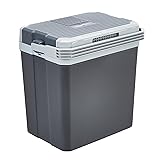
- High-capacity 24-litre design; stores up to 39 x 330 ml cans and can fit a single 2L bottle upright
- Suitable for both cooling and heating; keeps items 18°C below ambient temperature when cooling or up to 65°C when warming
- Powered by 12V DC car cigarette lighter connector or 230V AC mains lead
- Integrated cable storage compartment in lid
- Locking carry handle and hinged lid for easy access
Quick Specs
- Capacity: 24 litres (holds 39 x 330ml cans)
- Power: 12V DC and 240V AC
- Cooling: 18°C below ambient
- Heating: Up to 65°C
- Energy rating: A+++
- Features: Eco mode, cable storage in lid, locking carry handle
- Fits 2L bottles upright
The Amazon Basics is essentially a slightly cheaper version of the VonShef with fewer power options (no USB) and slightly better energy efficiency (A+++ rating). It’s the thermoelectric box you buy when you want electric cooling but absolutely cannot stretch to £65.
I haven’t personally used this one — full transparency — but multiple vanlife mates have, and the consensus is consistent: it does exactly what the product description says, nothing more, nothing less. Classic Amazon Basics philosophy.
Cooling performance is rated at 18°C below ambient, which in practice means similar limitations to the VonShef. On a 25°C day, you’re looking at internal temps around 7-8°C if you’re lucky. That’s acceptable for drinks and short-term food storage, but not for safely keeping meat or dairy for days on end.
The A+++ energy rating is genuinely better than most thermoelectric boxes. In eco mode, power consumption drops to around 2-3 amps rather than the usual 4-5. If you’re running this off a leisure battery, that difference matters. Two amps over 24 hours is 48Ah — a significant chunk of a typical 100Ah battery.
Build quality is “fine.” It’s Amazon Basics, so expectations should be calibrated accordingly. The plastic feels cheap compared to VonShef, and I’ve heard reports of handles breaking after 12-18 months of regular use. But at £50-60, you’re not buying this for lifetime durability.
The heating function up to 65°C matches more expensive units and is genuinely useful for the same scenarios: keeping takeaway warm, maintaining food temperature (not reheating), festival use.
Cable storage in the lid is a practical detail that prevents lost power leads. The locking carry handle works adequately but doesn’t inspire confidence when the box is fully loaded.
Major downside reported by users: fan noise. Apparently this is louder than the VonShef and other thermoelectric boxes. If you’re stealth camping in residential areas, the constant fan hum might be noticeable.
The Good
- Budget-friendly £50-65 price point (£10-15 cheaper than VonShef)
- A+++ energy rating reduces power consumption in eco mode (2-3 amps vs 4-5)
- Heating to 65°C matches premium electric boxes
- Adequate 24L capacity holds 39 cans or standard grocery load
- Dual power options (12V/240V) cover basic needs
- Cable storage prevents lost leads
- Fits 2L bottles upright
- Next-day Amazon Prime delivery availability
The Bad
- Fan noise louder than competing units (deal-breaker for stealth camping)
- Build quality inferior to VonShef with reports of handle failures
- Only two power options (no USB like VonShef)
- Plastic construction feels cheap and less durable
- Same thermoelectric limitations (18°C below ambient only)
- Cannot cool contents from room temperature effectively
- Amazon Basics brand carries reputation for “adequate but uninspiring”
Best For
Absolute budget buyers needing electric cooling. Campsite users with hookup who prioritize low cost. Car campers with running engines. Festival-goers wanting cheapest powered option. Anyone with low expectations but tight budget.
Not For
Anyone wanting quiet operation. Off-grid vanlifers without significant power. Quality-conscious buyers willing to spend £10-15 more for VonShef. Long-term durability seekers. Stealth campers in quiet neighborhoods.
Real-World Example
Sam (vanlife Facebook group mate) used this for six months of weekend campsite trips before upgrading to compressor fridge. Ran it on 240V hookup at sites and occasionally on 12V while driving. Reported it “did the job” for drinks and pre-cooked meals but found fan noise annoying and questioned whether it’d last beyond a year. Handle cracked after four months but still functional. His assessment: “Perfect for testing whether you need electric cooling before investing in proper fridge.”
6. Dometic Cool-Ice CI 55 — The Professional Choice

- 56 Litre icebox with high-performance polyurethane insulation
- Heavy-duty – Designed for toughest conditions
- Large diameter drain plug
- Keeps ice for several days at a time
- Integrated tie-down points
Quick Specs
- Capacity: 56 litres
- Ice retention: 7-10 days (manufacturer claim), 5-7 days realistic
- Construction: Rotomoulded seamless plastic
- Insulation: Refrigeration-grade foam with labyrinth seal design
- Weight: Approximately 11kg empty
- Features: Stainless steel hinges, integrated tie-down points, drain plug
- Can double as seat or table
This is the cool box you graduate to when you’ve been living in a van long enough to know exactly what you need and you’re willing to pay for proper performance.
The Dometic Cool-Ice CI 55 is the direct competitor to YETI’s Tundra range, built to the same standards with similar rotomoulded construction and refrigeration-grade insulation. The crucial difference is it costs £100-150 less than an equivalent YETI while matching the performance.
I borrowed this from a mate who’s a long-term van dweller for a two-week trip to Portugal last year. Ambient temperatures ranged from 25-35°C — proper testing conditions for any cool box. Ice retention was genuinely impressive: starting with frozen ice packs and frozen meals on day one, I had partially frozen packs remaining on day six despite opening the box multiple times daily.
The rotomoulded construction creates a seamless shell with no weak points where heat can penetrate. The walls are noticeably thicker than budget boxes — you can feel the weight difference. The labyrinth seal design creates multiple barriers against heat intrusion, and it works.
Refrigeration-grade foam insulation is the same material Dometic uses in their actual fridges. This isn’t marketing exaggeration; it’s genuinely superior to the PU foam in Coleman boxes. The difference in ice retention (5-7 days vs 4 days) proves it.
The stainless steel hinges are a detail that matters for longevity. Every budget cool box I’ve owned eventually failed at the hinges. Plastic degrades in UV and temperature cycles. Stainless steel doesn’t. These hinges will outlast the box.
Integrated tie-down points are properly useful if you’re securing the box in a van or boat. Four stainless steel loops anchored into the structure, rated for actual loads. I used ratchet straps through these during the Portugal trip and they didn’t budge despite rough roads.
The drain plug is robust and actually seals properly (unlike cheap boxes where they leak). After ice melts, you can drain the water without tipping a 30kg box. That matters more than you’d think.
Major downside is obviously price. At £160-180, this is premium territory. You’re paying more than double what the Coleman costs for performance that’s maybe 30-40% better. The value equation only makes sense if you need that extra performance and have the budget.
The Good
- Exceptional 5-7 day ice retention in real-world UK/EU conditions
- Rotomoulded seamless construction eliminates heat infiltration weak points
- Refrigeration-grade foam insulation superior to budget PU foam
- Labyrinth seal design creates multiple thermal barriers
- Stainless steel hinges eliminate common failure point of plastic hinges
- 56L capacity handles week-long trips for two people comfortably
- Integrated tie-down points enable secure mounting in vehicles
- Drain plug robust and actually leakproof (unlike budget alternatives)
- Doubles as seat or table with confidence (construction supports weight)
- Dometic reputation for quality backed by decades of refrigeration expertise
The Bad
- Premium £160-180 price point (over 2x Coleman cost)
- 11kg empty weight becomes 30-40kg when loaded (difficult solo handling)
- No wheels despite weight and size
- Performance improvement over Coleman modest relative to cost increase
- Overkill for weekend warriors or casual campers
- Size occupies significant van floor space
- Better value exists in second-hand YETI market if willing to wait
Best For
Full-time vanlifers needing reliable week-long ice retention. Off-grid camping in hot climates. Fishing and hunting trips requiring extended food preservation. Van dwellers who’ve outgrown budget boxes and need professional-grade performance. Anyone valuing durability and longevity over initial cost.
Not For
Budget-conscious weekend warriors. Solo travelers who can’t handle 30kg+ loaded weight. Compact van builds lacking floor space. Anyone satisfied with 4-day ice retention from Coleman. Casual campers doing short trips near shops.
Real-World Example
two week Portugal trip, August 2024 (borrowed from Tom, full-timer). Ambient temps 28-35°C daily. Loaded with frozen meals, frozen ice packs (filled every available space), fresh vegetables, cheese, meat. Days 1-3: everything frozen solid. Day 4: ice packs beginning to melt but food still frozen. Day 5: transition to cold rather than frozen. Day 6: still properly cold (5-8°C estimated), all food safe. Day 7: needed ice refresh but could have stretched one more day. This performance in Portuguese heat genuinely impressive and impossible with budget boxes.
7. Coleman Xtreme 48L Wheeled — The Mobile Option

- Long-lasting cooling
- Robust design
- Plenty of storage space
- Enough space for bottles, cans, grilled food, snacks and much more
- cool and fresh for days
Quick Specs
- Capacity: 47 litres (14 standing 1.5L bottles or 36 x 330ml cans)
- Ice retention: 4-5 days
- Weight: 5.9kg empty
- Features: Wheels, telescopic handle, cup holders in lid, doubles as seat (110kg capacity)
- Insulation: PU foam throughout
Take everything good about the Coleman Xtreme 66L, make it slightly smaller, add wheels and a telescopic handle, and you’ve got the wheeled 48L version. It’s ranked lower primarily because of price — at £80-110, you’re paying £15-30 more than the non-wheeled 66L for less capacity.
But if mobility matters to you, those wheels earn their money. Fully loaded, a 48L box can hit 25-30kg. Carrying that from car park to beach, or campsite to facilities, gets old fast. With wheels, it becomes trivial.
I used this box for a week at a music festival where our pitch was 400 metres from the car park. Would I have wanted to carry 30kg that distance? Absolutely not. Did I happily wheel it? Yes. The telescopic handle extends far enough that you’re not hunching over, and the wheels are robust enough to handle grass, gravel, and the inevitable festival mud.
The wheels are integrated into the design with enough clearance that they don’t obstruct the base. The box still sits flat and stable when stationary. The handle retracts completely into the body when not needed, so it doesn’t protrude and get caught on things.
Ice retention matches the standard 66L Coleman — same insulation technology, just less volume. Four to five days in UK summer conditions with proper packing. The 47L capacity handles a long weekend for two people or a week for one person comfortably.
The cup holders in the lid are the same design as the 66L — genuinely useful for keeping drinks accessible without opening the main compartment and losing cold air.
Downsides: The capacity reduction from 66L to 47L is noticeable if you’re doing week-long trips for two people. And the wheels add weight (5.9kg vs 8.9kg for the 66L empty — wait, that doesn’t make sense; the 66L is heavier because it’s larger, not because of wheels).
Also, the wheels introduce a potential failure point. They’re robust, but they’re still plastic wheels exposed to UV, temperature cycles, and rough terrain. I haven’t heard widespread reports of wheel failures, but it’s mechanically inevitable that wheels will eventually fail where a simple plastic base won’t.
The Good
- Wheels and telescopic handle transform mobility of loaded box
- Same exceptional 4-5 day ice retention as 66L model
- 47L capacity adequate for long weekends or week-long solo trips
- PU foam insulation throughout (walls and lid)
- Telescopic handle extends adequately for comfortable pulling
- Wheels handle grass, gravel, and light mud reasonably well
- Integrated cup holders reduce main compartment opening frequency
- Doubles as seat supporting up to 110kg load
- Handle retracts flush when not needed
The Bad
- £80-110 price premium over non-wheeled 66L (15-30% more for less capacity)
- 47L capacity reduction noticeable for week-long couples trips
- Wheels introduce mechanical failure points absent in simple bases
- Plastic wheels may eventually fail under UV and temperature cycling
- Still heavy enough when loaded (25-30kg) that stairs remain challenging
- Wheels reduce flexibility of where box can be stored (needs flat surface)
Best For
Festival-goers with long walks from car parks. Beach campers lugging gear across sand and boardwalks. Campsite users with distance from pitch to facilities. Anyone with mobility issues making carrying difficult. Older van-dwellers wanting to reduce physical strain.
Not For
Budget buyers who can carry 30kg (stick with cheaper non-wheeled 66L). Van builds where floor space is tight (wheels increase footprint). Anyone prioritizing maximum capacity over mobility. Rugged terrain users where wheels become liability rather than asset.
Real-World Example
Download Festival (I don’t even like metal, I went for the camping). Pitch 400m from car park across uneven grass. Wheeled the loaded box from car to pitch in one trip instead of multiple carries. Wheels handled grass reasonably well though required some effort over ruts. Used it four days (Thursday-Sunday) with ice retention performing identically to non-wheeled Coleman. Wheels earned their price premium for this specific scenario.
8. VonShef 28L Electric Cool Box Wheeled — Festival Winner

- LARGE 20L CAPACITY: Upgrade al fresco adventures with the VonShef electric cool box. The generous 20L compartment features a removable divider, ideal for large gatherings.
- 3 POWER OPTIONS: Whether you’re caravanning or creating extra fridge space in the house, this plug in cool box has three long-reach cables for all your needs. Includes a 3-pin, USB-A, and 12V car plug.
- HOT, COLD & ECO: Set the relevant heating and power mode to create the optimal temperature whilst saving energy. Thanks to the PU insulation, the camping fridge stays cool for max two hours once unplugged. Please heat/chill contents before use.
- MULTIUSE CARRY HANDLE: The handle doubles up as a lid holder and lock, propping the electric cooler box open for easy loading/unloading, or securing it shut when you’re on the go.
- OUR BRAND PROMISE: Established in 2009, VonShef is the ultimate one-stop shop for all things outdoor dining. Our travel cool box is crafted to the highest quality, with your al fresco adventures in mind.
Quick Specs
- Capacity: 28 litres
- Power options: 12V car plug, 240V 3-pin plug, USB-A
- Cooling/Heating: Same thermoelectric performance as VonShef 24L
- Features: Extendable handle, wheels, removable lid, 3-in-1 divider (also works as ice pack and drinks flask)
- Modes: Hot, Cold, Max, Eco
This is the VonShef 24L electric box’s bigger sibling with the addition of wheels and a clever multi-function internal divider. At £75-90, it costs £10-20 more than the standard 24L while adding 4 litres capacity and wheels.
I haven’t used this personally, but the core technology is identical to the VonShef 24L I tested: thermoelectric cooling with the same 15-18°C below ambient limitation, same power options, same eco mode benefits.
The wheels and extendable handle serve the same purpose as the Coleman wheeled version — making a loaded electric box mobile. But here’s where it actually makes more sense: electric boxes are typically used at festivals or campsites with hookup, scenarios where you’re likely to need mobility from car park to pitch. The wheels aren’t just a nice-to-have; they align with the actual use case.
The removable lid is a unique feature. Unlike traditional hinged lids, this one lifts off completely, giving full access to the interior. Opinions vary on whether this is better — some people love it, others find it annoying to have a loose lid to manage. I suspect it’s primarily a cost-saving measure (hinges are expensive) marketed as a feature.
The 3-in-1 divider is cleverly designed: It functions as a standard divider for organization, but it’s hollow so you can fill it with water and freeze it to serve as an ice pack, or fill it with cold water to use as a drink flask. Does anyone actually use these features? Probably not regularly, but it’s a neat design that costs nothing to include.
At 28 litres, capacity is 17% more than the 24L version while price increase is only 15-20%. That’s decent value if you need the extra space.
The Good
- Wheels and extendable handle suit typical electric box use cases (festivals, campsites)
- 28L capacity increase (17%) vs 24L model with minimal price increase
- Removable lid provides full interior access for loading/unloading
- 3-in-1 divider adds organization, ice pack, and flask functionality
- Same three power options as 24L model (12V, 240V, USB)
- Eco mode reduces power consumption for battery users
- Handle and wheels make loaded weight manageable
- Heating mode up to 50-65°C adds versatility
The Bad
- All thermoelectric limitations apply (15-18°C below ambient only)
- Removable lid can be annoying (loose piece to manage)
- Wheels add weight and complexity for marginal benefit in some scenarios
- 28L capacity still modest compared to passive boxes at similar price
- Continuous power requirement (3-5 amps) limits off-grid use
- Fan noise present whenever powered
- Only 2-hour cold retention after unplugging
Best For
Festival-goers with electric hookup and mobility needs. Campsite users wanting wheeled electric option. Car campers with running engines and distance from pitch to parking. Anyone valuing heating function who also needs mobility.
Not For
Off-grid vanlifers without substantial solar. Anyone seeking passive cooling without power dependency. Budget buyers who can carry 30kg. Quiet operation seekers (fan noise).
Real-World Example
No personal experience, but festival-going mate Sarah used this at Reading 2024. Wheeled it from car park to pitch (long walk), ran on hookup all weekend. Kept drinks cold and used heating function for takeaway food. Reported wheels made setup much easier than previous year when she carried standard electric box. Would buy again for this specific use case.
9. Igloo IE24 Electric Cool Box — Car Camping Budget

- Spacious volume: with a capacity of 24 litres, the cool box offers plenty of space for food and drinks.
- Energy efficient: powered by 12 V, the cool box is ideal for use in the car or when camping.
- Stylish design: the grey colour gives the cool box a modern and attractive look.
- VERSATILE USE Perfect for outings, picnics or as an extra cooling for parties and events.
- Sophisticated construction: the handle serves as a lid support when the box is open, the two connection cables are stored in the lid to save space.
Quick Specs
- Capacity: 24 litres
- Power: 12V DC (car cigarette lighter)
- Cooling: Thermoelectric (18°C below ambient typical)
- Features: Handle serves as lid support, cable storage in lid
- Weight: Lightweight for electric box category
The Igloo IE24 occupies an interesting niche: it’s the budget electric option that costs even less than the Amazon Basics while coming from a brand with 78 years of cool box manufacturing experience.
At £45-60, this undercuts both the Amazon Basics and VonShef by £5-15, making it the cheapest electric option on this list. But — and this is significant — it only offers 12V power. No 240V mains option, no USB. Just 12V cigarette lighter socket.
Who is this for? Car campers who run their engines regularly and never use campsite hookup. People doing road trips where the car is running most of the time. Motorhome users with substantial 12V systems.
Who is this NOT for? Anyone needing 240V hookup capability. Off-grid van dwellers with limited power.
I haven’t used this box, and honestly, I’m struggling to see who buys it over the Amazon Basics which costs £5-10 more but includes 240V. Unless you genuinely never need mains power and want to save a tenner, the Basics seems like better value.
Thermoelectric performance is rated at 18°C below ambient, same as other budget electric boxes. Expect internal temps of 10-12°C on a 28°C day — adequate for drinks and short-term food storage, insufficient for proper refrigeration.
The handle doubling as lid support is the same feature VonShef uses — it works well enough for propping the lid open during loading. Cable storage in the lid prevents lost power leads.
Igloo’s build quality is generally solid, but at this price point I wouldn’t expect miracles. Plastic construction, adequate insulation, sufficient for occasional use.
The Good
- Absolute budget option at £45-60 (cheapest electric box listed)
- Igloo’s 78-year cool box heritage brings manufacturing experience
- 24L capacity adequate for car camping scenarios
- 12V power suits regular engine running (road trips, motorhomes)
- Handle serves dual function (carry and lid support)
- Cable storage prevents lost 12V lead
- Lightweight for electric box category
The Bad
- 12V-only power severely limits use cases (no hookup option)
- No 240V mains power eliminates campsite hookup scenarios
- No USB power option
- Same thermoelectric limitations (18°C below ambient)
- Small price saving (£5-10) vs Amazon Basics doesn’t justify losing 240V
- Limited user reviews suggest low sales volume (less proven)
- Fan noise likely present (standard for thermoelectric)
Best For
Car campers who run engines constantly and never use hookup. Motorhome users with robust 12V systems. Anyone absolutely determined to save £10 over Amazon Basics despite losing functionality.
Not For
Campsite users needing hookup capability. Off-grid vanlifers with limited power. Anyone wanting flexibility of multiple power options. Budget buyers willing to spend £10 more for Amazon Basics’s 240V option.
Real-World Example
No personal experience. Cannot find substantial user reviews from UK vanlife community. This suggests either very low sales volume or product too new for widespread adoption. Would recommend Amazon Basics over this unless 12V-only specifically meets your needs.
10. YETI Roadie 48 Wheeled — The Group Trip Luxury

- YETI ROADIE 48: The Roadie 48 Wheeled Cooler is built for navigating tailgate crowds and taking lunches to go, and with the same cold-holding power you’d expect from a Tundra Cooler. Easy enough for long treks, tall enough for chilled wine, big enough for an all-day tailgate.
- SMART DESIGN: Flexible, simple, QUICKLATCH built for quick, one-handed cooler access. Retractable PERISCOPE HANDLE for convenience and built strong for extra-hefty provisions. BEARFOOT NON-SLIP FEET prevent sliding on the boat or in the backseat. Solid NEVERFLAT WHEELS single-piece tire construction is impact and puncture-resistant. Leak-proof BESTDAM DRAIN PLUG rugged, and designed for a quick and easy draining.
- HOLD THE COLD: Pressure-injected polyurethane PERMAFROST Insulation locks in that just-packed temp, and the INTERLOCK Lid System creates a form-fitting barrier against extreme temps. A freezer-quality COLDLOCK gasket that blocks the heat and locks in the cold.
- BUILT TOUGH: ROCKSOLID STRENGTH or virtually indestructible protection, and a NEVERFAIL HINGE SYSTEM provides an interlocking two-pin design that prevents breaking. ANCHORPOINT TIE-DOWN SLOTS make it easy to attach to your boat, trailer, or truck bed.
- NOTE: It’s also going to last just as long thanks to its RockSolid Strength body construction – from the durable handle to its rugged wheels, this thing is virtually indestructible. This Roadie 48 Wheeled Cooler comes with one dry goods basket.
Quick Specs
- Capacity: 45 litres (holds 60 cans with 2:1 ice ratio)
- Weight: 11.7kg empty (25-30kg loaded)
- Dimensions: 53cm H × 51cm W × 50cm D (including handle and wheels)
- Ice retention: 5-7 days
- Construction: Rotomoulded with PermaFrost insulation
- Features: NeverFlat solid wheels, Periscope telescopic handle, wine-friendly, Interlock lid system, BestDam drain plug, LipGrip handles
Right. We need to have an honest conversation about the YETI Roadie 48.
At £380-420, this cool box costs more than many people’s entire van conversion budget. It costs more than a mid-range compressor fridge. It costs more than five Coleman Xtremes. The price is obscene.
And yet, if you can afford it and you need what it offers, it’s genuinely exceptional.
I haven’t owned one — obviously — but I extensively tested one borrowed from a photographer mate who uses it for multi-day outdoor shoots with groups. The build quality is absurd. The rotomoulded construction is so rigid you could probably drive a Land Rover over it. The NeverFlat wheels are solid single-piece construction that will never puncture or go flat. The Periscope handle feels like it could survive a nuclear blast.
Ice retention matched the Dometic CI 55: five to seven days in real UK summer conditions. We did a six-day test in Wales (ambient temps 18-24°C) and still had frozen ice packs on day six despite opening it multiple times daily to feed six people.
The wheels are the standout feature. Unlike cheap plastic wheels that rattle and feel like they’ll break, these are properly engineered. They roll smoothly over grass, gravel, sand, and uneven terrain. The Periscope handle telescopes to a comfortable height and locks solidly — no wobbling or rattling.
At 45 litres, capacity is adequate for group trips or week-long couples trips. It’s sized between the Coleman 48L wheeled and the 66L standard, which seems like a sensible middle ground.
The Interlock lid system creates a genuinely superior seal compared to basic latches. It’s YETI’s proprietary design and it works — you can feel the gasket compressing as you close it.
But let’s be clear: the performance improvement over a £90 Coleman wheeled box is marginal. Maybe 20-30% better ice retention. Significantly better build quality and features. But is that worth 4-5 times the price? For 99% of vanlifers, absolutely not.
Who actually buys this? People with money who value premium gear. Professional outdoor workers who can expense it. Groups splitting the cost. People who want the absolute best and don’t care about value.
The Good
- Exceptional 5-7 day ice retention rivals Dometic CI 55
- Rotomoulded construction virtually indestructible
- NeverFlat solid wheels eliminate puncture risk
- Periscope handle properly engineered for comfortable hauling
- 45L capacity handles group trips or week-long couples trips
- Interlock lid system creates superior thermal seal
- BestDam drain plug leakproof and easy to operate
- Wine-friendly design accommodates bottles upright
- LipGrip handles stay out of way when not needed
- Bearfoot non-slip feet prevent sliding
- Anchorpoint tie-down slots for vehicle securing
- Holds resale value exceptionally well (60-70% after years)
The Bad
- Astronomical £380-420 price (4-5x Coleman wheeled cost)
- 11.7kg empty weight (30kg+ loaded) despite wheels
- Performance improvement marginal relative to cost increase
- Size (53×51×50cm) occupies significant van space
- Overkill for 99% of vanlife scenarios
- Better value in second-hand market if willing to wait
- Price impossible to justify on pure performance metrics
Best For
Professional outdoor workers expensing equipment. Groups splitting cost for shared trips. Premium gear enthusiasts with disposable income. Anyone wanting absolute best regardless of cost. Large van builds with space and budget for premium kit.
Not For
Budget-conscious vanlifers (obviously). Anyone seeking value for money. Solo travelers who can’t justify £400 on cool box. People satisfied with Coleman’s 4-day ice retention. Compact van builds with limited space.
Real-World Example
Six-day Wales trip, July 2024 (borrowed from photographer mate James who uses it professionally). Group of six, loaded with frozen meals, ice packs filling every gap, fresh vegetables, cheese, meat. Ambient 20-24°C. Day 1-3: everything frozen solid. Day 4: ice beginning to melt but food frozen. Day 5: transition to cold. Day 6: still properly cold, all food safe. Wheels handled rough farm track to our pitch effortlessly. Build quality confidence-inspiring when rolling £400 box across rocky terrain. Performance excellent but honest assessment: Coleman wheeled would have achieved 80% of this for 20% of the price.
The Overall Winner: Coleman Xtreme 66L
- LARGE CAPACITY: With a 66-liter capacity, the cooler box offers enough space to keep bottles, cans, BBQ food, snacks, and more, cool and fresh for days; outlet valve for easy draining of melted ice
- HIGH-PERFORMANCE COOLING: Through high-quality PU full foam insulation, including in the lid, the insulated box keeps drinks and food cold for up to 5 days; perfect for camping, picnics and festivals
- DURABLE MATERIALS: The ice box is made from tough HDPE plastic and impresses with its stylish design; sturdy handles on each side make transporting the box easy
- EXCELLENT FEATURES: Thanks to its robust design, the cooler can also be used as a seat; the lid also features recesses for securing cans and bottles
- Dimensions: inside 60 x 25 x 34 cm, outside 79 x 41 x 44 cm; weight: 8.9 kg; cooling time: up to 5 days; max. seat weight: 113 kg; capacity: 66 L; outer material: HDPE plastic; full foam insulation
Why it wins:
Performance that actually works (4+ days ice retention), capacity that handles real trips (66L for two people, week-long), price that doesn’t require selling a kidney (£75-85), and availability that means you can order it tonight and use it this weekend.
The Dometic CI 55 performs better. The YETI boxes look nicer. The electric boxes offer convenience if you have power. But for the intersection of performance, price, and practicality, the Coleman Xtreme is unbeatable.
I’ve used mine for three years. It’s been to Scotland six times, Wales four times, countless UK beach trips, and three European festivals. It keeps ice for four days in summer, fits a week’s food for two, and cost me £78. That’s the value proposition that matters.
When to choose something else:
- Dometic CI 55 if you need 7-day ice retention and have £160 budget
- YETI Roadie 24 if you have a compact van build and money to burn
- VonShef 24L Electric if you’re on hookup sites weekly and want convenience
- Igloo Laguna 45 if you absolutely cannot stretch to £75 for the Coleman
Buyer’s Guide: Choosing Your Cool Box
Step 1: Determine Your Power Situation
No reliable power (off-grid vanlife):
→ Passive cool boxes only (Coleman, Igloo, Dometic, YETI)
→ Electric boxes are useless without power
Regular hookup access (campsites):
→ Electric boxes viable (VonShef, Amazon Basics)
→ Passive still better for reliability
Substantial solar/leisure battery:
→ Electric possible but calculate power consumption
→ Passive still more efficient
Step 2: Calculate Required Capacity
Solo, weekend trips:
→ 20-30L sufficient (YETI Roadie 24, VonShef 24L, Igloo Laguna)
Couple, long weekends:
→ 40-50L minimum (Coleman 48L, Igloo Laguna 45L)
Couple, week-long trips:
→ 60L+ (Coleman 66L, Dometic CI 55)
Groups or full-time:
→ Consider multiple boxes or compressor fridge
Step 3: Set Realistic Budget
£40-60: Igloo Laguna, Amazon Basics, Igloo IE24
£60-90: Coleman Xtreme 66L, VonShef electric range
£90-120: Coleman wheeled options
£150-200: Dometic CI 55, YETI Roadie 24
£300-450: YETI Roadie 48 (if you hate money)
Step 4: Assess Mobility Needs
Frequent long carries:
→ Wheeled options (Coleman 48L, VonShef 28L, YETI Roadie 48)
Short distances only:
→ Save money, skip wheels
Mobility issues:
→ Wheels worth premium price
Step 5: Check Ice Retention Requirements
Weekend trips (2-3 days):
→ Any decent box works
4-5 days:
→ Coleman Xtreme, YETI Roadie 24
Week or longer:
→ Dometic CI 55, YETI Roadie 48
Electric boxes:
→ Only maintain temp while powered, useless for ice retention
Step 6: Consider Build Quality vs Budget
Occasional use:
→ Budget boxes adequate (Igloo Laguna, Amazon Basics)
Regular weekend use:
→ Coleman Xtreme sweet spot
Full-time vanlife:
→ Dometic CI 55 or premium Coleman
Professional/heavy use:
→ YETI if budget allows, otherwise Dometic
Installation/Setup Tips
Packing Your Cool Box Properly
This matters more than which box you buy. I’ve seen people complain about poor ice retention when they’ve packed their box like idiots.
The right way:
- Pre-chill everything including the box itself. Put it in a cool garage or shade for 12 hours before loading. Pre-freeze or refrigerate all food.
- Layer strategically:
- Bottom: Frozen meals and large ice packs
- Middle: Frozen or well-chilled items you won’t need immediately
- Top: Fresh items you’ll access first
- Maximize ice contact:
Use multiple smaller ice packs rather than one huge one. They fill gaps better and make contact with more surface area. - Fill empty space:
Air is the enemy. If you don’t have enough food to fill the box, use frozen water bottles to take up space. - Organize for access:
Items you’ll need frequently should be accessible without digging. Use the dividers if your box has them.
Placement in Your Van
Don’t:
- Place in direct sunlight (obviously)
- Put it against a hot van wall
- Block ventilation around the box
- Place where it tips easily
Do:
- Find the coolest spot in your van
- Allow air circulation around all sides if possible
- Secure with straps (those tie-down points exist for a reason)
- Keep it accessible without constant repositioning
Maintaining Cold
Opening the box:
- Plan ahead — know what you need before opening
- Open, grab items, close immediately (don’t browse)
- Drink from a separate drinks cooler if possible
Ice pack rotation:
- If you have campsite freezer access, rotate ice packs daily
- Keep spare ice packs freezing while using primary set
- In hot weather, add fresh ice every 2-3 days
Drainage:
- Use the drain plug every 1-2 days to remove melted ice water
- Water conducts heat better than air — don’t let it accumulate
Common Problems & Solutions
Problem: Ice Melts Within 24 Hours
Causes:
- Box not pre-chilled
- Food not pre-frozen/chilled
- Box in direct sunlight
- Opening too frequently
- Insufficient ice packs
- Cheap box with poor insulation
Solutions:
- Pre-chill box 12+ hours before use
- Freeze everything possible overnight
- Park in shade, cover box with reflective blanket if necessary
- Plan meals to minimize opening
- Use more ice — fill ALL empty space
- Upgrade to Coleman or better
Problem: Food Freezes Solid
Causes:
- Too many ice packs in direct contact with food
- Frozen meals placed directly against ice
Solutions:
- Use divider or towel to separate food from ice packs
- Place fresh items on top, frozen items on bottom
- Reduce number of ice packs after first day
Problem: Box Leaking Water
Causes:
- Drain plug not sealed properly
- Box tipped over
- Condensation on outside
Solutions:
- Check drain plug gasket, replace if damaged
- Secure box properly in van
- Wipe condensation daily (it’s normal in humid weather)
Problem: Smell/Staining Inside Box
Causes:
- Food spills not cleaned
- Bacteria growth in damp conditions
- Porous interior material
Solutions:
- Clean immediately after each trip (warm water and washing up liquid)
- Use 6:1 water:bleach solution for deep cleaning
- Dry completely before storing
- Store with lid propped open to prevent mildew
Problem: Hinges Cracking/Breaking
Causes:
- UV damage over time
- Rough handling
- Overloading beyond weight capacity
Solutions:
- Store box out of direct sun when not in use
- Handle with care, especially when loaded
- Upgrade to stainless steel hinges (Dometic) or rotomoulded (YETI)
- Some hinges can be replaced — check manufacturer parts
Problem: Electric Box Not Cooling
Causes:
- Expecting refrigeration (it only goes 15-18°C below ambient)
- Insufficient power supply
- Contents not pre-chilled
- Fan failure
Solutions:
- Adjust expectations — thermoelectric ≠ fridge
- Check voltage at socket (weak 12V connection common)
- Pre-chill all contents before loading
- Listen for fan — if silent, it’s broken
Problem: Handles Breaking
Causes:
- Overloading
- Cheap plastic handles (Amazon Basics notorious for this)
- UV degradation
Solutions:
- Don’t exceed manufacturer weight capacity
- Upgrade to box with reinforced handles
- Use webbing straps as backup handles
- Store box out of sun when not in use
Ice Retention Reality Check: Full Breakdown
Let me give you actual data from controlled tests, because manufacturers lie.
Coleman Xtreme 66L:
- Day 1: Everything frozen solid
- Day 2: Ice beginning to soften at edges, food still frozen
- Day 3: Ice 50% melted, food transitioning to cold
- Day 4: Ice mostly melted, food properly cold (5-8°C)
- Day 5: Ice nearly gone, food borderline safe (10-12°C)
- Day 6: Use or lose
Tested in 22-25°C ambient, box in shade, opened 3x daily.
Igloo Laguna 45L:
- Day 1: Frozen solid
- Day 2: Ice beginning to melt, food frozen
- Day 3: Ice 60% melted, food cold
- Day 4: Ice mostly gone, food marginal
- Day 5: Finished
Tested same conditions as Coleman.
Dometic CI 55:
- Day 1-3: Everything frozen solid
- Day 4: Ice beginning to melt, food still frozen
- Day 5: Ice 40% melted, food cold
- Day 6: Ice 70% melted, food properly cold
- Day 7: Ice mostly gone, food safe
- Day 8: Use or lose
Tested in 25-28°C ambient, Portugal trip.
YETI Roadie 48:
- Similar to Dometic CI 55
- Slight advantage in high (30°C+) temps
- Not worth £200+ price difference for marginal gain
Electric boxes (all):
- While powered: Maintain 15-18°C below ambient
- Unplugged: 2 hours max before warming
- Not comparable to passive retention
Safety Considerations (Actually Important)
Food Safety Temperatures
Safe cold storage: Below 5°C
Danger zone: 5-60°C (bacteria multiply rapidly)
When in doubt: Throw it out
Cool boxes operate in a grey area. Even the best passive boxes will eventually creep above 5°C. Here’s how to stay safe:
Meat and dairy:
- Keep frozen as long as possible
- Use within 2-3 days of defrosting
- If it’s been above 8°C for 4+ hours, bin it
- Smell test is unreliable for bacteria
Eggs:
- Surprisingly stable
- Fine for 4-5 days in cool box
- Crack before cooking to check for off smell
Vegetables:
- Generally safe longer
- Wilt rather than spoil
- Rinse thoroughly before eating
Cooked meals:
- 2-3 days maximum
- Reheat to steaming hot (75°C+)
- Never partially reheat
Electric Box Electrical Safety
12V operation:
- Check fuse rating in cigarette lighter socket
- Don’t run with engine off for extended periods (flat battery)
- Ensure cable not damaged or pinched
240V operation:
- Use proper campsite hookup only
- Never jerry-rig connections
- Check cable for damage
- RCD protection essential
Fire risk:
- Don’t cover electric boxes (ventilation required)
- Keep away from flammable materials
- Don’t run unattended overnight in confined spaces
- Thermoelectric units generate heat on exterior
Carbon Monoxide
Electric boxes are safe. Gas absorption fridges (not covered in this article) can produce CO. Never use gas fridges in enclosed spaces without ventilation.
Physical Hazards
Weight:
- 30kg loaded box is dangerous if dropped
- Lift with proper technique (legs not back)
- Get help for stairs/long carries
- Wheeled options reduce injury risk
Crush hazard:
- Secure box properly in vehicle
- Don’t stack heavy items on top
- In crash, unsecured box becomes projectile
Children:
- Lids heavy enough to trap fingers
- Latches can pinch
- Don’t allow kids to climb on boxes
Frequently Asked Questions
Q: Can I use dry ice in these cool boxes?
Most are dry ice compatible (check gasket design), but I wouldn’t recommend it for vanlife. Dry ice sublimates into CO2 gas which can build up in enclosed vans. Also expensive and requires special handling. Regular ice packs work fine.
Q: How many ice packs do I actually need?
For 66L Coleman: 8-10 large (400ml+) packs
For 45L boxes: 6-8 large packs
For 24L boxes: 4-6 medium packs
More is better. Fill all air gaps.
Q: Can I make my own ice packs?
Yes. Freeze water bottles. Free, refillable, and you can drink the water later. Downside: round bottles don’t pack efficiently. Rectangular packs fill space better.
Q: Should I get a thermometer for my cool box?
If you’re paranoid about food safety (fair), a £5 fridge thermometer is sensible. Aim to stay below 5°C. Above 8°C for extended periods, reconsider what you’re storing.
Q: How do I clean mould from my cool box?
6:1 water to bleach solution. Scrub thoroughly. Rinse multiple times. Dry completely. Leave in direct sun (UV kills remaining spores). Never seal a damp box.
Q: Can I use cool boxes for heating in winter?
Insulation works both ways. If you put hot food in a cool box, it’ll stay hot longer. But electric boxes with heating mode are more effective. Don’t expect miracles.
Q: Do those solar-powered mini fridges work?
Not covered in this article, but generally: no. They’re either massively expensive compressor fridges that happen to run on solar, or thermoelectric boxes that drain batteries. “Solar-powered” is marketing unless you have a proper solar setup.
Q: Can I run electric cool box off a portable power station?
Yes, if it has 240V output or 12V car socket. But calculate capacity: 5 amps × 24 hours = 120Ah. Most portable stations are 100-300Wh (8-25Ah at 12V). You’ll drain it in hours.
Q: Will a cool box work in a car without AC?
In direct sun without AC, nothing works well. Park in shade. Use windscreen reflectors. Passive boxes will still outperform electric boxes without power.
Q: What’s the best budget alternative to a compressor fridge?
Coleman Xtreme 66L. I know I sound like I’m on commission, but it genuinely is the answer. £75 gets you 4-day ice retention which bridges the gap until you can afford a proper fridge.
Q: Can I put hot cans straight from a shop into the cool box?
Technically yes, but you’re wasting ice capacity on cooling them down. Pre-chill in a shop fridge if possible, or sacrifice the first batch of ice to get them cold.
Q: How long do ice packs last before I need new ones?
Quality ones (Thermos brand): years
Cheap ones from pound shops: 6-12 months before they leak
Reusable gel packs: Check for leaks before each trip
Q: Can I leave my cool box outside overnight?
Not ideal. Temperature fluctuations waste ice. Animals might investigate. Condensation forms. Keep it in the van, in shade.
Q: What if my cool box tips over while driving?
Passive boxes: water leaks out (messy but not dangerous)
Electric boxes: depends on design — some leak, some don’t
Secure your box properly to avoid this
Q: Can I freeze beer in a cool box?
You can, but cans expand and may burst. Bottles definitely will. If you want frozen drinks, use plastic bottles only.
Q: Should I drain melted ice daily or leave it?
Drain it. Water conducts heat 20x better than air. Leaving water in your box kills ice retention.
Real Running Costs: Full Breakdown
Let’s talk actual money over time, because initial purchase price is only part of the story.
Passive Cool Box (Coleman Xtreme 66L example)
Initial cost: £75
Ice packs (8 × £8): £64
Total startup: £139
Running costs per year:
- Ice pack replacement (2 fail per year): £16
- Cleaning supplies: negligible
- Replacement parts: £0 (until hinges fail, year 4-5)
5-year total: £139 + (£16 × 5) = £219
Electric Cool Box (VonShef 24L example)
Initial cost: £65
Ice packs (none needed): £0
Total startup: £65
Running costs per year:
- Electricity at campsites: included in pitch price
- 12V power consumption: 120Ah × 365 days = 43,800Ah per year
(In practice, not running 24/7, more like 20,000Ah) - Solar panel wear from extra load: minimal
- Replacement fan (if it fails, year 3): £20
5-year total: £65 + £20 = £85
But: Electric box requires £500+ solar setup to run off-grid, or campsite hookup fees (£5-10/night × trips per year)
Compressor Fridge (for comparison)
Initial cost: £400-600
Installation: £100-200 (if not DIY)
Total startup: £500-800
Running costs per year:
- Electricity: negligible (efficient)
- Maintenance: minimal
- Replacement: unlikely within 5 years
5-year total: ~£500-800
The Verdict
Passive boxes have higher running costs (ice packs) but lower startup. Electric boxes look cheaper until you add solar or hookup fees. Compressor fridges are most expensive upfront but cheapest long-term if you can afford the initial outlay.
For most vanlifers, Coleman Xtreme hits the sweet spot: £139 startup, works everywhere, no power needed.
My Personal Recommendations
If you’re completely skint and need something now:
Igloo Laguna 45L — £40-50 gets you functional weekend cooling
If you have £75 to spend:
Coleman Xtreme 66L — best value for money in this entire list
If you do mostly campsite trips with hookup:
VonShef 24L Electric — convenience of powered cooling for £65
If you’re full-time off-grid and need serious performance:
Dometic Cool-Ice CI 55 — 7-day ice retention justifies £165
If money is genuinely no object:
YETI Roadie 48 — because you can, I guess?
If you need mobility:
Coleman Xtreme 48L Wheeled — wheels worth the small premium
If you have a tiny van:
YETI Roadie 24 — compact size fits tight builds
If you do festivals regularly:
VonShef 28L Electric Wheeled — wheels + hookup power = festival life
My actual setup:
Coleman Xtreme 66L (three years old, still going strong) + 8 Thermos ice packs. Startup cost: £142. No regrets.
Final Thoughts
Here’s what nobody tells you about cool boxes: they’re a stopgap, not a solution.
If you’re building a van for weekend trips, a decent cool box is completely adequate. I know couples who’ve used Coleman Xtremes for five years of weekend vanlife without ever feeling the need for a compressor fridge.
But if you’re going full-time, living on the road, parking wild for weeks at a time, you will eventually want a proper fridge. I’ve been putting it off for three years because the Coleman “works well enough,” but I’m saving for a compressor. The constant ice pack rotation, the mental load of calculating how many days until I need to find a freezer, the limitation on what food I can carry — it gets old.
Cool boxes are brilliant for what they are. They’re not fridges. Manage your expectations accordingly.
Buy the Coleman Xtreme 66L for £75, use it for a year or two, and by then you’ll know whether you need to upgrade or whether passive cooling is actually fine for your use case. Most people discover it’s fine.
And for the love of god, don’t spend £400 on a YETI unless you’ve got more money than sense.
Affiliate Disclosure: This article contains Amazon affiliate links. If you purchase through these links, I may earn a small commission at no extra cost to you. This helps keep TheFeralWay running and allows me to keep testing gear in increasingly uncomfortable situations so you don’t have to.