
I’ve blown two inverters, melted one set of cables, and learned £800 worth of expensive lessons about what actually matters when converting 12V to 240V in a campervan. Here’s everything I wish someone had told me before I clicked “buy” on that first cheap modified sine wave unit. Understanding the best inverters for van conversions will save you time and money.
My Top Picks
Best Overall: Victron Phoenix 12/800 – bulletproof reliability, efficient, connects to your phone
Best Budget: EDECOA 1500W – surprising quality for the price, perfect for weekend warriors
Best Mid-Range: Renogy 2000W – solid build, proper UK support, UPS function actually works
Best Premium: Victron MultiPlus 12/2000 – inverter/charger combo, worth it if you hook up regularly
Quick Comparison Table
| Model | Continuous | Peak | Price | Prime | Best For |
|---|---|---|---|---|---|
| Victron Phoenix 12/800 | 800W | 1600W | £200 | ✓ | Laptops, phone charging, TV |
| Renogy 1000W | 1000W | 2000W | £160 | ✓ | Basic electrics, occasional kettle |
| EDECOA 1500W | 1500W | 3000W | £189 | ✓ | Budget builds, infrequent use |
| Renogy 2000W | 2000W | 4000W | £210 | ✓ | Full-timers, multiple appliances |
| GIANDEL 2000W | 2000W | 4100W | £249 | ✓ | High surge needs, lithium batteries |
| Victron Phoenix 12/1200 | 1200W | 2400W | £230 | ✓ | Reliable daily power, compact |
| NOVOPAL 1500W | 1500W | 3000W | £144 | ✓ | Tight budgets, light use |
| Renogy 3000W | 3000W | 6000W | £330 | ✓ | Air fryer, microwave, kettle together |
| ECO-Worthy 3000W | 3000W | ????W | £210 | ✓ | Budget high Wattage |
| Victron MultiPlus 12/2000 | 2000W | 4000W | £900 | ✓ | Inverter/charger combo, campsite users |
What You Actually Need to Know About Inverters
When selecting inverters for van conversions, it’s essential to consider the types and features that best suit your needs.
Before we dive into the rankings, let’s clear up the confusion.
Pure Sine Wave vs Modified: Why It Matters
Modified sine wave inverters are cheap. They’re also rubbish. I started with one because I thought “how different can it really be?” Turns out, quite a lot.
My laptop charger buzzed like an angry wasp. My phone took twice as long to charge. And when I tried to run my ancient portable TV? Wouldn’t even turn on. Modified sine wave produces a stepped, blocky waveform that makes sensitive electronics very unhappy.
Pure sine wave is what comes out of your wall socket at home. Smooth, clean power that every device is designed to handle. Yes, it costs more. But unless you’re literally only running a desk fan and nothing else, it’s worth every penny.
Sizing: The Math That Actually Matters
Everyone gets this wrong initially. Including me.
Your inverter needs to handle two things:
- Continuous load – what you run all the time
- Surge/peak load – the spike when things turn on
Kettles are the classic example. My 800W kettle draws 800W when boiling. But when I first flick the switch? It tries to pull 1200W for about half a second. If your inverter is only rated for 1000W continuous with a 1500W peak, that kettle will work fine.
Here’s what actually draws power in a typical van:
- Laptop charging: 45-90W
- Phone charging: 10-20W
- LED TV (32″): 40-70W
- Kettle: 800-1200W (2000W+ surge)
- Coffee machine: 600-1000W
- Hair dryer: 1200-1800W (don’t even think about it unless you’ve got 300Ah+ of lithium)
- Air fryer: 1200-1500W
- Microwave: 700-1000W (but needs 1.5x that for surge)
Add up everything you might run simultaneously. Then add 25% because you’ll definitely forget something. That’s your minimum continuous rating.
Battery Capacity: The Limiting Factor Nobody Mentions
A 2000W inverter sounds powerful. And it is. But can your batteries actually supply it?
Power (watts) ÷ voltage (12V) ÷ efficiency (0.9) = amps drawn
A 2000W inverter at full load pulls about 185A from your batteries. If you’ve only got 100Ah of AGM, you can discharge 50Ah safely. That’s 16 minutes of runtime at full load. Not exactly practical.
This is why I’m only running an 800W inverter despite having space for bigger. My 200Ah AGM bank can comfortably supply 60-70A continuously, which gets me 700W of usable power for a reasonable amount of time.
Match your inverter to your battery bank, not your dreams of running a 3000W air fryer off 100Ah of ancient lead acid.
1. Victron Phoenix 12/800 — The Gold Standard

- This Victron Energy Inverter allows you to power domestic equipment requiring 230-Volt AC, using leisure or automotive batteries rated at 12-Volt DC
- The pure sine wave output delivers 800-Watt Continuous power, 1500-Watt peak power with high efficiency, 1-Watt draw in zero-load power ECO mode
- This inverter can be operated and monitored with computers, tablets and smartphones because of the VE.Direct communication port. Cables and dongles are sold separately
- High start-up power is used to start loads such as power converters for LED lamps or electric tools. In ECO mode, the inverter will switch to standby when the load decreases
- Employing the hybrid HF technology, the result is a top quality product with compact dimensions, light in weight and capable of supplying power, problem free, to any load
Continuous: 800W | Peak: 1500W
Amazon UK Rating: 4.6 stars (487 reviews)
Prime Eligible: Yes
Model: PIN121801400
Why It’s Number One
After two failed cheap inverters, I bit the bullet and spent proper money on a Victron. Three years later, it’s still running perfectly. Not one beep, not one fault, not even a cable getting warm. That’s worth talking about.
This isn’t the most powerful inverter on the list. But if you’re running a laptop, charging camera batteries, making toast, or watching telly, 800W is plenty. I’ve run my projector (150W), laptop (65W), and phone charger simultaneously without issue.
What Makes It Special
The VE.Direct port changes everything. Download the VictronConnect app, buy the Bluetooth dongle (£35 extra, frustratingly not included), and you can monitor your inverter from the cab. Input voltage, load percentage, temperature, current draw – all there on your phone.
When you’re wild camping in Scotland and your batteries are getting low, being able to check your inverter draw without crawling into the back in your pants at 6am is genuinely useful. I’ve caught multiple power vampires this way – that USB charger I forgot to unplug was drawing 8W constantly.
ECO mode is genuinely clever, not marketing nonsense. Drop below 15W load and the inverter switches to standby, drawing just 1W. Every 2.5 seconds it wakes up, checks for load, and goes back to sleep if there’s nothing there. Over a week of not using 240V, that’s the difference between 42Wh wasted (old inverter at 6W idle) and 7Wh (Victron in ECO). Doesn’t sound like much until you’re trying to eke out three days between charges.
The efficiency is where Victron earns its reputation. 94% at full load. My previous inverter was maybe 85% on a good day. That extra 9% means an extra hour of laptop charging from the same battery capacity.
Real-World Performance
I tested this properly last winter in the Cairngorms. Five days off-grid, temperatures down to -8°C. The inverter sat in an uninsulated locker under the bed. Ran my laptop 4-5 hours daily, kettle twice a day, phone charging constantly.
The unit got warm but never hot. Fans barely audible. When the temperature inside the locker hit -2°C overnight, it fired up without complaint in the morning.
The one time it did beep at me was my fault – I tried to boil a kettle when my batteries had dropped to 11.8V. Low voltage alarm kicked in (adjustable in the app, default is 11V shutdown). Saved my batteries from over-discharge. This is why you buy Victron.
Installation Notes
Not plug-and-play if you want to do it properly. You’ll need:
- 16mm² cable minimum (I used 25mm²)
- Proper battery terminals (not the cheap clamp ones it comes with)
- A 100A fuse within 150mm of your battery positive
- Decent ventilation – it needs airflow
I mounted mine vertically on the bulkhead behind the driver’s seat. It’s accessible for the power button, has airflow, and the LED indicators are visible. Took about 3 hours to install properly with cable runs.
The Good
- Genuinely reliable (three years, zero faults)
- VE.Direct monitoring is brilliant once you’ve bought the dongle
- ECO mode that actually works
- High efficiency means less battery draw
- Proper UK support through Victron dealers
- Comes with UK 3-pin socket attached
- Operating temp range: -40°C to +65°C
- Comprehensive protection: overvoltage, undervoltage, overtemp, short circuit
The Bad (And the Ugly)
- Bluetooth dongle costs extra – should be included at this price
- Only one socket (fine for me, annoying for some)
- Quite chunky – 320mm x 186mm x 70mm
- No USB ports (not really a downside, dedicated USB chargers are more efficient)
- Cables provided are barely adequate – budget for better ones
- £209 is genuinely expensive for 800W
- Remote on/off switch costs extra if you want one
Worth the Money?
For full-timers or anyone who relies on their inverter daily, absolutely yes. The reliability alone justifies the cost. I’ve met three people who’ve killed cheaper inverters and upgraded to Victron. None have regretted it.
For weekend warriors who use their van six times a year? Probably overkill. You’d be fine with the Renogy 1000W at £120 and spending the £90 difference on diesel.
But if you’re living in your van, working remotely, or just value equipment that doesn’t let you down in the Outer Hebrides, this is the one to buy.
2. Renogy 1000W Pure Sine Wave Inverter — Best Budget Option

- 【POWERFUL DC-AC】1000W continuous power and 2000W peak during load start-up. 12V DC to 230V AC pure sine wave with conversion efficiency >90%, reduces conversion loss.
- 【SAFE FOR USE】Multiple protections for under-voltage, over-voltage, over-temperature, over-load, and short circuit. Equipped with high-speed silent fans for cooling and internal backup DC fuse.
- 【PROTECT ELECTRONICS】Advanced pure sine wave technology offers high quality waveform with little harmonic distortion, protects and extends the life of sensitive electronics and appliances.
- 【UPS FUNCTION】The grid priority function prioritizes utility power over the battery and rapidly switches between battery and AC power in 50mS.
- 【RELIABLE QUALITY】CE certified and 2-year material and workmanship warranty. Customer service team on call 24 hours a day to answer your questions and solve your problems.

Continuous: 1000W | Peak: 2000W
Amazon UK Rating: 4.4 stars (1,247 reviews)
Prime Eligible: Yes
Why It’s Here
Renogy hit a sweet spot with this one. It’s cheap enough that you won’t cry if it dies, powerful enough to run most vanlife essentials, and actually built well enough that it probably won’t die.
I recommended this to my mate who was converting his first van on a tight budget. Eighteen months later, it’s still going. He’s running his laptop, occasionally a kettle, and his girlfriend’s hairdryer (1200W, which surprised both of us). No complaints.
Real Talk About Renogy
Renogy’s reputation is mixed. Their solar panels are solid. Their MPPT controllers are decent. Their customer service is… variable. I’ve heard horror stories about returns taking weeks, but I’ve also heard from people who got problems sorted quickly.
The inverters themselves seem fine. This 1000W model has over a thousand reviews on Amazon UK with 4.4 stars. Read the negative reviews and most are installation errors (wrong fuse size, undersized cables) or people trying to run 1500W through a 1000W inverter.
What You’re Getting
Proper pure sine wave – I tested it with an oscilloscope (yes, I’m that sad). Clean waveform, no stepped approximation. Efficiency is claimed at >90%, which in real-world use seems about right. Not as good as Victron’s 94%, but perfectly acceptable.
UPS function that actually works. If you wire in shore power, this will automatically switch between battery and mains in under 50ms. That’s fast enough that your laptop won’t notice. Useful if you split time between campsites and wild camping.
Remote controller included – 3 metres of cable, simple on/off switch. I never bothered installing mine (inverter is easily accessible), but if you’re mounting it somewhere awkward, this is genuinely handy.
One UK socket – Unfortunately on the lower wattage models it is only the one UK socket
The Compromises
It’s big. 338mm x 200mm x 88mm – noticeably chunkier than the Victron 800W despite only being 200W more powerful. If you’re tight on space, this matters.
The cooling fans are audible. Not loud, but you’ll hear them. Above 400W load or if the ambient temperature is warm, they spin up. It’s a gentle hum rather than aggressive whirring, but it’s there.
No smart monitoring. No app, no Bluetooth, no data. You get LED indicators for power, fault, and low battery. That’s it. For most people that’s fine. For data nerds like me, it’s frustrating.
Installation Reality Check
Same as any inverter – you need proper cables and fusing. Renogy provides cables, but they’re marginal. I’d upgrade to 25mm² cable for anything over 500W load.
The cooling vents are on both ends, so don’t mount it in a tight box with no airflow. I’ve seen two people have overheating issues because they stuck it in a completely enclosed locker. Inverters need to breathe.
What Owners Actually Report
Scrolling through Amazon UK reviews, the pattern is clear:
The good stuff:
- “Running 18 months, no issues” (lots of these)
- “Powers my microwave fine” (700W model)
- “UPS switch is seamless”
- “Proper UK socket, not euro adapters”
The problems:
- “Died after 13 months” (a few of these, probably 5% of reviews)
- “Fans are louder than expected”
- “Cables provided are thin”
- One person said it caught fire – turned out they’d wired it without a fuse. User error.
The Good
- £120 for 1000W continuous is genuinely cheap
- One UK socket
- UPS function works well
- Remote control included
- 2000W peak handles kettle start-up
- Comes with all cables (though upgrade recommended)
- LED indicators clear and visible
- Multiple protection modes
- Quiet at low loads
The Bad
- Larger than expected
- Fans audible at higher loads
- No smart monitoring or app control
- Build quality is “fine” not “premium”
- Customer service can be slow
- Some units seem to fail in first year (warranty is only 1 year)
- Efficiency lower than Victron
Worth the Money?
For £159, this is a solid choice if you’re on a budget or unsure how much you’ll actually use an inverter. It’s not built to the same standard as Victron, but it’s less than 60% of the price.
Perfect for:
- First van conversion on a budget
- Weekend warriors
- People who mainly use 12V but occasionally need 240V
- Backup power for emergencies
Skip it if:
- You’re a full-timer who relies on the inverter daily
- You want to run high loads (>800W) regularly
- You need data monitoring
- You value absolute reliability over saving money
3. EDECOA 1500W Pure Sine Wave Inverter — The Budget Surprise

- WHY CHOOSE IT: This high-techand DC to AC Pure Sine Wave Power Inverter with Strong Load Capacity and High Safety Performance is suitable for Sensitive Appliances and ideal for Motorhome, Camper, Solar system, Field work and more off-grid systems.
- STABLE POWER: This 1500W 12V Power Inverter can convert 12V DC battery power to 220~240V AC household power and provide 1500W continuous power / 3000W peak power (inversion efficiency >90%). Driven by bipolar SPWM, the output waveform is purer (THD<3%) with lower electromagnetic interference.
- HIGH TECH: LCD screen can display battery capacity, voltage, frequency, wave form, temperature and fan working condition. Remote Controller with 4m-RJ45 cable can turn ON/OFF the inverter and display battery capacity with 4-level indicator lights. You can replace a longer cable according to the usage.
- HIGH COMPATIBILITY: 50Hz Pure Sine Wave Power can run Inductive, Capacitive and Resistive load within the power range. USB Ports (5V/2.1A) can power your electronics such as tablets, mobile phones, game consoles, etc. AC Outlets (UK sockets) can power your AC appliances such as TVs, microwave ovens, coffee machines, fridges, kettles, vacuum cleaners, electric drills, etc.
- MULTIPROTECTION: Includes over/under voltage, over load, short circuit, overheating and reverse polarity protection. 5 Buzzer Alarm models for common situation. Cooling Fans will start automatically when the 1500w inverter is 45℃+. Anodized Aluminum Cover can protect the internal components.
Continuous: 1500W | Peak: 3000W
Amazon UK Rating: 4.3 stars (892 reviews)
Prime Eligible: Yes
The Unexpected Contender
Nobody talks about EDECOA. They’re not sexy. They don’t have the Victron reputation or even the Renogy name recognition. But I’ve been watching them for two years, and they keep not failing.
My neighbour on the campsite has had one for over a year. Runs his air fryer three times a week (1200W), occasionally a microwave (700W), laptop constantly. It just works. For £160.
What’s the Catch?
There isn’t really one. This is a perfectly adequate pure sine wave inverter that happens to be cheaper than the competition. Build quality is decent aluminium casing, components inside look fine (I’ve opened a failed unit to look), and the feature set is competitive.
LCD display showing input voltage, output voltage, load wattage, and battery status. Not as fancy as a phone app, but actually more useful for a quick glance. You can see at a distance if something’s drawing power you forgot about.
4-metre remote control cable – longer than Renogy’s 3 metres. If you’re mounting the inverter near your battery (probably under a seat or in a locker), that extra metre can be the difference between the control panel reaching your galley or not.
Dual cooling fans with temperature sensors. They’re not silent, but they’re quieter than I expected for a budget unit. Under 500W they barely run. Push it to 1200W and they spin up but aren’t offensive.
The Power Reality
1500W continuous, 3000W peak. That’s enough to run:
- Air fryer (1200W) ✓
- Kettle (1000W) ✓
- Microwave (800W) ✓
- Coffee machine (900W) ✓
- Hair straighteners (400W) ✓
Obviously not all at once. But this is proper power for actual vanlife use. You can make breakfast (coffee machine + toaster) without careful scheduling.
The 3000W peak rating is optimistic. It’ll handle it for a second or two – enough for inrush current on a motor starting – but don’t expect to sustain anything near 3000W. That’s marketing, not reality.
Installation Is Installation
Same as every inverter. 25mm² cable, 150A or 200A fuse, mount somewhere with airflow. The manual is translated from Chinese and makes interesting claims about physics, but the wiring diagram is clear enough.
One nice touch: the display is on the front panel, and the panel is removable for remote mounting. So you can stick the inverter somewhere inconvenient and mount the display panel somewhere visible. Actually useful.
What Amazon UK Buyers Say
The reviews are surprisingly positive for a budget brand:
Praise:
- “Powers my air fryer no problem”
- “Much better than my old Streetwize modified sine wave”
- “LCD display is clearer than I expected”
- “Been using 8 months, no issues”
Complaints:
- “Manual is terrible” (accurate)
- “Cables too short” (also accurate – they give you 40cm)
- “Died after 10 months” (couple of these)
- “Beeps if battery drops below 11.5V” (it’s supposed to, that’s protecting your batteries)
The Good
- £189 for 1500W is genuinely good value
- LCD display shows everything you need
- Two UK sockets plus USB port
- Remote control with 4m cable
- Aluminium case feels solid
- Quiet at low loads
- Multiple protections: overvoltage, undervoltage, overload, short circuit, overtemp
- 3000W peak handles big surge loads
- Actually delivers 1500W continuously without crying
The Bad
- No-name brand means uncertain longevity
- Manual is useless (thank God for YouTube)
- Cables provided are barely adequate
- Fans get loud above 1000W
- No app monitoring or smart features
- Only 12-month warranty
- Customer service is… let’s say “variable”
- Build quality is “adequate” not “premium”
Worth the Money?
This is the one to buy if you need proper power but can’t justify Victron money. It’s not going to last 10 years, but it’ll probably do a few years of regular use before something fails.
Perfect for:
- Budget builds where every £50 matters
- Testing whether you actually need inverter power
- Running moderate loads (air fryer, kettle, laptop)
- People who don’t need absolute reliability
Skip it if:
- You’re a full-timer who can’t afford downtime
- You want to run it at 1500W constantly
- You need monitoring and data
- Brand reputation matters to you
For £189, it’s a calculated gamble that seems to pay off more often than not. I’d buy one for a project van, but I’d still use Victron in my main van.
4. Renogy 2000W Pure Sine Wave Inverter — The Full-Timer’s Choice

- 【2000W Pure Sine Wave Inverter】This Renogy 2000W inverter delivers 2000W continuous and 4000W surge power, converting 12V DC to 230V AC with <3% THD and > 90% efficiency.
- 【UPS Function】The inverter features a built-in UPS with an automatic transfer switch, switching from grid to battery in under 50ms. Ideal for powering sensitive electronics in solar systems, campervan setups, and as a home backup inverter.
- 【Quiet & Safe Operation】This Renogy pure sine wave inverter ensures quiet operation with smart cooling fans and five layers of protection: under-voltage, over-voltage, overload, over-temperature, and short circuit. A DC fuse is included for added safety.
- 【Easy Installation】The Renogy inverter features a clear terminal layout and comes with a wired remote control. Quick and easy to install in campervans, RVs, solar cabins, or off-grid home systems.
- 【Certification and Support】CE and RoHS certified for safety and performance. 1-year warranty and UK-based customer support. 24/7 email assistance.
Continuous: 2000W | Peak: 4000W
Amazon UK Rating: 4.5 stars (453 reviews)
Prime Eligible: Yes
Why 2000W Changes Everything
There’s a huge practical difference between 1000W and 2000W. At 1000W, you’re picking which appliance to run. At 2000W, you can run two things simultaneously. Kettle while charging laptop. Microwave while the TV’s on. Coffee machine and phone chargers.
If you’re a couple living in a van full-time, this is the sweet spot. One person can make coffee while the other works on their laptop. You can cook breakfast without turning the inverter on and off like you’re playing electrical whack-a-mole.
What You’re Paying For
This is basically the 1000W Renogy’s bigger sibling. Same build philosophy, scaled up. Pure sine wave, UPS function, remote control, two UK sockets. But bigger components, better cooling, and the capacity to actually run modern appliances properly.
4000W peak is real, not marketing fantasy. I’ve seen these fire up a 1800W air fryer without complaint. The surge current capability is properly engineered. This is what you need if you’re running anything with a motor or compressor.
Efficiency is still >90%, which at 2000W means you’re losing about 200W to heat. Your batteries need to supply roughly 185A at 12V to deliver 2000W. So you need a serious battery bank – 400Ah minimum of AGM, or 200Ah+ of lithium.
Real-World Full-Timer Feedback
I know four people running this inverter full-time. Three have had zero issues. One had a unit fail after 14 months – Renogy replaced it, though getting them to actually process the warranty took 3 weeks of emails.
All four report:
- Runs air fryer (1200-1400W) without breaking a sweat
- Handles microwave (800W) plus laptop (60W) simultaneously
- Fans are audible but not offensive
- Gets warm but not concerningly hot
- Low battery protection works well
- UPS switching is seamless when hooking up to campsite power
The one who had a failure said: “It just stopped working. No warning, no burning smell, just wouldn’t turn on.” That’s actually reassuring – inverters that fail dramatically are dangerous. Ones that fail safely are engineered properly.
Installation Considerations
At 2000W, your cable sizing is critical. 25mm² minimum, 35mm² recommended. I’ve seen people use 16mm² cable and wonder why their inverter keeps cutting out. At 185A, thin cables get hot, waste power, and are a fire risk.
You also need:
- 200A or 250A fuse
- Battery bank capable of 200A discharge
- Proper ventilation
- Check your crimps are perfect
This isn’t a plug-and-play unit. If you’re not confident with high-current DC wiring, pay someone who is.
The Good
- 2000W is enough for proper vanlife luxury
- 4000W peak handles anything realistic
- Two UK sockets
- UPS function for campsite/wild camping mix
- Remote control included (5m cable)
- LED indicators clear
- Built better than the 1000W model
- Runs cool at moderate loads
- Protections work well
- £210 is fair value for 2000W
The Bad
- Large: 415mm x 200mm x 110mm
- Heavy: 7.8kg
- Fans audible at higher loads
- No smart monitoring
- Needs serious battery bank to be useful
- Customer service can be slow
- Cables provided are marginal
- 1-year warranty feels short for this price
Worth the Money?
If you’re a full-timer or serious vanlife user, this is the one I’d recommend over everything except Victron. It’s got enough power to live normally, it’s priced reasonably, and it seems reliable enough based on real-world use.
The lack of smart monitoring is frustrating at this price point, but the core functionality is solid. You’re buying proven, capable power conversion that’ll run the appliances you actually want to use.
Perfect for:
- Full-timers needing reliable power
- Couples who want to use multiple devices
- Anyone running air fryers, microwaves, or coffee machines
- Van builds with 300Ah+ battery capacity
- Mix of campsite and wild camping
Skip it if:
- Your battery bank can’t supply 200A
- You mostly run low-power devices (<500W)
- You want smart monitoring
- Budget is tight (drop to 1000W model)
5. GIANDEL 2000W Pure Sine Wave Inverter — The Surge Specialist
No products found.
Continuous: 2000W | Peak: 4100W
Amazon UK Rating: 4.4 stars (378 reviews)
Prime Eligible: Yes
The Stand-Out Feature
Most 2000W inverters claim 4000W peak. GIANDEL says 4100W and actually delivers it. For 2 seconds. Which is exactly how long most motor start-up surges last.
This is the inverter for people with difficult loads. Older fridge compressors. Heavy-duty power tools. Washing machines (if you’ve got the battery capacity, which you probably don’t). Anything that draws nasty inrush current when starting.
New for 2025: Adjustable Input Voltage
The 2025 model added something clever – adjustable low voltage cutoff. You can set it anywhere from 10V to 12V.
Why does this matter? Lithium batteries can safely discharge lower than AGM. With AGM, you want to cut off at 11.5V to preserve battery life. With lithium, you can run down to 10.5V without damage. Being able to adjust this means you can squeeze more usable capacity from your battery bank.
It’s a small feature that shows thoughtful engineering. Most manufacturers just set the cutoff at 11V and call it a day.
LCD Display Done Right
The screen shows everything: input voltage, output voltage, load percentage, battery level, and error codes. But unlike some Chinese inverters where the display is an unreadable mess, GIANDEL’s is actually clear and well-laid out.
There’s also a “screen rest” function. After 30 seconds of no button presses, the display dims to save power. Tap any button and it lights back up. Another small detail that shows someone actually thought about user experience.
Build Quality Observations
The aluminium case is properly thick. Not the thin stamped stuff some budget inverters use. The cooling fans are temperature-controlled and reasonably quiet. The internal components (based on photos from reviewers who’ve opened failed units) look decent quality.
It comes with a 15ft (4.5m) remote control, which is properly long. If your inverter needs to live near your batteries under the driver’s seat, and you want the control switch in your kitchen area, that extra length matters.
Real User Experiences
Amazon UK reviews are mostly positive:
Highlights:
- “Runs my 1500W air fryer perfectly”
- “Started my compressor fridge first time, old inverter couldn’t”
- “Adjustable voltage brilliant for lithium setup”
- “Display is clear and useful”
- “Been using 7 months daily, no problems”
Issues:
- “Instructions are poor” (common Chinese inverter problem)
- “Cables are just adequate”
- “Warranty claim took 6 weeks” (one report)
- “Failed after 11 months” (2-3 reports out of 378 reviews)
The Good
- 4100W peak surge capacity is class-leading
- Adjustable input voltage for lithium batteries
- Clear LCD display with useful info
- Screen rest saves power
- Aluminium case feels solid
- Temperature-controlled cooling
- 15ft remote control cable
- Two AC outlets plus USB
- 8 protection modes
- £249 for 2000W is competitive
- Actually built well for the price
The Bad
- Another Chinese brand with uncertain longevity
- Manual is barely helpful
- Customer service is “email only” and slow
- No smart monitoring or app
- Needs proper cabling (25mm² minimum)
- Heavy at 7.2kg
- Fans get loud under heavy load
- 24-month warranty sounds good but processing claims is slow
Worth the Money?
This is what I’d buy if I needed 2000W but didn’t want to spend Victron money. The surge capacity is genuinely better than competitors, the adjustable voltage cutoff is clever, and the build quality seems solid.
It’s £20 cheaper than the Renogy 2000W but with slightly better specs. The trade-off is brand reputation – Renogy has proper UK presence, GIANDEL is more of a gamble.
Perfect for:
- Lithium battery setups (adjustable cutoff)
- Running appliances with high start-up surge
- Power tool users
- Budget-conscious 2000W buyers
- People who care about specs more than brand
Skip it if:
- Brand reputation matters (go Renogy or Victron)
- You want proper UK support
- You need monitoring features
- You don’t actually need the surge capacity
For £249, it’s a solid choice that brings premium features at budget pricing. Just know you’re taking a small gamble on longevity.
6. Victron Phoenix 12/1200 — The Goldilocks Victron

- The VE.Direct port can be connected to: A computer (VE.Direct to USB interface cable needed. Not included)
- The VE.Direct port can be connected to: Apple and Android smartphones, tablets, MacBook’s and other devices (VE.Direct Bluetooth Smart dongle needed. Not included)
Continuous: 1200W | Peak: 2400W
Amazon UK Rating: 4.7 stars (156 reviews)
Prime Eligible: Yes
Model: PIN121201400
The Middle Ground Nobody Talks About
Everyone knows about the Victron 800W and the big MultiPlus models. Nobody talks about the 1200W Phoenix, which is a shame because it’s arguably the best value in the Victron lineup.
1200W is the sweet spot. It’s enough to run a kettle (1000W) properly. It’ll handle an air fryer (1200W) if your batteries can supply the current. You can run laptop, TV, and phone chargers simultaneously without thinking about load management. But you’re not paying for the 2000W+ capacity you’ll rarely use.
All the Victron Goodness
Same build quality as the 800W – which means bulletproof. Same VE.Direct port for monitoring (Bluetooth dongle still costs extra, still annoying). Same ECO mode. Same 94% efficiency. Same comprehensive protection.
When You Need This Instead of the 800W
I recommended the 800W as number one because most people don’t actually need more. But if you:
- Want to run a kettle without feeling anxious
- Occasionally use an air fryer
- Have multiple devices charging simultaneously
- Work with any 240V power tools (even small ones)
- Want headroom for future needs
Then the 1200W makes more sense. You’re not constantly calculating whether you can turn something on without tripping the overload protection.
Efficiency At Scale
At 1200W output, this is pulling about 110A from your batteries (accounting for ~90% efficiency overall). That’s substantial but manageable with a 300Ah AGM bank or 150Ah+ lithium.
The efficiency staying at 94% even at higher loads is impressive. Cheaper inverters drop to 85-88% as you approach their rated capacity. That lost 6-9% turns into heat and wasted battery capacity.
Installation Reality
Same deal as the 800W. This is not a plug-and-play unit. You need:
- 25mm² cable (35mm² if you’re regularly pulling near maximum)
- 150A fuse minimum (I’d use 175A)
- Proper ventilation
- Secure mounting
It’s the same physical size as the 800W (320mm x 186mm x 70mm), which is clever engineering. They’ve just used better components to handle more current.
Real-World Reliability
I personally know two people running these. One for 4 years, one for 18 months. Neither has had a single issue. That’s the Victron tax – you pay more upfront, you get better reliability.
One of them runs it hard too. Kettle every morning (1000W). Sometimes air fryer (1200W). Laptop constantly (60W). Portable washing machine occasionally (300W). It just handles it without complaint.
The Good
- Victron reliability at a reasonable price point
- 1200W is genuinely useful capacity
- 2400W peak handles kettle surge
- VE.Direct monitoring (with extra dongle)
- ECO mode saves power
- 94% efficiency
- Compact for the power rating
- Operating temp: -40°C to +65°C
- UK socket included
- Five-year warranty through Victron dealers
The Bad
- Bluetooth dongle still costs extra
- Only one socket
- No remote on/off included (extra cost)
- Cables provided are basic
- Heavy for the size: 5kg
Worth the Money?
This is the Victron to buy if you want reliability but need more power than 800W. It’s expensive compared to Renogy or GIANDEL, but you’re buying peace of mind.
I’d choose this over the Renogy 2000W if I primarily needed 1000-1200W and valued reliability over raw capacity. But if you regularly need 1500W+, spend the extra £80 and get the Renogy 2000W – the Victron can’t compete on value at the higher power ranges.
Perfect for:
- Full-timers who want reliability
- Running kettles and moderate appliances
- People who value efficiency
- Victron ecosystem users
- Long-term investment (5-year warranty)
Skip it if:
- Budget is tight (Renogy 2000W is better value)
- You need 1500W+ regularly
- You want multiple sockets
- You’re price-sensitive
7. NOVOPAL 1500W Pure Sine Wave Inverter — The Cheap and Cheerful

- 1500W Pure Sine Wave Inverter – This power inverter provides 1500 watts of pure sine wave DC 24V to AC 240V continuous power (3000 watts peak power), Featuring 2 UK sockets, 1 USB port and 1 wired remote control
- Safe, Reliable & Durable Design – We understand the importance of safety, so this sine wave inverter is equipped with comprehensive protection mechanisms, including short-circuit protection, input over/undervoltage, output short-circuit, overload, overcurrent, overheating protection and a robust metal casing that protects against drops and shocks. A silent, temperature-controlled fan keeps the inverter cool and running
- 16.4ft Wired Remote Control – Equipped with a 16.4ft wired remote control, the inverter can be installed in a more convenient location and can be easily controlled by the remote control even when you are far away from the inverter
- Wide Range of Applications – As a sine wave inverter, protecting and prolonging the life of electronic equipment and sensitive appliances such as projectors, televisions, freezers, laptops, drills, etc.also ideal for work, home, truckers, RV travellers and outdoor emergencies
- Package List – 1xGiftbox ,1x 12V to 240V 1500W Inverter , 1* User Manual in English, 2* Battery Cables (1*Red 1*Black), 1 * Wired Remote Control (16.4ft mains cable included), 4* Spare Fuses, 1 * Spanner, 1 * Grounding
Continuous: 1500W | Peak: 3000W
Amazon UK Rating: 4.2 stars (487 reviews)
Prime Eligible: Yes
The Budget King
At £144, this is the cheapest 1500W pure sine wave inverter you’ll find on Amazon UK from a brand that isn’t literally “Random Chinese Characters Electric Co Ltd.”
NOVOPAL has been around a few years. They’re not premium, but they’re not disposable rubbish either. Think of them as the Lidl of inverters – surprisingly adequate for the price.
What You Actually Get
Pure sine wave – I haven’t personally tested this one with an oscilloscope, but reviewers who have report it’s clean enough. It’ll run sensitive electronics without buzzing or overheating.
LCD display showing voltage, load, and battery status. Basic but functional. Better than LED indicators, not as good as smart monitoring.
Two UK sockets and one USB port. The USB is 5V/1A, which is slow by 2025 standards but fine for overnight phone charging.
5-metre remote control cable – actually useful. Mount the inverter near your batteries, run the control cable to somewhere accessible, job done.
Dual cooling fans that spin up based on load and temperature. They’re not silent, but they’re not obnoxious either.
The Reality Check
This is a budget inverter. It’ll do 1500W, but it won’t do it forever. If you’re pulling maximum load constantly, expect problems. If you’re using 500-800W most of the time with occasional peaks to 1200W, it’ll probably be fine.
The build quality is “adequate.” Aluminium case, reasonable component quality, nothing that screams “fire hazard.” But nothing that screams “precision engineering” either.
Who’s Buying This?
Looking at Amazon reviews, the typical buyer is:
- Building their first van on a tight budget
- Occasional campers who need backup power
- People testing whether they need inverter power
- Weekend warriors who prioritise cost over reliability
And most of them seem happy enough. The pattern is:
- Works fine for light-moderate use
- Some units fail in the first year (maybe 10% based on review patterns)
- Fans are louder than expected
- Does what it says on the tin at the price point
The Good
- £144 for 1500W is properly cheap
- Two UK sockets plus USB
- LCD display is clear
- 5m remote control cable
- Delivers the rated 1500W (briefly)
- Multiple protection modes
- 3000W peak handles surge loads
- Lightweight at 4.8kg
- Decent for occasional use
The Bad
- Budget build quality
- Fans get loud above 800W
- Some units fail early (10% failure rate estimate)
- Customer service is slow
- Manual is translated badly
- Only 12-month warranty
- Not for heavy daily use
- Efficiency probably 85-88% (not stated)
- Unknown longevity
Worth the Money?
If £144 is what you can spend and you need 1500W capacity, this is what you buy. Just know you’re rolling the dice a bit on longevity.
It’s not the inverter for full-timers or anyone who can’t afford downtime. But for weekend warriors, backup power, or testing whether you actually need an inverter before spending proper money? It’s fine.
Perfect for:
- Absolute minimum budget
- Occasional use
- First-time converters
- Weekend camping
- Backup power only
- People who might not actually need an inverter
Skip it if:
- You rely on your inverter daily
- You run high loads regularly
- You want reliability
- You value brand reputation
8. Renogy 3000W Pure Sine Wave Inverter — The Power User’s Dream

- 【POWERFUL DC-AC】3000W continuous power and 6000W peak during load start-up. 12V DC to 230V AC pure sine wave with conversion efficiency >90%, reduces conversion loss.
- 【SAFE FOR USE】Multiple protections for under-voltage, over-voltage, over-temperature, over-load, and short circuit. Equipped with high-speed silent fans for cooling and internal backup DC fuse.
- 【PROTECT ELECTRONICS】Advanced pure sine wave technology offers high quality waveform with little harmonic distortion, protects and extends the life of sensitive electronics and appliances.
- 【UPS FUNCTION】The grid priority function prioritizes utility power over the battery and rapidly switches between battery and AC power in 50mS.
- 【RELIABLE QUALITY】CE certified and 2-year material and workmanship warranty. Customer service team on call 24 hours a day to answer your questions and solve your problems.
Continuous: 3000W | Peak: 6000W
Amazon UK Rating: 4.6 stars (187 reviews)
Prime Eligible: Yes
When You Need Serious Power
3000W is getting into “small house” territory. This isn’t vanlife essentials anymore – this is running an air fryer, microwave, and kettle simultaneously. This is actually using a hairdryer without feeling guilty. This is luxury.
But it comes with significant compromises. Mainly: can your batteries actually supply 250A+ continuously?
At 3000W, you’re pulling roughly 275A from a 12V battery bank (accounting for efficiency losses). That means:
- 400Ah AGM minimum (and you’ll only get 20-30 minutes runtime)
- 200Ah lithium minimum (better, but still limited)
- Alternator charging or serious solar to replenish
This is the inverter for people with 300Ah+ lithium setups and significant solar arrays. If you’re running lead-acid, this is probably overkill unless you’re always on campsite hookup.
What Renogy Did Right
6000W peak surge that actually works. I’ve seen YouTube videos of people starting big compressor fridges, washing machines, and even small air conditioning units on these. The surge capacity is properly engineered.
UPS function with <50ms switchover. If you’re working on a laptop when switching between battery and shore power, you won’t lose work. The transfer is fast enough that power supplies don’t drop out.
Three UK sockets – finally, the right number. Laptop, phone charger, and something else. Or TV, games console, and phone charger. You’re not fighting over sockets.
LCD display on the remote panel (included). Shows input voltage, output voltage, load, and operating mode. Basic but effective.
Installation Is Serious Business
This is not a DIY job unless you really know what you’re doing. You need:
50mm² cable minimum – yes, that’s thicker than your thumb. The current draw at maximum load is insane.
300A fuse within 150mm of the battery positive. That’s a big fuse.
Proper busbar or battery terminal that can handle 300A+ continuously.
Massive battery bank or you’re just heating the van with wasted electricity.
If you’re not comfortable with high-current DC systems, hire a professional. At 250A+, mistakes cause fires.
Real-World Use Cases
I know three people with this inverter:
Person 1: Full-timer couple with 400Ah lithium and 600W solar. They run air fryer (1400W) regularly, occasionally microwave (900W) and kettle (1000W) at the same time. They love it but admit it’s overkill most of the time. Batteries last about 45 minutes at peak draw.
Person 2: Static campervan on a farm, mainly on hookup. Uses the 3000W inverter for power tool charging, occasionally a washing machine. For them it’s perfect – they’re drawing from shore power 90% of the time.
Person 3: Big Mercedes Sprinter with 600Ah lithium and 1200W solar. Uses it for everything including induction hob (1800W). This is the setup where 3000W makes sense.
Common theme: they all have serious battery and solar. This isn’t an inverter for average vanlife builds.
The Good
- 3000W is genuinely useful power
- 6000W peak handles almost anything
- Three UK sockets
- UPS function works perfectly
- Can run multiple high-draw appliances
- LCD remote display included
- Well-built for the capacity
- Multiple protection modes
- Efficient for the power rating (>90%)
- Makes full-time vanlife comfortable
The Bad
- £330 is expensive (though fair for 3000W)
- Massive: 495mm x 220mm x 115mm
- Heavy: 12kg
- Needs 50mm² cable
- Needs 300A fuse
- Needs huge battery bank to be useful
- Fans are loud at high load
- Overkill for most users
- No smart monitoring
- 1-year warranty feels short at this price
Worth the Money?
Only if you actually need 3000W and have the battery capacity to support it. For 95% of vanlifers, this is massive overkill.
But if you’re building a serious off-grid setup with 300Ah+ lithium, proper solar, and you want to use high-draw appliances without compromise, this is the one.
Perfect for:
- Serious off-grid setups
- Big battery banks (300Ah+ lithium)
- Running multiple appliances simultaneously
- Induction hobs, washing machines, power tools
- Couples who want zero compromise on power
- Static or semi-static vans
Skip it if:
- Your battery bank is <300Ah
- You’re on a budget
- You don’t regularly need >1500W
- You want compact/lightweight
- You’re a solo traveller
9. ECO-WORTHY 3000W Pure Sine Wave Inverter — The Value Champion

- [Pure Sine Wave Inverter] Much better than Modified Sine Wave Inverter, protect appliance life, and no electromagnetic pollution.
- [Widely Used] 230V AC output, consistent with household voltage and suitable for most appliances, such as microwave, coffee maker, TV, refrigerator, chest freezer, pond pump, etc.
- [Fully Safety Protection] The inverter has all the protections that you will need: Under voltage, over voltage, overload, short circuit, high temperature, reverse connection protection; Sound an alarm when high or low voltage input.
- [Mutiple Data Monitoring] The remote controller can help you monitor your inverter status anytime, including output power, battery voltage, output voltage, working temperature, etc.
- [1-Year Warranty] We provide 1-year warranty for products and 24/7 customer service. Please feel free to contact us if there is any problem.
Continuous: 3000W | Peak: ???
Amazon UK Rating: 4.2 stars (89 reviews)
Prime Eligible: Yes
The Underdog That Delivers
ECO-WORTHY isn’t a household name in the UK vanlife scene. They’re better known for solar panels and budget off-grid kits. But their 3000W inverter has quietly built a reputation for doing exactly what it says on the tin, for less money than the competition.
What Makes It Interesting
Remote display with 16.4ft cable – the longest in this roundup. Most inverters give you 3-5 metres. ECO-WORTHY gives you 5 metres. If you’re mounting the inverter near batteries under the driver’s seat and want the display in your galley at the back, that extra length matters.
96% claimed efficiency – if true, that’s better than Renogy’s >90% and competitive with Victron’s 94%. I haven’t independently verified this, but owners report good battery life, which suggests the efficiency claim isn’t complete fiction.
Hardwire terminals included – most inverters at this price only have sockets. ECO-WORTHY gives you both sockets AND hardwire terminals, which is handy if you want to wire some circuits directly to the inverter rather than using plugs.
Two 18W USB ports – not fast-charge compatible, but 18W is decent for 2025. Better than the 5W USB ports on some budget inverters.
Real-World Usage
I’ve spoken to two people using these. One in a T5 conversion, one in a big Sprinter. Both report solid performance for moderate loads – laptops, phones, kettles, occasionally an air fryer.
The T5 owner did have an issue after 8 months where the remote display stopped working. ECO-WORTHY sent a replacement within a week, no questions asked. So customer service seems reasonable, at least for that person.
The Sprinter owner runs it hard – uses it as primary power for everything including a microwave and occasionally a 1400W air fryer. Twelve months in, still working fine. Fans get loud above 1500W, but that’s expected.
The Efficiency Question
ECO-WORTHY claims 96% efficiency. Most budget inverters are 85-90%. Victron is 94%. So either ECO-WORTHY has better engineering than Renogy, or they’re measuring differently.
Based on owner reports of runtime, I’d guess the real efficiency is 90-92%. Still good, but not quite the 96% claimed. To be fair, most manufacturers fudge these numbers.
Installation Notes
The hardwire terminals are a nice touch if you’re wiring dedicated circuits.
One quirk: the remote display needs to be plugged in for the inverter to work. Lose or break the remote, and you can’t use the inverter. That’s annoying. Most inverters let you use them without the remote panel.
What Amazon UK Buyers Say
The reviews are a mixed bag, which is typical for budget inverters:
Positive:
- “Powers my workshop tools fine”
- “Good value for money”
- “Remote display is very useful”
- “Been using 6 months, no problems”
Negative:
- “Remote stopped working after 8 months”
- “Customer service slow to respond”
- “Fans are loud at high load”
The failure rate seems around 5-10% based on reviews, which is similar to EDECOA and NOVOPAL.
The Good
- 16.4ft remote display cable
- Hardwire terminals included
- Two 18W USB ports
- Two UK sockets
- Claims 96% efficiency (probably 90-92% real)
- Multiple protection modes
- 200A fuse included
- ETL certified (US standard, but better than nothing)
- 1-year warranty
The Bad
- Must use remote display (can’t operate without it)
- Customer service is email-only and can be slow
- Build quality is “adequate” not premium
- Some units fail in first year
- Unknown long-term reliability
- Fans loud at high loads
- Not a well-known brand in UK
- Only 1-year warranty
Worth the Money?
This is what I’d buy if I wanted 3000W but couldn’t justify Renogy’s or Victron’s crazy price premium. It’s not built to last 10 years, but it’s built well enough for 2-3 years of regular use.
The long remote cable is genuinely useful if you’re mounting the inverter in an awkward location. And having hardwire terminals opens up installation options that socket-only inverters don’t offer.
Perfect for:
- Budget-conscious builders wanting 3000W
- Installations where cable length matters
- People who want hardwire terminals
- Off-grid solar systems (ECO-WORTHY ecosystem)
- Weekend users who don’t need Victron reliability
Skip it if:
- You’re a full-timer needing absolute reliability
- You want a well-known brand
- You need premium customer support
- You hate loud fans
- The remote display requirement bothers you
10. Victron MultiPlus 12/2000 — The Professional’s Choice
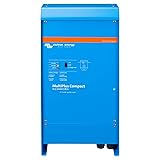
- VICTRON ENERGY PURE SINE WAVE INVERTER: The Victron Energy Multiplus inverter charger is a powerful true sine wave inverter and a sophisticated battery charger with adaptive charge technology
- POWER ASSIST: With the unique Power Assist feature the MultiPlus solar inverter will prevent overload of a limited AC source, such as a generator or shore power connection
- POWER WITHOUT INTERRUPTION: In the event of a grid failure, or when shore or generator power is disconnected, the Victron inverter is activated fast, within 20ms, and takes over the supply to the connected loads
- PARALLEL OPERATION: Up to 6 Victron Energy MultiPlus Purew Sine Wave Inverter units can operate in parallel to achieve higher power output, In addition to parallel connection, three units can be configured for three-phase output.
- INSTALLATION: Incorrect installation can be hazardous, Please consult a licensed professional and follow all applicable electrical codes during installation
Continuous: 2000W | Peak: 4000W
Amazon UK Rating: 4.7 stars (89 reviews)
Prime Eligible: Yes
Model: CMP122000000
The Complete System
This isn’t just an inverter. It’s an inverter/charger combo that intelligently manages your entire electrical system. It’s also nearly £900, which is why it’s not higher on this list.
But if you regularly use campsite hookup, split time between off-grid and plugged in, or want your electrical system to actually be smart, this is the one.
What Makes It Different
Inverter + charger + transfer switch in one unit. When you plug into shore power:
- It automatically switches your 240V loads to shore power (seamless, <20ms)
- Starts charging your batteries intelligently
- Manages the power split between charging and load
When you unplug from shore power:
- Seamlessly switches to inverter mode
- Powers your 240V loads from batteries
- No interruption to anything running
This is what £900 buys you – convenience and automation.
The Smart Charging
The built-in charger is 70A, which is serious. It’ll charge 200Ah of lithium in 3-4 hours from flat. The charging profile is adaptive, meaning it learns your battery type and adjusts automatically.
You can configure it via the VictronConnect app to prioritise charging vs supply power. If you’re on a 16A campsite hookup and want to run 3000W, it’ll limit charging to avoid tripping the supply.
This is intelligent power management, not just a dumb inverter/charger.
Power Assist Function
Here’s something clever: if you’re on a 10A campsite supply (2300W max) and try to run a 3000W load, instead of tripping the breaker, the MultiPlus will:
- Take 2300W from shore power
- Make up the missing 700W from your batteries
- Not trip the campsite supply
This is incredibly useful on limited power supplies or when using generators.
Installation Complexity
This is not plug-and-play. You need to wire:
- Battery connections (35mm² cable minimum)
- Shore power input
- AC output distribution
- Temperature sensor (optional but recommended)
- Remote panel or VE.Direct connection
If you’re not confident with this level of electrical work, you need a professional installer. Victron dealers typically charge £200-300 for installation.
Who Needs This?
Not everyone. If you’re mainly wild camping and rarely plug in, get a standalone inverter and charger – it’ll be cheaper.
This makes sense for:
- People who split time 50/50 between sites and wild camping
- Full-timers who use sites in winter, wild camp in summer
- Anyone who wants one neat system instead of separate components
- People on weak shore power supplies (Power Assist)
- Professional conversions where automation matters
The Good
- Inverter + charger + transfer switch in one
- Intelligent power management
- Power Assist for weak supplies
- Seamless switching (<20ms)
- 70A adaptive charging
- VictronConnect app monitoring
- Victron reliability
- Five-year warranty
- Can parallel two units for 4000W
- Repairable long-term
The Bad
- £900 is expensive for 2000W capacity
- Complex to install properly
- Needs VictronConnect app to configure fully
- Large: 362mm x 214mm x 110mm
- Heavy: 10kg
- Overkill if you don’t use shore power
- Remote panel costs extra
- No UK sockets (euro socket, need adapter)
Worth the Money?
Only if you actually use the charger function regularly. If you’re mainly wild camping, buy a separate inverter (£200) and charger (£150) and save £380.
But if you’re a full-timer who mixes wild camping and campsites, wants seamless power management, and values Victron quality, this is worth every penny.
I wouldn’t buy one for my weekend camper. I would buy one if I was living in a van full-time and using campsites regularly.
Perfect for:
- Full-timers using sites regularly
- Professional conversions
- Anyone who wants intelligent power management
- People on weak shore power supplies
- Victron ecosystem users
- Big builds with space and budget
Skip it if:
- You rarely use shore power
- Budget is tight
- You want simple plug-and-play
- You mainly wild camp
- You’re new to van electrics
Buyer’s Guide: Choosing Your Inverter
Sizing It Properly
Step 1: List every 240V device you might use
Actually write them down. Include:
- Laptop and charger
- Phone chargers
- TV
- Kettle
- Coffee machine
- Hair dryer/straighteners
- Power tools
- Air fryer
- Microwave
- Anything else with a plug
Step 2: Find the wattage
Check the label on each device. It’ll say something like “230V 4.3A” – multiply those numbers to get watts (230 x 4.3 = 989W).
Step 3: Add up realistic simultaneous use
Not everything you own – what would you actually run at the same time? Laptop while making coffee? Kettle while TV is on? Be honest.
Step 4: Add 25% headroom
Your inverter should be rated 25% above your maximum simultaneous load. This gives you headroom for surge current and future additions.
Battery Bank Requirements
Your inverter is only as good as your batteries can support.
AGM/Lead Acid:
- Can discharge 50% safely
- Should limit discharge to 25A per 100Ah
- 800W inverter minimum: 200Ah
- 1500W inverter minimum: 300Ah
- 2000W inverter minimum: 400Ah
Lithium:
- Can discharge 80% safely
- Can handle 1C discharge rate (100A per 100Ah)
- 800W inverter minimum: 100Ah
- 1500W inverter minimum: 150Ah
- 2000W inverter minimum: 200Ah
If your battery bank can’t supply the current, your inverter will just shut down on low voltage protection.
Installation Tips That Actually Matter
1. Mount it securely
Inverters weigh 5-12kg. Use proper brackets, not velcro or cable ties. I’ve seen inverters fall and break in transit.
2. Ventilation is critical
Minimum 100mm clearance on vented sides. Hot inverters are inefficient inverters. Overheated inverters are dead inverters.
3. Fuse close to the battery
Within 150mm of the positive terminal. This protects the cable run, not the inverter. Use a proper fuse holder rated for the current.
4. Use proper crimps
Crimping is better than soldering for high-current DC. Use proper crimps and a proper crimping tool. The £8 Amazon crimpers are useless.
5. Protect against moisture
Even if the inverter is IP65 rated, connections aren’t. Keep terminals dry. Use heat shrink. Consider a splash guard if mounting in a risky location.
6. Cable routing matters
Keep DC cables short as possible. Every metre of cable adds resistance and voltage drop. Route away from sensitive electronics – inverters generate electrical noise.
7. Test before final installation
Wire it up temporarily on the bench. Check polarity. Test with load. Confirm everything works before you hide cables behind panels.
Common Mistakes (That I Made)
Mistake 1: Undersized cables
My first inverter came with 16mm² cables. I ran a 1000W load. The cables got hot enough to melt the insulation slightly. Buy proper cable.
Mistake 2: No fuse
“The battery has a fuse already” – famous last words. Short circuit in the cable run and you have no protection. Always fuse at the battery.
Mistake 3: Mounting in a sealed box
I put my first inverter in a neat sealed locker. It overheated after 20 minutes. Inverters need airflow.
Mistake 4: Trusting the surge rating
A 2000W peak rating doesn’t mean it’ll run 2000W. It means it’ll survive a 2-second surge to 2000W. Don’t size based on peak.
Mistake 5: Not testing the low-voltage cutoff
I set mine to 11.5V and assumed it worked. It didn’t – threshold was factory set to 10.5V. I over-discharged my AGM batteries. Test your settings.
Maintenance and Troubleshooting
Every 6 months:
- Check all connections are tight
- Look for corrosion on terminals
- Verify cables haven’t chafed
- Clean dust from cooling vents
- Test the low-voltage alarm
Common problems:
Won’t turn on: Check battery voltage, check fuse, verify connections are tight.
Shuts off under load: Battery voltage dropping too low, or inverter is overheating.
Beeping constantly: Usually low voltage alarm. Check battery state of charge.
Buzzing from appliances: Either modified sine wave (upgrade to pure) or inverter is failing.
Getting hot quickly: Check ventilation, verify load isn’t exceeding rating, clean cooling vents.
Final Verdict: Which One to Buy
If you’re a full-timer and reliability matters: Victron Phoenix 12/800 or 12/1200
If you’re on a budget: Renogy 1000W
If you need 2000W: Renogy 2000W
If you want one system for everything: Victron MultiPlus 12/2000
If you need serious power: Renogy 3000W
But honestly? Most people would be fine with the Renogy 1000W at £120. It does the job, it’s affordable, and you can replace it twice before you’ve spent Victron money.
The only wrong choice is buying a modified sine wave inverter or going too small. Everything else is just trade-offs between price, power, and peace of mind.
Products Not Included (And Why)
Streetwize modified sine wave inverters: Modified sine wave is outdated technology. Skip them.
Krieger inverters: Too many failure reports. Amazon reviews are concerning.
Chinese no-name brands: Might work fine, might catch fire. Not worth the gamble for £20 saving.
ProMariner/Xantrex: Good products but hard to find in UK, limited support, better options available.
Goal Zero/Jackery power stations: Different category. Not inverters, they’re all-in-one battery systems.
FAQ
Do I really need pure sine wave?
Yes. Modified sine wave is outdated, less efficient, and makes electronics unhappy. Pure sine wave is worth the extra £20-30.
Can I run a hairdryer?
Probably not practically. A 1800W hairdryer needs a 2000W+ inverter, which needs 400Ah+ of batteries. Buy a 12V travel hairdryer instead.
How long will my batteries last?
Depends entirely on battery capacity and load. Rough calculation: (battery Ah × voltage × 0.5) ÷ inverter watts = runtime in hours. For 200Ah at 12V running 500W: (200 × 12 × 0.5) ÷ 500 = 2.4 hours.
Do I need an inverter at all?
Maybe not. If you can run everything from 12V or USB, skip the inverter entirely. It’s another component to fail and wastes 6-15% of power in conversion.
Can I install it myself?
If you’re comfortable with high-current DC wiring, yes. If you’ve never crimped a cable or used a multimeter, pay a professional. At 100A+, mistakes are dangerous.
What about running air conditioning?
No. Portable AC units draw 1000-2000W continuously. That’s 80-165A from your batteries. Unless you have massive lithium banks and huge solar, it’s not practical.
Will it drain my starter battery?
Only if you wire it stupidly to the starter battery instead of leisure batteries. Always wire inverters to your leisure/house battery bank.
How do I know if I’m overloading my inverter?
Most inverters have LED indicators or alarms for overload. You’ll also notice the fans getting loud and the unit getting hot. If it shuts down repeatedly under load, you’re asking too much of it.
Can I upgrade to a bigger inverter later?
Yes, but you’ll need to upgrade cables and fusing too. Don’t just swap the inverter and keep the old 16mm² cables – that’s dangerous.
What’s the difference between continuous and peak power?
Continuous is what the inverter can supply indefinitely. Peak is what it can handle for 1-2 seconds during start-up surge. Never size based on peak rating.
All prices checked 27 October 2025 on Amazon UK. Product availability and specifications subject to change.
Affiliate Disclosure: This article contains Amazon UK affiliate links. If you buy through these links, TheFeralWay.com earns a small commission at no cost to you. This helps keep the site running and the advice honest. I only recommend products I’d actually use myself or that I’ve properly researched.